, May 19, 2026
Translated by
the thing between the wall and my body
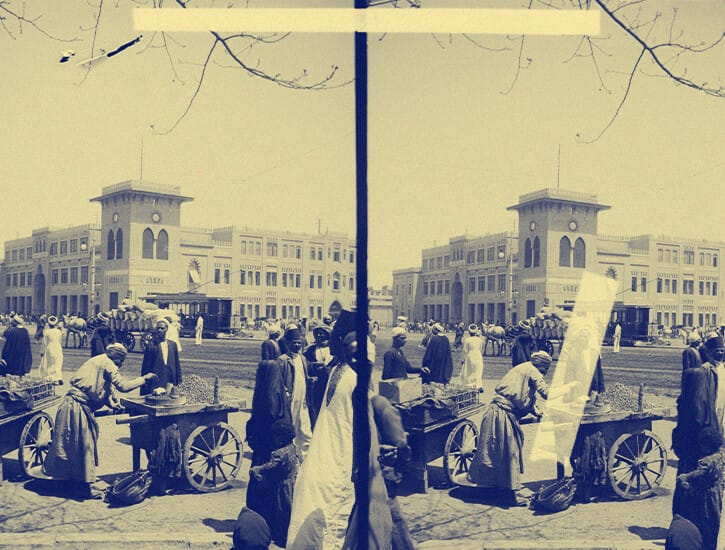
Railway station in Cairo, Egypt. | Library of Congress
Ahmed Douma is an Egyptian poet and revolutionary who emerged in 2011 as one of the most unyielding voices of Tahrir Square. The founder of several major protest movements, Douma was given a life sentence and spent a decade behind bars as a political prisoner, continuing to write voraciously throughout his incarceration. Released by presidential pardon in 2023, he remained under constant investigation and repeated summons by the Egyptian state. In April 2026, Douma was imprisoned again after publishing a political essay on cross-border abolition and the carceral logics of governance in Egyptian society. He is now facing an expedited trial and is scheduled to be sentenced on June 3. If convicted, he faces another five years in prison.
During his three short-lived years of freedom, Douma regularly published scathing commentaries and poems and organized protests for Gaza. “When the Knesset passes a law to execute prisoners,” writes Douma in the essay that led to his most recent arrest, “it signals an escalation of its ongoing, now three-year genocide against Palestinians toward what can be called ‘legalized genocide.’ And when detainees in Egypt disappear for thirteen years amid near-total silence and broad complicity, the message delivered to society is this: Prison is the only alternative to absolute subservience or silence.” His staunch refusal to accept the politics of futility has made him impossible to neutralize as so many revolutionaries before him were. Douma’s poetry is inseparable from that refusal.
Written from Badr Prison in 2023, “the thing between the wall and my body” traces the physics of incarceration: cold concrete, restricted movement, withheld sunlight, and a body forced into negotiation with survival itself. Inside a space whose span is “four adult strides, or six / child ones,” Douma surgically renders the prison cell that has swallowed him once again. As we, again, await the state’s verdict in a haunting déjà vu, Douma brings us into the incarcerated body through the intimacy of posture, temperature, and breath.
—Abdelrahman ElGendy
To sleep, I must
evict the chill
that crowds me. First:
I pull my knees off
the wall, not so far
I drop onto the snare
of bare ground. I nest,
coiled, at the center (though I am a friend
of the edge).
How does air flee
the wall and slap us?
I tuck one foot into the crook
of the other knee, then switch
as if rehearsing
a dance. I wedge a thing
between the wall and my body.
zzzzzzzzzzzzzzzz—what is this
endless hum? The thin
blanket won’t fold
under my ribs; to shield
one flank, the other
must disrobe. (Inside a cell,
you forfeit your body’s
symmetry before you
forfeit freedom.)
I breathe calmly, as my psychiatrist
once advised. I am horizontal:
why does breath come
in gasps? Cold air pricks
my chest. I hear it
crackle like a tired
café chair.
My clothes—
save those strung
on the line, four more
days to dry—
do not warm
my soul. They grow
cold; I grow colder.
They have forbidden
blankets and winter clothes
this year. (We’re still losing
the tug with the jailer
over our ration
of vitamin D.) The sun
and we have gone a whole season
not meeting. It used to slip us
a thread or two—contraband
light—and we worked it
into our skin, kneaded it
through our damp,
to keep from rotting.
This year, the sun
hasn’t breached
its annual passage.
I wedge a thing
between me and the thing
between the wall and my body.
How does this wall manufacture
such a current?
I stand and scuff in place,
lauding the socks
on my feet (allowed only
after haggling. They’ve also banned
anything baked. Perhaps next month
they’ll relent; perhaps
we won’t last long
enough to know.)
There’s no room
for running. Four adult
strides, or six
child ones. Were I a tortoise,
perhaps I’d spend the day
in transit, inch
the distance down,
interrupt the cold’s
innocent tales. I’d carry
that carapace—would it be
lined?—make do
with a single green
leaf, no waiting
for rations, no hungering
till morning. I sip
steaming anise tea. Its taste
icks me, its heat
ephemeral. The cold
devours it before I reach
the cot. I prefer it baked
into biscuits. I rise
to urinate. I cradle
her waist on my way back,
remember the only dance
she ever granted me,
and my pinkie strays
toward the warmth
I desire. Steady—not
all the way.
Dawn is edging in. I’ll stand
before Allah, shaking, mouth
fogged with questions, heart
icing over. Will I end like this:
upright, seized
by frost?
Beware: my spirit
longs for release
into warmth, and the cold
banked inside me
will spill out. So, dress warm. Kindle
some tobacco and timber.
Let it lift, unhurried,
upon a cloud, balmy and quiet.
Light embers above
my head—an undying
witness.
Badr Prison, 2023