, June 5, 2026
Goldboys
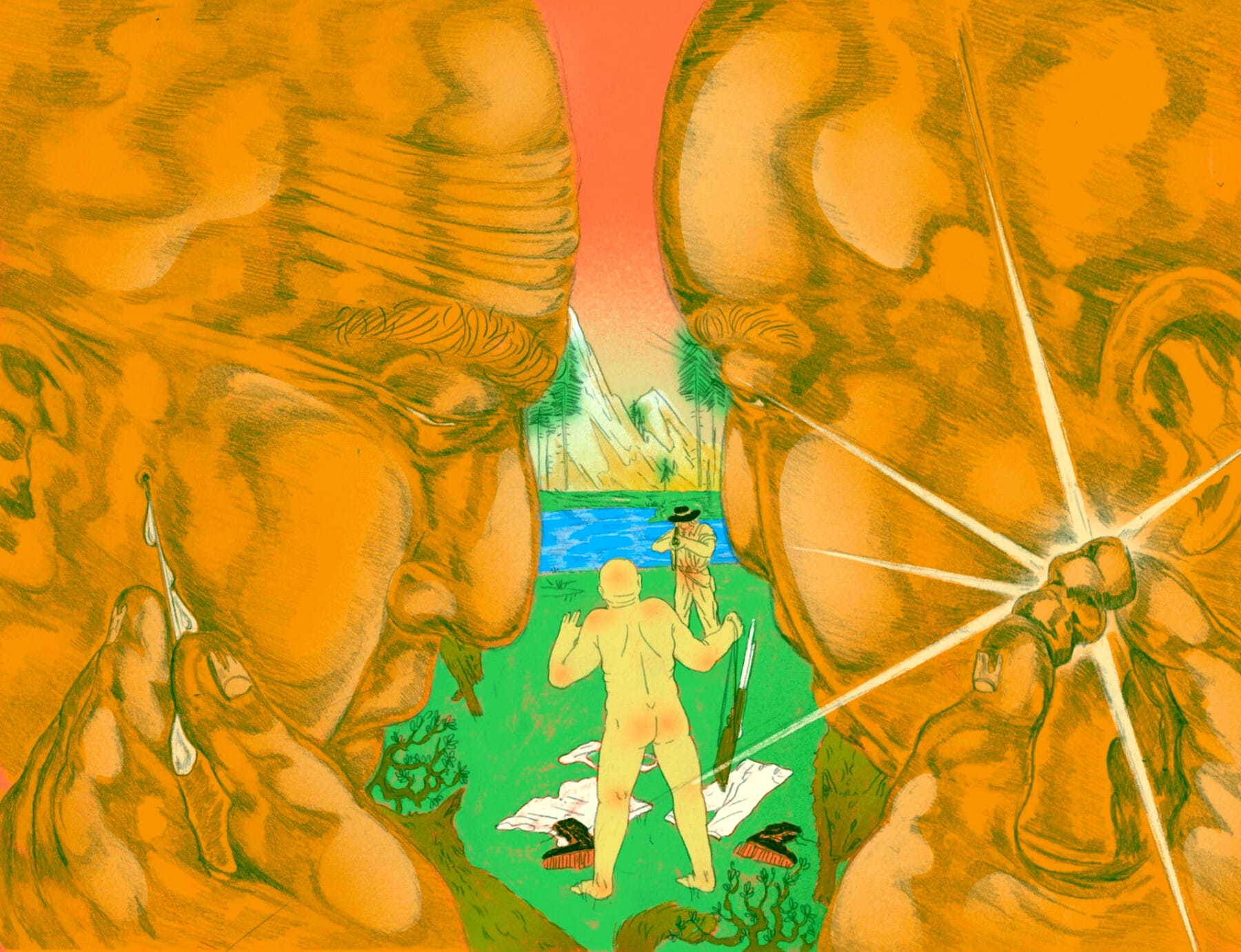
“I told ‘em fucking gold, Dippy. Gold. But those amateur cunts couldn’t take a piss without the bank. They didn’t know a thing about fungibility and I said—I—I—I said fiat was going the way of fish, Brother Son, either extincted or overbred. What the hell can you do with a sardine? Feed it to a coyboy, sure, but it won’t buy you a single bean turd. Not a nip. Nothing at all. I said like fish, Dippy, like fucking fish and I was right.”
All the while, as Brother Dad was talking, he sprayed. Eons ago, before Dippy was born, Brother Dad had gone far up into the mountain and blocked up the stream with rocks. He carried them one by one, as he often told Dippy, piling up those “barn breakers” and “iron whores” till the dam rose above his head. Then he dredged a channel. It got narrower and narrower, so the water built up pressure for a half a mile before funneling into a wide metal pipe and then, finally, a yellow tube, the “big pisser,” which is what Brother Dad was holding. That water “could bore a hole through the moon if I aimed it up to the sky,” claimed Brother Dad. “I once cut a mooseboy in two.” And Dippy believed him because the few times he’d stepped within arm’s length of the blast he’d felt its sting. Now Brother Dad was aiming it at the loose rock, the former stream bed, blasting the Earth down into the wide sluice box he’d created, where the nuggets and flakes and “shineturds” and “twinkies” would settle in the divots.
“Gold!” continued Brother Dad. “I said gold to anyone who came through back then, even a fed. And who else would come around ‘sides those usurpers? Talking t—t—talking climate and national parks and, well, that’s very fine—that’s very fine and very convenient if you’re a fucking amateur who wants to take the land from those of us who work it. From hardworking people. From all of us who are fucking—fucking working so hard, Dippy.”
Brother Dad had lost his breath.
“Hahahahaha,” laughed Dippy.
“What’s funny?”
Dippy didn’t know. He’d just been guessing. Caught in his ignorance, he shook his head and muttered, “Fucking feds.”
Brother Dad nodded and shut off the water. Dippy didn’t have to be told what to do then. He ran toward the sluice box, his boots squeaking on the freshly wetted landscape. He stepped nimbly between the scree, his eyes scanning for a glimmer. He had no idea what a fed was.
This is how it went when they weren’t on the hunt for deerboys. Brother Dad would get up before the sun and wake Dippy just by climbing down from his top bunk. They’d spend the morning “blowing chunks” or “chopping rock” or “goldpanning.” Then they’d eat a spot of dried moosemeat and drink rough grog straight from the barrel. In the afternoon, it was back to “sucking bullion.” In the evenings, Brother Dad made a fire and Dippy would feel his limbs go to sleep one by one. He’d wake once each night, when Brother Dad finally lumbered, sloshlimbed, up to that top bunk.
That was life and always had been, till one morning Dippy woke to a silent sunbeam cutting through the woodbox they called home, boiling his closed eye. He hadn’t felt Brother Dad clamber down that morning, a first. Dippy didn’t dare move as he considered the possibility that Brother Dad had woken early, jumped down from the top bunk, grabbed that gold, and slipped away into the mountains, those “cragbastards,” those Old Brothers, leaving Dippy to fend for himself.
Can’t a sovereign man live a goddamned second in his own house without a—a—a cunty bureaucrat knocking at his door?
Dippy listened intently for Brother Dad’s breath, but he only heard the snow dripping as it melted and slid off the metal roof. From the oven, the final pop of a smoldered-out fire. He shimmied into waffled long johns and socks before unsheathing himself from his sleep pack. He stood. From his lowly stature, he couldn’t see anything on the top bunk. He thought to call out Brother Dad!, but he didn’t dare risk such a waking. He could almost hear the words now. Can’t a sovereign man live a goddamned second in his own house without a—a—a cunty bureaucrat knocking at his door?
For a hard minute Dippy stood there, feeling a weakness rising from his knees. The blood seemed to have stopped churning in his chest. Still, he managed to latch his right arm in the bunk’s ladder and push with his toes on the bottom rung, giving his eyes just enough clearance to see the scene.
It was like the time they were out hunting, and he’d felt Brother Dad’s sharp calloused fingers on the back of his neck, drawing his attention to a light-footed foxboy not twenty feet away. “A hen-thieving menace, but goddamned beautiful,” Brother Dad would later say of the animal. But there, in that moment, the two of them dug out in the ice, he’d spoken only with his grip. And Dippy had watched the foxboy bound in the white and wondered whether every animate thing was just like him—like Dippy himself with his springing joys and vacuous uncertainties—or else completely different.
Dippy could hardly think the question for how deeply it confounded him. And it was a similar stupification that he felt now, except he had not seen a flighty red beast. Only a heavy, placid, unmoving lump.
Dippy moved up the ladder one more rung. Brother Dad didn’t stir. Around his mouth was a patch of yellow foam that seeped down to his jaw. Dippy thought he saw movement in Brother Dad’s beard hair, but it was just one of the flyboys come up from the pooper.
Brother Dad had told Dippy about death. He’d frequently wished it upon every fed, hippie, blowbagger, lagabout, and bitchbiting mosquite around. But he’d also said, just once, “I figure liver rot will get me soon enough, Dippy, but you can’t let those fuckers—fucking cuntwitted bastards—know about it, alright? I—I—I can’t—you can’t give ‘em the satisfaction of knowing they outlived Brother Dad. When it comes, just leave me be, load your rifle, and take that hot gold to Cowtown. Tell Mr. Boston I’m out striking and you trade—you trade in my name.”
Despite these instructions, Dippy felt unsure what to do. He was still hanging onto the ladder, staring at Brother Dad’s half-open lids. It didn’t feel real. What if he took his rifle and the gold and then Brother Dad woke up? He would track Dippy and give him a brutal thrashing. He might even, as threatened before, “skin a tinsy loutfucker.”
Brother Dad! Dippy wanted to yell out, but his voice caught in his throat. He pushed at the hardened, yellowed toe that stuck out from the unpatched sheet. Nothing. But Dippy needed to be sure. He needed proof. Whenever they spotted a small glint in the sluice, they’d test it with the pan to see if it sunk. “Gold shines like an angel, but she’s dense as a bitch.” But for larger hunks there was another method. Brother Dad would take out his needle and see if he could bore a hole. “Real gold puts out.”
Dippy jumped off the ladder and stumbled toward the table. On the rough wood was strewn yesterday’s bowls, still claggy with gruel, the gas lantern, a smattering of the strangely colored “wizard stones” that Brother Dad collected, and the tool belt. Dippy opened the leather pouch on the belt and extracted the four-inch needle. He went back to the bunk, climbed up to the top, and placed the tip of the needle above the hairy patch on Brother Dad’s chest. Before it punctured the skin, a few beads of translucent fluid pilled around the tip. Then it went in and Dippy drove it deep, till his fingertips touched Brother Dad’s clammy skin. There was no response. When Dippy pulled the needle out, no gore, just more of that clear sap pooling around the bloodless black dot. So, death then. Slowly, he climbed back down the ladder, landed on the wooden floorboards, dropped the needle, and crumpled. A fevered sob escaped from his throat. He shook.
Dippy thought crazy thoughts on the floor. Like that he should eat the man who’d raised him or burn the cabin to the ground or else that he should lay out Brother Dad’s body and eviscerate it with the “big pisser.” It felt wrong to leave him up there. “That festering cunt,” Brother Dad had often said, of anything at all. But he was speaking no more, and Dippy realized that all that disgust which Brother Dad had evicted through his mouth, day in and day out, like mucus, would now be trapped inside his dead leather. Unexpelled, it would spoil his soul. Something had to be done. At the very least, he should be taken outside.
The Brother Son unfurled his trembling limbs and rose. He went to the wall and took down the heavy coiled rope that hung from a sturdy nail. He climbed the ladder and tied the end of the rope to the knob at the top corner of the bunk. Brother dad was twice his size, but he had to come down somehow. Dippy walked to the door and opened it. Jaunty, biting air swept through the cabin. Dippy heard a coyboy whine. A pack of them lingered outside every morning, waiting for Brother Dad to throw out yesterday’s bones and grog gunk and rind.
“He’s coming,” Dippy said to the loitering animals. They were the first words he’d spoken that day. And had he said anything the day before? He could not remember. Often, he just listened. And who would he listen to now?
He set his besocked feet into a crack between the boards for leverage, then Dippy yanked the rope. The bunk yawed to the side, then corrected, landing back onto all four legs with a violent creak. He took the rope again, but this time he pulled with constant force. As it came down, one corner of the bunk caught the table, splitting it through the middle, sending Brother Dad’s tools and “wizard stones” all about. But most of the bed’s weight struck the floor, sending up a clap that scattered the coyboys and made Dippy jump. Brother Dad’s naked form was flung from the mattress and rolled twice before striking the far wall.
Dippy felt a surge of energy. Fate! Brother Dad might have cursed if he’d been there. The boy put on his boots. He layered up his woolens, his leathers. He packed his pockets with dried moosemeat and saltsweet. He loaded his rifle and put spare shot in his biggest pocket. He lashed a tin flask of water around his neck. He picked up the sack of gold—a hundred jumbled rocks and a sealed plastic canister of flake—and set it outside the door. Three coyboys were crouched in the snow near the lone spruce, watching him.
He went back into the cabin, knowing it would be the last time. He uncorked the barrel and let rough grog flow into his cupped hands, which he brought to his lips again and again, until he felt bloated with yeasty strength. He let the rest flow into the cracks, where it would seep into the Earth below. “Give thanks to the God of Dirt, Dippy, the only bitch I ever loved!”
Dippy approached the body. It was already another kind of thing, he could see, smelling of dung and wet hair. Its head was split open, the pink skin slipping away, revealing a sticky white. Still no blood flowed. Dippy grabbed it by the ankle and dragged it toward the door, but one of the limp arms snagged on the leg of the broken table. To untangle it, Dippy had to lift the cold brawn of the bicep, the black-crusted callouses of those familiar fingers. As soon as he let go, the arm dropped like a sawed log. Once he had it there in the wide outside, Dippy marveled at how small it looked. Smaller by far than Brother Dad ever was. The busted head hung at a strange angle. One eye half open, the lips parted. Gold! Dippy heard Brother Dad’s voice in his head as he caught the glint of a fake metallic tooth.
The coyboys were up on all fours now, gathering in number near that tree. They waited in their majestic way, as they always did, to come claim what the Brothers could no longer use themselves.
Dippy glanced once more at the only life he’d ever lived, then he tightened his belt, shouldered his rifle and his sack of gold, and walked away from the north-tilting sun. He didn’t close the door.
For most of his young life, Dippy hadn’t been allowed to accompany Brother Dad to Cowtown to trade gold. Instead, he was left in the care of Brother Gunridge, who lived round the mountains. He had the same flat nose and receded, sparkling eyes as Brother Dad. His skin was a crosshatch of dirt-crusted lines. As they sat the daylong in the man’s deerboyskin abode, saying nothing, Dippy would imagine drawing his knifepoint along those grooves in the Brother’s arms, dredging out all that grime.
Sometimes, Brother Gunridge would pick up an ashy stick to paint a crude snake on the leather walls. Brother Gunridge was one of the only other people who lived year-round in the Spread. Brother Dad, Brother Gunridge, and Brother Soldier, who talked nonsense but liked to stop in for a cup of grog and to trade feathers and other charms. Dippy had twice met another man, Brother Soot. Brother Dad killed him.
Dippy realized that all that disgust which Brother Dad had evicted through his mouth, day in and day out, like mucus, would now be trapped inside his dead leather.
Finally, last summer, Brother Dad announced that Dippy was big enough to follow along to that “open wound” called Cowtown. And there, Dippy met other people for the first time. Too many to name. Some who called themselves Brothers and others who didn’t. He even saw a Brother Sister there—carrying a live bird into a shed—but he didn’t hear her voice. “No luck in Brother Sisters, Dippy! That’s why they don’t get names. Keep ‘em out of your eyes and out of your mind. Ain’t a Brother Sister ever been worth half a pinky shineturd.”
In the middle of Cowtown, they’d entered a boxy room where a man sat behind a metal desk. He didn’t call himself Brother. Just Mister Boston. Another man stood by the door with a big gun. Mooseboyhead on the wall. It smelled like cooking gas. The negotiations started immediately.
“Four fifty,” said Brother Dad.
“Three,” said Mr. Boston.
“Four twenty-five.”
“Three is better than you’ll get anywhere.”
“Four.”
They said numbers back and forth like that until Brother Dad threw the sack on the desk and the man with the gun counted out some bills. They purchased flour and ammunition from the store and started back home. On the trail, Dippy jumped into the first stream they crossed and let the water flow directly into his open jaws.
Now, as he trudged away from the cabin, trying to ignore the yips of the coyboys behind, Dippy thought of that earlier journey, that stream, the three landmarks he’d have to pass on the way to Cowtown. He’d take a left at the wizened dead beech tree below Black Peak, go straight on past the ruined mill—just a slab of concrete—then take another left at the dead lake.
Dippy carried the rifle and the sack on opposite shoulders. The weapon’s ropy strap dug into his collarbone and the uneven rocks slapped against his back. He swapped shoulders every couple of miles to even out the pain. There was nothing he could do about his head, which began to ache once the fortifying effects of the rough grog wore off. He just kept his eyes level, watching the horizon, ignoring the swaying trees in the periphery.
In the afternoon, the sun dimmed. Lacy gray clouds swirled in the sky, eagerly organizing themselves in a secret pattern. They darkened, thickened. Dippy had passed only the first landmark, but he sensed he had to get to shelter. He moved toward the rock crops to the east and found a hooked crag just as the sky broke open. He swept loose loam and pine needles into a soft mound and settled there.
Don’t just sit there like an unfooted boot! Brother Dad might have said as he sparked a fire or cleaned the rifle. But he was dead. And what was most left of him was this gold. All his hours distilled into nuggets. And it was Dippy’s life now. He laid his head on the sack.
As he fell asleep, Dippy watched the rain streak across the landscape of frayed evergreens. He paid attention to the sounds of water; droplets on stone, ice cracking up, runnels taking form. And he could hear the bits of gold talking to each other, whispering about that old mountain. Some said they were still a part of it, despite traveling so far. Others claimed that they’d become their own particular selves, goldboys.
When he woke, the sun was two fingers above the horizon, painting wide, watery streaks of yellow. The rain had quit. His tooth hurt, as it often did in the morning. The only cure he knew was rough grog, the first sip of which Brother Dad would give him at noon. Dippy knew he just needed to move, warm himself up, but he didn’t want to. Whatever resolve he’d felt yesterday had collapsed. He feared the encounter with Mister Boston, Cowtown. He was sure that they’d see it on him, Brother Dad’s death, like a rash. Dippy rubbed his eyes, sat up, and only then did he notice the animal.
A small horseyboy, his back piled high with cloth bags, canteens, and animal hides. He stood placidly, about ten feet away, his long face pointing west. Dippy reached for his rifle, knowing that the horseyboy’s rider must be near, but his hand found no weapon.
“Hello?” Dippy called out. “Hellooo? Is there a Brother Stranger here?”
There was no response. He stood and inched away from the shelter. Birds called out angrily from the trees. Wind caught at the ravaged ends of his greased hair. The horseyboy bobbed his head.
“Hello?”
“Hello,” came a warbling voice from the heavens. Dippy looked up. On the ledge above was a man. Mid-aged, thin, wearing a hat, his skin pale under the wide brim. He was pointing Dippy’s rifle.
“Please don’t move, sir.” Dippy didn’t move.
“You got other weapons?”
“No,” responded Dippy, patting his loose shirt. He thought for a moment of the needle that he’d used to test Brother Dad’s life. Left behind in the cabin.
“Sorry for shooting pointers—er uh—pointing shooters so early in the morn.” The man kept the barrel aimed in Dippy’s general direction, though it bobbed in his skinny arms. “What’s your name then?”
“Brother Dippy.”
“A Brother?” The man sounded alarmed.
Dippy nodded. The man shook his head and rose his chin to the sun, as if he saw something in the sky.
“You know, sir—did you not know? No more Brothers out on the Spread. It was decreed.” Dippy didn’t know what to say about that.
“By The King,” the man added.
“The king?”
“The King.” The man shook his head again. Baffled, agitated. He lowered the rifle and banged its barrel against the rock, muttering to himself.
“I’m going to Cowtown,” explained Dippy.
“Kingsland, that too. All around for miles. You God to honest didn’t know?”
Dippy shook his head. Brother Dad had never mentioned a king. “No taxmen here, Dippy. No—no not a single scum weasel stupid enough to try levying a Brother on the Spread.”
“This Brother business,” the man said, narrowing his eyes. “It would be better if you weren’t a Brother.”
Dippy didn’t know what to say about that, either.
“Listen,” said the man, but then he didn’t say anything as he carefully worked his way down the rock with the aid of one hand. When he was finally on level ground, he continued: “You see, The King has put pricing on every pelt, coys to hoppers to birds.” The man nodded to the skins piled on the horseyboy’s back. Dippy noted their snouts now, their snuffed-out eyes.
“Wants them out. Thieves, the lot, he says, taking from the Kingsland. I got the list of prices here.”
The man went over to the weathered beast, opened a satchel, and took out a piece of parchment. He scanned it with a frown. His gray beard was a few days long, his teeth the color of Dippy’s piss in the morning. He twisted the parchment around and held it out for Dippy to see. Dippy couldn’t read.
“Prices for every hide here. These coys alone will fetch twenty-five a piece.”
“Thieves?” Dippy asked, his mind just now catching on the word.
“Thieves. That’s the law. Everyone has to pay their dues or make improvement for his liege.”
“Improvement?”
“Improvement, Brother Dippy!”
“Okay,” said Dippy.
“Twenty-five for a coy and ten for a deer it says. If you bring in a Sitka log you can get a hundred. And here’s the problem for us two—for the two of us. Says here that for every Brother it’s one twenty-five.”
The man waited for a response. But Dippy, too, was waiting.
“If I leave you here it’s as good as thieving myself,” the man said, sounding exasperated that he had to lay it all out. “But if you give me one twenty-five I can pass that right along to The King. That will buy your right to life.”
“I don’t have any numbers,” said Dippy. He thought now to run for the trees, but some calculation in his feet told him he wouldn’t make it.
The man shook his head.
“I’ve got gold,” said Dippy, reluctantly. He didn’t want to betray Brother Dad’s final wishes.
The man stepped forward and whispered, “Gold? First, you admit being a Brother, and now you admit to gold. Damn the foolish. You can’t pay your life in gold when The King already owns it. Kingsland, I told you. Everything. All his.”
“We mined it ourselves. Washed it out with the big pisser. I’m going to trade it in Cowtown,” said Dippy forcefully, holding on to his one sure thing.
The man tipped up his hat, revealing a ridge of blistered skin—a burn—crawling up from his brow. “Are you witdimmed? Is this—are you—is this a test?” He turned his head left and right, took the rifle in both hands.
Fate! Dippy thought the word. But it wasn’t right. Brother Dad would never grovel to this man-made circumstance. Fate was what the mountains and the clouds and the dirt pressed onto you. This was cunty blowbaggery. This was federal usurpation of a man’s natural rights. All his life, Brother Dad had been warning Dippy of just this.
“I—I—I—” Dippy tried to talk, but he couldn’t summon a pattern of words that might help him.
The man shut one eye and aimed down the barrel with the other. He didn’t shoot. Instead, he clicked his tongue a few times. Then he lowered the weapon and sighed.
“Listen, I don’t want to round up a young boy like yourself, Brother or no.”
Dippy nodded.
“So Maybe we can go by Oldendays laws. Just this once.”
Dippy nodded. Brother Dad hated Oldendays more than anything. “Like being packed in an anthill back then, Dippy, like being a cunty ant among even—even cuntier ants. I’d rather be dead as a fucking toenail.” But Dippy was willing to take whatever laws might have him.
“I figure you’re in debt to the King for both life and gold. Insolvent. By Kingslaws I should kill you, but by Oldendays laws there’s a recourse called bankruptcy.”
“Bankruptcy.”
“You get to be free of all debts, but you carry it with you for life.” Dippy nodded.
“But you can’t have nothing at all when you take it. You give it all up, everything. Won’t even be a Brother anymore.”
“I need water. I need my clothes. Maybe my moosemeat.”
The man muttered thoughtfully, kicked a rock, and looked to the sky again. The sun had burned off the moisture. Finally, the man spoke. “Here’s a thought. You can gift me your clothes and flask and moosemeat. Naked as a rat, you take the bankruptcy. Then, I gift ‘em back to you. I’ll have to keep the gold though.”
He could hear the bits of gold talking to each other, whispering about that old mountain.
Dippy nodded. He walked back to where he’d slept and picked up the sack of gold and his flask. He tossed them toward the man. Then he unclasped his belt, took off his leather britches, his sheepboyhide top. He peeled off his woolens, long johns, and socks, and kicked all this away. The air nipped at his penis, shrunk up his “holy unholies.” Dippy pinched the skin on his thighs with both hands.
“Okay,” he announced.
“Okay then,” said the man. “I say you’re bankrupt and free of all debts. You’re no longer a Brother. Let it be known.” The man clapped once. He coughed. He went and picked up Dippy’s things and carelessly tossed the clothes, flask, and moosemeat back in the boy’s direction.
“That’s it,” he said. “You feel any different?”
Dippy didn’t. But, after the man had loaded the gold and the rifle onto the horseyboy and had lifted himself into the saddle and had nodded and rode away into the forest, Dippy realized he hadn’t been breathing. He’d been holding his breath since the moment he woke, maybe since the moment he found Brother Dad dead. And now, when he finally exhaled, it was like a tree branch being pulled from his throat. How long had it been growing there? Empty of stale air, he had nothing to worry on. No gold. No Cowtown. He wasn’t even a Brother. Bankrupt. “Free as a summer coyboy.” Nothing at all between him and the acts of life and death.