, May 29, 2026
God Save the Children
The perils of intercountry adoption
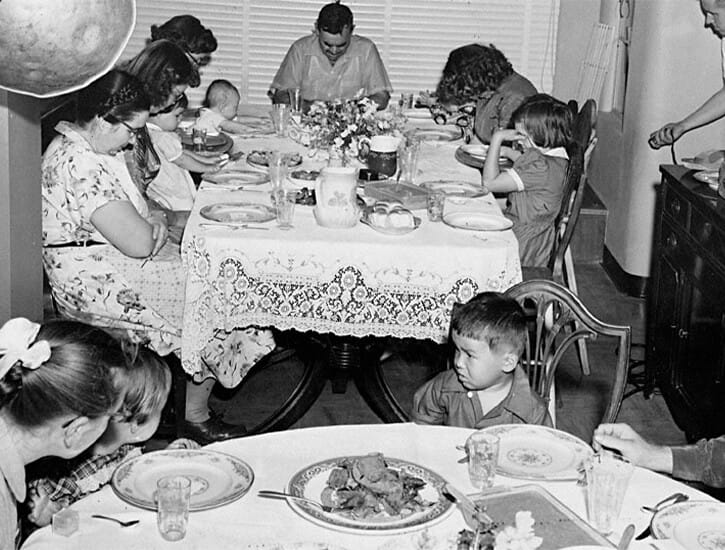
A family meal at the Holts’ in 1955. | Oregon History Project
What They Stole: A Familicide Rooted in Intercountry Adoption by Paige Towers. Iowa State University Press, 350 pages. 2026.
In late 1954, after the end of the Korean War, an evangelical reverend working in East Asia returned to the United States and embarked on a cross-country tour to spread the word of God. More specifically, as a cofounder of the Christian humanitarian aid group World Vision, Bob Pierce wanted to raise awareness of the plight of multiracial Korean children fathered by American servicemen—referred to at the time as “Amerasian” or “GI” children—whom World Vision depicted in anticommunist propaganda materials as ostracized and especially vulnerable to starvation, homelessness, and death. According to World Vision, God wanted Christians to financially “sponsor” mixed-race Korean children, Save the Children-style.
In attendance at Pierce’s December 1954 presentation in Eugene, Oregon, were Harry and Bertha Holt. First cousins from Iowa who fled the state in order to evade a law that prohibited their marriage, the Holts had settled in Oregon in 1940. Harry—a stubborn individualist with an eighth-grade education who hated labor rights and governmental “red tape”—became a millionaire by buying up cheap timberland and logging it off at his sawmill. Bertha, who had been trained as a nurse at the University of Iowa, stayed at home to care for their six children. But in 1950, at age forty-five, Harry suffered a heart attack; he refused to seek medical attention, never fully recovered, and was forced to retire. A devout Christian—he and Bertha had been “born again” as evangelicals after being raised in the Plymouth Brethren, an insular, conservative sect—Harry waited for God to tell him what he should pursue next.
As Bertha later wrote in a memoir, both she and Harry experienced the World Vision presentation as a push from God not just to sponsor but to personally save multiracial Korean children. In April 1955, Harry suggested to Bertha that he travel to Korea to find eight “GI” babies to adopt. Despite being told they were bad candidates for adoption by a social worker at the local county clerk’s office because of their age and Harry’s health, and despite it being against U.S. law to adopt more than two refugee children, they proceeded full-force—Harry traveled to Korea in May 1955.
By August of that year, the Holts had successfully lobbied Congress to pass a law specially amending the Immigration and Nationality Act “for the relief of certain Korean War Orphans,” permitting he and Bertha to adopt them. That fall, Harry brought home four girls (Christine, Mary, Helen, and Betty) and four boys (Joseph, Robert, Nathaniel, and Paul), all babies and toddlers, all but one multiracial. Thus began the Holts’ messianic movement of transnational adoption. The next year, after the Holt Adoption Program’s first “babylift” plane carrying more than ninety Korean children touched down in San Francisco, Harry told reporters, “I can’t stop. Some men are mechanics or lawyers and have their work. My job is to save as many homeless babies as I can.” It was a vocation endorsed not only by the South Korean and American governments as a solution to social ills stemming from the Korean War, but by God himself.
The Holts’ drive to “save” these babies by bringing them to the United States was premised on shaky ground.
Forty-five years after the end of the war, Sheryl and Steve Sueppel, a Catholic couple from Iowa City, adopted a one-year-old baby boy from Korea via Holt International Children’s Services, as the agency Bertha and Harry had founded in 1956 was now named. They named the boy Ethan. Steve was a vice president at Hills Bank and Trust Company and came from a prominent and affluent Iowa City family; Sheryl taught third and fourth grade. Sheryl had dreamed of adopting since she was a child, and ended her teaching career shortly after Ethan’s adoption. The Sueppels would adopt three more Korean babies: a boy they named Seth in 1999, a girl they named Mira in 2002, and a girl they named Eleanor in 2005.
On the night of Easter, March 23, 2008, Steve murdered Sheryl and all four of his adoptive children before dying by suicide. Nearly six months earlier, he had been forced to leave his job at Hills Bank after being confronted with evidence that he had embezzled more than half a million dollars. After an investigation by the FBI, the IRS, and the local sheriff’s department, in February 2008, Steve was federally indicted on one count of embezzlement of bank funds and six counts of money laundering and released on $250,000 personal bond. His trial had been scheduled to begin on April 21.
The Sueppel familicide and the Holts’ hubristic, religiously motivated quest to export Korean children to the United States may appear only tangentially related. Yet in her devastating book What They Stole: A Familicide Rooted in Intercountry Adoption, literary journalist Paige Towers uses research and reporting—including access to some of the Holts’ remaining children and Sheryl Sueppel’s brother and friends—to build the case that the tragic murders of the Sueppel children and their adoptive mother are inextricably linked to the geopolitical social experiment that Bertha and Harry Holt began in 1955. Reading What They Stole, it’s hard not to emerge with the impression that Ethan, Seth, Mira, and Eleanor—and tens of thousands of other children like them—never should have been taken from South Korea at all.
Though Towers begins her book in Iowa with the Sueppel familicide and spends early chapters describing how the family grew through adoption from 1998 to 2005, and though she weaves the story of Steve’s financial crimes and his final, harrowing violent crime throughout, What They Stole ultimately offers a far more detailed portrait of the Holt family. In part, this seeming imbalance can be chalked up to the fact that there is much more documentation of the Holts to draw upon—Bertha wrote four self-published memoirs detailing the couple’s work and ideologies, and participated in an oral history project in 1992, eight years before her death. Towers also quotes from ample contemporaneous media coverage (largely sentimental and positive) about Korean children imported by Holt Adoption Program (HAP), as well as from archival records of the International Social Service (ISS), an NGO that operated in Korea and was critical of the Holts.
Yet as What They Stole progresses, it becomes clear that Towers’s narrative is not uneven at all—in order to understand the Sueppels, the book argues, one must understand the Holts. Connected to this material only through her Iowan background, Towers does not explicitly articulate her personal opinion or use the first-person; instead, via carefully accrued evidence, she constructs a damning, infuriating portrait of Harry and Bertha Holt that underlines how wholly unfit they were to care for vulnerable babies and children in Korea, transport them to the United States, and match them with suitable adoptive parents.
The most sickening sequence in What They Stole depicts the early days of HAP in 1956. World Vision, ISS, and state child welfare departments had pleaded with the Holts to reconsider uprooting Korean children, impressing on them the importance of keeping families together and supporting preexisting though deeply underfunded social welfare organizations in Korea. Harry Holt saw these groups as bureaucracies conspiring against his holy plan. In May 1956, ignoring basic child welfare advice, Harry forged ahead to establish HAP’s first independent childcare center in Korea on a plot of land donated by a Church of Christ missionary. “The property consisted of a ‘30-foot-shack,’ as well as a rusty, hollowed-out van parked in a clearing,” Towers writes. Though Harry had donated to World Vision the year prior to build a Reception Center for Mixed-Race Children in Seoul staffed by a medical team, he came to believe that “money should be spent on airfare . . . not housing and medical care,” as Towers writes.
Harry got away with all of this because of his wealth, the force of his charismatic personality, and the cooperation of the South Korean government.
Harry wanted to have complete control over the babies and children he “collected” or “hunted”—revealing terms the Holts used at the time—hence the stubborn decision to house them on a site with no running water, toilet, electricity, kitchen, or trained personnel. While David Hyungbok Kim, a Christian Korean man the Holts hired to assist in negotiating with Korean officials, worked to secure the documents necessary for the rapid emigration and adoption of the children, Harry affixed makeshift roofs to the van and shack hunkered down there with twenty-six of them. Within days, the children, who suffered from diarrhea, starvation, measles, pneumonia, and other ailments, began to die. At least five perished before Harry sent the remaining babies and children—all grievously ill—to an orphanage where they could receive medical care. Days later, he “collected” thirty-five new children.
As Towers attests, Harry got away with all of this because of his wealth, the force of his charismatic personality, and the cooperation of the South Korean government. President Syngman Rhee, an anticommunist Christian who had taken power in 1948, was eager to allow the transnational adoption of mixed-race Korean children, even ordering a door-to-door census to locate such children for the Holts in 1956. Towers quotes from historian Arissa Oh’s book To Save the Children of Korea: The Cold War Origins of International Adoption to explain South Korea’s collaboration with HAP: “Having witnessed the outpouring of relief aid during and after the Korean War, the Rhee administration continued to rely on foreign agencies and individuals to take care of the country’s social welfare needs.”
It could have been otherwise—war-torn Germany and Japan had by the 1950s established social safety nets and family planning services to reduce the need for international aid and adoptions. But, as Towers notes, “Even by 1957, only 2 percent of South Korea’s national budget was spent on support systems for an impoverished population.” Allowing Americans to adopt thousands of Korean children afforded the Rhee administration “to shirk the responsibility of providing social support, strengthened bonds with the West, flooded the country with Western currency, and eradicated a perceived social threat”—that of mixed-race children whose very existence was proof of sex work and out-of-wedlock sexual relations with American servicemen.
The Holts’ drive to “save” these babies by bringing them to the United States was premised on shaky ground: It was never cut-and-dried that “Amerasian” babies were stigmatized to the point of exile in Korean culture. Towers cites the work of historian Yuri Doolan, whose research of Korean camptowns—areas surrounding U.S. military bases, where sex work was common—reveals that in the mid-to-late 1950s, multiracial children were accepted by their communities, and that the single Korean mothers of these children were loath to relinquish their children for adoption. Korean mothers often hid their “Amerasian” babies from white missionary workers and men like Harry Holt—not out of shame but because they were afraid of being coerced to give them up.
HAP routinely partnered with Korean police to forcibly remove “GI” children, and later, children of full Korean heritage, from their families. Mothers often didn’t understand the permanent nature of this separation, and would try in vain to reunite. Wrenchingly, in some cases, HAP adopted out children who had been kidnapped; families searched for years for children who had long ago been sent thousands of miles away. Locating any child adopted via HAP would be a tall task for Korean families—the agency frequently created birth records out of thin air, turning them into “paper orphans” so they could be taken to the United States.
Indeed, the children that the Holts—and the news media covering them—often referred to as orphans were not truly orphans at all. Prior to 1953, American law had prevented the intercountry adoption of refugee children who had at least one living parent. In the aftermath of World War II, both President Harry S. Truman’s 1945 refugee directive and the 1948 Displaced Persons Act permitted displaced European children non-quota visas only if they were full orphans, meaning both parents had died or disappeared.
But the Refugee Relief Act of 1953—a Cold War-era anticommunist piece of legislation originally designed to help people flee the Soviet Union and communist European countries—changed the definition of orphan to allow the child to have a remaining living parent who “is incapable of providing care for such orphan and has in writing irrevocably released him for emigration and adoption.” Critically, Towers notes, the act also declared that a child could be considered an “orphan” if they had been “lawfully adopted abroad by a United States citizen and spouse” who provide assurances that they would recomplete the adoption process in the United States.
The Holts exploited this last definition to bring thousands of children to America. They practiced proxy adoption, by which prospective adoptive parents in the United States would designate a proxy agent (in the early years, often Harry Holt himself) to act on their behalf and adopt children under Korean law. This allowed HAP to avoid American procedures that required extensive screening of prospective adoptive parents and took about two years between application and adoption.
Proxy adoption also allowed HAP to operate completely outside accepted child welfare procedures. For decades, HAP matched Korean children with American parents not through home studies conducted by social workers but through prayer. As Bertha told a reporter in 1972, “Some people think that is foolish, but it nearly always works. I just pray that the Lord will send every child where He wants him to go.” What was most important to HAP was that prospective adoptive parents were Christians. That those parents might be abusive or neglectful, as Towers documents through many cases well preceding the Sueppel familicide, was of little concern.
After Harry Holt died of another heart attack in 1964, HAP rapidly professionalized. While Bertha became board president and focused on converting disabled children in one of Holt International’s Korean centers to Christianity, new leadership emphasized the organization’s cooperation with other child welfare agencies and new focus on being “reputable and reliable,” as David Hyungbok Kim wrote in his memoir. By 1968, the agency was now known as Holt International Children’s Services and was adopting Korean children out to European countries and Canada and Australia. A decade after Harry’s death, Bertha told a reporter that their agency had placed sixteen thousand Korean orphans.
By the time the Sueppels began to adopt via Holt International in the late 1990s, it was considered the “Cadillac” of adoption agencies: streamlined, expensive, and efficient. Holt International still used proxy adoptions, so the Sueppels never had to travel to South Korea to retrieve the babies they incorporated into their family. Ethan, Seth, Mira, and Eleanor each arrived by plane—thankfully not the unpressurized cargo planes HAP used in the early days, where babies and children routinely died on the ride over or shortly thereafter.
The South Korean government has in recent years begun to investigate and admit its role in the facilitating fraudulent adoptions.
But, as Towers explains, Holt International was still participating in fraudulent practices throughout the period when the Sueppels adopted. In 2024, an investigation by the Associated Press and Frontline found that Holt International and other adoption agencies operating in Korea routinely turned children with living families into “paper orphans” with fake identities after coercing or forcing relinquishments or turning to kidnapping. “The South Korean government not only knew of fraudulent practices but designed laws to speed up the exportation of children it deemed undesirable,” AP reporters Kim Tong-Hyung and Claire Galofaro write. “Western governments turned a blind eye, sometimes even pressuring South Korea for children, while promoting the narrative that they were saving orphans with no other options.” Some 200,000 children were adopted out from Korea over the years, with about 150,000 going to American families like the Sueppels.
“It’s unclear whether the Sueppels grasped the complexities behind why children from a wealthy modernized nation were being sent to the Global West,” Towers writes. It’s also unclear, though Towers attempts to build evidence to suggest that it ought to have been foreseeable, that Holt International—or any social service agency—could have predicted that Steve Sueppel would kill his family and himself rather than own up to embezzlement. A former Iowa City police sergeant who was on the team investigating Sueppel’s financial crimes tells Towers he was a narcissist, as does Sheryl’s former personal trainer. Thomas Joiner, a psychology professor and expert on murder-suicide from Florida State University who never met Steve, also tells Towers that it’s likely Steve had narcissistic personality disorder, and that his distorted sense of self-importance contributed to his decision to kill his family.
Towers also cites a 2005 study from the medical journal Pediatrics to suggest that the fact that Ethan, Seth, Mira, and Eleanor were adopted made them more at-risk to be killed by their adoptive parents, quoting a line that states “young children who reside in households with an unrelated adult are at nearly 50-fold risk of suffering a fatal inflicted injury, compared with children residing with 2 biological parents.” But when I read the study myself, I was surprised to see that the researchers made the strange decision, as the result of “several passionate discussions during presentations of [prior] study findings by people who felt that the adoptive parent’s motivation for becoming a parent is strong” to classify “households with adoptive parents in the same way as biological-parent households.” At any rate, there were only two households with adoptive parents in their data set, both in the “control” group, which drew on cases of children who died of natural causes.
This is not to say that the filicide of adoptive children is not a real and harrowing phenomenon, though it appears to be extremely rare and understudied. Besides the Sueppel children, Towers details the killings of nine other Korean adoptees by their adoptive parents from 1957 to 2012; almost three-quarters were adopted out by Holt. Each is devastating, especially the case of Wendy Kay Ott, the first Korean child who died at the hands of an adoptive parent, whom the Holts defended and later invited to Korea to choose two more children to adopt.
But Towers has a stronger case for the preventability of the Sueppel familicide embedded into the very project of What We Stole that makes this Mindhunter-esque criminal profiling superfluous: Had the Holts not pioneered this method of transnational adoption by proxy—had the South Korean and American government not gone along with it so long—four Korean children would not have been adopted, and later murdered, by Steve Sueppel.
As Towers touches on toward the end of What They Stole, the South Korean government has in recent years begun to investigate and admit its role in the facilitating fraudulent adoptions. After petitioning by Korean adoptee activists, in 2023, South Korea’s Truth and Reconciliation Commission—originally convened in 2008 to investigate human rights abuses from the country’s military dictatorships that spanned from 1948 to 1987—agreed to investigate an initial 376 cases of adoptees’ origins being falsified. In a preliminary report released in March of last year, the TRC concluded that “the state violated the human rights of adoptees protected under the constitution and international agreements, by neglecting its duty to ensure basic human rights, including inadequate legislation, poor management and oversight, and failures in implementing proper administrative procedures while sending large numbers of children abroad.” In October, President Lee Jae Myung apologized for the foreign adoption programs, offering “heartfelt apology and words of comfort” to adoptees on behalf of South Korea. The government announced in December that it would phase out foreign adoptions entirely by 2029.
The United States, meanwhile, has yet to investigate or take accountability for its role in perpetuating the Korea-to-America adoption scheme—not just by allowing agencies like Holt to bring in thousands of “paper orphans,” but by wreaking devastation on the Korean peninsula in the name of eradicating communism. The fight against communism continues—more than 25,000 American troops are currently stationed in South Korea. And the ongoing costs of that fight are born in part by tens of thousands of Korean adoptees who have suffered needlessly.