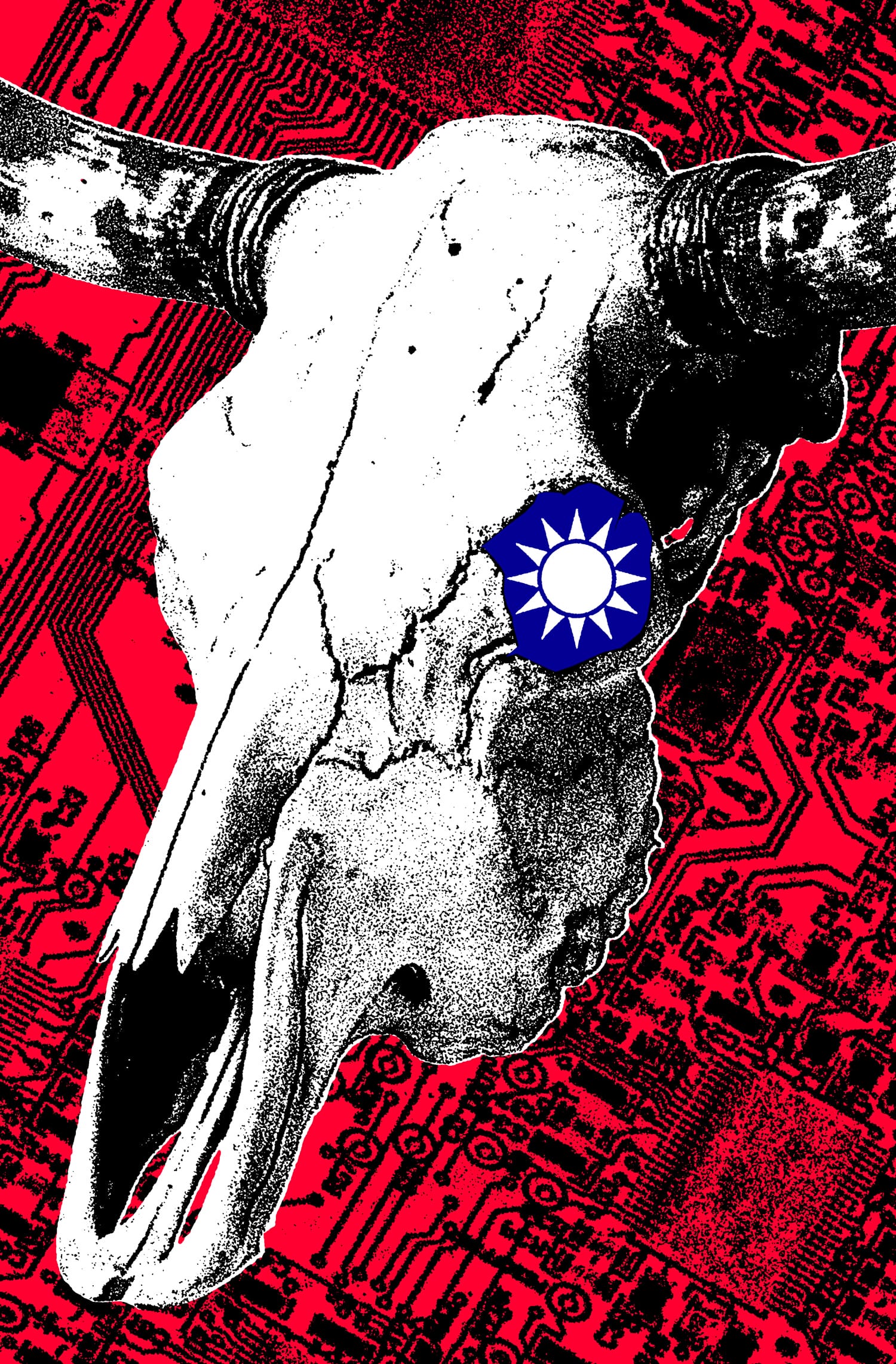
Driving through the country roads of Socorro, you wouldn’t think that you were passing through an up-and-coming tech hub. A West Texas city of about thirty-eight thousand, Socorro is wedged next to El Paso and the eastern industrial sprawl of Ciudad Juárez, Chihuahua, Mexico. The town’s history dates to the Pueblo Revolt of 1680, when the Spanish relocated a great number of Indigenous communities in response to the revolt from present-day northern New Mexico to missions near El Paso del Norte on the Rio Grande. Since then, Socorro has become a small, predominantly Mexican American city centered on Mission Trail tourism, hectares of arid farmland, and a cluster of warehouses for nearby maquiladoras, or export-assembly plants, in Juárez. Yet these dull-colored facilities are at the heart of a new multimillion-dollar transpacific deal to bring Taiwanese manufacturing to Texas.
In June 2025, Taiwanese manufacturer Wiwynn, a key supplier of Meta’s artificial intelligence servers, announced a $152 million investment in the town. The new facility is perfectly situated to support the regional AI boom, led by Meta’s $10 billion data center in El Paso and OpenAI and Oracle’s $165 billion data center in Santa Teresa, New Mexico. According to Wiwynn, the facility in Socorro aims to generate over five hundred “high-skill” jobs for an assembly and distribution plant that will support the manufacturer’s recent investments in the region. The deal has received support in Socorro, with the mayor repeating the firm’s promise of $26.80 an hour for workers and regional economic lobbies like the Borderplex Alliance citing the facility as a sign of future investment. City officials claim that the deal’s success owes to recent efforts to reshape Socorro into a high-tech logistics hub, which has included generous tax incentives and the city’s self-designation as a “foreign trade zone” in 2023. Although new incentives might have pushed Wiwynn to invest in Socorro, it isn’t the only Taiwanese firm setting up shop in the Texas-Mexico borderlands.
Wiwynn’s new venture in West Texas is emblematic of what some observers have referred to as Taiwan’s AI-fueled “Lone Star pivot.” Over the past decade, Taiwanese firms have invested over $11 billion in the state, with $5.3 billion worth of investments in 2025 alone. The new surge of Taiwanese investment is overwhelmingly focused on tech, especially manufacturing to support data centers and the material underbelly of AI. Here, geopolitics coincide with profit-seeking: Donald Trump’s call for Taiwan to support U.S. manufacturing in return for lower tariffs on Taiwanese imports seems to be accelerating investment and bolstering a pro-U.S. wave in Taiwanese politics.
In Taipei, the ruling Democratic Progressive Party (DPP) has embraced Trump’s requests and recently signed on to what is officially being referred to as the “Pax Silica,” formally strengthening cooperation around AI and defense between Taiwan and the United States. The DPP has been an enthusiastic partner of the Trump administration, and Vice Premier Cheng Li-chiun has promised that the renewed U.S.-Taiwan alliance will construct a “high-tech supply chain for the democratic camp,” deploying Taiwan’s decades-long supremacy in chip manufacturing to produce “democracy chips” for its American allies. This political alliance has emboldened Taiwanese electronics firms like Foxconn, Wistron, and Inventec, which have already poured nearly $1 billion collectively into Texas-based facilities. Even Taiwanese food chains like Bafang Dumpling are riding the wave by opening locations across the Lone Star State.
Despite the wage disparities between the United States and Taiwan’s traditional satellite manufacturing hubs in mainland China and Southeast Asia, there are a few good reasons why Taiwanese firms are moving to Texas. Much like Arizona—where Taiwan Semiconductor Manufacturing Company, the world’s largest chip manufacturer, will be constructing a $165 billion semiconductor fabrication megacomplex—decades of right-wing governance, anti-labor legislation, and bare-bones environmental protections have rendered Texas a hospitable state for tech companies. Investment terms are even better in rural peripheries like Socorro or Sherman, Texas, where land, water, and labor are cheaper; local governments are happy to roll out the red carpet; and unions traditionally have no foothold. Of course, the state’s lack of income or corporate income taxes further sweetens the deal. Yet, most importantly, the key ingredient to Taiwanese tech firms’ shuffle to the U.S. Southwest is its proximity to Mexico.
The Taiwanese pivot to the borderlands stems from the convergence of geopolitical tension and capital’s long-term scramble for cheap labor.
In the 1980s, Mike Davis wrote that the “neocolonial logic” of Sunbelt capitalism rested on Mexico’s northern borderlands position as a “domestic hinterland” that offered “an almost infinite reserve army of labour” to U.S. capital. Over the past twenty years, Taiwanese manufacturers have learned to grasp the importance of this dynamic. For every Taiwanese firm opening a logistics hub or assembly plant in Texas, a much larger maquiladora seemingly exists to pair with it in northern Mexico. Although Wiwynn’s spending in West Texas is significant, the new facility is merely a support center for the company’s expansive maquiladora, located eight miles away in Ciudad Juárez. That same plant rests within the cradle of a 2,500-meter industrial park (about twenty-two football fields) managed by Inventec—another Taiwanese manufacturer ramping up investment in Texas that aims to hire up to seven thousand workers for its assembly lines in Juárez. Taiwanese firms Foxconn, Inventec, Wistron, Pegatron, and Wiwynn have already transformed Ciudad Juárez into their primary manufacturing hub for North American markets.
The Taiwanese pivot to the borderlands stems from the convergence of geopolitical tension and capital’s long-term scramble for cheap labor. Taiwanese firms’ maquiladoras help insulate them within Mexico’s tariff exception in the USMCA, the mutated and besieged successor to the North American Free Trade Agreement. Likewise, Taiwanese firms’ move to Mexico has facilitated a broader process of what Wiwynn chairwoman Emily Hong has referred to as the “de-Sinicization” of transpacific supply chains. Wiwynn is not the only Taiwanese firm moving away from investment in the People’s Republic of China. Since 2021, cross-strait investment has been falling significantly, and the current administration in Taiwan is lauding its decoupling from the PRC and its closer economic ties to the United States. De-Sinicization resonates with the implications of President Lai Ching-te’s “democratic supply chains,” and recent U.S. calls for “friend-shoring,” but anyone imagining thousands of Texan workers dressed in overalls lined up each morning for their new factory jobs should temper their expectations.
“Clever, Obedient and Hard-Working”
Taiwan itself had once been a coveted object of desire for global manufacturers. In 1969, local government officials gathered in Taoyuan, a city just outside Taipei, to inaugurate the Radio Corporation of America’s first factory in the Republic of China (the official title for the government in Taiwan). The facility promised a new era of cooperation between the ROC and U.S. manufacturers. By the end of 1970, RCA had constructed factories in Taoyuan, Yilan, and Hsinchu (later of semiconductor fame), and at its height employed about eighteen thousand workers in Taiwan. These employees spent their working days manufacturing television sets and audio equipment for export to U.S. consumers.
American capital had found a loyal friend in the Kuomintang’s (KMT) governance of Taiwan during the 1960s. In the final years of the Chinese Civil War, Chiang Kai-shek and the KMT began a steady retreat to the nearby island of Taiwan, which had been turned over to the Nationalists after the Japanese surrender in 1945. Following fifty years of Japanese colonial rule, the KMT greeted Taiwan’s local political trajectories and cultural practices with extreme disdain. Tensions soon exploded on February 27, 1947, after KMT soldiers beat a female Taiwanese cigarette vendor and killed a bystander, sparking riots across the island. The KMT responded to the riots with a brutal crackdown of political opposition, an event now commemorated as the 228 Massacre. Suspicious of local political adversaries and underground communist organizing, in 1949 the KMT implemented martial law, a measure that was presented as temporary but lasted until 1987. For four decades, the KMT prohibited left-wing political organizing and kept tight controls on civic life, a period now referred to as the White Terror. The KMT’s suppression of left-wing dissent nevertheless endeared Taiwan to the United States, who found an eager anticommunist ally in Chiang’s rogue state. In the 1960s, the KMT refocused its energy on encouraging rapid industrialization through foreign investment. The proximity of the U.S. Navy’s Seventh Fleet and the ROC’s own generous promises to U.S. capital made the deal too good to pass up.
By the early 1980s, Love River was so contaminated with industrial waste that locals referred to it as a “stinking gutter.”
RCA was one of many U.S. and Japanese firms to take the KMT up on its offer to build factories in Taiwan, producing everything from shoes and bicycles to television sets and petrochemicals. General Instrument started the trend, and in 1964 the American company built an export-assembly plant outside Taipei, paired with a women’s dormitory to house the young workers it expressly sought out in newspaper advertisements. The export-industrial model soon received formal approval from the ruling KMT government in 1966, with the opening of the world’s first Export Processing Zone (EPZ) in the southern port city of Kaohsiung. Designed as a hybrid free-trade zone and industrial district, the Kaohsiung Export Processing Zone (KEPZ) offered foreign investors a walled enclave fitted with twenty-four-hour security guards, cheap access to utilities, and ready-made industrial lots. Within the zone’s heavily policed walls, manufacturers could import primary materials and export manufactured goods abroad duty-free. U.S., Japanese, and Hong Kong investors clamored for space in the tiny zone, and within a few years, the KEPZ had reached capacity. In response, the ROC approved the creation of two more EPZs and greenlit the construction of dozens of other industrial parks.
Despite the perks and provisions of the EPZs, investors were interested primarily in the ROC’s guarantee of island-wide labor peace. What made Taiwan’s self-proclamation as “Free China” so appealing to global capital was the government’s guarantee that investors would be free from any meaningful opposition. Trade representatives frequently reminded foreign investors of the rigors of the KMT’s police state, pledging that Taiwan was “an anti-communist base.” They also promised that Taiwan had “abundant low cost labor with inherited clever, obedient and hard-working traditions.” These advertisements were referring almost exclusively to the tens of thousands of adolescent girls who worked roughly 80 percent of export-assembly jobs in Taiwan from the late 1960s to the late 1980s—a hiring preference mirrored by EPZs and maquiladoras across the world.
Global firms deployed a variety of tactics to attract, retain, and discipline such workers, but few were as effective as martial law. As the scholar-activist Linda Gail Arrigo noted, American manufacturers relied on the KMT’s “mechanisms of political and coercive control over the labor force” to rationalize the transpacific relocation of assembly lines. This was not just a Taiwanese phenomenon. Global manufacturing has historically flourished under authoritarian governments, and the Cold War provided a slew of options. Although Mexico and Puerto Rico also offered cheaper labor to U.S. manufacturers, many firms preferred the tighter political controls in East Asia. The EPZ model flourished in South Korea under Park Chung-Hee, in the Philippines under Ferdinand Marcos, and of course, in Chiang Kai-shek’s anticommunist fortress on Taiwan.
Trade unions were ironically at the heart of the KMT’s efforts to stifle labor activism. In the late 1960s, the KMT established units of the Chinese Federation of Labor (CFL) in its EPZs and export industries. These KMT-controlled unions had no interest in helping workers organize, but rather existed to organize the surveillance of labor, and each factory-level union came outfitted with a cadre of KMT lackeys. Until the end of martial law in 1987, the CFL’s control of labor ensured a “strike-free” environment for the global electronics industry. And for those interested in agitating for their rights, fear of being sent to Green Island—the concentration camp set up for communists and “subversives” twenty-one miles off Taiwan’s eastern coast—or being disappeared into one of the other torture facilities scattered across Taiwan kept radical visions under wraps.
The KMT also used subtler forms of control to keep an eye on its army of adolescent workers. One key form of control were dormitories, which were established in most industrial parks and EPZs to offer housing to young girls coming from rural areas. These facilities provided workers low-cost housing, night schools, recreational activities, and even language classes, but they also prohibited male entry, subjected residents to heightened surveillance, and pressured workers to participate in anticommunist rallies and lectures.
Despite these authoritarian controls, popular memory of women’s work in foreign factories has been dulled by nostalgic recollections of national development. The export-industrial boom helped stimulate a period of record economic growth later referred to as the “Taiwan Miracle,” and women workers’ sacrifice of their youth for economic growth has become a core cliché of the sanitized historical narrative. Yet the riches of the Taiwanese Miracle were unevenly shared by the general population, and the island’s urban workers were the first to experience the toxic underbelly of global manufacturing.
Problems first appeared in 1972, when an epidemic of industrial poisoning swept through the foreign-owned factories of Taipei and Kaohsiung. Dozens of workers fell ill, with a few dying from health complications, after consistent direct exposure to trichloroethylene (TCE), a chemical solvent used to clean industrial machinery. Known as the Philco-Ford and Sanmei incidents, the worker poisonings prompted mass resignations among workers.
In the late 1980s, Taiwanese firms were becoming adept at high-tech manufacturing, but the island was no longer a free-for-all for capitalists.
Despite assurances from state and capital, injury and chemical exposure persisted in Taiwan’s export industries. Electronics companies continued to use a wide array of toxic chemical solvents, especially TCE. Global capital’s prolonged contamination in Taiwan is exemplified by the case of RCA in Taoyuan: Twenty years after RCA opened its first factory in Taoyuan, when the dust settled from the splendor and awe of the Taiwanese “economic miracle,” RCA workers discovered that the company they had once been proud to work for had systematically poisoned them. In the late 1980s, RCA was sold to General Electric, which then sold the electronics division to Thomson, which ultimately closed the plant in 1992 after discovering high levels of groundwater contamination due to prolonged use of TCE and other carcinogens. Following a public investigation into the poisoning, former RCA workers—over a thousand of whom had developed cancer due to exposure to chemical substances—organized themselves in a decades-long (and ongoing) struggle to demand justice and compensation from all three firms.
TCE poisoning was one of global manufacturing’s many ecological stains on everyday life in Taiwan. In the 1970s, lured by minimal environmental regulation, as well as lower labor costs, global manufacturing turned Taiwan into a giant dumping ground for industrial materials, a pattern that was duplicated across the world. In Kaohsiung, local EPZs disposed of their industrial waste at incinerators in the rural outskirts of the city or directly into the nearby Love River, filling the air and water with hazardous material. By the early 1980s, the river was so contaminated with industrial waste that locals referred to it as a “stinking gutter”; government officials warned that nearby reservoirs were facing long-term contamination due to the EPZs. Local fishermen and rural communities led some of the first protests against industrial pollution as early as the 1970s, in a prelude to the vibrant labor and democratization movements that engulfed the island in the 1980s. The pressure from social movements transformed the landscape of Taiwanese civic life for decades to come and finally helped bring down martial law in 1987. Yet just as the first signs of electoral democracy arrived in Taiwan, Taiwanese and foreign manufacturers were preparing for their departure.
Taiwan’s Maquiladoras
In January 1993, a delegation of Taiwanese business people and functionaries from the ROC’s Ministry of Economic Affairs visited Mexico’s northern border cities to check out the country’s maquiladoras. Dubious at first, the Taiwanese delegation later reported its shock at Mexican workers’ efficiency. The Economic Times reported on the delegation, writing that, with its low wages and high output, Mexico seemed like Taiwan “over ten years ago.” Visiting delegates attested that the visit had initiated a “180-degree change” to their previously negative stereotypes of Mexicans’ work ethic. The visits from ROC officials and capitalists show East Asian firms’ interest in establishing maquiladoras in Tijuana, Ciudad Juárez, and other Mexican border cities on the eve of the implementation of the North American Free Trade Agreement in 1994.
By the 1990s, Mexico’s border with the United States had become one of the cheapest places in the world to manufacture goods for U.S. markets. Although Mexico had begun its own ambitious export-industrial reform in the 1960s, opening its first maquiladoras in Ciudad Juárez, the program had a much slower start than its East Asian peers. The ruling Institutional Revolutionary Party tried to exert authoritarian controls on worker organizing, but the early maquiladora industry did not have the same grip on its workers as in Taiwan. Workers in the borderlands fought bitterly against low wages, state-controlled unions, and poor conditions throughout the 1970s. From 1982 onward, however, multiple rounds of currency devaluations and neoliberal reforms pulverized wages in border cities and pushed the working class into situations of greater desperation.
For global manufacturers, then as now, crisis and social collapse usually mean good business. After the economic crisis of 1982, the maquiladora industry grew at a record rate. Transnational firms that had been hesitant about Mexico suddenly sought to avail themselves of the country’s “comparative advantages”: a devalued currency and a party-state ready to abandon economic nationalism for neoliberal austerity. Border cities’ proximity to the United States made them favorable manufacturing hubs for foreign firms looking to export to North American markets. A factory producing TVs could get its cargo on an eighteen-wheeler and across the border in two or three hours, far more quickly than the overseas container shipping required when manufacturing in East Asia. In the new era of free trade, Mexico’s border cities became indispensable to global firms looking to service American consumers’ ravenous hunger for cheap electronics. Taiwan’s new cohort of small manufacturers took notice as well, but it would take a while for Mexico to earn the trust of Taiwanese capitalists. Despite their warm perception of Mexican border cities, Taiwanese manufacturers began their own offshore production close to home.
By the 1990s, Taiwan’s export-industrial boom had produced new configurations of wealth and power. Although American brands favored Taiwan, U.S. investment and ownership were always a fraction of the industry on the island. Taiwan’s “Small and Medium-Sized Enterprises” (SMEs) dominated the export sector through subcontracting deals with global firms. Although many SMEs operated in the EPZs, many others set up smaller and more dynamic operations, sometimes adding another web of subcontracting by sending out simpler assembly jobs to the “living room factories” that abounded in Taiwanese homes in the late 1970s. Simultaneously, cautious of too much dependence on foreign investment, the ROC took steps to build up local high-tech industries. Such was the impetus behind the opening of the Hsinchu Science Park (a kind of high-tech EPZ) in 1980 and the creation of the Hsinchu-based public-private Taiwan Semiconductor Manufacturing Company in 1987. Although Hsinchu had some big-name U.S. investment, over 70 percent of investment in the Science Park came from local Taiwanese SMEs, which cut their teeth producing game cartridges, computer peripherals, and semiconductors.
In the late 1980s, Taiwanese firms were becoming adept at high-tech manufacturing, but the island was no longer a free-for-all for capitalists. The end of martial law also saw the beginning of independent unionization drives, expanded environmental activism, and a lively culture of protest. Labor organizations and environmental struggles could openly challenge export industries’ collateral damage. Likewise, conditions were no longer “comparatively advantageous” to labor-intensive manufacturing. Wages had gone up since the early 1970s and were trailing behind nearby EPZs in Southeast Asia.
Taiwan’s EPZs soon began a slow process of hollowing out, as local and foreign firms looked elsewhere for the cheap labor they had previously enjoyed on the island. At first Taiwanese firms did not follow, however, their Asian counterparts en masse to Mexico, where Japanese companies like Sony and Yazaki had established successful borderlands maquiladoras in the 1980s. In a twist of fate, it was the People’s Republic of China that won over Taiwanese manufacturers. In 1978, the PRC began a process of economic reform—referred to as “Reform and Opening Up”—that slowly reintegrated the world’s second largest socialist country into global capitalism. Two years later, the PRC established four Special Economic Zones (SEZs) in the coastal provinces of Guangdong and Fujian that allowed foreign investment in individual firms of up to $30 million. The SEZs drew significant inspiration from EPZs in Taiwan and South Korea, but the PRC argued that its “special zones” weren’t capitalist enclaves, but rather corridors designed to develop productive forces within China’s socialist project. However, for capitalists across the strait, the new “socialist” SEZs seemed to offer an enticing cost-cutting opportunity.
Wages in the new SEZs were staggeringly lower than in Taiwan and Hong Kong, and the regions’ manufacturers rushed into the new enclaves. Although direct investment from Taiwan was not fully legalized until 1991, in 1987 the ROC authorized its citizens to visit family members on the Chinese mainland, providing a loophole for manufacturers to begin semilegal investment projects. Taiwanese investment in the new SEZs grew rapidly, especially among shoe and electronics subcontractors. Most investment was concentrated in Fujian and Guangdong, whose proximity to Taiwan facilitated quick business trips. By the early 1990s, the Taishang, or Taiwanese investors in the mainland, had become key protagonists of the PRC’s export-industrial ambitions.
In the PRC’s SEZs, Taiwanese SMEs earned a reputation as strict disciplinarians who rallied a capitalistic ethos into their workforce. Conditions mirrored the worst abuses of the EPZs during martial law, as Taiwanese firms imported dormitory labor regimes, bodily searches of workers, minimal concern for environmental hazards, and strict penalties on labor infractions. Abuses abounded in Taiwanese and Hong Kong capitalists’ pioneering factories in the SEZs, but few generated as much uproar as the conditions at the region’s largest electronics subcontract manufacturer, Foxconn.

Foxconn in the Desert
Hon Hai Plastics Company, commonly known as Foxconn, is emblematic of Taiwanese SMEs’ extractive road to success in the PRC. Terry Gou established Hon Hai Plastics with his business partners in 1974 as a small subcontract manufacturer in Taipei’s Tucheng Industrial Zone that specialized in plastic and metal processing. In the late 1970s, the company became the first Taiwanese firm to produce its own components for black-and-white television sets, earning acclaim in the Taiwanese business press. Following a series of expansions in the mid-1980s, in 1988 the firm built its first factory in Shenzhen, and in the 1990s relocated most of its assembly operations across the strait.
Like other Taiwanese firms, Foxconn imported an authoritarian and militaristic labor regime, and one that frequently incorporated Gou’s pseudo-philosophical aphorisms, such as “Growth, your name is pain.” By 2011, the firm boasted nearly a million employees and had become one of the largest electronics subcontract manufacturers in the world. As with export manufacturing in 1970s Taiwan and Mexico, Foxconn’s rapid growth in Shenzhen ultimately depended on a steady stream of rural migrants, whose low wages combined with the company’s strict labor practices to produce enormous profits. In 2010, Foxconn’s working conditions made headlines after a series of worker suicides at its dormitory brought global attention to the firm, especially since it was one of the primary manufacturers of the iPhone, revealing rampant labor abuse, miserable wages, and an authoritarian dormitory labor regime. In response, the company set up suicide prevention nets, invited overseas researchers to observe the factories, and tried to smooth over its worst abuses in Shenzhen.
In January 2010, Foxconn faced another controversy thousands of miles away, in Ciudad Juárez. Although Foxconn was located primarily in the PRC, the firm had built dozens of satellite factories across the world, including in Mexico’s borderlands maquila belt. Foxconn purchased its first assembly plant in Ciudad Juárez in 2003 and constructed two other large-scale manufacturing operations in the city over the next decade.
Despite their successive trips to Mexico, only a few Taiwanese companies had decided to build maquiladoras in border cities in the 1990s, and Foxconn was the first Taiwanese manufacturer to double down on its operations in the country. In the first decade of the twenty-first century—one of the most violent periods in Ciudad Juárez’s history—Foxconn constructed an impressive manufacturing base in San Jerónimo, a subdivision of Juárez’s northwestern border with Santa Teresa, New Mexico. Foxconn’s facility is located directly across from the international port of entry, functioning almost as an express lane for the company’s exports to the United States. Yet, much like their peers in China, workers at Foxconn’s assembly plants in Juárez were dissatisfied with long hours, low pay, and forced overtime. In 2010, workers at the San Jerónimo plant fought security guards and set fire to a cafeteria after the firm tried to force employees to work an extra night shift. The company retaliated by firing dozens of workers.
Foxconn’s reputation among workers in Ciudad Juárez deteriorated over the next ten years. Workers went on strike in August 2015, this time joining walkouts from other maquiladoras across the city in a rare strike wave to demand an independent union for maquila workers, higher wages, and an end to rampant sexual harassment. Foxconn retaliated again, firing anyone involved in the unionization drive. This time, striking workers set up a monthslong encampment outside Foxconn and other companies’ maquiladoras. In November 2015, with the intervention of Chihuahua’s state government, workers agreed to end their encampment and accept a settlement for the 103 workers who had been fired during the strike. Despite state intervention, Foxconn refused to rehire workers fired during the strike wave, maintaining its reputation as a retaliatory firm. Five thousand Foxconn workers walked out again in 2018, this time demanding the payment of mandatory bonuses that the company had been decreasing for years. More recently, worker grievances at Foxconn’s maquiladoras resurged in 2020, after the plants—many of which were labeled “essential” industries at the time—pushed workers to labor through the worst months of the pandemic despite successive worker deaths.
Despite Foxconn’s labor abuses, administration after administration in Chihuahua has continued to warmly welcome Taiwanese firms.
By this point, Foxconn had been joined by many other Taiwanese companies. As the scholar Fabricio A. Fonseca has shown, Mexico has become the largest recipient of Taiwanese investment in Latin America, primarily in electronics manufacturing in Chihuahua and Jalisco. In fact, Taiwanese investment in Mexico currently exceeds investment from the PRC, garnering consistent praise from Mexican functionaries. Despite Foxconn’s labor abuses, administration after administration in Chihuahua has continued to warmly welcome Taiwanese firms. After all, Foxconn has become a critical component of Mexico’s industrial output. In 2013, PCE Technology de Juárez, Foxconn’s affiliate in Mexico, had been named the country’s second largest exporter. By the 2020s, official enthusiasm reached a new pitch, as Covid’s disruption of supply chains, cross-strait geopolitical tension, and rising wages in the PRC pushed new Taiwanese firms to follow Foxconn in their hunt for cheaper labor in Mexico’s borderlands.
In the past five years, Ciudad Juárez has transformed into one of the most important manufacturing hubs for Taiwanese firms operating in North America. Although earlier Taiwanese manufacturing focused on computer peripherals, the new push is almost single-mindedly focused on AI.
Enveloped in this recent boom, Inventec, Wistron, Pegatron, Foxconn, and Wiwynn have been building factories in Juárez with a zeal that recalls the 1990s, when NAFTA led to a dizzying uptick in maquiladora expansion. Much like the construction craze of the NAFTA years, the new wave of Taiwanese investment has created a host of problems. Taiwanese manufacturers—like the American and Japanese manufacturers before them—have tremendous land, energy, and water demands that have led to conflicts with working-class residents living near new factories, who have faced water shortages due to the construction surge.
Mexican officials have nevertheless graciously courted these firms with mariachis and praise at high-profile events, as Taiwanese expansion has come during a period of contraction in the maquiladora industry. Thanks to tariff panic and increased factory-level automation, Juárez has lost nearly sixty-five thousand maquiladora jobs since 2023. Local officials have pointed to Taiwanese investment as a site of hope for the thinning industry, and recently Cruz Pérez Cuéllar, the mayor of Juárez, toured Taiwan to promote good trade relations. For better or worse, Taiwanese capital has become a new pillar of the Texas-Mexico borderlands economy, fitting in nicely with its other longtime economic foundation—border militarization.
A Laboratory of Our Future
The excitement behind Wiwynn’s investment in Texas has recently been overshadowed by the Department of Homeland Security’s plans to build a concentration camp just down the road. On January 17, 2026, DHS finalized its $123 million purchase of three industrial warehouses in Socorro to be refitted into an 8,500-person-capacity migrant detention facility. The logistics warehouse-turned-prison is slated to be the largest detention camp in the United States, a title that currently belongs to the nearby Camp East Montana, a facility at the Fort Bliss military base in East El Paso. At the time of writing, Camp East Montana detains about three thousand migrants but has capacity for five thousand, and has recently been the site of multiple deaths, systemic racist mistreatment of detainees, and atrocious living conditions that have recently given way to a measles outbreak.
Wiwynn’s logistics hub is located about four miles from DHS’s future warehouse prison, but it’s not the only Taiwanese firm operating in proximity to the border’s sharper edges. Foxconn’s massive San Jerónimo industrial park in western Ciudad Juárez is situated right across from the recently expanded border wall at the Juárez-Santa Teresa border. In combination with cruel enforcement measures, these fortifications have contributed to record death rates of migrants in the El Paso Sector of the U.S.-Mexico border.
Although earlier Taiwanese manufacturing focused on computer peripherals, the new push is almost single-mindedly focused on AI.
Foxconn and Wiwynn are arguably more enthusiastic about regional data center growth than new migrant concentration camps, but the AI boom cannot be easily disentangled from the United States’ rapidly intensifying imperial ambitions at the border and abroad. Not merely a staging ground for the world to come—a “laboratory of our future,” as the journalist Charles Bowden once christened Ciudad Juárez—the border is where U.S. technologies of war and surveillance are being manufactured for global export. The Trump administration has a particular passion for AI, which is well suited to the demands of its globe-trotting military aspirations and the domestic deportation machine. The Department of Defense has prioritized AI as a key technology for both its internal surveillance and overseas operations. Meta and OpenAI—two firms overseeing massive data center projects in the El Paso-Las Cruces region—have been eager collaborators with the administration’s reinvigorated imperialism. Meta has offered its open-source AI model Llama to national security agencies and is working with Anduril to put its augmented-reality and AI technology to work for the Department of War. OpenAI used the beginning of the U.S.-Israeli war on Iran to announce its own collaboration with the department, expressing its firm belief that “the U.S. military absolutely needs strong AI models to support their mission.” The destructive capacity of AI has been on full display in this latest war on Iran and Lebanon, in which AI “kill chains” have helped Israel and the United States identify and barrage thousands of targets.
So how do Taiwanese politicians feel about Taiwanese manufacturing’s relationship to the spasms of American empire across the world? At least in the upper echelons of government, the mood is quite encouraging. Days after the war began, the Foreign Ministry voiced its support for U.S. and international efforts to “help the Iranian people pursue freedom and democracy” and emphasized that “the United States and Israel are both allies of Taiwan’s.” Such support is in line with Taiwan’s recent efforts to cozy up to Israel, a strategy that has included plans for funding a medical center in an illegal Israeli settlement in the West Bank and President Lai’s speech at the first AIPAC meeting in Taipei. Yet, more broadly, Taiwan’s embrace of Israel and Trump 2.0 is symptomatic of the DPP’s recent flirtation with the global far right. This has been evident in the yearslong courtship of the Heritage Foundation (the authors of Project 2025) by Tsai Ing-wen and Lai, as well as the DPP’s recent uncritical embrace of the Trump administration. The DPP’s ties to the far right are more perplexing when you consider the party’s more progressive stances on LGBTQ rights, Indigenous rights, or environmental issues at home. Nevertheless, the DPP is keen to push these policies under the table when the fascists from Washington come to visit, especially as the administration prepares to purchase $14 billion worth of military equipment from the United States.
Taiwanese manufacturing’s Lone Star pivot is therefore not only remapping tech manufacturing but also facilitating a deeper alignment between Taiwan and the U.S. imperial project. The relocation of Taiwanese chip production to the Texas-Mexico borderlands is a key step in the United States’ desired reconfiguration of tech manufacturing while offering (maybe) Taiwan an extra layer of protection from the PRC. Nevertheless, President Lai’s promise of “democratic supply chains” and “democracy chips” rings hollow as Taiwan’s allies wage another round of genocidal war. Likewise, Taiwanese firms’ integration into the U.S.-Mexico border is reproducing the old exploitative dynamics of North American manufacturing in Mexico. Even with their Texan investments, Taiwanese firms are increasingly dependent on Mexico’s low-wage maquila system—just as Taiwanese manufacturing had once depended on low-wage labor at home and in the PRC.
It may be a short-lived alliance. In Silicon Valley, tech firms are feeling anxious about their reliance on Taiwan at a time of rising cross-strait tensions and may seek to diversify their sourcing for chips and AI servers. There is also potential for grassroots challenges to these new AI supply chains. Borderlands social movements have a lot more in common with Taiwan’s migrant workers and labor organizers than the Terry Gous of the island. Communities throughout the U.S. Southwest are fighting against both the rapid expansion of ICE detention and the extractive AI data centers in the already water-scarce region, while workers in Ciudad Juárez continue to struggle against U.S. and Taiwanese bosses. In Taiwan, social movements have also not been so willing to appease the gringo imperium. Protests have been on the rise against the DPP’s relationship to Israel and its silence on the genocide in Gaza, and for obvious reasons, the labor movement in Taiwan is far less willing than the island’s ruling class to believe in the hype of “democratic supply chains.” Taiwanese capital might be making a long-term bet on the borderlands, but border people will not be docile inputs for a world of democracy chips and detention camps.