, May 21, 2026
Hunger Games
Battling food insecurity and waste in the Big Apple
.jpg)
My lower Manhattan food-finding path almost always takes me by First Avenue’s Theater for the New City, a doggedly idealistic nonprofit performance space founded in 1971. General admission tickets, always wickedly cheap, are twenty dollars. For decades, though, I never noticed the clean, incised lettering above the theater doors: first avenue retail market.
The building went up in 1937 and was opened the following year in person by Mayor Fiorello H. La Guardia. Around this time, La Guardia, using Works Progress Administration funds, created a scatter of city-owned and city-run food stores, including the Bronx Terminal Market, Essex Street Market, Fulton Fish Market Complex, and Gansevoort Market, sites intended to push pushcarts off the streets—La Guardia abhorred them—and, in return, give traders shelter and access to loading docks, running water, and electricity.
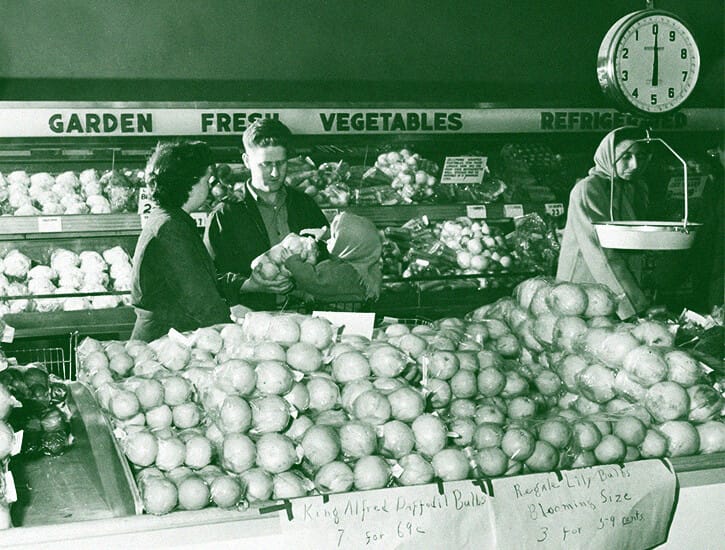
One 1938 photo shot inside the pristine First Avenue market shows scores of hatted shoppers, women and men, in a produce area, and vendors behind their wares. A hand-lettered sign stuck near what looks like potatoes reads “4 for 10.” Cents? (A thin dime equals $2.35 now.) In the late 1930s, New Yorkers, along with almost everyone else, suffered from an unexpected, almost crippling, post-Depression recession, leaving many without enough to eat. National unemployment rose to more than 20 percent. The term “food insecurity” hadn’t been invented, so “going hungry” would have to do.
La Guardia, a lifelong Republican who leaned populist-left, is the mayor New York’s new mayor Zohran Mamdani most admires, and building city-run grocery stores was a small but bright star on Mamdani’s platform. They would bring down rapidly ballooning, infuriating food costs for New Yorkers, he said, because they’d be nonprofits, like that theater. Markets for the New City. On April 14, Mamdani revealed East Harlem’s La Marqueta—opened in 1936 by La Guardia with the name Park Avenue Retail Market—as the first site identified for the city’s municipal grocery store program, slated to open in 2029. And then earlier this month, he announced that the second store—which will actually open next year—will be located in the Hunts Point neighborhood of the Bronx. At a press conference, Mamdani evoked President Reagan: “He famously said the nine most terrifying words in the English language are, ‘I’m from the government and I’m here to help.’ It’s a good quote, but I disagree. I think nine more terrifying words are actually, ‘I worked all day and can’t feed my family.’”
When Mamdani proposed these markets during his campaign, merchant organizations and conservative commentators belittled the idea, saying it would cost the city a fortune it doesn’t have and that no examples of publicly owned markets have ever worked—the latter of which, at least, is nonsense. The Department of Defense operates almost 240 commissaries—supermarkets—worldwide, most in the United States. There’s even one in Fort Hamilton, right here in New York City. Most of their items are tax-free to credentialed shoppers (including soldiers, veterans, U.S. ambassadors and families), and a 5 percent surcharge goes directly to store maintenance. The latest estimate is that prices are about 25 percent lower than parallel retail stores. No one calls these long-running commissaries communist, though there have been rightwing squeaks about privatizing them.
Cite, if you like, successes and failures of nonprofit markets in the past, for past reasons. But isn’t “now” different? Mayor Mamdani thinks so. Also, the city would probably know just what to do with wilting produce and best-by-X or soon-to-expire items, any market’s inevitable food waste.
One evening a few months ago, as I was leaving a new Whole Foods Market “Daily Shop” near Manhattan’s StuyTown—a small-format urban branch similar to those of Target, Trader Joe’s and Walmart—I saw a uniformed staffer haul a brown paper bag almost as big as he was to an outdoor dumpster and empty dozens of bagels or donuts into it. Markets throw food out all the time, although they can’t—or won’t—release accurate data to the public. According to the U.S. Environmental Protection Agency, over one third of the food produced in the United States is never eaten.
As may be obvious to select readers, Too Good To Go is a classic hookup app, a ground-beef Grindr.
I was there to pick up the Surprise Bag I had scored on the app Too Good To Go, “the world’s largest marketplace for surplus food,” which was created by five Copenhagen guys in 2015. Their initial goal? To reduce food waste by selling, at first, what buffets would otherwise toss in the trash—or maybe donate—at the end of the day. Around five hundred million meals “saved” is the for-profit company’s present stat. The app covers much of Europe, Canada and the United States, Japan, and recently New Zealand and Australia, with 120 million registered users. No Too Good To Go in South America, the remaining Asias, Middle East, or Africa—kinda white bread so far. It hit New York City in 2020 and did well. It’s not the only one like it but by far the most popular.
Here’s how Too Good To Go works from a user’s point of view: On the app, scrollable lists of opportunities within a distance you determine, one to twenty miles, appear in categories (meals, bread and pastries, groceries, flowers and plants, pet food, vegetarian, vegan). Images beckon, each with an accurate distance attached, down to “x feet away.” I check out places in my neighborhood that are strolling-close, though anyone with a car in various locales may take a drive for a carton of sprinkle cupcakes or overlapping slices of reheatable pizza within a specific pickup window. As may be obvious to select readers, Too Good To Go is a classic hookup app, a ground-beef Grindr.
The draw is that you pay about a third of retail for stuff that Too Good To Go businesses need to get rid of each day. (The app makes money by charging an order-based fee as well as an annual one to its signed-up businesses, which the company calls “partners.”) These operational details may read promotional, but you get a bag of something that may fill your eating bill at an awesome discount—all while ostensibly reducing food waste. But here’s a customer paradox: in most cases, you don’t know exactly what you’ll be eating. I had no idea what treat or defeat was in my parcel when I left that condensed Whole Foods.
It’s why they’re called Surprise Bags. And who doesn’t love a surprise? As it happens, plenty of folks, depending on what it is. Could be that you don’t eat beef or pork, or cringe at four-day-old mummified wraps and collapsed salads, all of which have been some of my TGTG delights. Yet for just a moment, back in my kitchen, I experience a childish “what’s in it?” joy as I pull open my bag and take out the semi-gifts one by one. Then comes my birthday grin or grimace, aimed at the adult giver who never had any idea what little Jeffrey wanted.
One day in early March, I claimed bags from two places I had starred as “Favorites,” the Whole Foods/Amazon at Union Square, and a bouncy, pricey Italian restaurant and bakery on Great Jones Street, Il Buco Alimentari & Vineria. Ordinarily, neither of these attracts low-income customers. Here’s the Whole Foods tally: truffle roast beef wrap, meh, retail $9.59; shrimp dumplings, $8.09; turkey bacon club sandwich, $11.79; cheese and cracker “snack break,” a WTF for $7.89. Total, $37.36; my tab, $10.88. At Il Buco, I prepaid $6.52 for a serious diversity of breads, including one of the best filones, a pillow-shape Italian yeast loaf, I have ever eaten. Over-the-counter prices came to a whopping $40. Slice and eat any of these immediately, bring as gifts, freeze. Breads and pastries such as bomboloni, soft Italian donuts filled with jams or flavored cream, thaw like champions.
I queried Whole Foods—press must contact Amazon—about why it connected to the app, but at this writing, no response. I’m not surprised. The omnivorous octopus has bigger sustainable fish to fry. Its Prepared Foods and Bakery Surprise Bags sell out quickly, and at a number of Manhattan stores, staff told me with late-work smiles that all sorts of customers pick them up, especially seniors like me. Il Buco Too Good To Go customers, at a glance, also seem older than the gabby diners still sitting at their suppers when I drop by to pick up my bag. In almost every TGTG destination I’ve been to, bag-grabbers assemble just before the pick-up window opens, as if offerings we’ve already bought would somehow sell out. Not sure why. Of my more than one hundred pickups since I joined in 2023, I’ve never been told there wasn’t one for me, although once in a great while a bag held less than or something quite different from what was promised.
Recently, I ran into a fellow writer who, when I mentioned Too Good To Go, told me that he and his wife joined the app in 2022 and have collected almost eight hundred Surprises, locally and in the UK. “It almost sounds like we’re addicted,” he emailed later. They’re slowing down, he said, because their favorite Favorites have left, and bags previously laden with surprises have become lighter and monotonous. His chief objection? “It’s about deals, not about saving food.”
At butter-scented Unregular Bakery, another of my frequent Favorites, manager Herwin lines up a cadre of white paper bags before he closes, each holding three or four unknowns he had just plucked from display trays. One may find a croissant wheel filled with burrata and basil “pearls” or a blueberry rosemary bombolone. Much younger TGTGers gather here, some of them nearby NYU students with no kitchen or time, a few told me, and assorted neighbors, chatting as we swipe and show mustachioed Herwin that we had ordered one, knowing we found a really good thing. Full price until the determined time, these baked inventions don’t feel like leftovers. But right at the swiping moment, they become so, Cinderella coaches magically reverting to pumpkin bomboloni.
We feel like we’re doing something good—eliminating or reducing waste—even though this isn’t a charitable enterprise.
Has Too Good To Go conjured a kind of a “leftover” customer who inhabits some mottled ground between privileged full-purchase and soup-kitchen, food-bank, or other charitable support, which are more and more crucial in our treacherous, mendacious world? It’s a tempting conceit, “leftover customer,” but I say no. The app, as well as wiry, nonprofit waste-saving organizations that aren’t consumer “deals,” ask late-capitalist consumers to solve a problem that was never our fault. We feel like we’re doing something good—eliminating or reducing waste—even though this isn’t a charitable enterprise. On my TGTG profile I see how much CO2e I “avoided,” and money I saved. An identical manipulation blames current and potential pollution victims for corporate slash political fossil-fuel disaster. Have we read this before?
Bargains are irresistible to anyone, as they say, “on a budget,” and even to some who are not. TGTG fans are contemporary coupon cutters. Scores of hospitable bakers and cooks wish to feed and please, showing their skills to those who can’t or wouldn’t walk in and pay in full. A few independent sushi sellers in New York City have cut-rate deals starting at 8 p.m.; lines form early. What a sadness to toss our handmade maki rolls, pastries, loaves of bread into the trash, compostable or not. Especially while anyone’s hungry.
Donna, a manager at Miss Lily’s 7A Cafe in the East Village, was actually there at 10 p.m. when I picked up my bag of jerk chicken, peas and rice, plus fried plantains, almost enough for two, for just $5.43. It’s a Favorite, so I obviously like the food and am never surprised: it’s usually the same chicken. Menu price is $29 for the entree and $9 for plantains, plus tax and tip. Donna wasn’t sure when Miss Lily’s began using the app, “But I know the goal behind it is to prevent food waste. It’s a good comparison to City Harvest.”
Nonprofit City Harvest, which began in 1982, is New York City’s largest volunteer food-rescue organization; it’s spawned many more. The statistics on its website are dramatic and accurate: almost half of NYC working-age households can’t “make ends meet,” about 1.4 million “experience food insecurity,” and two-thirds of New Yorkers who use food pantries are employed, with incomes that can’t keep them fully fed and afloat in their city. When asked for an update, City Harvest communications manager Molly Horak emailed that “this year, City Harvest will rescue nearly 90 million pounds of high-quality food that would go to waste and deliver it to food pantries and soup kitchens across the five boroughs of NYC.” I see City Harvest trucks on the street almost every day.
I asked City Harvest what it thought about models such as Too Good To Go. Do they detour usable food from the city’s most needy? Or are they another part of an unfortunately necessary effort? Horak replied that “we cannot accommodate your request at this time.” When I posed similar questions to Too Good To Go, U.S. PR manager Molly Sposato emailed: “We see organizations like City Harvest not as competing solutions, but complementary parts of a shared mission. The reality is, food waste is a global crisis requiring a range of solutions that fit different use cases, support varying business needs, and bring everyday consumers into the fold. For that reason, we will never advocate against donation-based models. In fact, many of our partners use both donation services and Too Good To Go side by side.”
Sure, we make food choices. Neither City Harvest nor any of these organizations needs to be around if government-mandated policy supported farmers, farmworkers, cooks, as well as making absolutely certain that we the people can feed ourselves. Instead, federal withdrawal of health care subsidies and inadequate SNAP benefits are a punitive double whammy; indeed, millions of Americans—and some three hundred thousand New York households—will lose some or all of their benefits in the coming months, leaving so many more than before having to make a daily Damoclean choice between medication or other essentials and something, anything, to eat. The mayor’s planned markets, which I cautiously support and are crucial acknowledgements of misery that may sustain hope, cannot change our vampire economy. We must sweep leftovers of any kind off the bargaining table. Savor your Surprise Bag, if you can.