, June 9, 2026
You Who Forsake the Lord
William T. Vollmann’s four-volume spook show
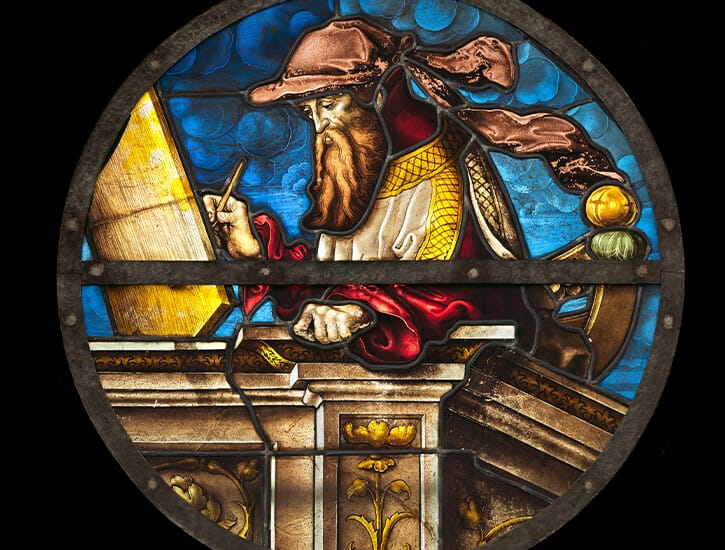
The Prophet Isaiah by Valentin Bousch (1533). | Metropolitan Museum of Art
A Table for Fortune by William T. Vollmann. Arcade Publishing, 3,096 pages. 2026
“The permanent underworld of American public life,” wrote Christopher Hitchens, “has only ever been captured and distilled by novelists.” The sentiment comes from his review of Harlot’s Ghost (1991), Norman Mailer’s “magisterial bid for dominance” among the fictional literature of U.S government affairs alongside contenders Don DeLillo’s Libra (1988) and Richard Condon’s The Manchurian Candidate (1959). Hitchens pushed against the notion held by some critics that such work was merely the dramatized white noise of conspiracy theories. The world of covert action, he argued, was best anatomized by novelists willing to “listen for the silent rhythms, the unheard dissonances and the latent connections” and to “ruminate on the emotions and the characters and the motives” of the state. “‘Conspiring,’ after all, means ‘breathing together,’” noted Hitchens, adding: “Why not check the respirations?”
One needn’t press a stethoscope against the pages of A Table for Fortune, the latest novel by the writer and journalist William T. Vollmann, to discern the deep state laboring within. It hisses along like an oven’s flume during the years intel analyst Elliott Stevens works the kitchens of the CIA. Codenamed DAVE, his job is to parse and assess reconnaissance gathered from the “Night Land” (his term for the surveilled world) to cook up “product”: memos flavored with the agency’s occasionally cheeky and often fully capped glossary of acronyms, argot, and aliases that he delivers to his superiors. They in turn prepare all received product for the daily briefings Langley serves to its executive branch “customers.” In Vollmann’s contribution to the gov lit genre, an achievement in facsimile, this is how the proverbial sausage is made. How “product” is devoured and digested is another matter. Less than a year before 9/11, DAVE dishes up this report:
With Iranian help, local extremists who met with Osama BIN LADEN (aka UBL) 2 years ago in Afghanistan are currently reestablishing themselves in their home mountains near Halabja . . .
“Not important,” says DAVE’s boss COULSON who adds “You have to think about the long pull.”
The quip is one of many portentous remarks found in this lurid American epic. Nearly fifteen years in the making, and at over three thousand pages, it is Vollmann’s longest and most resonant work of fiction. Stewarded by DAVE, it is a “novel of ideas” charting the rise, ruin, and refashioning of America as unapologetically hegemonic and quasi despotic; grafted into it is a “novel of feelings” that follows the Stevens family into rupture and DAVE’s son Matthew into vagrancy.
It is primarily through DAVE’s unusually long career (1968–2019) that Vollmann scrutinizes a half century of U.S. foreign policy skewed by 9/11 to account for the “lessons not learned, the expediencies of power, of course, and most certainly with consciences disabled on all sides.” It’s a prescient time to consider them: spring has not yet arrived and “instruction-averse” Trump, (MOGUL in the ergot of Secret Service code names Vollmann adopts) has already taken out not one but two world leaders, instigating a war and a global fuel crisis. 2026 sees several incremental anniversaries germane to DAVE’s interests: the end to the Iran hostage crisis; the collapse of the Soviet Union, 9/11, and TRAILBLAZER’s (that is Bush II’s) proposal of a Department of Homeland Security, which DAVE contrasts to the Stasi; the execution of SADDAM Hussein, the conclusion to the War in Iraq, MOGUL’s first election to office, and the withdrawal from Afghanistan.
Nearly fifteen years in the making, and at over 3,400 pages, A Table For Fortune is Vollmann’s longest and most resonant work of fiction.
What makes this history fresh is DAVE’s perspective as someone employed at America’s panopticon. DAVE is something of black sheep to his colleagues and superiors, a veteran “mental soldier” who, even prior to 9/11, has come to suspect the CIA, the White House, and the United States of acting in bad faith to oust Saddam Hussein. DAVE’s not seeing evidence that the Iraqi dictator is funding Islamists and developing weapons of mass destruction, but he still scrambles to find it regardless that it’s Osama bin Laden’s name appearing in the recon. The problem is that unless any of this intel shows a direct link to Saddam, his colleagues and superiors can’t be bothered.
An ace analyst during the Cold War, key to the agency’s East German triumph, DAVE has been subsequently assigned to the Iraq desk (where he’s rated middling at best), where he’s become a “balding, tightlipped, overweight, ever more unhandsome fellow” who hopes newly elected president TRAILBLAZER and vice president ANGLER (Dick Cheney) “would step up” their attention to bin Laden’s activities. Many of his co-workers would sooner see this Cold War geezer step down into retirement. But then the biggest blunder in the history of American intelligence blindsides Langley and leaves DAVE with the bitter awareness that his instincts were both right on the money and completely beside the point. He hadn’t “seen the possibilities.”
Another ominous remark! Vollmann imagines this one coming from Donald Rumsfeld in response to DAVE delivering “product” warning of the regional fallout an invasion of Iraq would create. He nearly quits when Rumsfeld approves the use of torture yet grumbles when the “inconvenient creep” Edward Snowden tattles to the public. Vollmann doesn’t excuse the intelligence community’s well-documented nefariousness, but casting DAVE as our sherpa upon the CIA’s paper trail, Vollmann does his best to illustrate the toll its highly pressurized environment has on the agency’s employees.
As a company man halfway between loyalty to the agency and disgust at its self-absorbed insouciance and genuflections to the White House, the burden of witness is what enlivens DAVE as a character. DAVE is embittered by the affirmation of his instincts over bin Laden and even sickened to know the invasion of Iraq was indebted to the “operational opportunity” of ANGLER, someone DAVE had begrudgingly respected since the administration of SEARCHLIGHT (Nixon), he swallows that hard pill and continues showing up for work.
Through DAVE we see SADDAM’s transformation into America’s supervillain and a metaphor for maniacal foreign policy. DAVE becomes conscious of SADDAM in 1969 “after a State Department ‘customer’ who could not yet have been Cheney demanded ‘a so-called comprehensive report’ on Iraq’s Ba’athist regime.” Assigned the “product” because Iraq’s hostility to Israel along with being among the GDR’s biggest suppliers of oil makes it “renascent” for DAVE at the East German division, he writes:
Soviet trade and military overtures to Prime Minister Ahmad Hasan al-BAKR (whose energetic deputy SADDAM Hussein bears watching) hint at the intention of transforming his new regime into another “socialist” client state.
Vollmann’s involvement in the narrative distinguishes him from the conspiration of espionage and 9/11 literature. He wants to direct your perception of this novel, not leave it open to interpretation. Most explicitly in the DAVE half of the book, Vollmann wants you to ponder, as he does, the many pins that connect East Germany to regions as unexpected as Angola, revealing underexplored CIA involvement in its Civil War. He wants to pique your interest in a history of colorful Cold War figures like a Nazi turned Mossad advisor, the assassinated Canadian inventor of a “supergun,” and the Soviet dissident Aleksandr Solzhenitsyn (a hero to DAVE). And of course he wants you to share the duty Vollmann feels in recalling Cheney’s America.
It’s an ostentatious survey of history navigable because of Vollmann’s omnipresent direction. Narrator avatars are not new to Vollmann, but he makes no pretense that he’s literally seated at his desk, commenting as composes At the Table of Fortune, breaking its fourth wall: “I who am trying to write this . . .” Time and voice render the novel’s multiple narrative layers into a single rhizomatic text, an effect he achieves using the leitmotif of an Ultravox reels buttons. “Let me REWIND to 1967,” he says to commence the book from its chronological beginning. “Now FAST FORWARD to 2001, a straightforward year when a S E C R E T intelligence arm merely and simply complied with S E C R E T government orders. According to REDACTED, whom I semi-sincerely ——, TRAILBLAZER and Cheney owned George Tenet. So they owned the office . . .”
The assorted typography brings a surreptitious vitality to Vollmann’s narration, as if he were testifying on declassified material. Fonts are often proprietary and expensive to rent, and Vollmann’s insistence on keeping them is what led, along with a fattening manuscript and dizzying printing cost, to him being dropped by his longtime publisher Viking. Had he listened to his editor’s advice, Vollman admits, “I could have made a living and expanded my readership. Well, I had to fight against both of those dangers. And in the great words of Bush Two: MISSION ACCOMPLISHED!”
Vollmann’s documentarian sensibilities, foundational to his legitimate bid as our preeminent literary chronicler, are underscored by his tectonic imagination. Without its quake, At the Table of Fortune might resemble something of a novelized Fahrenheit 9/11 or Ken Burns special on the CIA rendered in prose. But whether it is the duty of the novelist to commit to the highest levels of verisimilitude is debatable. When he says his extrapolations of Langley are as accurate as “a 1940s science fiction novel about Venus,” what he means is he didn’t quite nail the colors of Langley’s elevators or the species of potted plants in its lobby. Even for writers wiretapping into reality to enrich their prose, such faults are often the most capable of moving us.
Vollmann’s err was to stay true to his creative absolutism, a practice valued by his zealous readers (to include the excellent fan podcast VOLLMANNIA). But he has paid a high price for his iconoclasm, and it came during a time of enormous tragedy. A span of two years saw the death of his daughter Lisa, the dehydration of his finances, a third of his intestinal tract lost to cancer, the terminal diagnosis of a pulmonary embolism after its remission. Somehow he found time to be smashed through a motorist’s windshield. So I don’t scorn him for signing with Arcade, an imprint of the controversial publisher Skyhorse, where far-right conspiracy theorists, canceled celebrities, and alleged predators—Alex Jones, Woody Allen, and Philip Roth biographer Blake Bailey—have found homes. But desperate times called for desperate measures. It didn’t hurt that Arcade not only backed Vollmann’s vision for At the Table of Fortune but assembled it into a handsome box set too. (I also take some comfort that Vollmann will be joining a list that includes Natalia Ginzburg and Ismail Kadare).
At the Table of Fortune’s indefatigable march of history forms only half of the book’s considerations. The remainder, which Vollmann refers to obliquely as “a novel of feelings,” is a raw and wrenching meditation on mental illness and survival. Vollmann’s work is often preoccupied with the moral calculus of violence and the otherness of people engaged with or ravaged by war, poverty, and maladies atypical to those experienced by his readership. As a journalist (who also cameos here) Vollmann has ensconced himself with his subjects: Mujahadeen fighters in Afghanistan, say, or unhoused Americans. Whether, and for whom, these aggressions or the extremities of living are justifiable or heinous was distilled most directly in Vollmann’s treatise Rising Up and Rising Down: Some Thoughts on Violence, Freedom and Urgent Means, but the idea underlines his ongoing saga of North America’s conquest (Seven Dreams) and his National Book Award-winning novel Europe Central, a fugue-like portrait of that World-War ravaged continent. At the Table of Fortune continues that research, but it is impossible to absorb the novel’s big-picture study of sanctioned American violence without taking in the brutal portrait of the Stevens family.
Just how affected DAVE is by the bends of his intelligence dives is revealed whenever he surfaces for air as Elliott. A taciturn husband to his saturnine wife Sally and an exasperated father to Matthew, in lieu of their company he prefers to hole up in his study to flip through Russian literature (a passion) or pull from his “soft files” of grander and lustier memories. DAVE’s taciturn personality keeps his social circle limited to his co-workers, extended family, and a neighbor friend. Among the only people DAVE seems to connect with are his former superior SANDOR; his sister Denise, who provides the book’s left-of-liberal ripostes; her daughter Amy, more politically aligned with conservatism; and Kimberly Wilson, aka CINDY, his workplace crush and confidante. That their limerence may be mutual prompts demeaning and dissuasive polygraph tests from their bosses. CINDY’s character exists, it seems, mostly to give DAVE a happy counterweight to the misery of his marriage to Sally. Central to their relationship rot is Matthew, who by 2001 is an eighteen-year-old struggling with addiction and mental health issues. Whatever sympathy DAVE wins from the reader as a disregarded intelligence officer drains out in Elliott’s failures as a parent, among them cowardice.
Sobered by Abu Ghraib, Elliott nonetheless defends a prisoner’s death by torture to his incredulous son Matthew:
DAVE saw that his son was crying again. Hoping to restore him to reason, he inquired: Is this really something to cry over? First of all, it may not be true. Why shouldn’t terrorist sympathizers lie? The media’s full of those. Second, who knows what this Iraqi did? What if he was shooting at us when we got him? Third, what about the thousands of our own people who died so terribly on September eleventh? Maybe you’re actually crying over them and you don’t know it. God knows, we’re all emotional—
Matthew cuts him off: “Dad, are you doing this to people?” The accusation prompts a row that permanently damages their relationship. Matthew runs away from home and, estranged from Elliott and Sally, embarks on odyssey across America “fairly described,” writes Vollmann, “as transient or homeless.”
The issues that challenge Matthew are those of intelligence trialed by low cognition and esteem. His indefatigable curiosity for “big picture” questions doesn’t transfer to a comprehension of the answers. Unlike his father, whose ability to memorize information is “off the charts,” Matthew struggles to remember anything or fathom the notion of intelligence analysis. This, along with his habit of asking a repetitious “why?” on what he overhears on the news grates on his father, who admonishes him for wanting knowledge without working for it (i.e. reading) and Matthew’s habit of forgetting what he’s told: “I’m stupid. I’m not brave and I’m not anything. I’m stupid.” Elliott suspects he gets it from his mother. “You think I’m stupid,” Sally says to her husband, leaving Elliott to think “that’s where Matthew gets it from.” He says nothing in return.
Vollmann doesn’t state it outright, but in Elliott I recognized with uneasy vividness the disease of PTSD. Elliott’s struggles with his mental health, seldom addressed, resembles several government men of high rank and security clearance who are unable to “log off.” It is a condition that my own father, a military combat veteran later staffed at the Pentagon on 9/11 and beyond, has worked to overcome. Elliott’s symptoms are most visible in his laconic verbal exchanges and disappearances into “mindwinging” (Vollmann’s term for Elliott’s lapses into occupational ruminations). Without professional help, the confidences offered by CINDY and his assumedly contractual inability to reveal anything about DAVE, exacerbate his troubled family relationship. What builds between them instead is resentment, at Sally for being unable to give him intellectual and sexual pleasures (she doesn’t read or fellate); at Matthew whose arrested development further atrophy Elliott’s love.
So DAVE avoids retirement because the agency is how he finds purpose and will continue serving Vollmann’s march through the government’s post-9/11 muck, when Matthew assumes a protagonist’s role for At the Table of Fortune’s later two volumes. The shift in tone and voice is a welcome one. Matthew is sent to live with his Aunt Denise, who the needy Matthew “deficits.” He loves her for it but can’t help but “see the possibilities” of flying out into the big picture and leaves the sheltered comforts of Denise’s behind. Vollmann describes Matthew’s subsequent journey into an America of horror and hope thus: “As I finally commence his story, without FAST FORWARD ing that reel I myself cannot tell you what he was going to find on what Thomas Wolfe called the last voyage, the longest, the best—in other words, the only voyage, the one toward the grave.” It is a life Vollmann has spent breaking bread (when available) and gaining wisdom (always available) from people on the margins. In several included photographs taken during these periods, none of his subjects, no matter their circumstances, display what could be described as wretchedness.
Even for writers wiretapping into reality to enrich their prose, such faults are often the most capable of moving us.
Vollmann writes of Matthew that he “clothed some of his wretchedness” in the sorrows of his daughter Lisa, noting that he “sprinkled in some of her parents’ anguish” just for fun. “I would not have mentioned family matters here at all,” he adds parenthetically, “but for the fact no private grief is private anymore.” But perhaps Matthew helped him to understand Lisa better, evident in the compassion he gives to Matthew, whose life he tries preserve as long as his character is able. Matthew comes close to wrecking it with bad decisions, even losing himself in relationship with a heroin-addicted ex who later abandons Matthew to save herself.
In her departure he’s to discover his own ipseity. His first great act of self-realization is provoked by Isaiah 65:11, which Vollmann also sourced for the title:
You who forsake the LORD, . . . who set a table for Fortune and fill cups of mixed wine for Destiny, I will destine you to the sword, And all of you shall bow down to the slaughter; because when I called you did not answer . . .
Matthew discovers the passage after a random flip into the Bible and is left “shocked and almost frightened.” To him it sounds “sinister,” and by extension so does the authority of God. From a thirteenth-century poem (it’s Boethius’s Consolation of Philosophy) he finds more solace in Fortune, whom he comes to regard as more loving even if she could not always provide “which Nature has made foreign.” He vows to stay motivated in the absence of her blessings.
Many of Matthew’s later experiences are written down in a notebook he also titles A TABLE FOR FORTUNE to scribble down passages (he becomes a voracious reader) and overheard musings by fellow spirits encountered on his nomadic wanderings. He develops a variation of his father’s mindwinging he calls “heartwinging” where imagines himself as a Chinese sage. And Matthew is good with people: robbed of his money in New York, his two muggers give him back twenty dollars when he asks to have a little something left. The friendliness he finds elsewhere in people willing to give him a meal, a bed, a bit of work (he’s good with his hands) helps him toward stability. Matthew wants to live “without government” and finds a like-minded community among off-the-grid tent-dwellers.
The government, and personal demons, will eventually come for Matthew and others like him, especially after MOGUL is elected and Matthew loses his notebook in a police raid. But in this book’s darkly cardiological darkness, it is Matthew’s heart that beats as long as it can. Near the end of the book there’s hope that Matthew might elevate to a greater purpose. He could, it seems, become something of a writer. He’s got the ear and habit for it jotting anecdotes of hardship and hard opinions. “Now what’s your interest?” he’s asked by the keeper of an oil rig turned shelter in the Louisiana Delta. “Well, sir, said Matthew, I’m interested in America.”