, January 13, 2026
Wegmania!
The grocery chain gets into the fine dining business
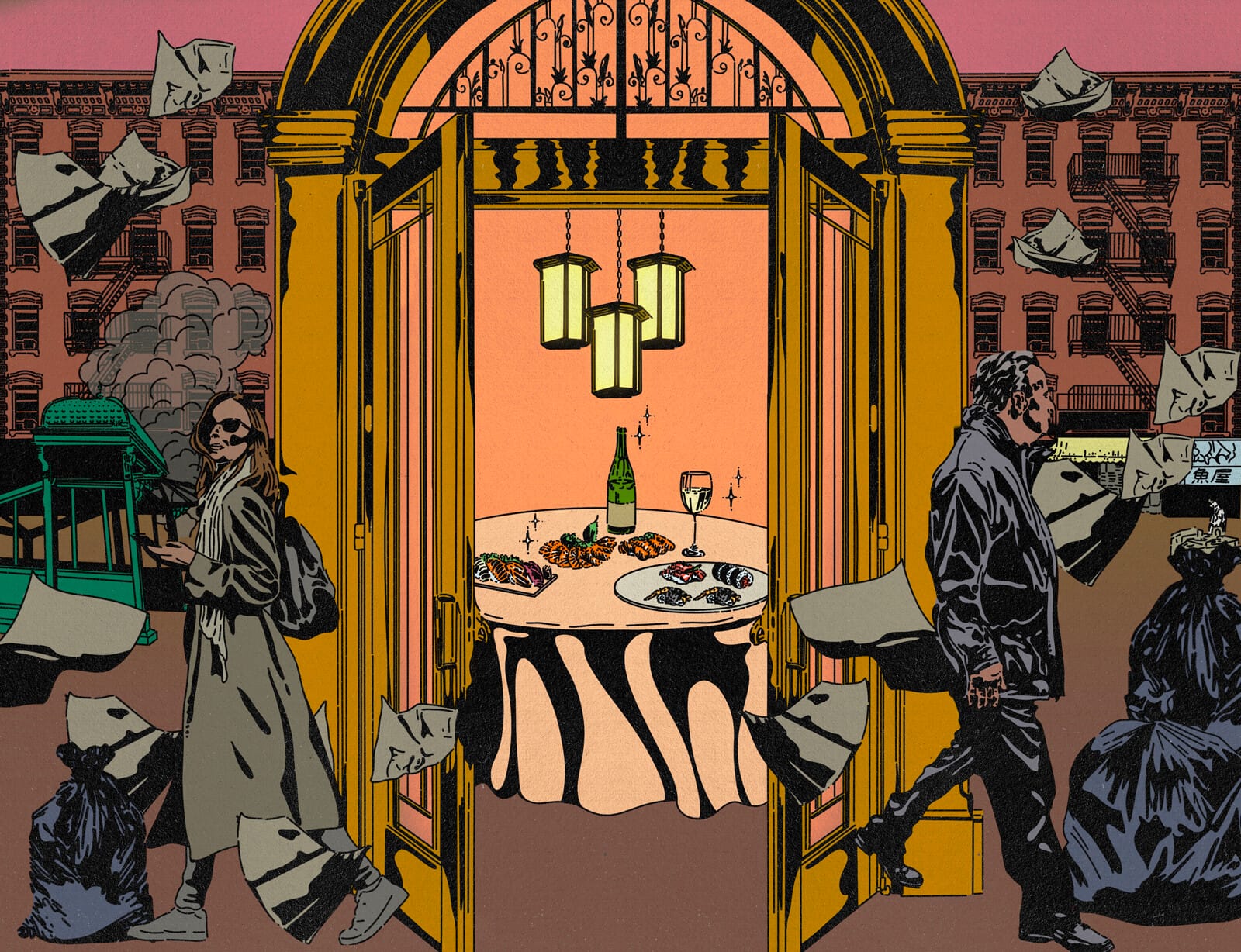
On a Sunday walk in my New York City nabe, I overheard an easy exchange between a pair of basic youngsters: “But it’s late, what’ll we do?” “Oh, I’m sure there’s some sushi-grade fish around here somewhere.”
I couldn’t have imagined a “sushi-grade” conversation like this even a few years ago.
So, are we what we eat—or when we eat, where we eat? Pardon my queries, but eco-truisms such as these go right to compost because there’s no steady we or where there, is there? But let’s do a test from where I’m sitting, at a desk in the rent-stabilized Manhattan apartment I’ve lived in for almost half a century. A very few pieces of svelte, beige pink bluefin chutoro lie in front of my laptop, the raw slab from which they were cut flown from Tokyo “two or three days ago” or so I was told by a kind staffer at the Wegmans on Astor Place, a bustling vessel of suburban chic that landed from the upstate mothership in Rochester about two years ago. That’s a serious carbon bootprint, to be sure.
A few-day delay shouldn’t worry plucky consumers because “just caught,” a big plus now and in my Brooklyn childhood household (my dad Harry cast his line in Sheepshead Bay and Montauk), is not always necessary. Some treasured, fatty fishes, in particular situations, age and grow richer, like raw beef and crooked mayors. Sold-cold sushi, however, can never be quite right, because the rice is meant to be a warmer contrast to the fish. It also becomes gummy. Stick with sashimi.
The fish and I live in New York’s fabled East Village. Some readers may know that after the grimy, clackety Third Avenue El started coming down in 1955, realtors and developers took the opportunity to waft the semi-monied scent of the West Village into this enlightened part of the Lower East Side, some naming it “Village East” and others “the East Village,” which took. It takes a realtor to raise a Village.
In the 1970s, 1980s, and 1990s, I was paid almost nothing to review restaurants for the Soho Weekly News and Village Voice—that ad-plump Voice owned by Rupert Murdoch and later by birdseed monarch Leonard Stern—eating around while trying to digest my neighborhood and city’s constant, churning change. (Union note: at the Soho News, which colleagues and I tried to organize, I threatened to write that my paltry income made me eligible for food stamps, later SNAP, which I indeed needed, collected, and spent. Headline: “Food Critic on Food Stamps.”)
While it’s drawn near-rabid excitement from brand loyalists, it doesn’t truly serve the place, which is a neighborhood, or the people in it.
Well-advertised Wegmans occupies the sad space of a former Kmart, which itself squatted for a quarter century in the mammoth main building of one of early retail capitalism’s surpassingly inventive and effulgent U.S. showplaces, Wanamaker’s department store. Wanamaker’s closed around the same time the El was knocked down. In 1905, John agreed to pay his horse-filthy, glittering city an annual rent of $2,171 for a direct entrance from the new Astor Place subway station into his store’s basement. Kmart kept that underground door open, though stationed with sleepy guards. Our new emporium has closed it off, a symbolic—as well as real—urban customer filter.
This Wegmans is a stone crab’s throw away from the stupid rotating Cube in Astor Place plaza (it’s named Alamo, which no one remembers) and a short stroll to the doleful Gen-Yawn coffeehouse that replaced the beatnik-hippie egg-cream hangout, Gem Spa, an East Village “icon” to no one younger than me. Wegmans, in other words, fancies itself “local.” But while it’s drawn near-rabid excitement from brand loyalists, it doesn’t truly serve the place, which is a neighborhood, or the people in it.
Deskbound Jeff had also dispatched four ounces of Wegmans Japan-jetted yellowtail sashimi: $13.92. Same weight of his chutoro—a coveted middle-fat part of the tuna—was $20.70. Do the math per pound. They’re a bargain, of course, compared to the market’s Caspian Golden Osetra caviar at $126.99 an ounce, easily delivered by Instacart. It’s a mid-competitive price, caviar for the Wegmans masses.
I didn’t know, though, that I could have bought pretty much the same high-flying fish from a little shop around the corner named Osakana, at 42 ½ Saint Marks Place. Yuji Haraguchi, originally from Utsunomiya in Tochigi Prefecture, Japan, opened the specialty sushi site in 2016 after a career or two in Tokyo and Boston. I had walked by Osakana dozens of times, but never went in because it looked like a prep kitchen, not an eating place or store. I was stupid, like the Cube.
While glossing this piece about New York City’s second Wegmans—the first opened at the Brooklyn Navy Yard in 2019 to ridiculous, cart-slamming fanfare—I read that Haraguchi sued the market and “a few of its business associates [for] fraud, trademark infringement, unfair competition, breach of contract, and more—claims which Wegmans argues are fully ‘without merit.’” Haraguchi’s February 2024 suit named Wegmans as well as associated marketing and distribution companies because he said he discovered that they sent staff to learn his trade and take it back to open a Japanese-themed fish-monger site in the Astor Place supermarket named Sakanaya (“fish market” in Japanese). He thought the moniker was lifted from his place’s name, Osakana, or “fish.” Wegmans and the others countersued, and according to court papers the case was denied as moot on August 1, 2025. Wegmans didn’t respond to my requests for comment.
When I walked into Osakana, finally, to speak to Haraguchi, manager Jackie said the founder had moved to Hawaii and he would relay my request. Haraguchi, who on Instagram is slicing fish and making menus in a new home, did not respond to attempts to contact him. Inside Osakana, I saw five aproned folks in a wee space housing small tables, manipulating cold, raw flesh with what any onlooker would call close intent. I was fascinated, even excited, by an intimate a sense of camaraderie.
Back at Wegmans, a chart under the unexpected fish imports on ice in its basement Sakanaya section, similar to many others online, outlines a few Japanese ways raw fish should be cut. Sporadic demos by an employee with a sharp knife impose the chart on a sacrificial fillet. Another sign says “custom ordering available from Toyosu Market.” Don’t expect Costco-type samples here: at this price, they’d have to be the size of a grain of rice. Some shoppers stop at this uncommon sight of marine extravagance and observe the hand ballet, but move on like budget tourists to grab the almond milk and bargain baby bok choy on their lists.
Despite Wegmans’ arrival in the neighborhood, Haraguchi’s place nearby is still open and continues to cater, sell DIY sushi kits that include packs of its proud product, and offer sushi classes at $195 per person. Perhaps, on my next birthday, someone will gift me a class—if pristine, sustainable fish, and I, are still aswim.
These two stores, big and small, make visible the dispiriting choices that late-capitalist consumerism offers to wildly uncertain American lives. Pleasure of various sorts is crucial to most everyone’s sanity, but satisfaction is increasingly undermined by media manipulation, incipient fascism, free-floating, unnerving doubt, not to mention the stultifications of big-box retail. The scary present and indefinite future may numb ready tongues when save-up celebration meals are set before us, a challenge to enjoy.
Ever since I was a desirous boy, delis, cafés, and restaurants have been a few of my favorite things, and not only because of food: the best of them are spaces of welcome, pictures of an “everybody” life. That’s always my hope, even when I learned of Next Door, the Astor Place Wegmans’ high-rent, Japanese-ish restaurant that opened at the end of last April.
At Wegmans, I find a literally transparent example of our eating moment: a micro-distinction or stratification of class through glass.
No question, food and drink are mirrors that reflect the opposites of hunger and delight. At Wegmans, I find a literally transparent example of our eating moment: a micro-distinction or stratification of class through glass. It starts on the outside, peering into Next Door display windows to see white-clothed tables and a very few staid, almost motionless customers. The eatery doesn’t trumpet its presence, formally divided as it is from the well-shod chaos of Wegmans proper by an anomalous Disney door, the kind a 1990’s Mall Shoppe would throw up to look grand. Also, the cold case where I bought my super sashimi is steps away from an in-store spy window, through which any sushi shopper could watch Next Door cooking staff in black uniforms do their semi-onstage thing.
Late one afternoon, I asked two youngish sushi-case shoppers, actively discussing what they should buy, if they were curious about the restaurant behind them. They smiled and said they had no interest. A guy checking every offering said he had never thought about it. All the sushi customers I interrupted were unconcerned. Silly me, I had imagined that they’d wonder if the pricey stuff under consideration was inferior in some way to Next Door’s, but the restaurant presents as something of a foreign body, not an inviting sandwich extension of the hip, convenient, exclusive supermarket made just for them.
Still, I’ve never seen a restaurant I didn’t at least want to meet and, in this anomalous case, compare and contrast to its appetizing “rival.” So my husband and I gathered ourselves and our funds one weekday evening, walked through the policed supermarket doors, and swung into Next Door, no reservation. None needed. Our cautious dinner for two came to $402.52, tip included. A proper restaurant review, I told my editor, would in olden times require three visits, at least ten meals or covers, as the industry calls them, and a few repeat dishes on slow days and weekends to check for consistency. So my opinion is merely an impression. Times are tough for luxurious evaluation.
We had what some of my contemporaries would call a lovely meal. Our gracious, if solicitous, waiter seemed perplexed that we were there. “Is it a birthday?” I think he asked. We didn’t sync, I thought, with the silent, burnished oldster couple across the room. Did they assume their table would be both adventurous and safe? Or with the small group of startup celebrants, toasting maybe their last afterwork reward.
What did we order? Two $26 special bargain glasses of wine, a rolling Far Niente Chard and beckoning Faust Cabernet; silken but predictable Wagyu carpaccio; lobster miso soup, which was better than a throw-caviar-in-it idea; totally OK toro maki; a seriously thought-out nigiri “variation”; and a suave sashimi plate that more than endorsed my desktop fish. A few other things too. Happy as clams, we needed no dessert.
At one juncture, our expert waiter, after serving some of the above, decided to look directly at me and say, “Now, tell me about yourself.”
“No.”
I probably lifted my eyebrows.
Surprised, he backed off. His partner waiter—they came in twos—rolled her eyes oh so slightly and grinned. I wish her all the luck in the world.
What does Wegmans think it’s doing here? Almost two-dozen Japanese, Chinese, plus Taiwanese, Korean, and Thai restaurants sit on one single block of neighboring St. Mark’s Place, with more than a few similar places, cheap and expensive, around the corner on East Ninth Street. Omakases, of all shapes and prices, are scattered along downtown streets.
Next Door seems created by AI, algorithmic and connected nowhere. The only Manhattan you get is from the bar.
I asked, when I was there, who the Next Door chefs were; no one seemed to know, though it has been reported that Oliver Lange is in charge and Kazuya Matsuoka makes sushi. Traditionally, sushi chefs don’t bow to Top Chef ego games, so credit goes to Wegmans for commercial modesty. Still, skill should be acknowledged. The two reviews I found after our supper mostly agree with me. Eater’s eater writes that food quality is “good” but the place “feels out of place,” and though she’d bring in-laws, wouldn’t come for a birthday or “even a solo meal out.” “Nothing wrong with the food,” The Infatuation’s critic writes, but thinks the room looks like an airport lounge and neither it nor the menu is suited for an after-shopping treat. Another reason to stay away? The kindly sign outside the market that says it “collects, retains, converts, stores or shares customers’ biometric Identifier information which may include: Facial Recognition, Eye Scans, Voiceprints.”
Restaurants fail all the time, but this one fails in a twenty-first-century way. Last century, when hospitality became an “industry,” we knew the game of joyous welcoming, cooking, and serving was up, even though warmth occasionally shone through and brave soloists could escape and thrive. But Next Door seems created by AI, algorithmic and connected nowhere. The only Manhattan you get is from the bar.
In 1983, I wrote a review of the East Village’s Church of the Nativity’s “soup kitchen,” which served four hundred customers once a week at a cost to the church of $257 (about $830 now). My piece included a recipe for chef Andrej Kodjac’s solid and spicy “Meatloaf for 75.”
Perhaps you may imagine what I was doing, trying to challenge the false contradiction of sustenance and pleasure. As I am writing, the SNAP or food stamp payments (which Wegmans accepts) that were viciously delayed by the punitive government shutdown have started again. Nearly 42 million Americans rely upon SNAP to prevent starvation, though the average monthly benefit per person, around $6.17 a day, doesn’t come close to fullness or health. The “formula” for that amount was faulty decades ago and is dangerous and absurd now, a pathetic per diem that buys a cappuccino or two pieces of sushi-grade fish.
I’m tempted to end with the scene of orphan boys peeking through a window to see their captors’ forbidden feast in the “Food, Glorious Food” number from the musical Oliver! But few would gaze longingly through the window into a spiritless restaurant, and, more to the point, no big spender inside Next Door is likely to look outside to see wanting faces from their room without a view.