, June 10, 2026
The Information Wage
The human workers behind the digital revolution
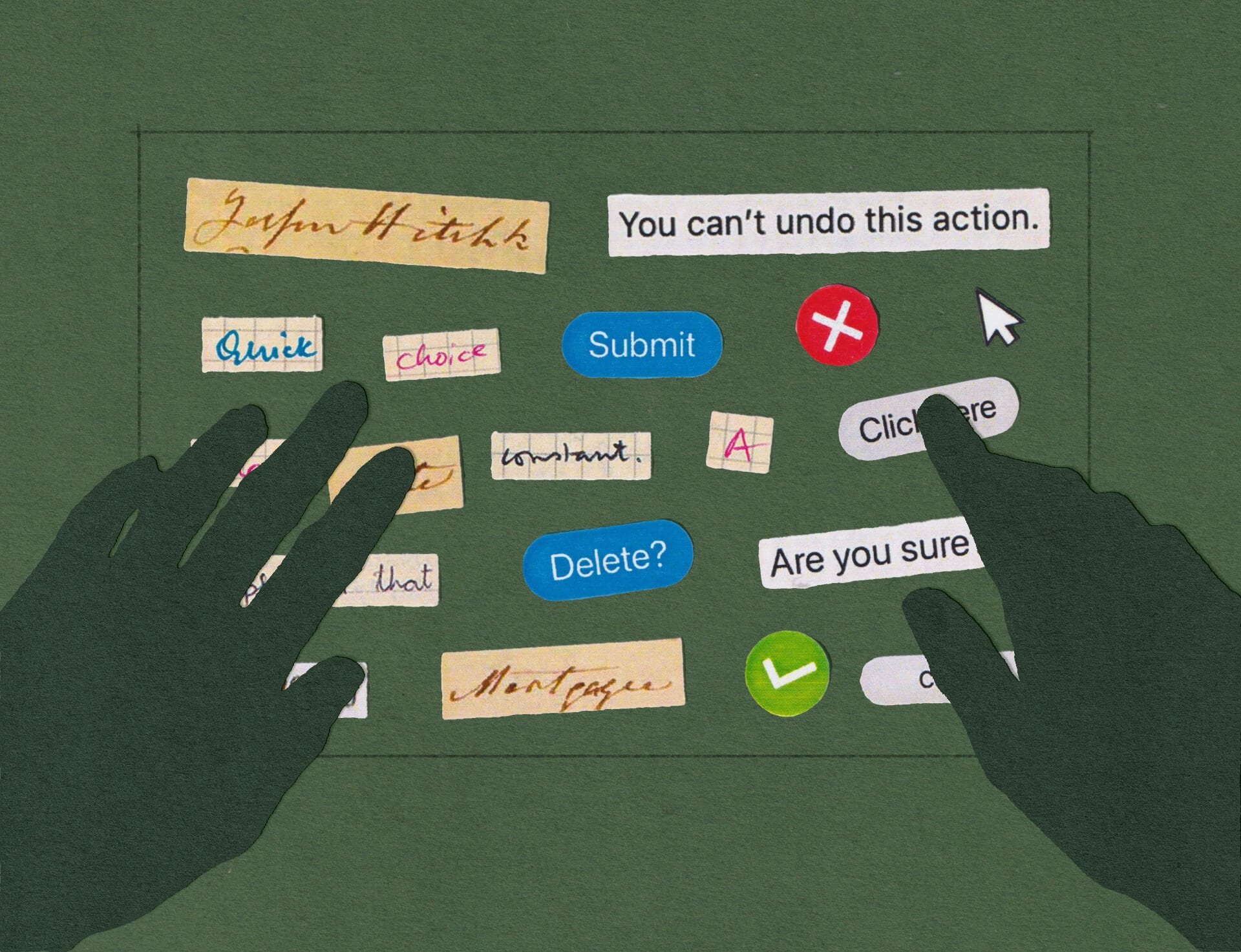
In 1971, planes carrying millions of financial and administrative records—order forms, charge slips, telephone system files, oil well logs—began arriving at Phoenix’s Sky Harbor airport. These paper records were then driven twenty-five minutes south to the Gila River Indian Reservation, home to the Pima and Maricopa nations, where, in the cafeteria of the reservation’s arts and craft center, dozens of employees, mostly Indigenous women, retyped them into computer-readable form. Few remember it anymore, but that cafeteria was the front line of the digital revolution.
In the 1960s, computers were sweeping corporate America, promising more efficient processing of insurance claims and retail sales, but the transition presented a massive logistical problem: Most companies still conducted their business on paper. If they wanted these expensive new devices to save time and cut costs, companies first needed to digitize everything: invoices, receipts, ticket sales, job applications, credit reports, letters, phone messages, and handwritten notes. The scale of paper records was staggering. The credit bureau TransUnion, for instance, needed to transpose fourteen million credit records into computer-readable form. At the federal level, the U.S. Treasury had to digitize four hundred million records per year. All that work would require human labor—a lot of it.
Many American businesses couldn’t afford to hire these new workers directly, so they decided to subcontract the labor out, creating a kind of geographically dispersed, auxiliary workforce they rarely chose to acknowledge. The analytics firm Fair, Isaac and Company, which went on to develop the FICO credit score, placed at least one newspaper ad offering flexible, part-time data entry work to California housewives in the late 1960s, as the scholar Martha Poon has documented. These housewives, close to two hundred in all, picked up credit documents from Fair Isaac, and then, from their homes, parked cars, or laundromats translated payment records into a computer-readable form.
But the transition to computers demanded a steadier labor supply than newspaper ads could provide. Many major companies turned to newly formed firms that specialized in data-entry work, including Highland Data Services in Blue Grass, Virginia, and Appalachian Computer Services in London, Kentucky. In these rural settings, where jobs were scarce, data-entry companies found a dependable stream of workers willing to sign up for a distinctly unglamorous line of work. Crammed into massive rooms, where desks equipped with key-to-disk processors were assembled in neat rows, data-entry workers couldn’t help but feel like they were on some new-age kind of assembly line.
The history of data-entry workers shows us that new technologies hardly succeed in eliminating human workers.
A 1973 report by a U.S. government task force called data-entry work one of the least desirable white-collar jobs, since it blurred the line between office and factory. One manager openly opined that data-entry workers “would probably be rejected for other purely white-collar work.” These were “dead-end jobs,” where women workers tended to stash “supplies of tranquilizers and aspirin at their desks.” As one insurance executive put it, “All they lack is a chain.” Such a crude attempt to compare data workers to prisoners would have sounded ridiculous were it not for the fact that a number of data-entry workers were incarcerated: In exchange for miniscule wages, inmates in California’s San Quentin prison keyed in data for Bank of America, Macy’s, and Chevron during the 1990s.
Around 90 percent of data-entry workers during this period were women, and many were women of color. In America, keypunch operators were disproportionately black, and at least one high-profile company, the Philadelphia-based Data Preparation Corp, was black-owned. In Canada, Korean immigrants performed a significant share of the data-entry work, according to the scholars Saemi Nadine Jung and Wendy Hui Kyong Chun. Managers often leaned on racial stereotypes to justify hiring—and underpaying—these workers. Data-entry bosses praised Korean-Canadian typists for their “nimble fingers,” while, on the reservation in Arizona, white executives at the FM4 Gila River Corporation boasted that Indigenous people “have a great capacity for work.”
The low wages paid by the FM4 Gila River Corporation—just $62 per week—were hand waved away because, as one office administrator from the Pima nation explained, “The Indian people have ways and means of being able to live on the money they earn here.” It’s probably not a coincidence that bosses, who viewed data-entry work as a new kind of factory labor, hired mostly women of color to do it. “The value that attaches to these jobs and the value that gets attached to this work, it really doesn’t have much to do with the work,” Mar Hicks, a professor at Duke University who researches the history of computing, told me. “It has to do with the people who are doing the work and how those people are valued.”
The same could be said of the subsequent waves of contingent labor forces that have sprung up to fill in the gaps that inevitably arrive with new technologies: the content moderators who screen out offensive and inappropriate posts for social media companies like Meta, the “microworkers” on Amazon’s Mechanical Turk who answer survey questions for a few cents, and, most recently, the millions of people who are quietly training AI systems. This last category of workers, called data enrichment workers, tags photos and videos for AI systems, discerning the difference between a jet and a plane or determining whether a person’s face looks happy or sad. Many data workers pick up assignments from Scale AI, a startup valued at $29 billion that operates as a subcontractor: gig workers in America or in countries like Kenya sign up to do data enrichment tasks that Scale AI sends to them. Scale AI isn’t the only massive tech company to cash in on the data enrichment boom. Contractors for Meta watch smart glasses footage and annotate what they see for AI systems. DoorDash has a new piecework job board called Tasks, where gig workers can sign up to take photos and record videos to gather training data for AI.
What is striking about AI data enrichment workers is that they aren’t really supposed to exist. AI is often presented as a replacement for menial work, just as computers were before it. In the 1970s, the automation writer R. Hunt Brown insisted that computers could replace “the same dull, drab, routine work” with “more interesting assignments.” Erased, in both cases, is that these technologies cannot function without staggering amounts of human administrative labor. Far from reducing the technical work needed to run, say, an insurance company, computers simply obscured it. Data-entry work was plucked out of the American office and kicked to ever-more-vulnerable groups of workers, who lacked basic protections or the ability to bargain for better wages. The vast human workforce behind AI systems—a significant portion of the 154 to 435 million online platform gig workers worldwide—remains just as forgotten today.
They also probably aren’t going anywhere soon. Tech commentators often frame the data enrichment industry as a temporary stopgap—a class of workers who will eventually input so much data into AI systems that they render their own labor irrelevant. These jobs are “going to zero,” unceremoniously replaced by more specialized gigs, where ever-smaller pools of humans help AI systems make targeted decisions. Perhaps to prove the point, Elon Musk recently laid off at least five hundred data enrichment workers at his company xAI. Surely, there is truth to the theory that data workers are precipitating their own decline: AI systems are labor automation tools, “constituted not by the imitation of biological intelligence but by the intelligence of labor and social relations,” as the scholar Matteo Pasquinelli puts it.
These technologies have a way of eroding the value assigned to human workers, creating a race to the bottom where the labor done by human data workers becomes less skilled and more precarious. But, importantly, the history of data-entry workers shows us that new technologies hardly succeed in eliminating human workers. Eventually, Arizona’s data-entry economy did vanish, for instance, but the human labor required to digitize paper records did not. Tech companies just found even cheaper ways of involving human workers.
Arizona’s FM4 Gila River Corporation was founded in 1971. Within a few years, the company was digitizing records for petroleum giants like Shell Oil and Standard Oil of Indiana, a state highway department, Palo Alto’s public school system, the aerospace company Garrett AiResearch, and credit purveyors like American Express, First National Bank of Arizona, and TransUnion. One client, the retail chain Akron, shipped “barrels of price stubs” to the Gila River Reservation.
Soon, leadership from FM4—by then employing a staff of close to one-hundred workers—began managing a company called Guadalupe Data Entry Services Corp in a nearby town whose economy had been hollowed out by the rise of industrial farming. In Guadalupe, where mostly poor Mexican American and Yaqui Indigenous people lived in mobile homes, farm laborers could be recoded as data-entry workers. Before the arrival of Guadalupe Data Entry Services, “our people had no place to work here,” a community leader in Guadalupe told a newspaper. “Now our women, and soon we hope some of our young men, will have skills that will let them make good money here.”
In their rush to computerize, American companies inaugurated a race to the bottom, paying workers ever lower wages to ensure their computers would bring a return on investment.
The problem for Arizona’s data workers was that even their relatively low wages proved too large for companies investing in computerization. Why pay American workers minimum wage to key data into computers, when they could hire foreign workers to do the same at a fraction of the cost? Driven in part by economic liberalization that encouraged companies to source workers abroad, data-entry companies began setting up operations abroad. The Dallas-based Pacific Data Services, for instance, taught basic English to more than two hundred workers in China, and then paid them seven dollars a week to transcribe legal data from court records into computer systems. California’s Compucorp paid programmers and engineers in Ireland one-third of the wages they’d have made in America. The Kansas-City-based firm Saztec International shipped hospital records, customer lists, and credit information to the Philippines, where workers, many of whom were recent college graduates, keyed in the data. One of Satzec’s largest clients was Mead Data Central, an American database provider that was trying to digitize legal records; you might know it today as LexisNexis.
The Caribbean, with its close proximity to the United States, became a hub of offshored data-entry work. In 1972, the Connecticut-based data entry company Key Universal, whose clients included insurance giants like John Hancock, set up operations in Grenada. Around a decade later, American Airlines shuttered its data-entry operation in Tulsa, Oklahoma, and outsourced all of the work to Barbados. Every morning, a plane delivered over 1,100 pounds of plane ticket information to the island, where workers were paid a little over two dollars an hour. Visiting a data-entry facility in Barbados, the scholar Carla Freeman remarked, “The muffled clatter of keys creates a sort of white noise, and the green glow of a sea of computer screens lends a sort of Orwellian aura to the tropical setting outside.”
American executives who oversaw these outsourced operations did not shy away from the criticism that they’d invented an “electronic sweatshop,” or that, by outsourcing data-entry work beyond the reach of American labor unions, they were engaging in what one academic called “telescabbing.” “We refer to our space as a factory,” George Simpson, chairman of Satellite Data, a data-entry company with operations in Barbados, told the New York Times in 1982. “We run it like a factory.”
In their rush to computerize, American companies inaugurated a race to the bottom, paying workers ever lower wages to ensure their computers would bring a return on investment. For office workers at home, it might have looked, in a certain light, that computers really were the efficiency miracle they’d been touted to be. It was easy to forget the human workforce behind them: The Caribbean alone had, by the end of 1985, over 2,300 low-wage workers digitizing paper records for American companies.
By the late 1980s, U.S. businesses were placing an ever-higher premium on speed. No longer could they waste time loading up planes with paper documents and microfilm canisters and airlifting them across the world. Digital competition was tightening, and credit bureaus and database providers needed a way to computerize their records within twenty-four hours. Data-entry work, once again, began to trickle back into America. Mead Data Central, proprietor of LexisNexis, began contracting more heavily with American companies to get legal records online faster than its competitors.
The invisible, geographically diverse workforce digitizing paper records for computers has shrunk significantly—but the actual labor of data entry hasn’t.
But something surprising happened. The foreign countries that had embraced data-entry work did not sit back and watch this new sector disappear. If American companies wanted speed, then they’d build the infrastructure to give them speed. The Philippines began investing in fiber-optic cables that could connect them more directly to hubs in the United States. Jamaica, meanwhile, created a telecommunications complex it called a “digiport,” with plans to staff more than ten thousand employees. The project included a fiber-optic cable that would link Jamaica to the United States, Puerto Rico, the Dominican Republic, and Colombia, allowing Jamaican data-entry companies to beam back their finished work to American clients more quickly. No more shuttling around computer tape.
Why invest in all of this fiber-optic infrastructure? Even at the time, business leaders knew that the data-entry economy might one day blinker out: Countries were investing in infrastructure to serve American companies that, in their rapacious quest for profits, might just one day outsource the work to an even cheaper labor force somewhere else. Technology posed a threat too. The rise of OCR (Optical Character Recognition), a technology designed to make text searchable, meant that companies could sometimes scan physical documents and have them translated into computer-readable form without the need for a human typist at all. There was a hope, however, that investing in data-entry work would be for something—that rural America and post-colonial nations alike would see their efforts pay off down the line, even if this current iteration of the work disappeared. As Norman Bodek, the former head of Connecticut-based Data Entry Management Association, explained in 1988, “Data entry is dying. Sure it’s dying—but with every death there is a rebirth!”
Perhaps they weren’t entirely wrong, although likely not in the way they imagined. It turned out that fiber-optic infrastructure would become the essential component for a new generation of unstaffed computer-processing facilities: data centers. Recently, as the global economy has contorted itself around AI, many areas rich in fiber-optic cables have drawn in data centers, whether locals want them or not. Two data centers have been built just outside Guadalupe, and a third is being planned. In Arizona and across the country, activists have criticized the staggering amount of water and power that will be required to run the data center. A telling comparison comes from Meta, which is building a data center in Wyoming that would consume more electricity than every single household in the state combined. Again and again, local residents are asked to foot the bill, in the form of increased utility costs, for all of this excess energy consumption. In return, they find that these expensive data centers rarely create a significant number of jobs.
In places like Arizona, the data-entry economy may have since disappeared from the region, but its remnants—namely, the fiber-optic cables that data-entry companies embraced—have turned it, decades later, into a desirable location for this next-generation of resource-extractive data processing technologies. We see these peculiar temporal links between former data-entry hubs and new AI facilities elsewhere too. Saztec Philippines, the Philippine data-entry company and the primary production engine behind Saztec International, and has reinvented itself as an AI company. Its old American client, Mead Data Central, no longer exists, but its core product, LexisNexis, is, as the company once hoped, one of the leading databases of legal information. (It is also a major vendor of surveillance technology to ICE.) LexisNexis does not appear to rely on as many data-entry workers as it once did; instead, it now operates a series of data centers across the United States, Ireland, and Hong Kong.
Old-school data-entry work still exists, in piecemeal form, but it has lost its centrality. Ironically, that isn’t because technology has eliminated the need for data-entry labor; OCR technology, which once seemed like it would automate out human workers, is often unreliable. Instead, companies have pulled a clever magic tragic: They’ve shifted data-entry work back onto customers. Today, “data entry no longer happens in back offices, where at least we can identify it as a separate step,” Corinna Schlombs, a history professor at Rochester Institute of Technology who researches data-entry workers, told me. Instead, “even our daily interactions with computers often involve us doing some of this data entry work. If I purchase a plane ticket, I enter my data. If I order a book through interlibrary loan, I enter the data on the book. If I put in financial payment often, I enter the data for that financial transaction into my bank payment system, and then the bank processes it.”
That invisible, geographically diverse workforce digitizing paper records for computers has shrunk significantly—but the actual labor of data entry hasn’t. Big companies just found ways to convert data-entry work from a low-wage job they outsourced to Barbados and Ireland, to something all of us do, for free, every time we enter the doctor’s office or file an insurance claim.