, May 26, 2026
Poetry from the Factory Floor
A conversation with Xiao Hai
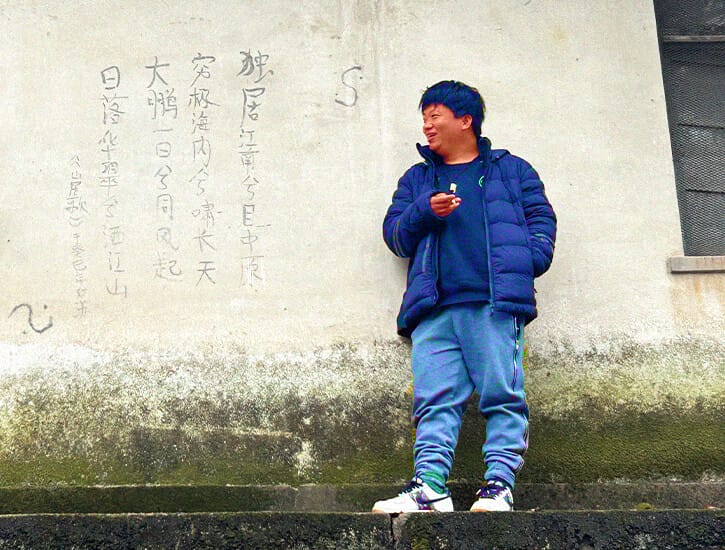
In Suzhou, Xiao Hai stands in front of a limerick he wrote. | Original photo courtesy Xiao Hai.
The corpus of so-called migrant worker literature has been at the forefront of China’s literary landscape in recent years. The genre originated in the 1980s and reached prominence in the 2010s, when the internet catapulted the names of worker-poets—including Zheng Xiaoqiong, Xu Lizhi, and Chen Nianxi—beyond the literary sphere. Though their work differs widely in style and form, most is autobiographical, concerned with firsthand experiences of precarious blue-collar work, family life, and Chinese society.
One migrant worker artist community that has gained nationwide fame is Picun, a commune on the outskirts of Beijing. There, residents regularly convene as part of the New Workers’ Literature Group, where they exchange original writings and attend lectures taught by editors and professors. Among the most active members of the group is Xiao Hai, a Henan-born poet who has been living at Picun since 2017. In 2019, he wrote a short memoir about his time working in the southern city of Shenzhen after dropping out of middle school. I first encountered it when it was republished under the title “Adrift in the South” in early 2024 by the Chinese literary and culture magazine One Way Street. I had the privilege of translating it into English for a China-focused issue of Granta. Neither Xiao Hai nor I had any idea that this would lead to the commission of a book—his debut book in any language, out this month. An expansion of the shorter piece, it follows Xiao Hai’s thirty-eight years of life, from his childhood in rural Henan, his stops across Southern China working in factories, to his eventual journey north to Picun, where he currently lives, working at a thrift store.
Xiao Hai and I corresponded closely in the first half of 2025. We caught each other at opposite times of the day: I late at night in Connecticut, my desk lamp attracting fireflies from outside; he at his thrift store in the afternoon, occasionally interrupting my litany of questions to help his customers—he knew them well and took time selecting clothes for them. That summer, he and I met in person for the first time. At his thrift store and the communal library, he tirelessly presented to me artworks by his coworkers and friends, and recounted story after story of guests he had met through art who he had hosted overnight at Picun. One day, when a journalist interviewing him asked him about his interest in music, he pulled out his guitar and improvised a five-minute alternative rock song with original lyrics.
In the words of Maghiel van Crevel, a professor of Chinese literature at Leiden University who has known him for almost a decade, Xiao Hai is “gregarious, entertaining, infectious,” “a hot and happening member” of the Picun Literature Group who “loves the camera and the camera loves him.” Xiao Hai himself would embrace these labels with pride—one would never expect that the vivacious man is the narrator behind a three hundred-page account of sweat and toil.
Xiao Hai and I spoke again last month over video call. Our conversation has been translated by me, and edited for length and clarity.
—Tony Hao
Tony Hao: You are among the hundreds of millions of Chinese people who can be called migrant workers. What does the terminology mean to you? How do you think the terminology, and also the population it denotes, have evolved over the years? What are several things you wish society would better understand about you as well as migrant workers in general?
Xiao Hai: When I was at my first factories in Shenzhen, I knew and thought little about how the world regarded me and my fellow workers. It was about a decade after I started working in the South when I learned of the term 农民工 (migrant workers, or literally, peasant workers)[*]. I thought that the expression referred to those from the countryside who had moved to the city for blue-collar jobs—specifically older people working on construction sites. Of course, the term encapsulates those of all age groups.
“People should pay closer attention to our true state of being within and beyond our workplace.”
I’ve met many people who dislike the expression, and I don’t quite find it suitable either. Especially after I came to Picun, I’ve come to prefer the term 新工人 (new workers). Back in the 1980s, when the first wave of blue-collar workers left the countryside, they were actually looking forward to working in the city, though they slowly grew ashamed of their status and tried their best to find other job opportunities. I wouldn’t go as far as saying the term 农民工 carries stigma, but it certainly does not carry any positive connotations.
The expression 新工人 suggests that my fellow coworkers and I have our own demands—we aren’t machines who can work twelve hours every day without ever getting tired. We want to have time for ourselves outside our jobs. Besides, we also have dreams. If we can’t realize them in real life, then we can turn to creativity and art, painting and music—all forms of spiritual needs and pursuits. This is where I see the term 新工人 differ from other outdated terms. Especially 农民工—the word evokes the stereotypes the mass holds against us, and it implies that the mass otherizes us. People should pay closer attention to our true state of being within and beyond our workplace. They should abandon their biases that we workers are inherently powerless and have no agency over our lives.
TH: You first began writing poetry on the factory floor as a hobby and a vehicle for self-discovery. Now you’re an internationally published and award-winning author. How have you developed as a writer over the years? How has your craft as well as your understanding of the art form changed?
XH: I first began writing poems when I was in Dongguan. It was 2005, and I found my life on the production floor quite monotonous. Back then, I only knew how to write snippets, and my desire to write was fueled by my sense of directionlessness as a youth. I must’ve written about freedom and loneliness, but I don’t remember what exactly I wrote—I threw all my scribbles away.
I bought a dictionary in Dongguan in 2007, and I began studying it carefully after I left the city, copying difficult words in my notebooks. Then in Meishan, I came across a classical Chinese poetry anthology in the public library. That was how I continued to educate myself. I also began writing song lyrics and casual poems, things I might now call limericks. But they didn’t allow me to sufficiently express my emotions. After arriving in Suzhou, when I first stumbled upon Hai Zi’s poems in 2012, I began to write contemporary free verse.
I’d say I went through three stages during my time in the South. In the first four years, I was in Guangdong, and I felt somewhat lost but also curious; in the next four years, I was in Ningbo, and I was extremely lonely and directionless; then four more years, in Shanghai and Suzhou, I felt everything was falling apart—I had tried so many different jobs, but nothing seemed to be getting better in my life. It was during those four years when I wrote the most—if I didn’t write I’d feel as if I wasn’t alive. I was obsessed with Bob Dylan and Allen Ginsberg. At that time, poetry and rock music saved my life. Literature was not a diversion but a weapon. I had nothing but literature, I had nothing but my passion. I used words to carve my own path through unknown, dangerous territories.
I wrote around two or three hundred poems. And then I thought I could test my luck—I began DMing famous rock musicians, dreaming that one of them would get back to me. That was how I connected with Zhang Chu and ended up coming to Beijing. In retrospect, I must’ve had some blind confidence in myself. But people need blind confidence—how else could they get anywhere with their lives?
I never became the rock star I had dreamed of becoming, but at least my job now brings me to meet all kinds of people, which is far more interesting than dealing with products on the production floor. And thanks to the Literature Group at Picun, I learned about the genre of nonfiction.
At first I didn’t believe nonfiction was a legitimate genre. So many people are living difficult lives already—what’s so special about me that could be turned into literature? I wrote about my grandfather, then my time working in Shenzhen, which was the purest, most formative period of my life, the first time I understood the concept of solitude. It’s true, I didn’t have a direction for my life, and I was almost scammed by illegitimate factories. But it was the period of my life when I was coming of age, and felt excited for the future. I worked long hours but rarely felt tired. That was how I wrote the Shenzhen essay in 2019.
I came to appreciate the practice of nonfiction writing—the materials never felt distant or lofty. It was all real life experiences, and I slowly realized that my life was worth being written about. As I wrote Adrift in the South, I came to understand the importance of rhythm and restraint. I learned to express more, deeper emotions by leaving things unsaid, rather than what I had done habitually when I wrote poems in the factories—blurting out everything on my mind.
TH: Poetry is a recurring topic in the book. How have your interests in poetry progressed over the years? How do you think your own poems have developed, in terms of topics, themes, inspirations, and techniques? How do you work differently when you write poetry versus when you write prose?
XH: Poems are often shorter than essays. When I was working at factories, poetry was perhaps my most convenient way to express myself—I only needed a few lines to find myself a dose of healing on the production floor.
My entrance to poetry was classical Tang dynasty poems, but I eventually found their formats restrictive—you can only do so much with five or seven characters per line. So I switched to contemporary free verse. I felt as though the machines on the production floor squeezed the verses out from my body. I didn’t have the time to write prose—poetry was far better at capturing instantaneous emotions. I don’t think too much about my craft when I write—my writing is mostly driven by my candor. Sometimes I try to make my language poetic, but my sentiment matters much more.
One of my favorite poets is Hai Zi, and one important lesson I’ve learned from him is truthfulness—his poetry made me realize that I’m allowed to embrace my loneliness and sense of being adrift, and I can turn them into my own poems. In the past I had been ashamed of admitting my emotions, and I had thought literature needed to be lofty and glorious.
I’ve been working on my writerly techniques thanks to the lectures at the Literature Group. After attending a class on the use of nouns, I wrote a poem titled “Confessions of a Youth Adrift in Beijing,” in which I listed things I possessed in my life and more things I didn’t possess. I’ve always been amazed by the effects I can accomplish with various techniques. The emotions I express in my poetry have also changed—in factories, my isolation was the result of my circumstances; more recently, it has shifted to being more existential, partly due to my age and my evolving understanding of the world. When I first began writing poems, my art was driven by my passion and instincts. Now, I’m capable of incorporating my criticism and reflections—you’ll be able to see in my debut collection of poems, Sisyphus on the Wenyu River, out in China this May.
In terms of the relationship between my poetry and prose, I’d say this: my poems are slices of my life, whereas my essays are extended annotations of my poems.
TH: I Deliver Parcels in Beijing by Hu Anyan has been a hit in both China and the Anglophone literary space, and many readers will inevitably draw comparisons between you and Hu. In what way do you think your and Hu’s books are similar and different? And what do you believe is the reason your and Hu’s works have been popular in China and in English?
XH: Both Hu and I document our lives as blue-collar workers, as well as how our experiences have changed. His documentation is more detailed than mine—he’s capable of expanding brief moments into extensive passages; as for me, I tend to capture only the few pivotal instances that suddenly injected energy into my life. I read his book a long time ago, and I gathered that we two have quite different personalities—he’s calm and controlled, while I’m more like a fire. I enjoy the sensation of burning; even if I’m engulfed in pain, I’d like to emit heat and light. My writing is more impassioned and self-focused.
As for why readers have become interested in our work, I’d say perhaps because of how society and the literary climate have changed? Readers have stopped regarding the most established writers as godlike figures, and they want more truthful documentations of life. Especially in recent years, many people have needed to work harder and take up odd gigs, and perhaps they want to read more relatable stories. In the past, they preferred grand narratives, and the microscopic accounts of ordinary humans might’ve been overlooked. As people become more inwardly focused and accepting of their struggles, rustic stories of individuals carry more power and resonance, and it makes sense that the genre of nonfiction has never been more popular.
TH: Earlier this year, you were traveling in Southern China, revisiting many cities you have spent your twenties in. How did it feel to revisit those places?
XH: Right, I’ve always been a nostalgic person. My partner and I were visiting Shanghai, which was close to Suzhou and Meishan, so we thought we should swing by those places. In Suzhou, we met up with Mister Vintage and Wu—yes, the Wu who had let me and Mister Vintage live at his old house for free when I was selling popcorn in Suzhou. Wu is now running a guesthouse, and he let us stay at his best suite without charge. I was not interested in visiting tourist destinations, and so Wu brought us to his old house. Guess what I found there? A limerick I had scribbled on the wall! But the house had been unoccupied ever since, and the old courtyard looked even more desolate than a decade ago, which made me really sentimental. But the sight also brought me comfort—the place that witnessed my and my artist companions’ passionate years had somehow survived the passage of time.
“Readers have stopped regarding the most established writers as godlike figures, and they want more truthful documentations of life.”
Our stop in Meishan was even more magical. We went straight to Yujia, the clothing factory I had worked at. There were no security guards at the gate, so we walked in without anyone stopping us. On the second and third floor we saw some plastic baskets, the same type I had used at work. I grabbed a uniform on a workstation, tried it on, and took some photos in it. The offices were on the fourth floor, and in one of them I saw the familiar clock-card machines, as well as scattered piles of cards. We grabbed a stack of cards and looked at the dates written on them: 2013. I was there in 2009. Maybe my own clock cards were somewhere around here? Could we maybe find it? And we sure did. It was over sixteen years ago, but no one had thrown them away. I felt like I had recovered an old lottery ticket worth a million dollars.
The next day we went to the new production floor and met many workers. Lots of them were in their sixties and seventies. One of them had been my crew captain, and she recognized me right away. She told me to take my time to walk around. We then ran into two more workers, and one of them also recognized me. “Hu Liushuai!” she blurted out my name and told me the exact task I had been responsible for on the production floor. I remembered that she was a QC (quality control) worker, but I had forgotten her name. She said that she and her coworkers had been talking about me earlier that year. None of them knew my pen name Xiao Hai. Another worker did not recognize my face. But the moment one of us brought up the fact that I was always reciting poems, she immediately recalled who I was. It was over sixteen years ago. Can you believe it?
People were happy to see that I came with my partner. If I went by myself, looking all poor and desolate like I had once been, then people might start mumbling, what had happened to this lad over these years?
TH: I must note the liminality and transience of many characters in the memoir, who make brief but crucial appearances in your life and do not return ever again. How do you look back at the many friends, acquaintances, and strangers you have met along your journey around the country?
XH: There’s a saying I always heard in the South: “Factories are built with metal, and through them workers flow in and out.” The worker population in every factory is fluid—they come and go without staying for long. And they’re not like artists who make deep connections at residencies. No, it’s very difficult for workers to get to know each other.
From my decades in the South, one person I certainly want to reconnect with is Tian Guoli, a brother-like figure who left rural Henan with me when I was a teenager; another is Li Juhua, a sister-like figure in Shenzhen who protected me and taught me how pure and beautiful friendship could be. I also want to keep in touch with those who encouraged me to write poems, especially when I was just getting started—folks like Wu and Mister Vintage. But aside from them, the only ones I’d say I had made true connections with were artists who inspired me—Bob Dylan, van Gogh—I still see them as my friends. They know my heart. I know their work well and view them with awe.
It was nearly impossible to make real friends at factories. Yes, my coworkers and I were all battling our difficult circumstances, but we were preoccupied with ourselves separately. And it was not just coworkers—the same is true even for my siblings and cousins. My older brother works in Lanzhou, where I have never been, and we only see each other a few times per year. I’d say perhaps with those I have a spiritual connection, they’ve offered me more to cherish.
I’ve heard many coworkers say that after we left our factories, we’d never cross paths again for the rest of our lives. It’s true that many of us were on good terms, and when we didn’t work overtime, we’d hang out and eat out together. But we all understood that our connections were held together by the factory, and nothing else.
[*] A note from the translator: Regarding nomenclature in English, van Crevel advocates for the word battler, which, as he summarizes in his upcoming monograph China’s Battler Poetry: Writing Like There’s No Tomorrow, is “an Australian colloquialism for ‘ordinary working-class people who persevere through their commitments despite adversity.” It is “a term of respect and endearment intended to empower and recognize those who feel as though they exist at the bottom of society.”