, May 28, 2026
The Loneliness of the Competitive Quizzer
For some, trivia isn’t just a hobby
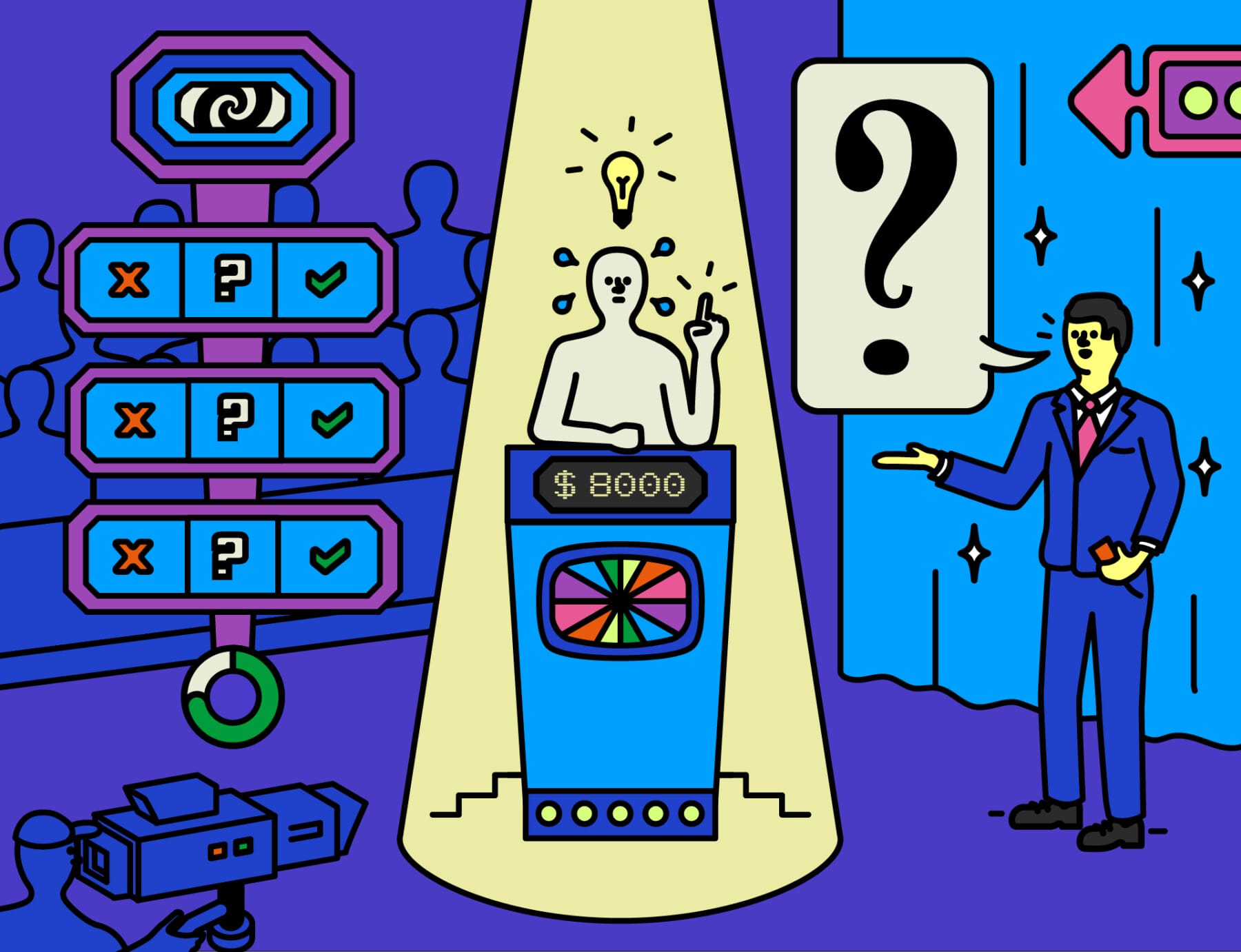
Facts are funny things. It was a fact, for instance, that in the spring of 2024 I won $132,000 playing trivia. That May, I’d flown from Oxford, where I was a graduate student, across the Atlantic to a soundstage in Los Angeles, and played for eight good days on Jeopardy!
It was also a fact—one I liked to tastefully overlook when asked at holidays or on trips home—that I was unemployed, that I’d gone to Oxford for a master’s degree in large part to escape further unemployment. But I had been decent on Jeopardy!, and I knew that decent trivia players were often invited back for a second chance at more money. Returning to the show, however—for something like the Tournament of Champions or the Jeopardy! Invitational—meant facing tougher questions against better players. And it was a fact that, to prepare for this possibility, I would need to throw myself into the world of competitive trivia, or quiz.
Quiz is many things to the disciple. It is not simply trivia. It is not simply a hobby. It verges, for the believer, on a way of life. Originating out of Depression-era American radio quiz shows and really taking root in the UK in the 1970s, quiz is a species of especially rigorous trivia, with regimented online competitions and questions that tilt toward the obscure. Elite quizzers are known to prep for, at minimum, two or three hours a day, thumbing through hundreds of thousands of flashcards at rapid-fire pace. They participate in four or five leagues a week. This can be all-consuming, but it can also vault the elite quizzer into a rarefied echelon of erudition. These players have spent decades in the ceaseless memorization of facts and are nearer, maybe than anyone else in history, to the sum total of human knowledge.
Each year, the greatest quizzers from around the globe assemble at the International Quizzing Championships (IQC) to vie for glory. IQC is perhaps the most prestigious—and difficult—trivia tournament in the world. It features a battery of individual competitions, testing general and specialized knowledge, as well as an Olympic-style contest for national teams. The weekend-long event culminates with the Individual Quiz and Nations Cup finals, but also includes specialist quizzes (designed to test aptitude in specific subjects) and an Aspirational Cup (for those teams which didn’t make playoffs, but one day, perhaps, might). IQC might function as a social mecca for the obsessively curious, but it’s also armed with a caliber of brainpower that’d outgun much of the Ivy League. I wanted to meet these elite quizzers, to learn from them. And deep down, I wanted to win.
This past November, IQC alighted upon Caserta, a small, sleepy suburb north of Naples, Italy. I flew out for the weekend to watch the action. Reigning world champ Daoud Jackson would be in attendance, looking to captain England to victory against an up-and-coming American delegation, led by perennial Jeopardy! contestant Shane Whitlock, and a sturdy Croatian roster helmed by TV quiz personality Dean Kotiga.
But as I pulled into town on a cool and waterlogged night, I found myself drawn to the individual competitions, which weren’t always dominated by top-flight, hand-picked rosters. It’s in these individual tests that, in theory, an enterprising quizzer can best distinguish themselves. The resulting standings are a who’s who of competitive quiz: elite players on top; fresh faces near the bottom; journeymen—good for a category or two, perhaps, but never quite able to break through—somewhere in the middle. These are the players—the also-rans and the always-in-its, the rank-and-file grinders, the steady hands a stone’s throw from the podium, but never any closer—that interest me the most. I’m one of these guys. In quiz. In life. A reasonable talent, good enough to know the distance that separates me from the top. In part, I came to IQC out of a vain hope that I might close that gap.
By necessity, there are winners and losers, and natural aptitude means that some people will always have a leg up over others.
So it was with a vague sense of reverence that I entered the venue—a strange, blocky hotel called the Plaza Caserta—the morning before the competition. Tournament organizer Jane Allen had invited me to attend an IQC travel excursion to Pompeii and Herculaneum. I joined a group of forty-some quizzers, mostly men in T-shirts and baggy jeans, milling around the hotel lobby. Despite the fact that everyone possessed a near-encyclopedic knowledge of what we’d see, I noticed almost no one had actually been to Pompeii. “People who have spent their life reading,” Schopenhauer once warned, “resemble those who have acquired precise information about a country from many travel descriptions,” but lack “clear and thorough knowledge of the country’s make-up.” For the quizzer, living vicariously through facts can be something of an occupational hazard. The idea of the excursion, in Jane’s telling, was to bridge this split between fact and life—to push quizzers to “not just land, quiz, go home” but to “get a real flavor for the place.”
On the tour bus, I sat next to Ben, a very slight and very kind quizzer from Manchester. He’d been quizzing for three years now, which made him little more than a greenhorn in the scene. But he was improving fast, he told me. He preps “at least three hours a day” and, to stay sharp, competes in five online leagues. I asked what motivated him, looking for guidance as much as anything else.
For one, quiz is a way to experience the world from home, he explained. The internet conveys information on demand, and Ben prefers to engage with facts this way, rather than the legwork, the indirection, of reading a book. For Neil Postman, this was exactly the issue with trivia. With the advent of the radio—and, much more fatally, television—people increasingly parsed their world into isolated and independent facts, disconnected from the immediate fabric of social life. “Where people once sought information to manage the real contexts of their lives,” Postman wrote, “now they had to invent contexts in which otherwise useless information might be put to some apparent use.” Trivia was this pseudo-context par excellence, “the only use left for information with no genuine connection to our lives.”
And yet, maybe for this reason, I agreed with Ben. There was something exhilarating about being inundated with new facts. This was a big part of trivia’s appeal for Ben—and, I had to admit, for me. “Most people want to feel productive,” he continued. “One wants to do some kind of task that’s rewarding.” With quiz, “you’re cultivating [the] garden of your mind, and so it feels like growth. It feels like progress.”
Equally, though, the virtue of information is that it’s unending. “It’s not perfectible and it’s not completable.” Ben shuddered at the idea of finishing learning, once and for all. “Then what do you do? What happens to your identity? What happens to your time?”
Ben came to quiz burnt out, at the end of a grueling career in academia. When I met him, he was not working, although he hoped to professionalize his relationship to quiz in some way. For him, and for so many other quizzers, learning is an identity which allows for a feeling of growth and progress in a world that otherwise seems to foreclose these values.
By Friday afternoon, IQC had kicked into high gear. The tournament officially opened with a brutally difficult qualifier, a weed-out designed to separate the men from the boys. I am, I soon discovered, one of the boys. I didn’t know the famous Viennese zither player from the 1940s (Anton Karas). I forgot the name of the trendy Danish author of The Copenhagen Trilogy (Tove Ditlevsen). Later, in a moment of profound and abject humiliation, I explained to a table of seasoned quizzers what Italian Brainrot was and the identity of a character named Tung Tung Tung Sahur. I could stomach all this because I knew that Saturday was my day. The specialty quizzes were then, and I had my eye on one in particular: Culture and Philosophies.
I’d studied philosophy in college, done my duty reading around the central texts, and I showed up the next morning with a fleeting bit of hope to find my spot in a sprawling conference room. I sat next to a middle-aged man in a black fleece, with deep sunken eyes and salt-and-pepper hair. We both read the questions projected at the front of the room and scribbled down our responses. Which Königsberg philosopher wrote the Critique of Pure Reason? (Immanuel Kant.) Who said that property was theft? (Pierre-Joseph Proudhon.) But as the quiz went on, the questions seemed to get harder. What city boasted the largest khurul in Europe? (Elista.) Which Massachusetts preacher popularized a large religious cult in the 1840s? (William Miller.) The middle-aged man—his name was Eduard—and I swapped papers to grade each other. There was a certain elementary-school logic to the exchange; even when I didn’t know the answers, the worst thing that could happen was a bad grade. (Indeed, I got twenty-eight out of fifty. The tied winners, Finnish phenom Tero Kalliolevo and England’s Daoud Jackson, both notched thirty-nine correct responses.) But if I was feeling relieved, Eduard was in agony. Between rounds, he sighed, dipped his head into his hands.
“This is the last time I come here,” he said in a thick eastern European accent. Flying to IQC from Romania had been expensive, and he was frustrated by the Western bias of the questions, especially the inordinate focus on Lord of the Rings. There are very few questions, he felt, about Romania.
But when I asked him why he competes, Eduard was thoughtful. Back in the nineties, he told me, after the Soviet Union fell and Ceausescu with it, life in Romania was difficult. It was hard to find work, and Eduard was, like me, a recent college grad looking for his footing. Then he appeared on a popular television quiz show, the Romanian equivalent to Jeopardy!, and won a life-changing amount of money. Ever since then, the habit had stuck. But in Caserta, it seemed like a habit Eduard wanted to kick. He looked at me miserably. “Quiz,” he said, “is about vanity.”
Eduard wasn’t the only person I met whose pride was on the line, nor who’d lived, in one way or another, off game-show returns. Marzena, from Poland, is supported by a recent stint on TV. So am I. For those of us who can’t find steady employment, the televised quiz show is a strange shadow play of knowledge-work, where facts can convert into dollars. But the real world doesn’t work this way. AI continues to grind down the white-collar labor force, and the vanishing few knowledge-work roles left subordinate book-learning to application, facts to skill. For those who’ve built their identities on the sheer accumulation of knowledge, this can increasingly feel like an existential threat.
I thought back to my conversation the previous night with two Canadian quizzers, Trevor and Hannah. Both stressed the social function of quiz, which introduced them to some of their closest friends and channeled a lifelong love for learning. Hannah told me that she spent a month and a half last year reviewing flashcards alone. But like Eduard, both conceded that quiz had something to do with reassurance. “Part of it is insecurity,” Trevor admitted. Another quizzer was more blunt: “People will play quizzes online instead of going to therapy.”
As I left for lunch, I wondered why I played quiz. Certainly, there was a financial incentive, but how much of my worth derived from being smarter than other people? And how much of intelligence did I simplify to knowing facts? I sat down in the cafeteria with American quizzers Raj and Leslie. Raj is a groovy-looking tutor from Los Angeles. Leslie, with long dark hair and a gleaming floral shirt, is far and away the bubbliest quizzer I met at IQC. Predictably, she took a sunny view of what we were all doing here.
Quiz, Leslie said, is about acceptance. For years, she worked at a major technology company, and as a woman without an engineering degree, always felt pressure to prove herself. Trivia was big part of building up her confidence. When she was younger, she’d been one of the first wave of women to go on Jeopardy! and really do well, and for her, the experience was a glimpse at something like meritocracy. In quiz, unlike life, it doesn’t matter who you were or where you were from. All that matters is what you know. Quiz had given Leslie the chance to prove what she knew, and it could give others that same opportunity. With enough effort, anyone could be good at quiz.
I wasn’t so sure. Most quizzers did seem to derive real comfort from the acceptance of their peers and the promise of a meritocratic structure. But it struck me that, like any form of knowledge-work, quiz could lend itself to bias. Cultural capital—the accumulated exposure to learning, facts, books—wasn’t equally distributed between countries and classes. (Indeed, unlike Eduard, Leslie and Raj didn’t feel there was an American bias to the questions that day.) And having the independent means to learn, even the ability to eschew work, could be a big asset in excelling at quiz.
But it also seemed to me that this meritocracy could complicate the acceptance that quizzers were seeking. Not everyone can be good at quiz. By necessity, there are winners and losers, and natural aptitude means that some people will always have a leg up over others. It was an open secret, one quizzer confided, that a fair share of top players had autism, and that this could be a gamechanger in prepping for competition. Talking to Leslie, it was obvious that she was brilliant and that this natural acuity made her one of a dying breed of quizzers who could stay afloat without really studying. But no matter how hard someone practices, you can’t beat a good player with an eidetic memory. Maybe some people—myself included—were just never going to get to the top.
It is perhaps this wrinkle to meritocracy which has pushed so many players, in recent years, to prioritize continual self-improvement over victory. With the proliferation of online leagues, competitive quiz has become an out-and-out arms race, where the truly dedicated players with time to spare study as much as possible, and questions become more difficult to test this elite few. The ordinary player can find themselves left in the dust. Nowadays, Leslie said, she competes mostly against herself. It’s more about learning than beating others. Raj agreed. Back in the day, he told me, his career in college quiz was driven partly by spite: a desire to win, to defeat others. With age, he’s mellowed out. He sees more value in learning for its own sake, as a process of self-discovery. “You never know,” he said, “when the next fact will change your life.”
What was the right reason to play quiz? For Leslie, trivia is about community. For Raj, it’s something like Bildung, that German ideal of education as a form of growth and self-expression, the student like a flower blossoming into new and richer life. For me though, I have to admit, I agree with Eduard. I play trivia because I want to win. I want to be better than other people. I’m vain. I’m prideful. I’m one of those pedants, for Montaigne, who “go picking knowledge here and there . . . and hold it at their tongue’s end, only to spit it out and distribute it.” And the more I struggle to get a foothold in the real world, the easier it becomes to take solace in intellectual achievement. In facts, which are comforting and solid and easy to handle. Facts are right or wrong. Black or white. Maybe we were all searching for the fact that would change our life.
Quiz events offer some social connection and fulfillment in an online world overwhelmed by information, much of it misleading or false.
Nor were we—the true believers here at IQC—the only people looking for reprieve in the world of quiz. Trivia is one of those rare social activities which has grown since the pandemic. During lockdown, millions sought out online trivia. Sporcle, a popular quizzing site, reported its daily user count nearly doubled in 2020, and many of these players have stuck around since. Bar trivia has boomed, as reopening venues looked to lure back lost customers. Today, the NYC Trivia League has more players and venues than it did in 2020, and Jeopardy! is rolling out a new bar trivia franchise to capitalize on the trend. Not only are more venues hosting trivia but for the average person today, quiz is fulfilling a greater social function. Whether bar trivia or IQC, quiz events offer some social connection and fulfillment in an online world overwhelmed by information, much of it misleading or false.
Looking for some of this connection, I walked back to the IQC venue, just in time for the wrap-up of an especially difficult marathon-length qualifier. The room was abuzz. I caught Anu, a top American player, after he finished the test. Anu’s no stranger to academic competition: He won the Scripps National Spelling Bee in middle school and has quickly become a breakout star in quiz. He also exemplifies a sangfroid common among top players. As the questions get harder, you have to accept the fact you’re not going to know it all. But Anu told me he’d gotten all the answers he knew and was proud of his performance.
Yet when I found Ben, his mood was darker. He seemed frustrated, knocked off-balance by the difficulty of the questions. “I’d like to be the best, but it takes time, and how much of that is talent?” he wondered aloud. “Thinking about the top players can be depressing or overwhelming.” I couldn’t help but agree. I thought of Anu, who seemed effortlessly intelligent and capable, who’d jumped into quiz and, in just a few years, slipped straight to the top. When the questions got harder, Anu seemed to excel. Ben and I felt like we were drowning.
“I don’t think the bubble of difficulty increase can possibly be an endless thing,” Ben continued, “because eventually you’re just going to be asking what’s the serial number on this helicopter or the color code or something. There has to be a ceiling.” But I think we both knew—standing in the wreckage of the qualifier, the detritus of years’ worth of study, put to the test and found, in certain ways, wanting—that this was wishful thinking. There is no ceiling. The questions will get tougher and tougher. Only one of us can be the smartest person in the room, and the purpose of quiz, in all its hard-edged meritocracy, is to distinguish the best from the rest.
And yet, I thought as I watched the English and Croatian national teams take the stage Sunday afternoon for the Nations Cup finals, there is a certain elegance to the gifted. To those eight men sitting at two foldout tables, with their heads in their hands. They are the ones who have it—who have immersed themselves in the crucible of human knowledge, and who’ve come out the other side as winners. They whispered back and forth, in hushed voices that sounded like pencils swiping over paper. Sometimes one stood up and huddled over the others. Sometimes there was dissension, and the four-man team conferred in a knifing back-and-forth. Eventually, an answer was required. The questions struck me as extraordinarily difficult. One bubbled onto the screen, asking for the name of a thirteenth-century Teutonic diplomat. I’d never heard of him. No one had, it seemed—not in a thousand years. Once, this man would’ve led armies, would’ve advised the pope. Now, it was as if he didn’t exist. England seemed stymied. Their captain Daoud Jackson pulled a name out of the sky. Hermann von Salza. He was right. It was remarkable. Even the judges seemed surprised.
As I watched the England team proceed to hammer Croatia, question by question, in a virtuosic display of dominance, the thought hit me—I would never be as good as these guys. These guys were just beyond me. Maybe, in twenty years, people will still talk about Daoud, who’s probably the world best, or Dean Kotiga. But in fifty? In one hundred? The facts of our lives seem to slip away from us. Once, I’d loved facts like these. That’s why I went to Oxford, to study history. To learn and remember and keep these little things alive. But the quizzers were still learning. They were sacrificing their lives to learning, in a constant and unending task which almost no one could or would appreciate, which the market certainly wouldn’t reward. But questions would only get harder. The facts more obscure. It was all anyone could do to keep up.
The room had already thinned out over the course of the finals, owing to the sheer difficulty of the questions. (Even many of the spectating quizzers didn’t want to watch this level of obscurity.) But as soon as England won the match, drawing the Nations Cup and, with it, IQC to a close, the room evacuated. Gerard, an older quizzer from England, stuck through it, though. He came over and sat down next to me. He was a little disappointed with his performance, he said, but there’s always next year. He’s old-school, doesn’t do the cards. Maybe he’ll have to. Quiz is changing. “On the way out,” he joked. “Soon you’ll just be able to download it all into your head, Johnny Mnemonic-style.” We sat silently, thinking this over.
We’d only been talking for a minute or two, but the room was all but empty now—a vast, vacant space. Quizzers from all over the world were ruffling their bags in the lobby, flooding out the doors to the airport. Returning to their jobs, their books, their desks. It was all over. The very last polymaths were dispersing, right before our eyes, to their small, shrinking corners of the world. I got the sense that Gerard was lonely. I realized I was lonely too. I think we all wished it could have gone on a little longer.