, June 3, 2026
Clinics and Collectives
The radical trans care of the Boston Gender Identity Service
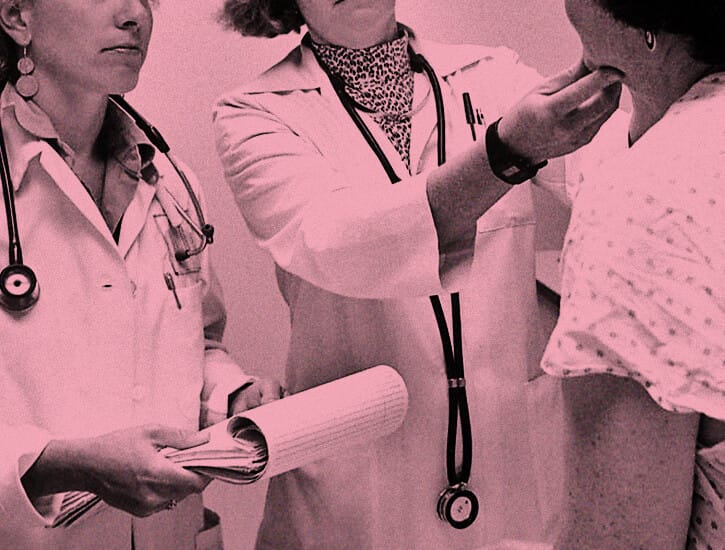
The Baffler/Flickr
Almost every night of the week, the house at 9 Knox Street in Boston’s Bay Village neighborhood became something unexpected. The owner—a young gay theatre producer—would transform his front room into an informal restaurant, serving home-cooked meals to those lucky enough to snag an invitation. And if you were to attend on the right night, you would see something even more unexpected: a group of gays and lesbians, many of them radical feminists, who were there not just to eat but to talk through their ongoing work of helping people access gender-affirming care in a time when the medical community looked at trans people with skepticism, if not outright hostility.
These dinners-turned-organizing-sessions took place in the 1970s, but they would be just as useful today, when trans people are under renewed assault across the country. According to the Trans Legislation Tracker, 793 bills have been introduced this year that seek to restrict or block trans people from receiving basic health care, education, and legal recognition. Fifty-five have already passed. While opponents of trans rights try to justify their actions in a variety of ways, a common strategy is to claim that trans health care somehow undermines gay and lesbian rights, or the rights of women in general. Trump’s prohibitions on gender-affirming care for prisoners and recognizing transitions in legal documents, for instance, were part of an executive order on “Defending Women.” Consider, too, the perverse alliance between the unrepentant transphobes of the Heritage Foundation and self-described feminists from the Women’s Liberation Front, or the rampant fearmongering that trans medicine is coming for gay kids.
This is all obviously bullshit—but even among those ostensibly on the right side of history, transphobia percolates. For the longest time, the mainstream gay rights movement viewed trans people dismissively, our presence and demands treated as politically risky distractions from the “real” work of establishing things like the right to marriage. Older trans people remember the conflict over the Employment Non-Discrimination Act, in which establishment gay rights organizations worked to exclude trans people from employment protection proposals. And much transphobic rhetoric—particularly around trans women—originates in the work of Janice Raymond, a prominent lesbian feminist of the seventies and eighties who argued that trans identity and life was a “problem” that “would best be served by morally mandating it out of existence.” The presence of both transphobic threads of feminism, part of the cluster of what Sophie Lewis calls “enemy feminisms,” as well as reactionary gay and lesbian figures, provides fuel to the impulse in the trans circles I run in that we must eschew solidarity and take things into our own hands.
But separatism constrains as much as it liberates; in the name of avoiding disappointment, it necessitates a withdrawal. Not only does this reduce resources for trans care, it also fixes the community in place, and encourages a view of history—and possibility—in which those outside of trans spaces or desires cannot be trusted to show up, and so should not be relied on to do so. We need histories, then, that counter this narrative that relations between trans needs and the concerns of gay, lesbian and/or feminist groups are inevitably oppositional; that there is nothing to be learned from engagement across this apparent divide but grief and disappointment. One such history is that of Boston Gender Identity Service—the program those Knox Street diners quietly built and ran.
It all started with Deb and Helen in 1968. A young sociologist, Deborah Heller was teaching at a local junior college when her colleague Helen was discovered by faculty to be a trans woman in the early stages of transitioning—and promptly fired. While Heller’s strenuous protests fell on deaf ears, the two went on to exchange over two thousand pages of letters, in which they discussed everything from Helen’s experience trying to access care to her day-to-day navigation of social and professional worlds. In parallel, Heller began graduate work in the sociology department at Boston College, and—piqued by her conversations with Helen—spent her master’s program embedded in the trans community in Providence, studying how people there navigated community formation, secrecy, and social life.
Conventional gender identity clinics were often designed not to provide care but to curtail it.
Heller’s work revealed to her the many limitations of how gender-affirming care worked at the time. As Jules Gill-Peterson has written for this publication, and as many other writers extensively document, institutionalized access to gender-affirming care came in the form of the gender identity clinic, or GIC: a structured, multidisciplinary unit usually hosted at a university-affiliated hospital. These clinics and their personnel—motivated by research as much as care—were often highly conservative and oriented around protecting themselves from lawsuits more than treating patients. Clinicians rejected the vast majority of patients and subjected the remainder to strenuous gatekeeping and extensive and humiliating tests—some lasting years—before they could even get access to hormones or surgery. Patients were asked about their sexual desires; patients’ parents were asked about their sexual desires; patients were photographed and videotaped, clothed and nude, while being physiologically tested on their attraction to men, women, and children. Some clinics expected their married patients to get divorced and never see their children again; others treated the presence of children (or a marriage) as inherently suspicious. Over and over again, patients found the process of seeking care almost as psychologically damaging as its absence.
As all of this suggests, these tests and gatekeeping processes went far beyond evaluating a patient’s certainty of their desire to transition; they often featured deliberate efforts to ensure the patients were otherwise “normal” in the eyes of clinicians who were predominantly middle-class white men. Trans women had to be highly feminine, and politically deferential; trans men had to want to work in traditionally masculine fields. Both had to be exclusively heterosexual and express white, middle-class hopes for a picket fence and 2.4 (adopted) kids. And to even get to an evaluation, a patient would have to pay through the nose—after having first relocated to one of the few major cities that had a clinic to begin with.
Recognizing that care was, as Heller later put it in her book Transvestites & Transsexuals, “few and far between, fragmented, and expensive,” and sharing trans people’s frustration with the hoops clinics required patients to jump through, Heller did the only reasonable thing for a PhD student in sociology: She decided to start her own clinic. And that’s precisely what she did, in 1972, when she and a group of professional contacts founded Boston Gender Identity Service (BGIS).
Seed funding came from the Erickson Education Foundation, a trans nonprofit established in 1964. In addition to Heller, early staff included Gerald Koocher, the future president of the American Psychological Association (better known for other work); Janice Irvine, a social worker who later became a prominent historian of sexology as a field; Tova Green, now a Buddhist priest; and Hilde Braunthal, an Austrian social worker and labor activist who had ended up in Boston after fleeing the Nazi regime. Alongside lawyers, endocrinologists, and independent surgeons, this nascent network took up residence in the Back Bay offices of Homophile Community Health Services, an early gay health care organization founded by Richard Pillar, where they began providing counseling and sign-off for hormone and surgery access, along with the direct provision of hormones and surgical treatments. They did so in a way almost unintelligible to conventional gender clinics.
First among the differences was ease of access. Conventional, formalized care had a lot of limitations, one being sheer expense. In contrast, BGIS offered affordable rates: Intake was twenty-five dollars and therapy was ten dollars an hour, with a sliding scale for poorer patients. This partially explains how BGIS flourished, with Deb reporting in 1976 that the program had around two hundred active clients. Second was the attitude and orientation of the therapists at work—one that viewed trans people, first and foremost, as people who were there for support, not to be gatekept.
Conventional GICs were often designed not to provide care but to curtail it, to reject any and every patient who did not meet a doctor’s narrow idea of who would make a “good” candidate for transition. What that often meant in practice was the rejection of upwards of 90 percent of applicants based on their sexuality, their family structures, or their physical appearance. Motivated in part by doctors’ fear of professional consequences should they make the wrong call, this meant patients were viewed with suspicion by physicians who were looking for reasons to not give someone care. In contrast, Koocher, one of BGIS’s psychologists, emphasized to me that he “never wanted to get in the way of [a client] who was otherwise stable.” In a 1979 profile in Boston’s gay newspaper The Phoenix, BGIS providers and clients both cited the “non-judgmental” nature of the clinic’s practices and personnel.
This worldview not only shaped how staff treated clients but the broader knowledge the clinic generated. Institutional GICs were often based at universities—and this was no coincidence. One of their primary goals was not clinical care, but the treatment of their patients as research subjects for the purpose of gathering knowledge about the “transsexual.” This goal, while sometimes paternalistically well-intentioned, justified much of the invasive nature of patient evaluations. And in practice clinicians seem to have gone out of their way to use this research to further pathologize their patients—to frame transness as inherently perverse.
Emblematic is the work of Leslie Lothstein, a psychiatrist at the Case Western Reserve University clinic in Cleveland, who interviewed an array of trans men who sought care from him about their relationship with their children in the 1970s. Lothstein concluded that trans men were poor parents, putting their children at risk for “severe emotional pathology,” and described the men themselves with such phrases as “shattered narcissism” and “severe character pathology.” But what is vital to understand is why his patients might have poor relationships with their children, or ambiguous feelings about them: three had been conceived via rape, two by members of their own family, with at least one organized by a relative seeking to “correct” the interviewee’s sense of gender. But in the eyes of GIC clinicians, a patient’s ambiguous relationship with his child was evidence of his pathology, not the violent circumstances by which that child came to exist.
BGIS also did research—often under the direction of Michael Fleming, a staff member who was also a beloved psychology professor at Boston University—but with a number of important differences. For one, this research took place after and independent of treatment: Participants were truly volunteers, with no pressure to participate as a precondition of receiving treatment. And just as importantly, the research was not pathologizing; indeed, researchers worked to actively depathologize trans lives in the questions they explored. Lothstein’s research on trans men focused on excavating their lives for signs they were unhappy or damaged, and attributing anything found to their trans status—but when BGIS conducted research with trans men, it was for a very different purpose. Studies aimed to refute claims of trans people being inherently pathological, using psychiatric and psychological evaluations to place patients into the context of their lives; to show, as one researcher on the team, Deb Cohen put to me, that “people weren’t crazy.”
Why take such a different approach to GICs? Part of the answer might be the luck of the draw; different people have different attitudes, and the circle of people who assembled to form BGIS was very different from the average faculty at a medical school. Part of the answer is different incentives, and cultures; as providers in private practice, only a few of them affiliated with universities, the staff of BGIS had fewer reasons to be sensitive to the reputational cost of being seen as comparatively radical. But a more complete explanation is that it came from the staff and patients themselves—because BGIS did not hold itself as separate from feminist or gay and lesbian concerns. Rather, they saw their involvement with and interest in trans care as part and parcel of their interests in gender and sexuality.
Staff might have met at 9 Knox or at a social worker’s house, but if you were a prospective client, you’d reach out to the BGIS office directly. The work of BGIS, and the advocacy for and provision of trans health care it undertook, was inextricable from the broader political milieu of Boston at the time: the presence of active, grassroots feminist and queer organizations, from the Homophile Community Health Service to the Boston Women’s Health Book Collective. This interwoven set of relations had a big impact on clinical care and staff’s orientations to clients. But it made a difference beyond that too—by helping reshape trans, feminist, and lesbian imaginaries of who their communities included.
BGIS did not hold itself as separate from feminist or gay and lesbian concerns.
As I mentioned, traditional clinics required patients to present in a very particular way, especially trans women: To be considered for treatment, they were expected to be hyper-feminine in their appearance, resolutely heterosexual, and dismissive or actively contemptuous of the women’s liberation movement. A failure to fit these expectations meant a refusal by doctors to provide care. The resulting image of trans people—and trans women, in particular—as supportive of normative society provided ammunition for a parallel process of exclusion in feminist and lesbian circles. Opponents to the consideration of trans women as women, feminists, or lesbians—the proto-forms of what we would now call trans-exclusionary radical feminists—pointed to these stereotypes and norms to argue that trans women were reinforcing and perpetuating patriarchy. Janice Raymond for instance, called trans women the “logical conclusion of male possession of women in a patriarchal society.”
BGIS took a different view in their clinical practice: Margo Schulter, a BGIS client in the early 1970s, emphasized to me that staff were “uncommonly progressive [in] supporting feminism and lesbianism” when it came to clients. Clients profiled in The Phoenix agreed, with one describing her transition as enabling her to go “from board rooms to consciousness-raising groups.” But stereotypes, and the exclusions they justified, remained in wider circulation. In response, BGIS’s patients and staff collaborated on a paper with what is now a very dated title: “Lesbian/Feminist Orientation Among Male-to-Female Transsexuals.” But despite the creakiness of the language, the work was groundbreaking. Drawing on autobiographical sketches, the authors argued that trans women could be radical feminists, could be lesbians, and could be both.
Moreover, the way that trans women came to recognize themselves as lesbians or radical feminists was equivalent to that of cis women’s coming-to-consciousness, meaning that community activists and medical practitioners needed to recognize that a trans woman “faces the same sexual life-style dilemmas and possibilities as a genetic female,” and that her sexuality “must be understood on a personal and experiential level.” The paper represented not only a unique counterpoint to arguments that trans women were “sexual Uncle Toms” but demonstrated a better and more collaborative way of approaching research with and by trans people—a standard most clinical research is still, fifty years later, yet to meet.
When Boston Gender Identity Services ended in 1982, it did so unexpectedly and incompletely. According to Bradford Macgowan, one of the clinicians, Hilde Braunthal, was sued by a patient—it’s unclear over what—a situation in which a therapist or program would usually rely on their malpractice insurance. But due to a paperwork delay, BGIS’s insurance had expired, leaving them unprotected and lacking the resources to underwrite a lawyer. Rather than face bankruptcy, the staff officially closed the clinic—although it kept, on an individual basis, providing care to and staying in touch with trans patients.
When medicine and advocacy are increasingly operating from a risk minimization perspective, appeasement becomes a common response to injustice.
Forty-four years later, BGIS remains vital as a case study in what happens when efforts to provide health care for trans people not only reject the domination of institutionalized medical frameworks, but do so while embracing the possibilities enabled by building bridges between different domains of activism and resistance. In a moment of tremendous backsliding—from the institutional cowardice of hospitals in pulling back from providing treatment, to the alternating silence and groveling to transphobes of traditionally gay-focused LGBT charities like Stonewall—it is easy to believe that we’re on our own.
These events appear to validate a sneaking suspicion many trans people have had all along: that non-trans people cannot be trusted when the chips are down. But BGIS—formed at a time when trans protections and access to medicine, were few and far between—demonstrates that it is institutional incentives, more than anything else, that drives this cravenness. The problem is not inherently non-trans people; the problem is that when medicine and advocacy are increasingly operating from a risk minimization perspective, appeasement becomes a common response to injustice. The right’s current assault on trans protections and care is inarguably part and parcel of a broader attack on gender, on abortion, on divorce, on social progress writ large. And so what we need is not isolationism, but solidarity—solidarity that BGIS’s existence demonstrates is possible.
BGIS was not, after all, founded by people who were trans. It was founded by people who took seriously the idea that knowledge—be that therapeutic or scientific—is best when it is aimed squarely at liberation and solidarity. It is a remarkable sign of the environment in which they were operating, to me, in that Heller, when asked about the clinic, told me that “at the time, it didn’t feel like we were doing anything special.” And in a sense, she’s right; what they were doing flowed logically from their own political commitments as feminists and as queer people. The lesson, then, is ultimately that far from being a late addition to feminist or lesbian activism, and far from sitting uneasily with either, the pursuit of trans rights has always been an integral component of how we achieve gender and sexuality justice for all.