, December 16, 2025
Cruising for Normal
Watching Plainclothes in the age of ICE
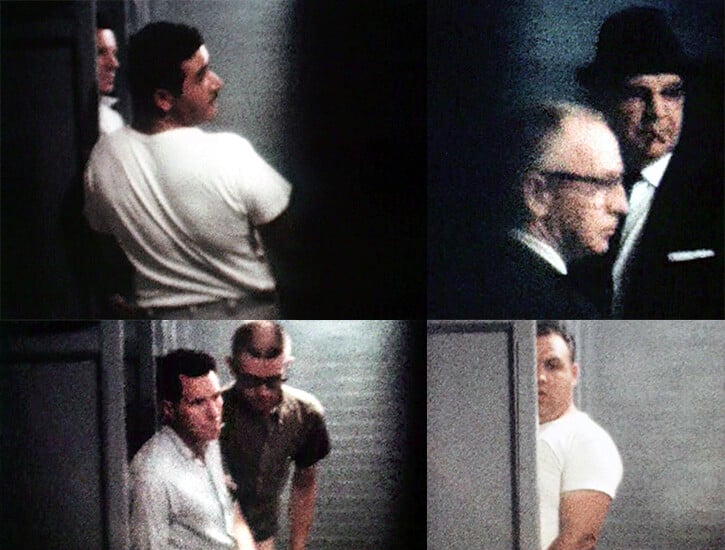
Stills from Tearoom (1962/2007) | William E. Jones
When I first watched Plainclothes, Carmen Emmi’s film about an undercover and closeted cop in the 1990s who arrests men for cruising in a public bathroom, I hadn’t yet seen the news about the raids.
Beginning in June, the Amtrak Police Department (APD) had been running a plainclothes sting operation in New York’s Penn Station bathroom—the old one near Eighth Avenue, not any of the new Moynihan ones. Writing for The City, Gwynne Hogan reported a clear “surge” of twenty-three arrests for “public lewdness” during Pride month alone. In the months that followed, around two hundred men were arrested, including, by September, twenty in one day. Amtrak confirmed this as a response to “customer complaints”—which, if true, marks pretty much the first time they’ve responded, and with such exacting force, to customer complaints.
We’ve been here before—but not so long ago as you’d think. As recently as 2017, the Legal Aid Society brought a class-action lawsuit against the Port Authority of New York and New Jersey, claiming that its police officers were violating the constitutional rights of queer, trans, and gender-nonconforming users of the men’s bathrooms. The suit followed more than a decade of documented “entrapment-style tactics” by officers, including “star[ing] at the targeted individual, mak[ing] gestures, or grab[bing] his own genitals, even expos[ing] his own genitals and/or peer[ing] over or around the privacy divider separating the urinals.” In other words, the officers were cruising to coax the queers out of the woodwork.
If anyone so much as met an officer’s gaze, they were arrested. In 2022, Legal Aid Society and the PAPD settled the case, agreeing “to end the now-paused plainclothes bathroom patrols for good, update sensitivity trainings for new officers and improve the process for filing complaints against officers.” Two years prior, the NYPD Commissioner Dermot F. Shea had announced the disbanding of plainclothes units, suggesting that the tactic had become obsolete—an odd idea, to be sure, as if, at one time, it had been justified.
Respectability is the enemy of progressive queer politics because it rarely seeks justice for behavior perceived as criminal.
The tactics of this year’s raids have been more aggressive. Undercover cops flirted with men in order to get them to touch themselves. Cops filmed men at the urinals from behind the locked doors of stalls. At least one man was arrested simply for wearing a rainbow wristband and taking too long to pee. Officers handcuffed him to a wall inside a detention facility, referred to him as a “fag perv,” and mocked his request for a glass of water. Amid all of this, as if to confirm the irony that recklessly flirtatious and obsessively voyeuristic cops were calling civilians “pervs,” the APD arrested a man for masturbating at the urinal who turned out to be, yes, an off-duty NYPD sergeant.
But intensity aside, something is categorically different about these raids. Subsequent reporting by Ramsey Khalifeh at Gothamist found that at least twenty of those arrested by APD were turned over to and detained by the United States Immigration and Customs Enforcement (ICE). One man had sought asylum in the United States after fleeing homophobic violence in Ecuador only to be arrested at Penn Station for, as he claims, being “very feminine in the way that I walk, that I talk, that I sit.” Most of the two hundred or so charges for “public lewdness” appear to have been, in the end, dropped, perhaps because of the 2022 settlement and the clear unconstitutionality of the tactics. But for the men now in ICE custody, it’s too late. They now face deportation.
New York City operates under sanctuary city policies. That is, its police force doesn’t turn anyone it arrests over to ICE, a federal agency. But because Amtrak crosses state lines, it’s a federal agency too. And because that particular bathroom sits within the jurisdiction of Amtrak, its police can, and apparently do, transfer anyone flagged in their system over to ICE, even if the charges are eventually dropped, as they were in these raids.
Some people thought this was very funny. Gay comedian Rob Anderson, author of Gay Science, posted a video of himself joking about the arrests. He mocks people online who compare the bathroom raid to the Stonewall riots. “The funny thing about some gay men,” he says, giggling, “is that they won’t care about anything until you tell them they can’t have sex or do drugs anywhere they want—that it’s a human rights violation.” Leaving aside the fact that state lawmakers wrote a letter to Amtrak police demanding that they stop their tactics “reminiscent of anti-LGBTQ policing from the Stonewall era,” Anderson misses the point.
What counts as criminal or distasteful behavior to the dominant culture—of which Anderson is a part—changes. Respectability is the enemy of progressive queer politics because it rarely seeks justice for behavior perceived as criminal. Instead, what Richard Grenell calls “normal gays” gain cultural capital by distancing themselves from those on the fringes of the cultural center—a fringe who, incidentally, shift that center. Meanwhile, “normal gays” (or “basic bitches,” if you prefer, as I do) leave the rest of us behind—or in an ICE detention facility. If there’s any use in raids like this, it’s in unmasking the normies of our culture, our own undercover narcs, who snitch on themselves as much as on the most vulnerable of society.
Just last year, in this very magazine, I wrote this about public sex: “The days of surveillance sting operations and plainclothes patrollers seem to have passed, at least for now.” I added the last clause because some part of me knew that what preceded it was merely provisional. I should have known the days would come back sooner.
This is the context for Plainclothes, a film whose premise alone warrants caution. Set in Syracuse in 1997, where its director grew up, Plainclothes asks: What happens when an undercover officer who’s trained to apprehend men cruising for sex instead falls in love with one? We’re invited to sympathize with a fag-busting cop who is, himself, on the DL. Caution aside, I was nevertheless excited that, for his first feature, a young director was turning his mind to cruising and police operations.
It’s not that there’s a scarcity of cruising films; there are enough for that label—“cruising films”—to mean something substantial, from Kenneth Anger’s 1947 Fireworks to Eliza Hittman’s 2017 Beach Rats, to more numerous examples in the present decade. The most notorious is William Friedkin’s 1980 Cruising, in which Al Pacino plays an undercover cop who descends into a cult-like den of leather enthusiasts, huffing poppers on the dance floor. The film equates cruising with stalking, sadomasochism with murder, even queerness with psychosis—despite the reality that these subcultural spaces were and remain obsessed by questions of consent. Throughout the summer of 1979, gay groups attempted to sabotage the film. Watching it now, I find Cruising a riveting failure that doesn’t offend me so much as make me laugh, perhaps in the haven of hindsight.
All to say, if one took issue with the equation of cruising and criminality, there’s probable cause for intervention. Yet this isn’t at all what Plainclothes attempts. Instead, it reinforces many of the tired and moralizing claims about cruising that queer artists and activists have worked hard to counter.
Plainclothes is obsessed with the past, a fixation that’s written into its narrative structure. It straddles two timelines. In the primary one, it’s New Year’s Eve, 1997, outside a snowy house in Syracuse, New York. Lucas Brennan, a thirty-ish white man, stares at us from a car window. His mother, Marie, is hosting a party that evening, just a few months after the death of her husband, Lucas’s father. Lucas, model son, is here early to help. Then, the film flashes back a few months earlier. Lucas, an undercover cop in a nondescript baseball cap and jeans, stands alone on the second level of a mall food court, staring down a man who’s sipping a soda in a Jazz cup while two teens play Hacky Sack and, over the loudspeaker, OMC’s “How Bizarre” plays. In other words, did you catch that it’s the 1990s?
The man sipping his soda returns Lucas’s gaze. This is the classic opening volley in an act of cruising, but something’s off. Suddenly, we see from Lucas’s point of view, and, for some reason, the view is that of a VHS camcorder. Visual static. The flash is jarring and violent, the footage grainy and blurred. Then it’s back to the typical, third-person gaze of Lucas. Lucas is surveilling, but we also sense that he feels surveilled, a fear that builds to the final moments of the film.
What follows is quick: The soda-sipper walks to the bathroom. Lucas follows. They stand together at the urinals. Lucas looks over and smiles. They hold the gaze. The man moves to an open stall. VHS footage shows the door of the bathroom storage closet, as if some cosmic horror lay behind it. Lucas walks over to the stall and hovers at the threshold, an uninvited vampire. We learn that he must never enter the stall, must never speak, as these moves count clearly as entrapment. Lucas nods and raises his eyebrows. The man unzips, and Lucas’s face goes slack. He turns, walks out, back to the food court where he taps Ron, his fellow cop, played by Christian Cooke, who sports a mustache so porny it miscues as comedy and seems to make light of the arrests that follow.
Ron flashes his badge and pushes the man against the wall and in cuffs. It’s rough and aggressive. The cruiser looks embarrassed and confused, is led out. Lucas hides behind a column like a little child, oddly shy and afraid, as if he weren’t the force of law—one of the many and increasingly fantastical details of the film. After Ron leaves, Lucas returns to the bathroom and washes his face. He’s distraught. We watch him have a panic attack to the sound of violin strings, the aesthetic roofie.
In this first sequence, the narrative struggle, if there is one, seems centered not around the unwarranted arrests of men looking for a little consensual fun in a dead-end town, not around the police force and the system that would criminalize public sex but on individual guilt, the dishonesty of a man who pretends not to be attracted to men. The closet plot.
Meanwhile, the Syracuse Police Department is ramping up its efforts to arrest men cruising in the bathroom for “indecent exposure,” despite the fact that, as the police chief notes, prosecution for such behavior is getting “harder and harder.” Most men are simply fined and rarely fight the charges, which requires an appearance in court. The homophobia here feels cartoonish, even for cops. Stiff dialogue turns them into stock villains just before a locker room scene showcases their naked, chiseled bodies gleaming with sweat. It feels too much like the scenes you skip in porn, a scenario that invites fantasy rather than character development. None of the film’s characters appear to operate as anything beyond pure positions. We’re encouraged to hate the cops but another response seems unlikely. The trouble with flatness, beyond tedium, is that it suggests allegory—in this case, moral allegory. Deprived of complexity, we look for what each character “represents,” a hunger for symbology born from the vacuum. Connect the dots, and the allegory becomes uncomfortable fast.
Not long after, Lucas is back at the mall, making eyes at another man, Andrew, played by Russell Tovey. Andrew looks up from his book to flash a wholesome smile. He follows Lucas to the bathroom. When Andrew invites him into the stall, Lucas steps in, and the entire tone of the film changes. Light piano music plays. “How are you?” Tovey’s character asks. Lucas just shakes his head no and locks the stall door. He swallows hard. Andrew, chill, tries to unzip Lucas’s hoodie, but the zipper gets stuck. The two giggle like children. It’s a meet-cute.
Lucas chickens out and runs off. Ron, weirdly, is right outside waiting for the green light. Lucas signals “no” and heads for the exit. Andrew catches him and gives him his number.
Something didn’t sit right for me here: that the only instance in which Lucas cruises leads to a passionate romance. Later, Andrew whispers to Lucas, “It doesn’t usually feel like this.” Exactly, I thought.
With a renewed mission, the Syracuse Police Department readies a new tactic: undercover filming. In the office, they screen surveillance footage from an old plainclothes operation in Ohio.
I couldn’t help but roll my eyes, but I also found myself wondering whether the training video was authentic. In fact, it is. Emmi borrowed it from Tearoom, a 2007 video piece by queer artist William E. Jones, whose work often repurposes queer media. For Tearoom, Jones presents real police footage with hardly any edits from a 1962 sting operation in Mansfield, Ohio. Using a color 16mm camera, Mansfield police, over the course of three weeks, hid behind a two-way mirror on the door of a supply closet and filmed men as they fooled around: A man in shirtsleeves and khakis jerks off next to another at the urinal, who leans over to whisper in his ear. Another man is bent over, looking over at the two-way mirror, perhaps watching himself, as he’s fucked by someone hidden by the stall. Shot after shot, men wash their hands, and we watch them as they scan the room for trade, for cops. At one point, a man walks over to the mirror and stares directly into the camera as he runs a comb through his hair. In his notes for the piece, Jones states that all of the men pictured in the film, which remains eerily silent, were later tried in court and convicted of sodomy—not “public lewdness” or “indecent exposure” but having butt sex or sucking dick. Each of them spent at least a year in the state prison, the mandatory minimum sentence at the time.
Tearoom isn’t just a glimpse at the past. It shows us our ongoing present—perhaps our future too.
Watching all fifty-six silent minutes of Tearoom is a powerful experience. The initial “establishing shots”—footage of the bathroom entrance, the steps down, the layout of the bathroom—are ominous because we suspect what’s coming. There’s an undeniable melancholy that arises from knowing that every single one of these men was sent to prison. But the lack of commentary makes space for multiple, contradictory responses. More than sorrow, I felt exhilaration. At times, the footage is, to be blunt, hot. It looks like any of the best “amateur” bathroom content on the internet. In this context, the men look brave, avant-garde against the forces of sexual oppression. The trysts seem not in vain; the cops somehow defeated. We watch the watchmen, and we know they’ve lost the culture war.
There’s another, more profound response to Jones’s Tearoom that’s difficult to articulate. The men perform their gestures with an ease and exactness that signals the ritualistic. You get the sense that this has been going on for a long, long time, and that, watching it in 2025, little has changed. As man after man performs the ritual, you feel, perhaps for just a moment, that whatever eradication of queer erotic life the state has attempted has failed. Over and over again, it has failed.
I felt none of this while watching the clips in Plainclothes, which inserts what Jones liberated back into the context of the police gaze, a kind of reincarceration. The scene allows the arrested no other role but victim. And, most troubling to my mind, it suggests some inevitable march of progress, an illusion conjured by historical hindsight and an ignorance of nuance. Just as the Syracuse cops are watching an outmoded “training” video from decades before, bemoaning the difficulty in prosecuting such cases, we’re watching cops prep for an operation whose methods, the film suggests, are outmoded too—the same obsolescence that the 2022 settlement had suggested—from a comfortable position in which this no longer happens, allegedly. Such narratives obscure the stories that don’t fit neatly into that progression, the aberrations that are, nonetheless, human lives.
Since Plainclothes is so turned toward the past, it’s worth noting a few historical facts. Sodomy, the so-called and ill-defined “crime against nature,” was illegal in Ohio until 1974, and it was illegal in New York, too, though only until 1980, when People v. Ronald Onofre, a state case, struck it down on grounds of the right to privacy. It’s worth noting that a similar right to privacy was established in Lawrence v. Texas, the 2003 landmark Supreme Court case that found anti-sodomy laws unconstitutional, though twelve U.S. states, most of them in the South, never repealed their sodomy laws, which remain on the books today. It’s worth noting that the same argument for the right to privacy was used to establish Roe v. Wade, the constitutional right to abortion, and that the same line of reasoning, the right to privacy, was seen as insufficient in 2022, overturning the federal right to abortion in Dobbs v. Jackson Women’s Health Organization. And so if anyone brought a sodomy case to our current federal Supreme Court, it could overturn Lawrence v. Texas, which would, in twelve states, immediately criminalize gay sex between two (or three! or four!) consenting adults—and even, potentially, non-procreative heterosexual sex.
What I’m getting at is that Tearoom isn’t just a glimpse at the past. It shows us our ongoing present—perhaps our future too.
The fear of being watched intensifies as the film doubles down on its romantic fantasy. After botching their first attempted hook-up at a movie theater, Lucas meets Andrew again, this time in a greenhouse, so they won’t be seen. They roll around on the gravel with their clothes on like awkward teenagers. Andrew dreams of traveling to San Francisco. Lucas asks whether that’s safe. “Yeah,” says Andrew. “You can’t get AIDS just by visiting San Francisco.” The perspective is some garbled, alien misremembering of 1990s gay life.
Plainclothes misses the mark on multiple levels. If it’s shooting at all, the barrel is aimed right at the very community it would probably like to lift up.
Later, in a flashback, as Lucas’s fear of surveillance escalates into full-blown paranoia, we learn that there was more to the greenhouse tryst: Lucas and Andrew fuck in the backseat of Andrew’s minivan. Here’s where the film tips into full sci-fi for me: Lucas bottoms for the first time like a champ. Future Lucas ugly cries as past Lucas orgasms in a montage scored with a song whose lyrics are, tellingly, “Don’t look at me, don’t look at me.” The scene exemplifies a core problem with the film as a whole: it doesn’t trust the viewer to have any kind of response except the one it dictates. It’s a series of wooden porn scenarios made flesh: the fantasy of a cop recognizing the error of his ways, the fantasy of anal without pain or mess. (One of the best corrections to the latter is Ira Sachs’s Keep the Lights On.)
And one more fantasy awaits: that of hooking up with a reverend. Yes, Andrew, as it turns out, is a man of the cloth, which we discover only after Lucas runs his minivan plates through the police database and stalks him. Just who is surveilling whom? (Whether intentionally or not, this detail recalls Laud Humphreys’s ethically dubious methodology for surveying men cruising in his notorious 1970 sociological study, Tearoom Trade: Impersonal Sex in Public Places). Lucas shows up at Andrew’s church unannounced like an angel of death, and Andrew pulls him into a room for a berating. Lucas wants to be with Andrew. Andrew scolds him. He has a wife and kids—in fact, they’re right outside the door—and he doesn’t hook up with men more than once. Lucas, child-like, crying and defeated, leaves. Later, in a letter to Lucas, Andrew writes, “I need you to know that it’s not too late for you,” but by the time it arrives, I found it utterly nonsensical, as if it were stripped from one gay melodrama and hodgepodged into another.
For all his surveillance paranoia, Lucas, when he’s ultimately pressured into revealing his queerness to his family at the New Year’s party, is met only with support. His mother and ex-girlfriend are totally cool with it. In the end, it was only his inner cop, internalized homophobia, that persecuted him. The struggle here, then, is not between the gay and straight worlds but between the normies and the deviants. As a standard-bearer of normalcy, Plainclothes traffics in tropes about the gay subculture: that men cruise because they’re ashamed; that these encounters aren’t real relationships; and that romantic love is somehow healthier than the ephemeral connections made during cruising. It isn’t a film about cruising at all, really. Cruising exists only as a foil against the overly revered romantic relationship, one that feels, ironically, not so much authentic as decoupaged with scenes from gay smut.
With a few technological tweaks, Plainclothes could easily be set in 2025. The implication, likely unintended, is that cruising like that is a thing of the past, something that gay men resorted to because they had to, out of loneliness or out of shame, and that police raids on cruising have largely ended. A friend I watched the film with mentioned that it made him think of Andrew Sullivan’s controversial 1996 essay “When Plagues End,” which claimed that the AIDS epidemic was coming to a close because of the advent of protease inhibitors. In reality, the crisis was slowing for middle-class white men, who had better access to information and medications to treat and (later) prevent HIV, while, at the same time, the crisis was escalating for black and Latino men, especially those from working-class backgrounds. The analogue fits for Plainclothes. Persecution has lessened for normative, white, gay men whereas it has persisted for black and Latino men—and with the recent raids that turned men over to ICE, we may be seeing the pendulum swinging more decisively from fines and criminality to detention and deportation. Plainclothes misses the mark on multiple levels. If it’s shooting at all, the barrel is aimed right at the very community it would probably like to lift up.
VHS camcorders pose a curious kind of surveillance—not so much “CCTV” as “home movies.” We record home movies to watch them later, replaying them endlessly in place of memory. Slowly, the videotape replaces the memory of experience, and the moment becomes fixed. That’s the danger with Plainclothes, I think. It’s nostalgic for the wrong parts of the 1990s. I was left feeling like the film itself was some kind of plainclothes operation, dressed as something sympathetic but out to confine our sense of what it means to be a man, of how queers have relationships in ways that rarely mirror straight relationships. We can do better.