, June 11, 2026
Wicked Games
Resistance to the World Cup at home and abroad
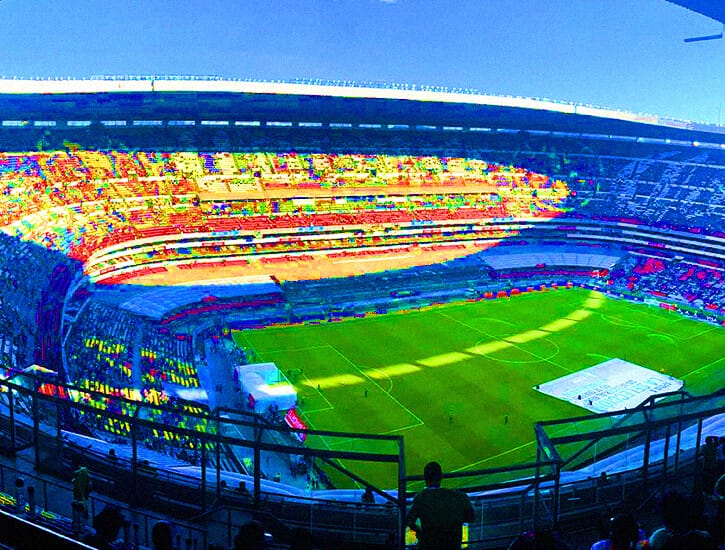
Estadio Banorte in Mexico City. | Wikimedia Commons

On a temperate Sunday morning this past March, a few dozen people gathered at an underpass in Mexico City for a pick-up soccer game. After a while, they decided to move out into the middle of bustling Tlalpan Avenue, where they cut off traffic, painted white lines across the road, and continued. This was not just an average street game. In the distance loomed the Estadio Banorte, more commonly known as Estadio Azteca, the enormous arena that will host the opening game of this summer’s FIFA World Cup, and the players—who have dubbed themselves the Anti-World Cup Assembly—were actually protesters.
“This is a space that we’ve named the Resistance Underpass,” Natalia Lara, a local organizer, told me. Since November, anti-gentrification activists and residents of Santa Úrsula Coapa, the neighborhood around the stadium, have made the weekly soccer game part of their ongoing campaign against the tournament, which they see not as an opportunity for joy and international unity but as a spectacular boondoggle, one that is draining public coffers, fueling state repression, turbocharging gentrification and displacement, and worsening an already severe water crisis—all while corporations and private investors benefit handsomely. “On World Water Day,” as Lara told the assembled crowd in March, “we continue denouncing the privatization and extraction of water in the area as well as calling out the capital’s government for its negligence towards territorial problems in the city.”
The members of the Anti-World Cup Assembly are far from the only critics of a World Cup that is on track to be the most expensive—and profitable—ever. From Mexico to California to Missouri, in the midst of intensifying human rights abuses, locals are coming together to call out FIFA, governments, and mega-corporations alike for their blatant disregard of the people who actually live in the shadow of the stadiums that will host the so-called “beautiful games” over the course of the next five weeks. “It’s a party for the rich, and we’re not invited. We’re seeing that echoed across all cities,” said Dana DuBari, a member of the Anti-Fascist Football Coalition, founded by the Black Alliance for Peace, “and all of the profit being gained from it is going to go back into international war and domestic repression.”
Resistance has—and will—take the form of protests, boycotts, and other public events aimed at disrupting the games and calling attention to human rights abuses waged at home and abroad. Just as the relationships of corporations and governments transcend borders, so does the resistance from below.
The underpass in Santa Úrsula Coapa first became the site of protest around 2022, when residents demanded the cancellation of a water extraction permit given to Televisa, the telecommunications conglomerate that owns Estadio Banorte. The permit allowed the company to drill a private well capable of pumping 450 million liters a year to supply the stadium as well as a nearby shopping center with apartment towers it hoped to build. To those living in the area—which has been designated as at risk of over-extracting its groundwater supply—the permitting process followed a common pattern in which authorities grant water to private companies involved in real estate development, while local homes suffer from dry taps. Indeed, as I have previously reported, some residents of Santa Úrsula only get water from their taps two or three times a week.
Despite attempts to quash their activities, the Anti-World Cup Assembly remained firm throughout the lead-up to the games.
Though the real estate development was ultimately abandoned, the permit remains and the well is pumping water. In the lead-up to the World Cup, the city announced that Televisa had chosen to temporarily divert the well’s water to the public system, but residents have not let up. “The neighbors are concerned about the government’s superficial disposition toward privatizing water,” Lara told the crowd beneath the underpass in March. “Instead of saying that it should be public, and taking action to strengthen its administration by the [water authorities,] the city government opts for a private entity to keep the water.”
As something of a consolation, the city government opened a rainwater retention garden next to underpass in March. Designed to prevent flooding while simultaneously recharging the aquifer, most residents saw it as underwhelming: nothing more than a cosmetic fix intended to impress World Cup tourists. “At the beginning, we had proposed as neighbors that there were other sites, a little further up-basin, that could have better infiltration capacities than this area,” recalled Adolfo Lara, Natalia’s father, who is also involved in organizing for water in Santa Ursula. “Here it seems that all the infrastructure exists to favor Televisa, the Estadio Banorte and the FIFA, and not carry out the works that impact the population.” “It’s very pretty, but it’s very small for the magnitude of the problem,” another resident told me. “It won’t last long.”
The rainwater garden, however, is just a drop in the bucket of the city-wide public works campaign to prepare for the tournament. Estimated to cost the city some $1.3 billion, it has involved the renovation of tourist infrastructure—as well as beautification efforts that have done little to address long-standing concerns of city residents. The houses of Santa Úrsula were not spared. In the months leading up to the tournament, city workers applied cement decals of pseudo-indigenous symbols on repainted facades near the stadium. “Right now, you go down the streets of Santa Úrsula and you find people painting all the houses,” Lara told me.
Those alterations came as the community’s concerns went neglected. “We’ve seen all these cosmetic transformations without attending to the main problems of water access, affordable housing, transportation,” she said, “and above all, intensive real estate speculation.” Indeed: Publicity for new apartment buildings in Santa Úrsula touted the tournament as a selling point, and, according to Lara, rents in the neighborhood are now double and triple what they were even a year ago.
As the protesters turned out week after week to rally at the “Resistance Underpass,” they began to see increased police attention: “More police presence, more cameras with the police taking our photos and our names,” said Lara. The ramping up of police is par for the course around events like this, says Professor Jules Boykoff, a former professional player and the author of Red Card: The 2026 World Cup, Sportswashing, and the FIFA Greed Machine. “The World Cup provides security officials a once-in-a generation opportunity to multiply and militarize their weapons stocks, to test experimental surveillance and weapons technologies, to leverage the state of exception in ways that advantage the state’s repressive apparatus.” Among Mexico City’s pre-World Cup investments in public infrastructure are some forty thousand surveillance cameras. The government has also announced a deployment of one hundred thousand security forces for this summer’s tournament, according to the New York Times, as an attempt to quell fears after the killing of a top cartel leader in February.
When I visited the underpass in March, activist Dana López took the megaphone to denounce her own case of government harassment. Several weeks earlier, she and her partner Jesse Alejandro Montaño Sánchez had disrupted an International Women’s Day event hosted by Mexico City Mayor Clara Brugada. In protest of the city’s uninvestigated femicides, the pair accosted the mayor, claiming her government isn’t doing enough. After the march, Sánchez was arrested by men dressed as civilians while walking through downtown. He was disappeared for several hours, during which time López claims he was tortured and beaten. Finally, after midnight he turned up at a police station, where he was formally charged with vandalism. The next day, the mayor’s security cabinet would present his arrest as an accomplishment for public safety, labeling him as a man out to sabotage the women’s march.
To López, Sánchez’s detention is a clear sign of the mounting repression associated with the FIFA’s presence. “We’re making a call to all our comrades to come together, comrades from all the causes, because only together can we get through these days of the World Cup, which are the days that we all face the most threats,” López said.
Over the last year, protests across the city have seen intensified police repression, even those not explicitly aimed at the World Cup. As Eliana Gilet reports for Desinformémonos—an independent media outlet that has thoroughly documented Mexico’s resistance to the tournament—the city has aimed to reduce the appearance of dissent in the run up to the games: Over the last year, police repeatedly kettled protestors during a series of anti-gentrification demonstrations in which anti-FIFA sentiment was clear. And earlier this month, police violently repressed members of the National Teacher’s Union on strike for pension reforms, with reporters noting that security forces carried turbo-charged weapons, including rubber bullets and teargas projectiles, which are rarely used by local police.
Despite attempts to quash their activities, the Anti-World Cup Assembly—which has drawn the attention of international media—remained firm throughout the lead-up to the games. “We foresee repression,” Lara told me, “but we’re committed to continuing with these activities and staying at the underpass as long as possible.” With just days to go before the kick-off the last time I spoke with them, the Assembly was still fine-tuning their plans for protesting the tournament once it is fully underway.
Another group mobilizing in the shadow of and against the tournament are victims of one of the largest human rights crises on the continent today: family members of Mexico’s 133,000 disappeared people. One such man is Ricardo García, the father of twenty-year-old Ana Amelí García Gámez, who went missing in July 2025 after climbing Mexico City’s Ajusco Hill, a popular hiking spot less than an hour’s drive from the Estadio Banorte. She sent a message to her family around four in the afternoon, and by five, their messages stopped going through.
Resistance to the World Cup and other events of its ilk is not restricted to Mexico, of course.
Amelí became one of five thousand-some missing people in the capital city. Her family spent a month searching the Ajusco, a 920-hectare colossus of forest and towns connected by steep, winding roads, for their daughter every day. “We started seeing that the Mexico City prosecutor’s office is a factory of impunity,” García told me. “It doesn’t have the human, technical or material resources, or the knowledge, experience or technology to do this kind of investigation.”
Indeed, in April, the United Nations’ Committee on Enforced Disappearance released a report declaring that Mexico suffers a crisis of systematic disappearances at the hands of the state. The federal government rejected the report, with President Claudia Sheinbaum arguing that organized crime, not state violence, was to blame—despite wide documentation of state complicity in disappearance cases.
As part of their search for their daughter, Amelí’s parents have reported several local officials, including the city’s Special Prosecutor for Disappeared People, to the local human rights ombudsmen. And in December, the Inter-American Commission for Human Rights issued a declaration requesting that the Mexican state redouble its efforts to find Amelí. And earlier this spring, Amelí’s family put out a call—under the slogan “Don’t play with our pain”—to protest the World Cup’s opening game to draw attention to the disappearance crisis. “The state is giving much more importance to promoting the World Cup than to dealing with this type of humanitarian crisis,” García said. “What the government cares about is political damage control.”
The World Cup protests are partly intended to warn visitors who could themselves go missing—but also as a way to counteract the government’s sportswashing by taking over the media spotlight. And they’ve managed to break through: A few days after World Water Day, on March 28, García joined a contingent of families who protested the Mexico-Portugal soccer game that inaugurated the reopening of the Estadio Banorte following a roughly $150 million renovation, evading government controls that restricted access to ticket holders only. Some national and international media outlets covered the protest.
And as the games neared, the tournament has became a constant theme among the families of the disappeared. As my colleagues at the Cooperativa de Periodismo reported, the tournament became a key aspect of the annual Mother’s Day march for mothers of the disappeared, an occasion that typically draws hundreds of protesters in the capital. Some marched with the Mexico national team’s jerseys printed with faces of their children and the slogan Dónde están? At the conclusion of the march, they once again took over the street, traced field lines on the pavement—and played a game of soccer.
Resistance to the World Cup and other events of its ilk is not restricted to Mexico, of course. The same weekend as the residents of Santa Úrsula Coapa kicked the ball beneath the underpass and in the middle of Tlalpan Avenue, a similar pick-up soccer game took place in Los Angeles.
Perhaps the largest contingent of people power confronting both the World Cup and Olympics in Los Angeles has organized labor.
Organizers of the NOlympics campaign, a coalition that opposes the city’s hosting of the 2028 Olympics, hosted a “liberation field day.” This cohort of Angelenos also has their eyes on the repression and displacement that massive sporting events like the World Cup bring to their region. As their webpage reads, “The Olympics accelerate displacement, militarization, and the erosion of democracy around the world. These games and other sporting mega-events threaten to destroy communities and cement cities as playgrounds for the rich.” Founded in 2017—when Los Angeles first submitted its Olympics bid—the coalition aims to get the games cancelled, and if not cancelled then at least raise public awareness and increase public engagement around the issues of displacement, policing, and militarization. They’ve pushed that goal through pressuring the city council and bringing together local unions and organizations that share their concerns. The group see this summer’s World Cup as something of a dress rehearsal for the Olympic festivities.
“These large-scale events are used as a way to sneakily militarize the city and kind of test out militarization for the future past the games,” Chris Tyler, a member of the coalition, told me. That will certainly be the case during the World Cup, as ICE is set to play a role in the tournament’s official security protocols. Mega-events like the World Cup and Olympics are covered by the Department of Homeland Security’s Special Events designations, which allow for the federal government to take over local policing. “What that basically means is it grants the Secret Service lead authority over the local law enforcement, so that means LAPD, the DHS, the CBP, and ICE in the same command system, and then that’s what the city kind of uses as justification to expand law enforcement,” Tayo, a member of the NOlympics campaign, told me.
The use of sporting events as a Trojan horse for amped-up policing harkens back to at least the 1984 Olympics, also held in Los Angeles, when the LAPD ramped up arrests, allegedly to target gang members. Carlos Sirah, a member of the Black Alliance for Peace, recalled that the LAPD’s resulting Operation Hammer grew out of policing sweeps that began during the 1984 Olympics. The program resulted in tens of thousands of arrests—almost all of them black and Hispanic youths—throughout the following years, most of which did not result in criminal charges. Citizen complaints against police brutality increased 33 percent between 1984 and 1989.
“These programs don’t disappear,” Sirah pointed out. “They become ingrained policy.” Professor Boykoff agrees. “It’s not as if after the tournament, the government boxes up these new weapons and returns them to the manufacturer. They become ingrained in ‘normal’ policing practices moving forward, which is to say, at least in the context of the United States, they turbo-charge racialized policing in the wake of the event.”
Traces of those strategies are visible across the cities hosting the World Cup. Kansas City, Missouri, for instance, allocated $25 million to build a jail with this summer’s tournament as a deadline. While initially proposed as a temporary facility as the city builds another, permanent facility, local city council members have discussed the possibility that it could be used long-term, and some officials, according to local reporting by the Kansas City Defender, have observed that it resembles an ICE detention center. “The World Cup’s coming whether we are ready for it or not, so we’ve got to get this built,” said councilmember Wes Rogers. It has unsurprisingly drawn the ire of local activists, who rallied outside the jail site in March. As Decarcerate KC member Patisha Royal told a reporter, “the FIFA cup will leave; the jail stays.”
As in Mexico City, activists in Los Angeles want to draw attention to the games’ impact on the stadium’s neighbors, where they anticipate displacement will intensify. The SoFi stadium that will host both the World Cup and the Olympics sits in the historically black community of Inglewood, which has suffered from decades of disinvestment. “Now suddenly there’s a lot of money funneling into that community to gentrify and turn it into a sports entertainment destination,” explained NOlympics member Chris Tyler. That includes pressure on rent-stabilized and affordable housing around the venues. “Landlords stand to profit if they can flip the unit, rent it out on Airbnb, collect several thousand dollars a night, probably more than they would get in a couple of months of rent from a tenant who’s been there for a few decades,” Tyler added. “And that in turn is also increasing the cost of housing the region and incentivizing landlords to pursue short-term rentals, other kinds of opportunities that are going to really maximize their return on profit.”
Perhaps the largest contingent of people power confronting both the World Cup and Olympics in Los Angeles has organized labor. For Unite Here Local 11, the union of hospitality workers that represents some two thousand food service staffers at SoFi Stadium, the key concern at the heart of the Cup is ICE’s participation in security. Many of their rank-and-file workers participated in marches and protests during last year’s ICE occupation of Los Angeles. “Then, of course, Minnesota happened, and we’ve seen what a violent menace ICE has become to our communities and to workers,” recounted union president Kurt Petersen. “Our shop stewards decided that they needed to protect themselves and their co-workers against this violence at the workplace perpetrated by ICE. So we sent a letter to all our employers saying that if ICE is at or around our workplaces, our members have the right, based on our health and safety language, to stop work.”
And so they did: At a hotel where ICE was staying, union members gathered in the cafeteria and walked out of work earlier this year. The employer moved the agents out the next day. “At SoFi, we had the same issue but on a more problematic level. Number one, FIFA has given a peace award to Donald Trump, and number two, Donald Trump and his administration has said that ICE is coming to the World Cup,” Petersen said.
Only days before the tournament, the union came to an agreement with Legends Global, the food service operator at SoFi Stadium. ICE’s presence was a key point of bargaining. Union members argued that ICE at the World Cup presents a threat to fans, stadium workers and journalists alike. The new contract, which includes wage increases, job protections, and privacy rights includes a provision that grants workers the right to strike if threatened by ICE. The New York Times reported in April that FIFA leadership discussed asking Trump for a moratorium on ICE raids during the games—but no concrete measures have been announced
The first World Cup game in Los Angeles kicks off this week.
Members of the Anti-Fascist Football Coalition have also called attention to the World Cup’s relationship to the genocide in Gaza. Consider Gianni Infantino, FIFA’s president, who gave President Trump the newly invented FIFA Peace Prize and joined the Board of Peace to administer rebuilding in Gaza. As Dana DuBari, a member of the Coalition, puts it, “We have the economic strangulation of Cuba and the intensification of the blockade there and the threat of a hot war in Cuba, the continued attacks on Venezuela, the ongoing genocide in Gaza, these endless bombings in Lebanon, the United States’ unprovoked war on Iran, to name a few, so how can we have this nation as a host for these games, as if to say, it’s okay that you’re waging all of these wars and you’re attacking global humanity and you’re centered in fascism and you’re repressing your domestic population?”
The coalition—part of the Black Alliance for Peace’s North-South Project for People-Centered Human Rights—comprises organizations across at least fourteen cities, including those hosting this summer’s games, in addition to members in Iran and Gaza. During an earlier phase of organizing, the coalition circulated a petition calling for the tournament to be canceled altogether and one demanding the U.S. and Israel be banned from the tournament, and they are organizing counter-programming events to raise awareness about the tournament’s impacts in host cities.
As with media coverage of the genocide in Gaza, dissent against the World Cup comes up against a complex of private and state interests that are working overtime to make them invisible. Ricardo García, the father of disappeared Ana Amelí, notes that the FIFA’s partnerships create a sort of informational firewall: “Many media outlets have commercial interests with the World Cup, those who pay for advertising. They have a conflict of interest, and they don’t touch the subject [of protests],” he said. Against that smokescreen, though, the people continue to mobilize, from Los Angeles to Mexico, refusing to let the world’s most popular sport become a tool in the hands of those who wage war. As the Cup kicks off and fans file into stadiums across Mexico and the United States, it remains to be seen if they will succeed.