, May 19, 2026
The Last Class with Balls
Bringing women into the military service academy system
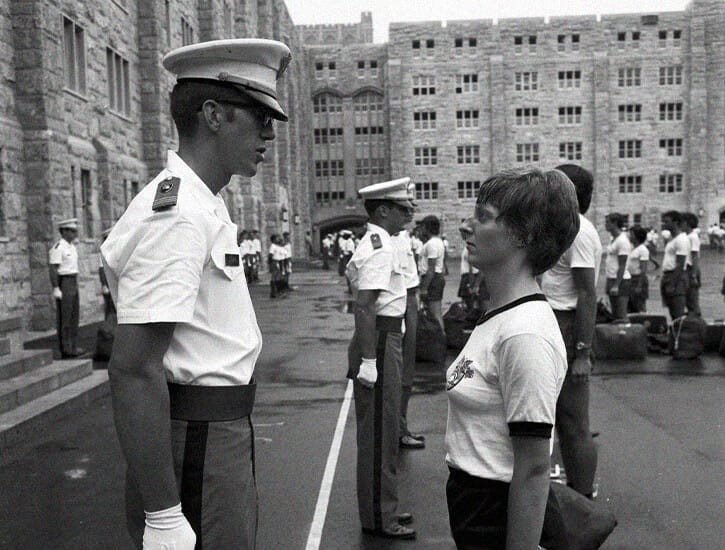
Women arrive at West Point, July 7, 1976. | Department of Defense
West Point’s class of 1979 witnessed what they viewed as the tragic end to their all-male power structure. They called themselves the “Last Class with Balls,” or, conversely, the “Last Class Without Bitches.” Some memorialized this grubby distinction on their class rings, with the acronym “LCWB.”
Over the preceding decades, lawmakers and military leaders had worked desperately to keep feminine energy out of the officer class. In 1944, Georgia’s Democratic representative E.E. Cox floated legislation to establish a separate service academy for women, one in which they were educated in “clerical, scientific and other duties” so that, once fighting broke out, “the able-bodied man may do the advanced work of fighting in the front lines.” The military later concocted a harebrained scheme to integrate the service academies that involved injecting female cadets with testosterone to make them more aggressive. By the time the Air Force Academy was constructed, in the late 1950s, women had been serving in official military capacities for decades, and yet still the school hung a large plaque at its entrance reading “Bring Me Men.”
The service academies were ultimately opened to women only thanks to hard-fought federal legislation first introduced in 1972 by Senator Jacob Javits of New York. After years of opposition, it was ratified in late 1975 with a stroke of President Gerald Ford’s pen. This was partly a push toward equity, but also a practical response to the personnel problems created two years prior with the end of military conscription.
Every academy superintendent opposed Javits’s bill, with West Point superintendent Sidney Berry personally lobbying President Ford against its passage, trying his damnedest to keep women from joining his secretive fraternity of military elites. Another powerful opponent was Army secretary and West Point alum Howard “Bo” Callaway, who argued that women would dilute the system’s “spartan atmosphere.” A lawmaker supporting integration responded that, on the contrary, women might help tame the system’s “Neanderthal” traditions. The public seemed mostly to be on the military’s side. Ahead of the law’s passage, one constituent argued in a missive to Senator Barry Goldwater of Arizona that the world had seen only one successful female combat officer. “That was Jeanne D’Arc,” he wrote, “and she was a saint. Also, she did not menstrate [sic].”
As revanchist brass and military school alumni loudly inveighed against the prospect of female cadets, feminist leaders were conflicted. Some felt that increasing women in the ranks would be positive for the movement, providing the final nail to men’s claims of higher standing. Others, such as Representative Patricia Schroeder, a Colorado Democrat, argued that “if equal rights is all about insisting that women should be as warmongering as men, then we’ve blown it.” Betty Friedan, author of the landmark book The Feminine Mystique, called the pitched debate “a red herring.” In the end, the feminist movement avoided deeply engaging with the issue, or supporting the women looking to break into the military officer class. The same year that Ford integrated the service academies, Representative Bella Abzug, cofounder of the National Women’s Political Caucus, flitted away a question on the issue. “I do not regard women in the military as my first priority,” she said.
Conservative activist Phyllis Schlafly filled the void, cynically invoking the prospect of female combat service as a key plank in her sustained and ultimately successful push against passage of the Equal Rights Amendment. At her rallies, children were given signs that read “Please don’t send my mommy to war.” William Rehnquist, a proud Army veteran and future Supreme Court Chief Justice, adopted Schlafly’s framing in his role as an assistant attorney general for President Nixon, drafting a memo opposing the amendment in which he warned it could make women “eligible for the military draft.”
The 1976 integration of women into the military service academy system landed a direct blow to the heart of America’s most elite masculine enterprise. The military had long thrived by concocting a specific conception of manliness, then facilitating a training ground to prove these traits. This scheme was plainly reflected in service academy applications, which long judged prospective cadets against a series of metrics known collectively as the “Whole Man” score. The military’s psychological grip on young men depended on a weak and largely subservient feminine construct, one in which women not only relied on, but were endlessly impressed by, male strength. Before the introduction of women, military school was viewed as the purest test of masculine bona fides. Those who failed were labeled with derogatory feminine terms like “pussy,” “lady,” or “fairy.” Now, one school commandant worried, “if women can make it, can it really be tough?”
Cathy Long, one of West Point’s first female cadets, routinely witnessed this masculine panic on campus. Before her arrival, she asserted, military school was a place “where a little man could go and feel like a big man.” She dealt directly with many of these guys, including one stunted upperclassman who screamed guttural insults in her face daily. Once, she looked deep in his eyes and realized that, under his bluster, was real worry. “We took away his masculinity,” she said.
When Javits’s law finally passed, it bound only the federal service academies. The network of other private, religious, and state-chartered military schools resisted gender integration for as long as they could. The Virginia Military Institute, for instance, didn’t become co-ed until a 1996 opinion from Supreme Court Justice Ruth Bader Ginsburg specifically ordered it to do so. The Citadel took a similar route, not admitting its first woman, Shannon Faulkner, until 1995, when she challenged the school in court. A few days after the judgment, cadets wheeled a huge sign to the highway. It read “DIE SHANNON.” She ultimately lasted about a week. In 2007, Valley Forge became one of the last private military schools to admit women, a decision that evoked a vehement response from powerful alumni, who complained that the school was “losing its character.”
West Point’s inaugural batch of female cadets first walked onto the parade lawn on July 7, 1976.
Faced with their own binding congressional mandate, service academy recruiters moved with characteristic swiftness to find their first female cadets, who enrolled into the class of 1980. Officials fanned out to high schools across America and sent more than eighteen thousand letters to guidance counselors seeking athletic women with high ACT and SAT test scores. They also scoured the enlisted ranks. Many of the students the military found harbored other dreams. But West Point made a powerful pitch, promising to turn them into heroines in the mold of MacArthur, Patton, and Eisenhower. None really knew what this transformation would entail, thanks largely to the school’s euphemistic recruitment materials, which vaguely indicated that the environment would be “taxing,” but that ultimately it would forge a “very special woman.”
West Point’s inaugural batch of female cadets first walked onto the parade lawn on July 7, 1976. There were just 119 of them among a class of 1,400. Roughly half would survive through graduation. Some had become enchanted by West Point’s romantic pitch, though many others signed up simply to secure a free education. Some hoped to escape their home lives or boring hometowns. Others wanted to prove their worth, to themselves, maybe, or, as with many male cadets, to impress their gruff veteran fathers. By this point, nearly 14 percent of all West Point cadets had been raised by career military officers.
No matter their motivations, though, these women proved highly unlikely to fully define themselves by their military lives. Contemporaneous school survey data shows that male cadets were nearly four times as likely as female ones to view their soldier status as deeply important to their self-perception. One of the first women West Point plucked from the ranks was Pat Locke, who had been serving as a private at Fort Polk, in Louisiana. Shortly after Javits’s law was ratified, Locke’s battalion commander whisked her into his office and asked if she wanted to attend West Point, insisting that she needed to answer on the spot. Locke had grown up surrounded by deep poverty and violence in Detroit, reared in “a house where we had a gun under every mattress.” She knew nothing about West Point but felt she could handle the intensity of whatever the Army threw at her. Plus, the pitch made the academy seem like a regal, exceedingly academic place, one where she might feel “free to breathe and do something other than just survive.”
Without much hesitation, Locke said yes. Hours later, she was on the road to upstate New York, where she would become one of two black women in this inaugural class. “The women shared a race, the men shared the commonality of being male, and with me I was black and female, so I shared almost nothing with the majority,” Locke explained in a 2015 interview for a West Point oral history project, adding she was also one of the few cadets who had been raised in poverty. “They didn’t know what to do with me.”
Another early female West Point cadet was Cathy Wells, a California kid who loved the classroom, notched great SAT scores, and dreamed of becoming a teacher. She had already been accepted to UC Davis, but her mother was “tickled pink” by West Point’s recruitment offensive. The prospect of her daughter becoming an Army officer felt like an important rejoinder to her era of homemaking. Wells applied to West Point and was accepted shortly after her mother died tragically in a car accident. She had her doubts about the Army, but wanted to honor her late mother’s wishes, and accepted her nomination. “It’s a major institution, it’s run by the government, I never thought it would be an unsafe place for me,” she reasoned. “I didn’t have any qualms about it.” Cathy Long had wanted to be a veterinarian. But her dad had died in Vietnam, and her stepdad was a general, so her path was preordained. “I wasn’t allowed to be me,” she told me.
During West Point’s initial charm offensive for female cadets, one high school girl asked, “Do you have to be a virgin to apply?” Technically you didn’t, but as the school prepared to welcome its first female cadets, administrators seemed singularly worried about the prospect that some in their coming class of plebes would become pregnant. This, one administrator explained to the press, would restrict them from participating in West Point’s “vigorous year-round activities.”
West Point was aware that female cadets would face threats, but their main response was to teach them how to fight.
The far more ominous prospect was that a group of eighteen- and nineteen- year-old girls was about to enter a militant, all-male environment with a two-hundred-year history of violent initiation rituals. The Air Force Academy took modest steps to protect their inaugural class of 157 female cadets, appointing a crew of active-duty female officers to serve as “upperclassmen” during the first two years of integration. This smoothed the transition through mentorship and protection, with female Air Force cadets making progress at similar rates as their male counterparts. West Point’s leaders, however, treated the prospect of female integration with lackadaisical cruelty. Regimental commander James Hall told a local reporter that hostilities on campus would simply “take time to work out.” Asked if he would recommend to his daughter that she commission on campus, Hall coldly responded, “I would not.”
West Point was aware that female cadets would face threats, but their main response was to teach them how to fight. The school employed Susan Peterson, who, in 1979, wrote a book called Self-Defense for Women: The West Point Way, as director of Women’s Self-Defense. Dotted throughout the pages of her book are photos of female cadets performatively gouging eyes, kicking groins, and knuckle-punching male cadets. The book profiles various common criminals, among them the “street bum,” the amateur thief, and the rapist, described as someone between eighteen and thirty who is unmarried, unskilled, low intelligence, and “unsure of his masculinity.” The book mostly fearmongers about the dangers of the “urban jungle,” when, in fact, danger—in the form of male cadets and officers—stalked the academy’s grass-and-stone campus. As for the prospect of pregnant cadets, the school banned them. Some medical staff at service academies also recommended female cadets go on birth control, even if they weren’t sexually active. “You never know what might happen,” one explained.
While female cadets were derided as soft, all were subjected to West Point’s classic hazing rituals—punched, kicked, screamed at, and spit on, among other humiliations. They all faced the stressors of drill and other stringent military regulations. One early female cadet, would, while sleeping, shout “Yes, sir!” and “No, sir!,” and sometimes even sleep march. In addition, male cadets endlessly flung vulgar insults at women, calling them “cunts,” “bitches,” and “whores.” They developed a glossary of military specific digs, joking, for instance, that a pool of swimming West Point women was called “The Bay of Pigs.” Girls at the Naval Academy were derided as “dumb, ugly bitches,” or “DUBS.”
Male cadets led the charge against female ones, but faculty and staff sometimes piled on too. Cadet Carol Barkalow recalled one teacher musing in class that she and the rest of the women’s basketball team were all “dykes.” Another professor gave a female cadet a “C” on a military science paper simply because “a woman shouldn’t be doing well in tactics.” Some squad leaders took bets with male cadets on which women would fall out of running exercises or cracked jokes about having sex with them. During West Point’s plebe summer initiation program, known as Beast Barracks, Susan Spieth’s squad leader ordered her out with him on three-mile runs every night. It was purportedly to improve her stamina, but the male cadet simply wanted to rag on her. “The whole time we would run he would talk to me about how MacArthur and Pershing and Eisenhower are turning in their graves because I’m there,” Spieth told me. During one session, the cadet leader pushed her to the ground. “I got up and gave him a look like, ‘Leave me the fuck alone,’” she recalled. “And he did.”
Much of the animosity toward women emerged from a single cadet company, B-1, which unofficially referred to itself with the longhand “Boys Won.” The company was driven by a psychosexual desire to entirely rid the school of women. They summed up their intent cryptically in West Point’s 1983 yearbook, which features their onetime battle cry: “B-1 or Be Gone.” A photo in that yearbook also shows a male cadet next to a female cadet, alongside a caption that reads: “That’s right, she’s mine.”
The campaign to oust women, known colloquially as “Project Zero,” included sexually charged shows of force, often under the cover of dark.
Barkalow appears to make a veiled reference to B-1 in her memoir, vaguely invoking a company that formed a “secret committee that would target one female a month and harass her until she quit.” This mission passed down to subsequent generations, and infected other companies too. When Valerie Coffey arrived for Beast Barracks two years after Barkalow, in 1981, a cadet leader screamed, “I’m gonna get every one of you fuckin’ bitches out of here!” At the conclusion of Kris Fuhr’s successful plebe summer, one in which she often outran the boys, a senior cadet kicked open her door one day and screamed, “You’re going to B-1—be male or be gone and you will be gone!”
The campaign to oust women, known colloquially as “Project Zero,” included sexually charged shows of force, often under the cover of dark—or sometimes, a black ski mask. In one case, a cadet snuck into the women’s changing room at night and, according to Barkalow’s memoir, “discovered an anonymous way to express his feelings on the subject of women at the academy. The next morning, my classmate found her bathing suit sticky with his opinion.” Fuhr shared a litany of stories from her year in B-1. There was the guy who ordered her every month to come by his room when his new Playboy arrived and critique the centerfold while he sat behind his desk and masturbated; then there was the guy who, no doubt due to the lack of window curtrains, had figured out how to spy on Fuhr, and each morning whispered in her ear what color underwear she had on. There was also the guy who stole all her underwear, and the guy who stalked Fuhr and attempted to rape her before she violently screamed and a squad leader came in and pulled the cadet off her. That same cadet was commissioned as an Army officer at the end of the year.
During Cathy Wells’s second year, she was assigned to B-1 and became a target. During the day, B-1 boys called her a “whore” and a “slut” ad nauseam. Her female friends knew of the company’s nasty reputation, and thus didn’t venture over much to visit her, which only deepened her sense of isolation. One night, when her roommate went off campus for a sporting event, Wells woke up with someone on top of her. “I don’t know who it was, and I don’t even remember to this day if anything really awful happened,” she told me. “I didn’t see his face ’cause it was dark.” While the night remains largely fragmented in her mind, she clearly remembers shoving a chair under her doorknob after the intruder left, and staying up the rest of the night, terrified.
Incidents like this were frequent and normalized. “I had people come in my room at night and touch me in ways they probably shouldn’t have,” former cadet Luci Fitzgerald told me matter-of-factly, explaining that female cadets routinely spent their evenings in a state of “low-grade vigilance,” and that she and her roommates, including Spieth, often put a trash can near the door to alert them to any intruders. One night, Spieth recalled, “my roommate woke up, saw the masked man, screamed bloody murder and he went running out.”
There was no acknowledgment by the administration of these night terrors, no public warnings from staff about the various men stalking the campus. Instead, women set up a whisper network. They warned each other about the masked intruder and also noted that a Peeping Tom frequented the women’s showers. Coffey told me that a friend of hers “was raped, she reported it, and nothing happened to him. Then she was raped again, and she didn’t report it.” Another female cadet woke up being assaulted in her bed with a pillow over her face. She never saw the man who did it and figured there was nothing she could do. “What am I supposed to report?” she thought.
A cadre of upstanding male cadets began to guard women’s rooms at night, but B-1 boys allegedly ordered some of them to stop. An internal West Point study from this time found that at least forty female cadets had been visited by late-night intruders. Brass responded to these numbers with relief. “I thought it was more than that!” one officer said. In exit interviews over many years, female cadets urged the school to install locks on their doors. West Point didn’t do so until the early 1990s.
The single unifying trait among the early classes of female cadets was their strength and self-esteem. All were highly accomplished, both physically and academically. All were also uncommonly brave. Male West Point cadets did everything in their power to disabuse them of these traits and run them out, but by and large the women demonstrated that they could succeed. Female cadets outperformed male ones in English and foreign languages. They held their own in other courses, and in physical drills, too. “The women, we found, are more willing than the men to push themselves past stress barriers,” explained one West Point official.
As women prepared to enter the Air Force Academy, the chief of staff’s son, himself a cadet, warned his father that this new crop wouldn’t be able to stomach even a week of drills. “I was your typical male chauvinist pig: Varsity football player, the whole bit,” he acknowledged to the Belleville News-Democrat in 1980. “But they were there . . . doing things I did as well or better.” When, around this time, the Army first integrated women into field exercises, they discerned no negative results. In 1981, Kate Wilder became the first woman to complete the Green Beret course, outperforming some of her male peers. The military reacted to her historic achievement with new regulations explicitly barring women from taking the course. Women’s pioneering military achievements were often curtailed, minimized, or met with terrifying aggression. Susan Golden, a member of West Point’s class of 1980, compared her psychological status upon graduating as akin to that of a battered spouse. For Spieth, “I came out of that place very much feeling like men had the upper hand and could be and would be violent and domineering and hateful and hurtful. I really hated men for a while.”
On her graduation day, all Pat Locke wanted to do was “get my diploma and get in my car and drive as fast as I could away from West Point.” Locke hoped that her abuse in the military was over, that she had proved her worth. Then an officer told her that while they had failed to drive her out of West Point, “we’ll take care of you out in the Army.” In that moment, she realized she was “a long way from being safe.”
In 1991, the San Diego Union broke the military’s first massive sexual abuse scandal. Their story zeroed in on the Tailhook Association, a fraternal organization of Navy and Marine Corps aviators, many of them Naval Academy graduates. The organization’s name derives from the pegs on fighter planes that, amid landings on aircraft carriers, catch an arresting wire. Tailhook confabs had long been debaucherous affairs. The organization’s board had, for instance, convened a special meeting to reckon with the 1985 convention, which, according to notes from one member, included binge drinking and property destruction among aviators who become so trashed they resembled “walking zombies.” The member further detailed “dancing girls performing lurid sexual acts on Naval aviators in public.”
Little had been done to reel in these urges by September 1991, when Tailhook convened its largest convention ever, at the Las Vegas Hilton. Many attendees arrived fresh off disappointing deployments to Desert Storm. The Navy’s role in the Persian Gulf had been relatively minor, in large part because they had no counterpart Navy to battle against, leading the Air Force to control most of the skies. When a batch of Navy Hornet planes did fly in combat, they struggled with projectile dysfunction, their laser-targeting systems largely unable to accurately lock missiles onto targets. These emasculating failures seemed to swell members with performative swagger and unearned bravado. Tailhook attendees were further juiced up by the recent release of Top Gun, which fictionalized a real training program then overseen by Tailhook’s venerated president Captain Frederic G. Ludwig Jr., whose call sign was “Wigs.” His son, Eric, recalled that after the blockbuster was released, crowds would sometimes roll out a red carpet for “Wigs” when he got out of his jet.
Tailhook conventions had a professional veneer, with daytime forums focused on war policy and new technology. The nights, however, were really what everyone was there for. Tailhook dropped over $35,000 for alcohol on the 1991 bash, fueling boozy banquets that led into sweaty, deviant afterparties overseen by blitzed-out aviators. The weekend was shot through with a nervous and threatened energy, thanks to the Navy’s embarrassing role in the Gulf, plus rumblings of military downsizing and growing discussions about empowering women to serve as combat aviators. During one forum, a female sailor asked an all-male panel when women would be allowed to be fighter pilots, to which the panelists, and many men in the audience, loudly laughed and jeered.
At night, one aviator donned a shirt that read “Women Are Property.” Others hired strippers, flopped their penises out of their pants, and formed a swarm of bodies on the third-floor hallway of the Hilton they called “the Gauntlet,” which they forced people to pass through. Over the course of the convention’s final evening, officers sexually assaulted at least seven men and eighty-three women, including an intoxicated underage girl who allegedly had her clothes removed. Many flag officers and other top brass were in attendance, including Navy Secretary H. Lawrence Garrett, who sipped drinks with Navy pilots on an outdoor terrace near the Hilton hallway where the “Gauntlet” assaults took place.
Garrett resigned under pressure in 1992. Washington spiked the careers of a few other aviators, but no one was criminally prosecuted. Meanwhile, the Navy hurriedly declared a sea change in its treatment of women. In short order, they permitted them to compete for combat pilot positions and opened nearly all naval vessels to their service. Tailhook also pledged to clean up its act, only to declare that it was moving its conferences from high-flying Las Vegas to Reno—a location arguably less notorious but every bit as debauched.
Many more allegations of grievous sexual misconduct, often referred to as flare-ups of “Tailhook syndrome,” continued to pervade the military. Not long after Tailhook, a horrific, historically large Army rape ring was exposed at Aberdeen proving ground, in Maryland. A subsequent survey on the progress of gender integration at the military academies showed intense animosity, with more than 50 percent of women at the Army, Navy, and Air Force academies reporting sexual harassment at least twice a month. This behavior again burst into public light a few years later at the Air Force Academy, where 12 percent of women in a class survey claimed they were survivors of rape or attempted sexual misconduct. Seventy percent said they had faced sexual harassment, including “pressure for sexual favors.”
These statistics, and many more to come, completely undermined the military’s long-articulated contention that military service is simply too harsh for women. The glaring truth is that military women often face far harsher, more violent conditions than men, facing threats from multiple fronts, chiefly foreign adversaries, but also the twisted bands of brothers that walk beside them.
Excerpted from God Forgives, Brothers Don’t: The Long March of Military Education and the Making of American Manhood by Jasper Craven. Copyright © 2026. Available from One Signal.