, May 15, 2026
Beneath the Paving Stones, the River
Lisa Robertson’s girlish signature
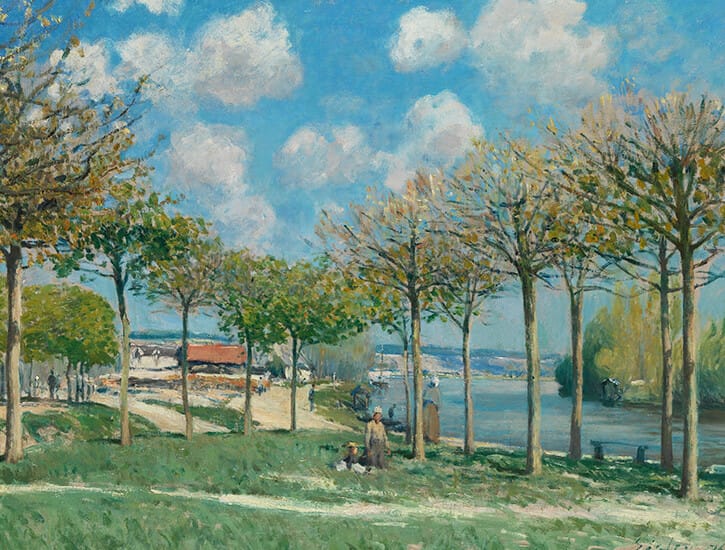
The Seine at Bougival by Alfred Sisley, 1876. | Metropolitan Museum of Art
Riverwork by Lisa Robertson. Coach House Books. 240 pages. 2026.
Cities love their rivers. From Shakespeare’s Tiber “chafing with her shores” to Walt Whitman’s ode to the East River’s “scallop-edg’d waves of flood-tide,” rivers have always been objects of awe, vigilance, fascination. Order and caprice coexist in them. They demarcate space, in their sinuous length, but threaten always to overspill their bounds. Dreams have thrived on rivers’ mystique: Think of the aged refugee Abu Qais fantasizing, in Ghassan Kanafani’s Men in the Sun, of “all the things he had been deprived of” by exile, glittering on the other side of the Shatt al-Arab. “Something real” lies in wait there.
Unlike the living river, available to myth, the dead river paved over with asphalt is far less common and useful as a trope. But precisely from the smoothed-over ruin of one such forgotten river—the Bièvre in Paris—the Canadian-born writer Lisa Robertson stitches together a lost world. Riverwork, only her second novel after a lifetime of ludic, elliptical poetry, assigns itself an essentially recuperative and archival undertaking. Its unlikely heroine is the self-described “hag” Lucy Frost, descended from a line of petty thieves and “small-time scammers.” She works as a cleaner in the dusty apartments of a member of Paris’s professoriate, known only as the Archivist. Having unearthed the notebooks containing the hydrological research of her mysterious great-aunt Em—who herself vanished years ago, never to be found—Lucy sets out to retrace her ancestor’s errant footsteps.
Unlike the living river, available to myth, the dead river paved over by asphalt is far less common and useful as a trope.
These lead her through Paris, over the Bièvre’s sedimented, occulted traces in life and in text. We learn, in fragments taken from great-aunt Em’s scribblings, of the river’s centrality to a robust feminized economy of laundresses, its historical use as a site where washerwomen pounded everything from bed linens to tablecloths and camisoles for a living. We read of its penchant for flooding, its conduciveness to amorous trysts, its proximity to abattoirs and tanneries, and above all, its miasmic stench. Condemned by Baron Haussmann as unsanitary and pestilential, the Bièvre and its washerwomen waged a losing battle against the elite, patriarchal industry of textile dyeing and luxury manufacture. As so often happens, the women bore the brunt of social blame; they were surveilled, banished to the fringes. The river itself was buried beneath concrete in 1912, stamped out of existence. Sous les pavés, la rivière.
Riverwork’s apparent arc is one of oblivion—like pressing an ear to the murmur and purl of an undercurrent. But its narrative premise is almost an alibi, for the textual disjecta that accrete around it are seemingly endless, aleatory digressions into everything from film criticism and medical trivia to literary biography and leftist history. Call it hybrid, genre-bending, unclassifiable—those totemic labels of the contemporary literary zeitgeist fall short. There is no story, Lucy Frost protests repeatedly—part lament, part apology, part political statement—in case we should expect otherwise.
Plotlessness is political, occasioned by real machinations of power. Stories, after all, are instruments of violence cast in the mold of improvement; the habitual “story of gender” or the “story of family,” of which the most common iteration might be heteronormativity, corrals its listener into obeisance. Lucy prefers “the difficulty of the poem,” the density of philosophy. She desires an “opacity” that “resembles the world,” a riotous tangle which evades capture. And identity, for Robertson, is a noose devoutly to be escaped. Take for instance the opening lines to a Robertson poem from her collection Boat (2022): “‘The women’ is itself not a content / It is an unwavering faith in the fictional / Because they don’t exist”—a nothingness from which Robertson writes. Her book The Men (2006) repeats the designation “men” so incessantly that it comes to seem more like incantation or like the unknown word for a lunar, otherworldly species. Where a story might strive to mimic reality and constrain one to follow its onward logic, a poem vibrates. It gestures. It dwells in interstices. Riverwork is an anti-novelistic novel, that most sly of creatures—straining to shed its own carapace, yearning to be something other than what it is.
We have had works like it: See Kate Briggs’s The Long Form, whose meditative textures model the slow and exasperating time of motherhood and test fiction’s limits against the unending labor of care. Is the novel an apt vessel for a commitment so continuous, so exhausting? Or Anne Boyer’s The Undying, which attempts to forge a grammar for pain in the throes of breast cancer. Or, even better, Chantal Akerman’s classic film Jeanne Dielman, a crucial intertext for Robertson and avowed interlocutor in Riverwork. In its interminable duration, structured around banal rituals of domesticity, Lucy Frost discerns an ethic. With every potato peeled, every bed made, an “incendiary manifesto of style” takes shape. It is not a coincidence, I think, that these three experiments in form—no matter their manifest medium or generic affiliation—all originate in the feminine body’s dispositions and rhythms.
Robertson’s oeuvre demands to be situated in such a feminist lineage; she has called herself a “she-dandy.” Her sentences are as sculpted and baroque as Djuna Barnes’s. They are resistant to paraphrase, for abstracted out of context, they seem gnomic. I have often described her to others as a more difficult and intractable Anne Carson (this was before I saw that the Village Voice had already referred to her as the “thinking woman’s Anne Carson”). For her, form is everything—form is the problem, and style can be as serious as life and death. In a poem from 3 Summers (2016): “form is always learning / how as it moves across surfaces.” But form also outlives value’s extinction. In Proverbs of a She-Dandy, she puts forth a manifesto of the menopausal woman as the dandiacal figure par excellence. No longer beholden to reproductive or sexual imperatives, the hag undergoing menopause may adorn herself for pure spectacle. Her foppery is now form stripped of function, aesthetics beyond the reach of instrumentalization, “an undocumented corporality.”
The writer Aurora Mattia has said, regarding her own ornate style and extravagant linguistic convolutions, “I seek an experience of genre that replicates my experience of gender.” Lisa Robertson would agree: Like the bodies that obsess her, her textual doctrine hews to the dandiacal and the foppish. She is a believer in “femme heresy,” paying attention to “how women survive” and, on the other hand, how they thrive. Elsewhere, Lucy reflects on the work and tedium of cleaning an apartment, “The real experiment is how to conduct a life whose form is unrecognizable.” No language might suffice, no genre prove capacious enough. Illegibility impresses itself rather in ciphers: notes hastily dashed off in a worm-eaten manuscript, a menstrual stain in a subway seat like a “girlish signature.”
But how do we get from here to there, from quotidian chore to exalted philosophy? What a gulf divides them. And yet that might be one of Robertson’s most miraculous transfigurations, one of the mysteries she incubates most insistently throughout her fiction, not just to take femme embodiment on its own terms but also to resignify it as a mode of thinking. Her debut novel, The Baudelaire Fractal (2020), whose protagonist is a younger and hornier version of Lucy Frost named Hazel Brown makes it clear: “My outfits and their compositions were experiments in syntax and diction.” Not only is a girl’s toilette akin to an idiolect with its own inflections and turns—though it is that, to be sure. Robertson reads intellectual rigor and theoretical acumen into the very forms by which femininity makes itself seen, heard, sensuously known.
The psychoanalytic thinker Mladen Dolar, cribbing from Fredric Jameson’s coinage, called the voice a “vanishing mediator.” By that, he means how the voice offers itself as the substance that supports the utterance but disappears at the very instant the words are uttered. What Robertson enshrines are these evanescent vessels: voices, accents, postures, gestures, atmospheres, relations. All that we intuit and often fail to apprehend. Another word for these intensities is tone—that ineffable mood that shadows a room, hovers over a crowd, whispers through a paragraph. Sofia Samatar and Kate Zambreno venture, in their collaboratively authored Tone, that tone is prepositional, a matter of how one thing is put beside another, an attunement to “positions and how feeling moves between them.” Riverwork’s spirit is prepositional; I might pick athwart, if asked, for how capaciously the book straddles scales and worlds.
To be clear, Robertson never sacrifices her bibliophilia; she still loves her Nietzsche and her Rousseau. But language for her is such a delicious, iridescent, shimmering thing that it is continuous with the material apparatuses of gender and sex. Reading is an erotic act—a whole chapter retells how Chateaubriand learns of lust and eroticism through his prodigious reading. A smock can encode disappointment, rage, passion in its folds, as intricately as any well-turned phrase. Rei Kawakubo and Ann Demeulemeester are theoreticians of form as skilled as Marx. “A dress is always more than a dress. It’s an invitation to parse or to renovate gestural language, and so to love differently.” Lucy frequently admires the Japanese sartorial collection of her employer, the Archivist, briefly donning pieces from Comme des Garçons and Yohji Yamamoto just to borrow the “passing pleasure of the postural inflection of the garment’s intellectual rigour.” (Rarely have I felt so understood, on a cellular level, in my transness.)
One of the refrains in Riverwork—for there are many, as is characteristic of Robertson’s iterative, accumulative style—is that age-old Marxist maxim: the formation of the five senses is a labor of the entire history of the world. It is an aphorism Lucy invokes more than once, almost as a talisman for her writing and her aesthetics. No body-mind split obtains here; indeed, the body with all its effluvia is a kind of pulsating mind. In yet another one of the novel’s numerous disavowals of fiction, she says, “The core of the event is absent. A river disappeared. Also, women, Also, poetry. I’m transfixed by the history of their valuelessness. Disappearance repeats in a fabric. Nothing new. It’s the iterative form that history takes.”
From river to women to poetry, Lucy limns her metonymic and provisional femme lexicon: one of cities, garments, texts, bodies. One slides into another, an elastic chain straying into fancy, speculation, invention. Who said interiority had to be faithful to the real? That gaping syntax, that vertiginous recursive swerve, is typical of Robertson’s language, her approach to time: no abstraction can be thought apart from its ground in sensuous experience. Thinking, for her, ought to be enfolded into the same breath as touching, fucking, tasting, dressing. Her loyalty is to frippery—those objects, spaces, gestures evacuated of value and visibility. In this, she might partake of what the critic Amy De’ath has recently identified as a “feminized” poetics, her expansive term for all subjects who transgress the prescriptions of gender and who bear on their skin the imprint of devaluation.
Robertson’s work is precisely about the negative space around authorship. Or, to state it otherwise, all that we might find when we renounce our attachment to that individual construct of genius.
What emerges begins to look a lot like a composite of Lisa Robertson’s own sensibilities—a personal canon and memoir of her artistic Bildung. In one sense, we could call this autofiction: Robertson, like Lucy Frost, lives in France and is similarly obsessed with Chateaubriand and Jean-Jacques Rousseau. (Here is Robertson in her nonfictional collection of prose essays, Nilling: “So I have, in my walks in Paris, deferred to Rousseau, taking his Reveries of a Solitary Walker as Baedecker . . .”) Both figures are Riverwork’s patron saints. The excursions into Marcel Proust, Hannah Arendt, Gertrude Stein—interspersed throughout the novel—could well be documents of the author’s own sentimental education. The few characters, from Lucy herself to the Archivist by whom she is employed, could plausibly be refractions of their creator.
In a different sense, though, Robertson’s work is precisely about the negative space around authorship. Or, to state it otherwise, all that we might find when we renounce our attachment to that individual construct of genius. Aren’t we all, in some fundamental acute way, antenna vibrating to the frequency of voices not our own? The Baudelaire Fractal, Robertson’s previous novel, boasts the Borgesian premise of a girl named Hazel Brown who wakes up having authored the complete works of Charles Baudelaire—including all his juvenilia, false starts, and letters. Riverwork’s ghost is, of course, Lucy’s great-aunt Em, but through her are ventriloquized a spectral assembly of other figures.
Might that not be fiction by another name? The kind that lurches and makes as if to supersede itself? The well-known literary critic Timothy Bewes, in his much-discussed monograph Free Indirect (2022), has suggested that we might be entering a “postfictional” age, heralded by Rachel Cusk’s infamous announcement that character no longer exists. Every generation must mourn the novel’s demise, it is true. But Bewes’s point is that the novel is something singular, inimitable. It places itself beyond the reach of biography and ideology; it harbors an excess that cannot be reduced to mimesis. The novel itself thinks. That might sound like sophistry, but there is something to it in Riverwork, whose fugitive cartographies have a mind of their own.
At the end, Lucy Frost admits to failure; she has come too late to this work of impossible retrieval. Riverwork too is Adornian late style, jagged and doomed to incompletion, at times ponderous and florid. I array these descriptors only to suggest that its self-avowed failing might be the emblem of its beauty. Its thwarted attempt to “contain everything” reminds me of the ninth-century Arab bibliomaniac and polymath al-Jahiz, who thought the apocalypse was nigh. In response, he dreamed of a book that would shelter the universe in its totality. Anticipating censure, he mounts an impassioned defense of the book as a medium. “Where else,” he writes (and James Montgomery translates), “will you find something that combines the beginning and the end, the deficient and the abundant, the hidden and the evident, the visible and the invisible, the high and the low, the lean and the plump, one thing and its contrary, one class and its opposite?”
And where else but in Lisa Robertson have we witnessed the hag in such splendor and decrepitude, with such aliveness and riverine ardor, ever on the threshold of ending and beginning again?