, May 14, 2026
A Whole New World
How Disney animatronics made automation adorable
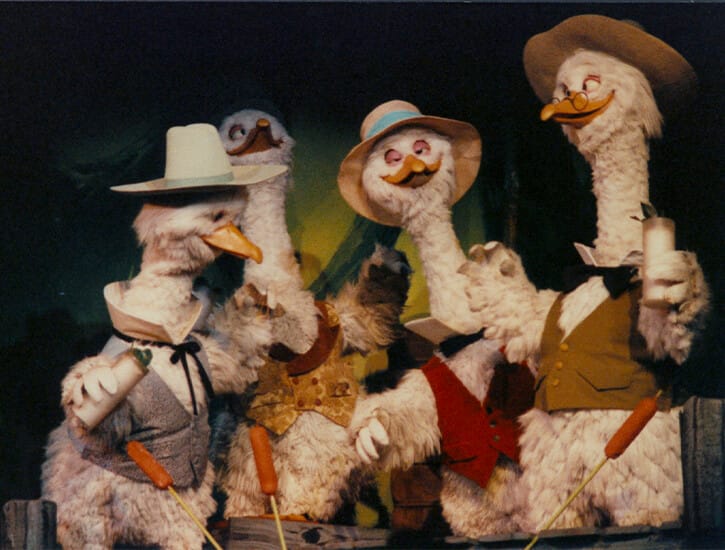
Animatronics in Disneyland. | Flickr
Disneyland and the Rise of Automation: How Technology Created the Happiest Place on Earth by Roland Betancourt. Princeton University Press. 416 pages. 2026
In late March, I encountered a topless woman at the Kona Club Tiki bar in Oakland. Her hips gyrated with a steady mechanical squeak, her grass skirt described a stiff, uniform ellipse, her wooden breasts did not jiggle. I asked the bartender if they turned her off at the end of the night or if she swayed to an empty room. The bartender explained that no, the animatronic hula dancer would need preventatively regular oiling and repairs if she were to dance all night, every night (there was a button you pushed at closing time to turn her off).
I’ve always been enchanted by animatronics. Their uncanniness is part of it. Grotesque, repetitive, lifelike: There’s something funny and doomed about them. Funny, because they are usually clunky and false looking; doomed, because forced to repeat precisely the same thirty-second snippet of movement for the viewer’s entertainment⏤or bemusement or disgust⏤ad infinitum. In Roland Betancourt’s Disneyland and the Rise of Automation, published this April, I came to better understand my sick fascination with automated “fun.” Betancourt’s book takes us from Walt Disney’s admiration of the conveyor belt at Ford’s auto plant in Dearborn to the minutiae of the Anaheim rides of the fifties and sixties, built from innovations in transportation and recording. Betancourt effectively demystifies the machines that make the magic happen. “Every Disneyland ride is a carefully camouflaged machine where you are its signature product.”
By showcasing rather than hiding the “machines in the garden,” Disneyland acted as a potent metaphor for, and celebration of, the increasingly automated postwar world.
Betancourt is an art historian at UC Irvine whose past books focused on sensory studies of Byzantium; it is somehow fitting that a scholar of late antiquity has taken on the prime pop-culture artefact of our new Dark Ages: Disneyland. Among glowing princesses, skeletons, and talking animals catering to a cult of initiates sucking on festive bread products in darkened caves, Betancourt is right at home. The book is split into five sections: “Automation,” “Systems of Control,” “Feedback,” “Computerization,“ and “Animation.” Each section hovers roughly between 1952 and the late seventies, concluding with a flash-forward discussion of the present.
Betancourt’s argument is that, in the postwar era, theme parks like Disneyland maintained tight focus on the mechanical logic of its attractions, teaching people to see their relationship to machines in a new way.
Technologies of industrial automation—systems largely hidden from public view in factories and warehouses—were transformed into amusement at Disneyland, setting the trend for the era of the theme park in the postwar period. . . . The modern theme park [was] where automation was not merely deployed, but aestheticized. Here, invisible industrial processes became visible, making the cold logic of servomechanisms and relays palatable in the guise of childhood fantasy and Hollywood cartoons.
By showcasing rather than hiding the “machines in the garden,” Disneyland acted as a potent metaphor for, and celebration of, the increasingly automated postwar world. Disneyland taught Americans how to embrace the technologies that undergird our lives, whether it’s the Programmable Logic Controller (PLC), a tiny computer box that makes a ride at Disneyland shut off during an emergency or the sensors in our cars that beep when we take our eyes off the road. Automation is everywhere now, and it was Disneyland that made it part of your world.
In 1948, Walt Disney embarked on his third trip to Detroit’s River Rouge Ford Plant, along with his colleague, the animator Ward Kimball. Betancourt writes: “The new beast of automation had just been given a name, and River Rouge was its primordial lair.” Strikes at River Rouge a decade before had resulted in Henry Ford’s security forces viciously attacking United Auto Workers union members in the Battle of the Overpass. Something had to be done about the ailing human element of labor, unable to adjust to the grueling hours on the assembly line. Or in the words of Walt Disney, who experienced an animators’ strike in 1941, “We’ve got to get rid of those damn pinkos and reds!”
The newfangled logic of “Detroit automation” developed between 1945 and 1965 as a solution to an overworked labor pool experiencing the first twitchings of Forditis. What made Detroit automation unique was transfer machinery that moved parts down the assembly line without the aid of human hands. As Kimball wrote in his diary: “Good god! What a sight! My mouth hung open!” The factory was “Just like Charlie Chaplin’s Modern Times!” Not quite, Ward! Unlike the Tramp, who is stuck on the assembly line twisting bolts with both his puny arms, the River Rouge workers acted as distant operators of the machines. However, the theatricality of Chaplin’s journey through the factory mirrored Disney’s and Kimball’s experience. Looped through the factory on conveyor belts, up close with cogs and gears, this factory tour was the model from which Disney drew. In a memo five days after his return from River Rouge, he outlined his new idea: a “Mickey Mouse Park,” which he began to build five years after his visit.
No discussion of the history of automation would be complete without a discussion of cybernetics, the U.S. military, and the technofuturist boosterism of trade magazines like Fortune. At MIT, the mathematician Norbert Wiener’s research into how World War II enemy pilots’ movements could be predicted as a man-machine hybrid resulted in his coining of “cybernetics” in 1947. Cybernetics was the science of communication and control. Automatic control was the dream for factory owners outlined in Wiener’s and others’ treatises of the late forties and early fifties. No longer governed by fickle human impulse, the machines of the cybernetic future would regulate themselves entirely without intervention.
Fortune’s slick 1946 diagram of the “Automatic Factory” looks, writes Betancourt, “nothing like Charlie Chaplin’s conveyor belt, but more like a sleek, sterile, and desolate industrial landscape where all runs at the push of a button.” MIT’s Servomechanism lab studied feedback control theory, and all the excitement resulted in a new Merriam Webster word in 1955: “automation.” It was a philosophical proposition, a utopia, a mechanical gleam in an automaton’s eye. Automation was a “logic” and not a machine, that would entirely reshape the manufacturing landscape. If technoutopianism permeates much of the early writing on automation, fears about the human workforce being replaced by machines also abounded. In a Blondie comic published in 1955, Dagwood confidently asks his boss for a raise as his boss is being sold an automated device. The boss’s response is “You know you can be replaced by a machine, don’t you?” Too bad that machine couldn’t automate a massive Dagwood sandwich to console him. At least not yet.
Meanwhile on the west coast, the Stanford Research Institute think tank, which employed a variety of managers and experts involved in the construction of everything from Ingersoll Rand industrial products to B-24 Liberator bombers, partnered with Walt Disney on his Mickey Mouse theme park in Anaheim, California. Operations research, a “scientific” management style that used feedback loop logic to govern the building of weapons and industrial technology, was now leveraged in building the theme park. “Akin to Wiener’s antiaircraft studies, in the work of the Stanford Research Institute the corporation became the gunner and the consumer its nameless target, a one-dimensional moving dot, whose movements and behaviors . . . could be reduced to servomechanical theory,” writes Betancourt. Sampling surveys assessing guest behavior was designed to increase revenue and ensure that Disneyland visitors were efficiently and smoothly conveyed through the park, reducing bottlenecks while keeping visitors there for as long as possible. These insights into bottlenecking were gained from the think tank’s studies of mess hall lines in military operations. Studies of television ratings and programming in the 1950s that streamlined the conveyance of a viewer from one show to the next informed the park’s layout. Just as audience flow in the 1950s was conducted by programming that prevented the “jarring juxtapositions” of early television, Disneyland sought to streamline the movement between rides. Disneyland can thus be seen as part of a larger “think tank aesthetic” that operationalized works of art and visual culture during the Cold War.
Da Vinci had sfumato. Donatello, stiacciato. Walt Disney had the Cleveland Tramrail track system. The system that carries human beings from Captain Hook’s Hideaway to Never Never Land is the same one responsible for conveying tons of materials used in steel foundries and papermaking factories. In 1953, Cleveland Tramrail furnished all the “dark rides,” and, along with the tracks, Disneyland’s engineers implemented the “block brake” system, a safety measure taken from industry protocols ensuring that cars don’t smash into each other. Complete automation, says Betancourt, was Disneyland’s “most important contribution to postwar American culture . . . Nowhere else could families step into the workings of a large-scale, automated factory.” In the 1970s, the rides were updated to a Programmable Logic Controller. Most automated systems today—from traffic signals to power plants to pharmaceutical vial cappers to robotic arms—run on PLCs. The logic of cybernetics, as predicted in the fifties, is now everywhere, in a stealthy, imperceptible form.
Disney also had magnetic tape, and in 1963 he built the Enchanted Tiki Room, the first audioanimatronic display of its kind. My Oakland hula dancer would be put to shame: Dozens of perfect dupes of parrots and flowers sing cabaret style, their mouth movements, tongue movements, even the rise and fall of their breasts controlled by machine. Magnetic tape is a recording device that was imported from a Nazi sound system when a GI stumbled on it playing symphonies all night long on a radio outside Frankfurt. This tape, affixed by a harness to the bodies of actors and animals, records their movement, and then replays that movement, reproduced as articulations on the joints of the machine. The equipment that guides rockets to the moon, Disney proudly tells us in a grainy tenth anniversary video of the Tiki Room, used the same technology.
Interestingly, Betancourt draws a parallel between Disney’s animatronics and the avant-garde sculpture and performance art of the 1960s. Jean Tinguely’s 1960 self-detonating mobile, Homage to New York or “The Gadget to End All Gadgets,” as well as a collaboration with Claes Oldenburg, were on Disneyland’s radar. Studio executives asked MoMA’s director for footage of Tinguely’s machine exploding, and Oldenburg had a studio residence at Disneyland that resulted in Giant Icebag, a massive sad-sack sculpture one imagines applying to a huge, hungover head, inspired by the Space Mountain ride then under construction at Disneyland. Antonin Artaud’s “theater of cruelty,” a surrealist aggression against the medium of art itself, was the era’s operative concept, Betancourt argues, not only for the exploding mobiles of New York City, but also for Disneyland’s animatronics and rides, one of which⏤Pirates of the Caribbean⏤ended with a town in flames. But, admits Betancourt, “While Disneyland’s attractions relied on automation to ensure the seamless operation of an immersive cinematic experience, both through the conveyance of people and the animation of objects, Oldenburg was aiming for a brute reduction of these technological capabilities.” The comedy in a drooping bag of ice is funny as a demonic, not a divine, comedy, to paraphrase Susan Sontag, because modernity is a series of meaningless mechanized situations of disrelation⏤a meaninglessness that Disneyland aims to conceal.
Toward the end of Disneyland and the Rise of Automation, explicit critique is sacrificed for summaries of the rides’ patents and manuals. Where I wanted argument I instead found an encyclopedia. Betancourt tells us early on that Sergei Eisenstein was a champion of Disney’s studio projects into the 1940s, without explaining the nuances of Eisenstein’s position. For instance, Eisenstein’s appreciation was for Disney’s films, particularly Mickey Mouse, who battles against “the grey”—the pitiless division of the soul, “just as the carcasses of pigs are dismembered by the conveyor belts of Chicago slaughterhouses, and the separate pieces of cars are assembled into mechanical organisms by Ford’s conveyor belts.” Though Betancourt makes passing reference to intellectuals like Eisenstein’s growing mistrust of Disney’s motives and aesthetic vision, I would have liked more about what made Eisenstein, Erwin Panofsky, Walter Benjamin, and Lewis Mumford change their minds—and perhaps what contemporaries were saying from the 1950s on about Disneyland. Instead, several chapters of the book are fannishly devoted to the minutiae of the rides’ specs, in language as artless and repetitive as the manuals themselves.
Granted, Betancourt engages with Umberto Eco’s assertion of Disneyland’s “hyperreality.” Eco says, “the public is meant to admire the perfection of the fake and its obedience to the program. In this sense, Disneyland not only produces an illusion, but⏤in confessing it⏤stimulates the desire for it.” But Disneyland is now no longer the only site of hyperreality, says Betancourt. Rather, it is a place for “discursively informing our knowledge and literacy of the systems of control that dominate our lives.” Betancourt thus amends Eco: “In some sense, the theme park now feels more critically self-aware of its own artificiality than we are when going about our daily lives.” Many machines that are made visible to us follow the same strategy as Disneyland. Chipotle’s “Chippy” is named and made to be flawed in a way that makes it more “human.” A robotic arm introduced in 2022 into the kitchen, “Chippy” is not “programmed” but rather “trained” to mirror human imperfections (in this case, inconsistent salting). There’s also the “friendly robotic barista” at Café X in the San Francisco airport, who is not hidden from view but proudly displayed pouring coffee. Cutesy demystification of automation is, as at Disneyland, part of the experience.
In truth, we all live in a Disneyfied world: Our smoking is automated by vape, our gambling is automated by betting apps, and our sex is automated by Tinder. Not even our vices, in the world that Disney made, are truly ours.
Though Betancourt is critical of finding solutions to nonexistent problems (why do we need automated baristas and chip-salters?) his book betrays admiration for Disneyland’s project. Betancourt’s encyclopedic recounting of patents implicitly invites us to marvel at the mechanical controls of Disneyland without asking what all this seamless automation is doing to us. When you are on the banks of the Mississippi and no alligators as promised appear, says Eco, “you risk feeling homesick for Disneyland, where the wild animals don’t need to be coaxed.” This is a problem Betancourt does not address: that a realism that promises more than reality itself⏤on-demand, at the push of a button⏤is an addictive thing, even after you check out the tech under the mouse ear–decorated hood, even after you learn to recognize its anthropomorphized presentation “in the wild.”
The Disney Adult whom Betancourt seems to partially have had in mind as this book’s audience is an easy target of derision. A vivid image comes to mind: the coddled sentimentalist, tantrum-prone, a perpetual sticky-faced child, whose instinct to preserve comfort manifests as a sickness, a logorrhea of factoids about Frozen, a pallid, indoor complexion, and a penchant for blue and white polkadots on sweaty polyester. The type whose favorite meal is noodles with butter, and who puts Splenda on everything that is not noodles with butter. Indeed, incidents at Disneyland this month involving dropped iPhones and Stanley cups (the huge sippy cups upon which Gen Z nervously suck when no watermelon strawberry cream choco-banana vapes are available) have stopped the rides for hours at a time because of the sensitivity of the park’s track sensors, forcing staff to ban these items from certain rides. Shelves at Disneyland stacked with adult-sized sippy cups suggest that old fashioned self-soothing can be easily handled by being briefly put aside. But when multiple interfaces that automate mind-numbing, addictive “fun” interfere with each other, who knows what might happen?
In truth, we all live in a Disneyfied world: Our smoking is automated by vape, our gambling is automated by betting apps, and our sex is automated by Tinder. Not even our vices, in the world that Disney made, are truly ours. And our taste is automated by algorithm. Liked Snow White? You’ll love Elsa! AI will embed automation even more deeply into pleasure. But nothing can automate our desire for the real, the thing that art, when done properly, dances nervously around, gestures haltingly at, bumps clumsily into. Unlike the seamless hyperreal of Disney, with its proud, logically perfect, ultrasafe mechanical fakes, the real is something that can intimately affect us, even hurt us. Reality bites. Animatronic alligators don’t.