, May 13, 2026
Tabula Raza
What comes after Asian American literature?
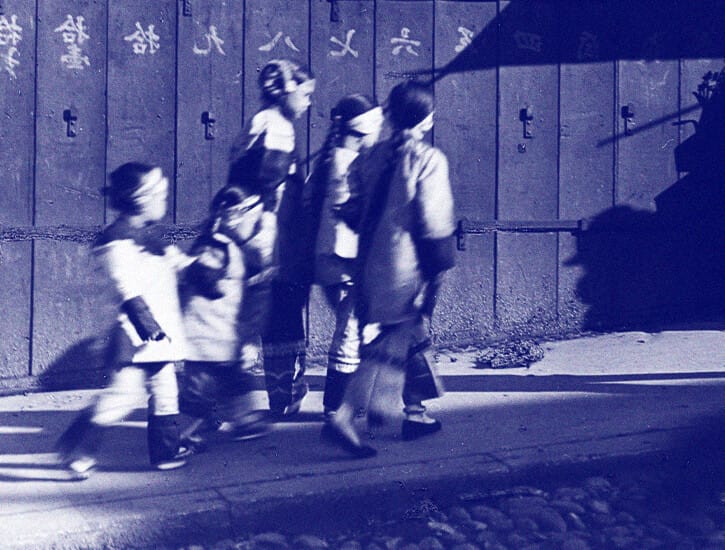
Scene from San Francisco’s Chinatown. | Library of Congress
My Dear You: Stories by Rachel Khong. Knopf, 240 pages. 2026.
Last fall, I went to visit a friend in Lima, Peru, a city where ethnic ambiguity and occasional Asianness are part and parcel of daily life. There, I underwent a mildly interesting if ultimately banal experience of race: As a biracial American—half Chinese and half white, an affiliation admittedly characterized in the United States by benign alienation more so than by the violence levied against many other minorities—I found myself in a locale where I could be said to resemble the average citizen. I have no real ties to Peru. My trip wasn’t a homecoming or cultural awakening of any sort, arguably just a coincidence of physical aesthetics. While I did occasionally bask in feeling like part of a racial majority, my time in Lima was dominated by one petty realization: I wasn’t at home here, but in the country I came from, I was perhaps even less so.
To travel I had taken time off from my entry-level publishing job, where I regularly field a melancholy strain of Asian American literary fiction made ubiquitous over the last decade. Spying translated editions of my employer’s novels on bookstore shelves, all the while attempting to cull any thoughts about my ballooning email inbox, I was overtaken by an urge to dramatize my pleasant racial reception in Lima using said works’ freighted, familiar style:
As I walked the streets of the southern hemisphere, strangers were open and interested in me. Warmth suffused my everyday interactions. I was inducted into the indiscriminate attentions of men. I even looked in the mirror less. My subclinical pathologies had historically included cisgender dysphoria, incoherence between my external and internal experiences, generalized insufficiency, inklings that I was fated to forcefully and inorganically insinuate myself upon the canvas of life where others encountered, experienced freely. Occam might attribute these aches and pains to my parents’ blunder, or my having been bald twice before the age of twenty. Now I was forced to reflect on the comparative flimsiness of my experiences back home, the remove and disregard I had accepted as just another facet of the unsavoriness of being. My blood ran cold. Could the culprit be . . . my race?
The characters in My Dear You, the first short story collection by novelist Rachel Khong, are all undergoing similarly belated, similarly ridiculous revelations about the ways life is refracted through Asianness. In the collection’s eponymous opening story, the newly deceased narrator (mauled and killed by an “old crocodile bitch,” mind you) discovers that in heaven, everyone gets to choose exactly how they want to look. “Skin color, nose shape, lips, and teeth—it’s all up to you,” she says. “All I had to do was drop the features into a shopping-cart-type basket, as though I were online shopping.” Everyone in heaven is reconfigured to the eternal age of thirty-three, “like Jesus,” a “hot age to be,” because, “yes: people in heaven are smoking hot.”
For a short while in the scheme of eternal time, the narrator revels in her “perfect features” and “fit, athletic physique.” She selects “fifty-four millimeters for the space between [her] eyes,” but isn’t “sure if [she wants] to be Chinese again.” In the end, she lets the heavenly program randomize her race and is “a little disappointed” to discover she’ll remain Chinese for eternity.
This racialized absurdity—blunt, often humorous, and just as often superficial—underpins many of the stories in My Dear You. So do the simpleminded, syllogistic voices of its first-person narrators, who churn out funny but ultimately vapid pronouncements with little narrative relevance. In the first paragraph of “The Freshening,” a cashier’s beautiful hair, “shinier and thicker” than the narrator’s, reminds her of Christopher Reeve’s Superman:
A strand of Superman’s hair could hold up a thousand-pound weight. . . . Superman’s hair, holding up the weight, looks as thick as a wire. A whole head of his hairs must have been heavy. But Superman’s neck was so strong, I figured, the weight of his head didn’t matter.
Much like the weight of Superman’s hair, many observations made by narrators in the first few stories of My Dear You don’t ultimately seem to matter: They are self-nullifying and, as you may notice, deeply preoccupied with the perception of beauty, racial categorization, and the feedback loop between the two. “She seemed youthful and careless,” the narrator of “The Freshening” goes on to say of the cashier with the Superman hair. “I guessed she was Filipina.” A few pages later, two “tall and unexpectedly handsome” men arrive at the narrator’s house to administer a federally mandated vaccine. “One clasped a clear plastic clipboard, and the veins on his hand bulged beautifully. . . . Sal’s skin was pale and his hair darker; Diego looked more Latino.” But the narrator’s mode of race-based voyeurism cannot last, at least not in this story. The vaccine will make the recipient perceive that everyone resembles the recipient’s own race and gender—even, say, the Wendy’s logo, which becomes black-haired and “yellowish” after the narrator is inoculated.
Rachel Khong is dedicated to generating narrative conditions under which race can be dissected ad infinitum, by whatever means necessary.
These goofy, lightly speculative setups make clear that Khong is dedicated to generating narrative conditions under which race can be dissected ad infinitum, by whatever means necessary. As far as “The Freshening” goes, its particular narrator’s neurotic attunement to the ethnic presentation of others may be justified. A needle poke is soon to eliminate all that is good and different, after all—if the anti-vax protests the narrator’s Asian-fetishist ex stirs up are any indication. But the impulse to excise everyone’s most salient physical features and drop them into their respective race buckets also feels like an expected artifact of Khong’s most recent novel, Real Americans, in which a Chinese-American-girl-meets-filthy-rich-white-guy love story becomes a meditation on the limits of personal agency. That book shares, in addition to My Dear You’s speculative bent, an obsession with cataloging the variable desirability of its characters, often along racial lines.
This isn’t the only thematic resemblance between the two books. Even in stories where characters aren’t so bluntly taxonomized on the physical level, My Dear You maintains a strict division between haves and have-nots—the coveted resource in question being a rigorous sense of personal identity and seeming protection against bouts of profound shame. In “Slow and Steady,” one of the collection’s few non-speculative stories, narrator Sophie emerges from a round of Seven Minutes in Heaven with the charming and self-assured Gabe—who only dates “rich girls with clear blue eyes and long soft hair”—afflicted by a familiar longing to be “someone different, someone better.” This kind of longing is the lifeblood of My Dear You, as it is of Real Americans. “So often, I wanted to be a different kind of person,” Lily Chen, one of the latter novel’s three narrators, similarly remarks. In the process of sorting through my material to write this review, I was certain Lily’s remark in Real Americans was actually coined by Sophie—perhaps as a result of my own inattention, perhaps because Khong’s characters are so amorphously and interchangeably afflicted.
Khong seems fundamentally unconcerned with assigning origins to this painful dislocation, and her subjects’ emotional landscapes are rarely brought into sustained focus. What insight we do receive comes in brief and definitive outbursts like those of the narrator in “Red Shoes”: “Every day of my life, I wish I knew what to do.” This wish to know and clarify a way, any way, forward, may be the book’s most telling declaration of all, because the vagueness and ambivalence of desire shared by its central characters—all Asian, all female—feels at once deeply pointed and fiercely aimless. While My Dear You also dabbles in moments of tenderness and more run-of-the-mill meditations on sexual racism, it is this condition of uncertainty the book seems most desperate to impart. The condition is not the effect of being an immigrant, nor the chronicled progeny thereof, but a base melancholia tangled up in Asianness as an irrevocable existential position, almost completely divorced from historical culture and thus practically qua ontology.
The various struggles Khong depicts have so little to do with national identity or assimilation that they beg the question: Can anyone be Asian? Real Americans attempted to formulate an answer by establishing that its tortured main characters, including Chinese American Lily and her white-passing son Nick, are culturally indistinguishable from their WASP compatriots. “I was as American as they came,” Lily reminds herself on her first date with Nick’s white father. Likewise in My Dear You, legitimacy as an American citizen seems to offer little help in dampening the low-hum unease and secondary inertia of essential difference. The strategies Khong uses to bring this dizzying state to life are varied, but almost all of her attempts demand some flavor of the supernatural, extraterrestrial, or divine. Some characters in Khong’s book are literally alienated; in “Colors From Elsewhere,” the narrator learns she belongs to an earthbound alien race called the Acela. (“The train was actually named by one of us. A nod.”) Others, as in “Tapetum Lucidum,” can’t speak Chinese but see ghosts no one else can.
All of these stories invoke some version of that nightmarish ambiance in which you are speaking but no one can hear you. They descend from Khong’s greater thematic lineage, which tracks a uniquely Asian variety of impotence in the face of aspirational normalcy. Like the evasive declarations of vulnerability in My Dear You, Real Americans includes a suite of dramatic but misty self-denouncements. In a letter to his estranged father, Nick Chen writes: “Regular people know what they want. . . . They have feelings and impulses and they act on them—or so I assume. I search the Internet for ‘how many slices of pizza is it normal to eat.’”
Nick is implied with some sci-fi flair to be a near total genetic copy of his white father. He is blond-haired, blue-eyed. His mother, monolingual and raised on “meat loaves and tuna casseroles,” has no relationship with Chinese culture, and yet Khong seems to argue that Nick’s self-conception as a “freak of nature” who “would never be normal” makes him as Chinese as any American can be.
While the scenarios presented in My Dear You are fairly creative, the fundamental theory Khong seems to develop across her works is of Asianness as chronic imaginative failure. (“I don’t know how to be, or who I am,” Nick shouts in a shudderingly earnest response to Lily’s tearful appeal that her mission as a mother had been to allow him “to choose everything for himself. To have real choices.”) Proximal to everyday power structures, the characters in My Dear You are frequently invited to partake in all the rituals of American individualism and self-fashioning. They just can’t seem to figure out how to.
This inertia of the will is Khong’s contribution to a troubled genre. Academics and essayists in the West have undertaken acrobatic attempts to locate an ontological Asianness, identifying melancholia (Anne Anlin Cheng), dissociation (David L. Eng and Shinhee Han), and inborn feelings of minor character (Cathy Park Hong) as defining characteristics thereof. Other ventures have theorized Asian femininity as ornamentalizing more so than objectifying (Cheng, again) and, most recently, expanded Asianness as an existential category to encompass the flow of online information capital (Danielle Wong).
This same period has also witnessed an unprecedented Asian American literary heyday. Readers tuned into the landscape of Big Five contemporary fiction, or observant of elaborate bookstore displays, will likely date this belle epoque to the late 2010s and early 2020s. These were peak years for the likes of Ocean Vuong, Ling Ma, Celeste Ng, Charles Yu—novelists intent on documenting an experience seemingly inextricable from the identity-first soil in which it was rooted.
Why were equally deft Asian American writers of the previous two decades—Chang-rae Lee and Ruth Ozeki come to mind—not received with similar fanfare? One possible explanation, if a bit linear, is that they were simply too early. It wasn’t until the sunset of the Obama era that the signature literature of the Asian American moment finally crystallized, during the apotheosis of a now-too-familiar strain of representational identity politics. Of course, one could argue that this consolidation was due to a newly critical mass as much as a nascent political moment: From 2000 to 2019, the Asian population in the United States nearly doubled. The explosion can’t be attributed solely to an influx in immigration; diasporic Asians have been on the decline relative to their U.S.-born counterparts for the entire twenty-first century. What has resulted is a veritable Asian America.
The Trump presidency and its associated traumas pushed minority groups to double down on identity-first politics, and Asian Americans leveraged this strategy in every arena, not just literature. These were the days of Andrew Yang, of Oscar wins for Parasite (Asian rather than Asian American, but celebrated as if the latter), of slogans like “Yellow Peril Supports Black Power” ahistorically and cringily misapplied. While Asian Americans were certainly not the only group to avail themselves of peak identity politics, the difference lies in their unwieldiness as a coalition, united by a set of dubious aesthetics and with few material causes to rally behind. The push to assimilate Asian American lit to the last gasps and heaves of the “Hope” era thus enabled aching, lyrical works with somewhat flimsy subject matter, like On Earth We’re Briefly Gorgeous and Crying in H Mart, to coast through the decade or so that followed with considerable acclaim.
That moment in the literary limelight is over, to put it plainly. With the culture’s growing resistance to identity politics, endemic tropes—tepid parents, where are you really from?, fruit and eyelids in general—have become objects of chagrin to not only edgelords but also former sympathizers, newly woke to the thinness of these depictions. Relative to its peer minority literary movements, Asian America was quite late to the party, and with every passing year that gasping heyday reads more and more like a burst of terminal exuberance, portending the ultimate flatline.
Where Asian characters once wept about being ciphers, they now dress their degraded position in a clown suit of irony and make a gag of it.
Khong wants readers to know that she has heard this death knell. The obtuse, though often funny, narration in My Dear You’s opening stories may well be a defensive crouch anticipating the kind of critique launched against her woke-era predecessors, Khong herself included. Her work has consistently followed similar themes of racially coded dissociation, but the tonal shift in My Dear You is remarkable. Whereas Real Americans and her more intimate debut Goodbye, Vitamin drip with sincerity, Khong’s depictions of racism and alienation in My Dear You can only be described as sardonic. As if knowing her Asian characters are destined to experience dehumanization, whatever the form, Khong doesn’t bother to enumerate these encounters with much sympathy or detail. “I feel like something’s wrong with [men who date Asian women],” one of about twenty Asian women who learn they’ve all been courted in the same way, by the same white guy, says in “The Family O.” “Like they can’t manage to date white women. They have to drop down to our tier. Is that self-hating?”
This is a telling, repudiating reaction to a dead mode of representation. At times it feels hasty—the body is still warm! At times it also feels like more of the dreaded same. In my most generous reading of My Dear You, Khong’s dismissive posture results from her own certainty that she’s hit upon an effective way to impart exactly what, within Asianness, stubbornly resists expression. Her instinct isn’t completely off; the melancholia she depicts in My Dear You is often moving. Less generous, and equally possible: She is the latest torchbearer in her subgenre’s time-honored tradition of meeting the moment wherever it may or may not be, at the ultimate cost of conviction.
Where Asian characters once wept about being ciphers, they now dress their degraded position in a clown suit of irony and make a gag of it. Both conditions nevertheless require that the subjects remain ciphers. Given the sorry state of the Asian diaspora’s literary output (and of contemporary literature, it must be said), My Dear You is a bit like Apollo 11 in that Khong is essentially rocket-launched into the vacuous space left by her predecessors with the hope of landing on the moon. I commend her good humor about the whole situation, and her willingness to satirize an experience historically approached with lethal sobriety. But just because something is unprecedented doesn’t make it altogether triumphant. As it stands, the collection proves more demoralizing and less thought-provoking with each consecutive story, if only by sheer accumulation. Could the culprit be . . . utterly inescapable? Is the orientalized other condemned to live out existence lite?
For most of the book, My Dear You doesn’t exactly lavish the reader in alternatives. Fiction is the medium of possibility, but Khong is prone to leveling her characters, tabula rasa. What does it say that a wave of God’s hand and semipermanent hallucinogenic injections are the book’s available reprisals to debilitating racial melancholy? Khong’s narrative philosophy toward her own subjects’ despair is well encompassed by the narrator in “The Freshening” as she listens to a party drug–induced orgy decimate her dead mother’s home: “What could I do? The damage was already done.”
Halfway through My Dear You, a volte-face. After tantalizing disaffected readers with irony, hijinks, and narration by the seemingly concussed, Khong sets out to reverse the hole she has dug her Asian characters into. Now there is friendship and sincerity in, if not spades, spoonfuls.
Khong’s collection doesn’t make leaps and strides, but by performing what may be a necessary exorcism, it does ready the fragile barge of its genre for a reversal of course.
Interestingly, this turn accompanies a change of setting: For a moment, we occupy Asia proper. First, a Chinese saleswoman in Shenzhen speech-trains a sex doll equipped with an LLM-powered voice box, then uses her entire savings to save said doll from life with a Chinese American in Ohio. Saleswoman and doll end up on the beach together, pineapple bevs within reach, “happy.” In another story, we arrive in the Malaysia of Khong’s birth, where an ethnically Chinese girl who calls herself Melati is fresh to factory work. Her coworkers are possessed, one by one, by spirits that may or may not live in the company toilet. It is the 1980s, and her best friend from childhood, a Malay girl named Cecilia, is dying of AIDS.
These are among the most moving stories in the collection, fully realized and graced with something intangible—hope, perhaps. In the latter story, “Good Spirits,” Cecilia is already doomed, but the two friends’ mutual recognition allows an alternate reality to be imagined into being. “Say it had all gone differently,” Melati muses on their shared childhood before launching into a page-long hypothetical that is some of the most breathless, promising prose in the book. A byproduct of this kind of imagining is a sense of certainty and conviction Khong’s characters otherwise famously lack, a guiding philosophy. God and hallucinogens need not intervene. In Melati’s vision of another, fuller possible life, she is forever trailed by a tiger: “Having an unknowable beast for a shadow means I never forget what is true, that I am always only seconds away from the whim that ends me, that it is a miracle and a mercy that I am here at all.”
My Dear You could have benefited from this kind of eternal specter. I don’t think it’s a coincidence that most of the collection’s best stories take place across the Pacific pond, where Khong must invest in a mise-en-scène without the American-grown buttresses of irony and racial taxonomy. This isn’t to say that these stories are humorless or bereft of Khong’s cheek and charm, just that they are more ambitiously imaginative—and attuned to a context. The best satire keeps its object on a tight leash, never letting it out of sight. Khong’s broader collection seems to want to tie the sincere, if flawed, efforts of the last few years up outside and forget they exist. In a gesture that resembles Khong’s orientation toward her characters, there is a somewhat bloody effort here to wipe the slate clean. Khong thereby denies the significance of her earlier, more earnest work. She replicates the disembodied and ahistorical blunder that ran Asian American fiction into the ground in the first place.
Still, if the existential condition we call Asianness—at least as it manifests in the diaspora—is one of imaginative failure, then the recognition thereof, and the resistant fantasies of those like Melati, may be most liberating thing My Dear You can offer. In Melati’s alternative imagination, the businessmen “never take the land, never excavate it, build onto it, never disrupt the wading birds or Komodo dragons. Or the spirits.” She continues to describe the ripple effects in the negative:
Cecilia’s kampong doesn’t vanish. She never leaves home to work in the microchip factory and I never leave to work on rubber gloves. Cecilia doesn’t become pregnant for the reason she won’t tell me. She doesn’t scream from nightmares, or water her pillow with tears. The spirits don’t attack us because they have other concerns: preoccupied with their own dramas, as we are with ours.
On its own, the passage is spare. But just a section prior, Melati has spared no detail enumerating the devastating reality: that developers have seized the land, razing entire villages and the trees the girls played in along with them. The destruction has extinguished the native gibbons and birds and will, soon enough, claim her beloved Cecilia. The alternate reality’s emotional force derives precisely from this act of historicizing, this location in time, place, and politics. It’s the very gesture that the last decade’s aestheticized grasp at Asian American representation neglected, and through it, tigers and tamarind wood are elevated from threadbare symbols of otherness into something truly capable of being lost.
At its best, My Dear You is the bleaker of these two complementary and ultimately triumphant passages writ large, a blow-by-blow of the missteps of the genre it attempts to critique. Khong’s collection doesn’t make leaps and strides, but by performing what may be a necessary exorcism, it does ready the fragile barge of its genre for a reversal of course. So, on the question of Asian American fiction: Say it had all gone differently. My Dear You bears the burden of knowing it didn’t, but that doesn’t stop Khong from beginning to imagine.