, February 5, 2026
Shakespeare in the Bardo
The death, and endless rebirth, of William Shakespeare
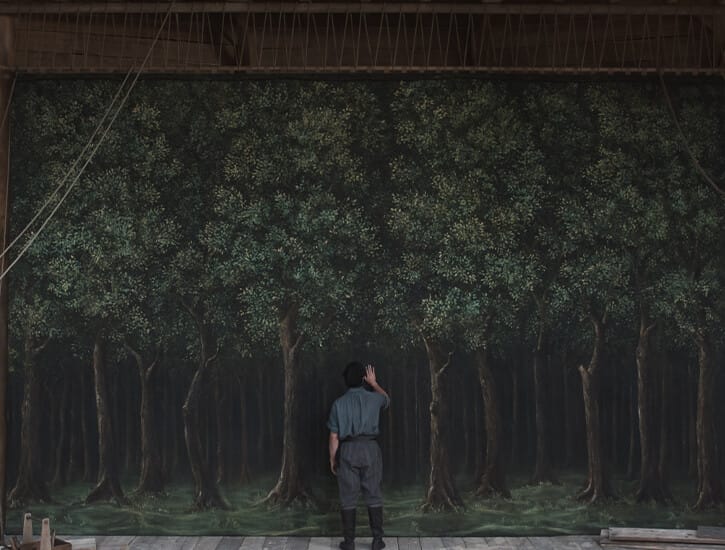
Still from Hamnet (2025). | Focus Features
The Tibetan Buddhist conception of death and dying invokes a liminal space, a kind of purgatory, called the bardo. Unlike purgatory, however, one graduates from this in-between not to hell but to rebirth. Death is not the end. It is a phase in the cycle of samsara as meaningful as life. There are many stages of the bardo, such as the struggle and pain of leaving the physical body, a difficult labor much like birth, and the process of becoming one with the universe before your next incarnation.
George Saunders’s novel Lincoln in the Bardo imagines Abraham Lincoln entering the bardo for one last communication with his dead son. In this story, grief becomes an alchemical solution that thins the membrane between life and death, making us feel closer to our lost loved ones. In Maggie O’Farrell’s novel Hamnet, William and Agnes Shakespeare become suspended in grief as a fetus is suspended in a sac of amniotic fluid. After their son Hamnet dies of the plague, the normal, forward momentum of survival breaks down, and they—and we—shake loose inside time, rattling around like teeth in a cup. Saunders imagines Abraham Lincoln in a more explicit bardo as he visits the graveyard and speaks with the ghosts who people it. The Shakespeares’ bardo is less literal but similarly timeless—a grieving field that is endless, with no distinct stages or landmarks, only a vast disorientation.
Our lack of knowledge about Shakespeare as a man, and our distance from his world, make it easier for us to fill his spaces with our own imaginings.
Hamnet director Chloé Zhao, who studies Tantric Buddhism, describes working on the film adaptation of O’Farrell’s novel in an interview on NPR as creating a series of defined “containers” for the actors within which they could feel safe to let their emotions expand and become “wild.” She likens this philosophy to Shakespeare’s plays, which also create a series of containers to be filled by the actor’s emotions, ideas, and bodies. While the same could be said of any playwright (dramatic writing is by necessity incomplete until it possesses the actor’s bodies), our lack of knowledge about Shakespeare as a man, and our distance from his world, make it easier for us to fill his spaces with our own imaginings. Like Greta Garbo’s famously mask-like face, instead of answers, it gives us back our own questions.
Both writing and film are time-based art. They move forward through time; our own lives pass as we read, and we die a little with every TikTok video. But there are strategies that allow us to slow down and contemplate, to appreciate life and to observe its passing, irrespective of what stage we are meant to be in. Zhao makes us slow down largely through her painterly aesthetic—long shots of dark woods and ferny underbrush. This muddy, Pre-Raphaelite gorgeousness, however beautiful, at times weighs the film down, mantling its star, Jessie Buckley, an actor whose face is the most marvelously mercurial seen on screen since Clara Bow.
In the novel, O’Farrell slows time further, splitting the story into two timelines: one shows the boy Hamnet growing like a vine into life, while the other introduces his mother, a strange girl whose own mother emerged from the woods like a fairy. Interspersed chapters break the tyranny of biological chronology. Hamnet, unable to find an adult to help his sick sister, climbs into bed with her and hopes death will take him instead (it will). Meanwhile, his mother meets his father (the young Will Shakespeare is a tutor in Agnes Hathaway’s house) and they copulate ecstatically on a crate of apples. In a form of samsara, Hamnet enters the bardo of dying at the same time the star stuff he is made of sparkles into life in his mother’s womb.
In the story, the boy Hamnet himself enters a bardo. This is represented in Zhao’s masterful mise-en-scène as a stage-backdrop of the real woods around Stratford where Hamnet grew up. The woods are wild and deep, yet tamed somehow, as in Plato’s theory of mimesis, where we are said to experience life as a copy of the real thing (he also viewed art as a degraded copy of the copy, a philosophy with which Zhao could certainly disagree). In the center of the painted woods is a dark, arched doorway. Hamnet, at first, appears to fear the darkness on the other side of the door, “the undiscovered country from whose bourne no traveler returns.” And yet, in Shakespeare’s play, that is exactly what happens.
In Shakespeare’s Hamlet, the dead come back to communicate with the living quite literally, in the form of the ghost of Hamlet’s dead father. One of the central conceits in Hamnet is that the play itself is an act of reincarnation, bringing the boy back to life in the Danish Prince. The most powerful moment in Zhao’s film is when Agnes, a country girl all her life, watches the first performance of Hamlet in London. At first, she is confused and distressed, thinking the actors on stage are mocking her son’s name. But then the actor playing Hamlet comes onstage, a young man very like Hamnet in his coloring and looks. We are reminded (unnecessarily, we are already there) of the scene where Hamnet tells his mother he will grow up to go on the stage with his father. In a kind of emotional double-exposure, Agnes experiences the play-as-play while also having a vision of her beloved child now grown and alive. When the character of Hamlet dies onstage, it is Agnes who breaks the fourth wall, reaching out to clasp the actor’s hand. Tears spring into his eyes, and he looks out over the audience to see them weeping, clutching at their clothes, and then, with Agnes, reaching out for him to give him comfort in death. As the camera rises gently above the audience, we see them as a great wave, divided from their loved ones by death, yet united in grief.
Yet the story of Hamnet is not just one of creative rebirth. We have seen plenty of stories like this, where the (usually male) protagonist churns loss into some kind of sculpture molded out of butter. Yet rebirth is, if you follow the idea of samsara, not just metaphorical but literal. Hamnet is remarkable for privileging Agnes’s story and the perspective of women, particularly mothers. There are too few creative works that make childbirth their subject, let alone evoke the pain of labor that brings a woman so close to death herself. In the moments before giving birth, a woman must accept her own mortality, must even welcome it if that is the deal required to bring what is within her into the world. There are parallels here, of course, to the creative act. Both O’Farrell and Zhao make birth the central crisis of the story. Onscreen, Zhao makes the birth of Hamnet as bloody, harrowing, and heroic as any battlefield drama.
Through O’Farrell and Zhao, Shakespeare’s work is reborn, as it has been throughout a long history of reinterpretation. Some of these interpretations do little more than slap contemporary clichés on Shakespeare’s stories. I’m thinking here of a particularly onerous Two Gentlemen of Verona done in the style of Pirates of the Caribbean—at least, I ask you, let it be Pirates of Penzance. A Shakespeare story should do more than simply use his material; it should tell us something about the plays or about ourselves.
Hamnet does a bit of both, but in both novel and film, the dramaturgical moment is very slight. We want to know more about how Shakespeare’s loss affected the creation of Hamnet. It is fitting that O’Farrell begins the book with an epigraph from the essay “The Death of Hamnet and the Making of Hamnet” by Stephen Greenblatt. Through books like Will in the World and the subsequent Hamlet in Purgatory, Greenblatt studies Shakespeare’s influences in order to make the playwright’s lost metaphors, bawdy jokes, and political skewers sing out again. The plays, under Greenblatt’s eye, are not dead things on the academic slab but lively puzzles that tell us not just about Shakespeare but about humanity.
Shakespeare is no longer just a playwright; he is an industry. Beginning with the waning golden age of the theater in the late nineteenth century, Shakespeare became the property of academics, transformed from entertainment into high culture. In the mid-nineteenth century, Shakespeare was popular culture. In Walt Whitman’s New York City, audiences were rarely literate yet usually had the plays memorized from seeing them in person so often. Everyone was a critic, so much so that a poor performance might be punished by a hail of garbage thrown down on the theater (and much of the audience below) by the “gallery gods” in the nosebleeds. A poorly fought duel was an invitation for a strapping young fireman, a real Mose type, to climb onstage and take over a timid actor’s part.
Contemporary works like Hamnet also make Shakespeare entertaining. However, they usually do so by cutting almost all of Shakespeare’s actual language. His work is reconfigured, sure, but frequently bears little resemblance to the original. On the other end of the spectrum, academic treatments of Shakespeare’s life often try to understand him in negative, building up a scaffolding of facts around the man and his work. In this tradition, we have books like Daniel Swift’s new history, The Dream Factory: London’s First Playhouse and the Making of William Shakespeare.
Like the work of many other Shakespeare historians, The Dream Factory proposes to tell us something about Shakespeare’s life and works through meticulous, obsessive attention to the minutiae. Swift, an associate professor of English at Northeastern University London, argues that we can understand Shakespeare by better understanding how the theaters that put on his work were built. It is largely about the Burbage family, who were responsible for the creation of the Globe Theatre, where Shakespeare got his start. The best parts of Swift’s study are the moments where he explicitly connects details about the creative economy to Shakespeare. Usually, these are moments when he focuses on working people, the players who roil up hilariously between Shakespeare’s tales of the great and powerful. We learn, for example, about the group of “rude mechanicals” in A Midsummer Night’s Dream: “Since the nineteenth century, editors have noted that Bottom takes his name from the core upon which a weaver winds his thread, that Flute is suitable for one who mends instruments, that a Quince is a carpenter’s wedge and that a Tinker might well mend the snout of a kettle.” Where these facts fall short, however, is in their insistence on remaining minutiae. How, one wonders, does this help unlock something interesting about Shakespeare’s plays? How might we play these parts differently, knowing this? This is not Swift’s goal, but his research is so exhaustive, and his interest so sustained, that one sometimes wishes it were put to better use.
These works benefit from being in conversation with Shakespeare, and we do too. Shakespeare is a common language.
Swift’s commitment to making something more out of ledgers and legal documents is admirable. It takes fortitude—and funding—to spend years mudlarking through the middens of a former world. Though admirable for its stamina, readers might come to the end of The Dream Factory still asking, “So what?” The book could use far more of Swift’s voice, which, when it comes through, is funny, smart, and ironic. However, like many historians who seek our noble literary father in the dust, the work makes Shakespeare seem deader than ever.
The Dream Factory constructs Shakespeare’s world again, board by board. Hamnet creates a thoughtful, female-centered narrative of grief and motherhood. They have a stake in the Shakespeare industry, yet Shakespeare himself is only a bit player. Perhaps this is the point. Writers from Nathaniel Hawthorne onward, especially in America, have worried about the long shadow cast by Shakespeare. When Harold Bloom writes about the “anxiety of influence”—the artist’s desire to repudiate her forefathers—Shakespeare seems to be impossible to shake. Yet these new works are explicitly in conversation with him. Would we prefer a book about the incompatibility of art and commerce in the Elizabethan Age? Probably not. Though the thesis, as Swift intends, has high stakes for our own artistic futures. Would we prefer a story about a wild young woman who loses her son and whose husband writes a play sort of about it? Probably not. These works benefit from being in conversation with Shakespeare, and we do too. Shakespeare is a common language.
In Zhao’s film, we hear that language and, because we have been through Hamnet’s story with Agnes, we understand more deeply what the players are saying. Rather than approach the language as a difficult text, we get to see Shakespeare’s work reborn in the bodies of the actors, and we are prepared, just as the audience in the film, with an understanding of what lies beneath the words. Shakespeare’s dazzle can distract us from the meaning of the words, and in Hamlet in particular, we get to hear the character and Shakespeare thinking out loud. The film helps us see Shakespeare not only as the words of a dead white man, but a container into which we can pour our own ideas and feelings: the grief of Agnes, the cinematic vision of Zhao, O’Farrell’s passion for privileging women’s stories in history, the disorientation of living in a post-Covid world that never truly mourned, the rupture in social norms at least as violent as those seen in Shakespeare’s time. Shakespeare has great staying power because he is a poet of life. His plays collapse time and distance and remind us to linger in the in-between spaces, the rhetorically grey areas, the excruciating moments of uncertainty before we make up our minds. We make and remake Shakespeare, as in the cycle of samsara, he is not dead but is becoming one with the universe. Shakespeare lingers in the bardo, preparing to be reborn.