, April 28, 2026
Red Noir
The progressive pulp fiction of Jim Thompson
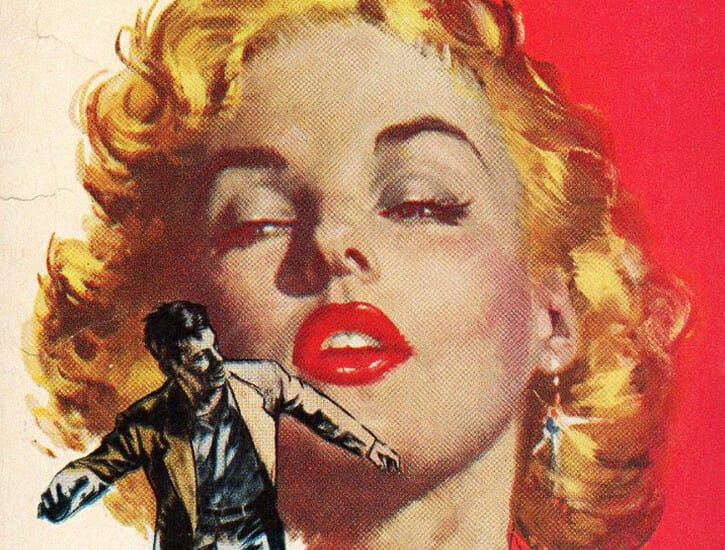
Cover of Recoil by Jim Thompson (1953). | Paperback Warrior
Jim Thompson: Five Noir Novels of the 1950s & 60s edited by Robert Polito. Library of America, 814 pages. 2026.
Given the masculine brutality endemic to noir fiction, it’s hardly surprising that many readers associate the genre with conservative, even right-wing, politics. From Mickey Spillane to James Ellroy, this enormously popular form revels in callous cops and private eyes who maim and kill in the name of truth, justice, and the American way. Ellroy’s loathsome self-appointed title “white knight of the far right” indicates that noir’s ideological reputation is at least somewhat performative if not completely deserved.
As the new Library of America edition of five Jim Thompson novels indicates, some crime fiction stands in vexed relation to the nation’s longstanding fascination with violence. Oh, Thompson’s novels are certainly bloody: Each title delivers copious acts of theft, assault, rape, and murder. Most of his protagonists are narcissistic sociopaths who commit unspeakable acts. But for all his characters’ cruelty, Thompson was reluctant to employ pulp sensationalism merely to perversely affirm the dominant social order. Unlike James M. Cain, Thompson doesn’t understand American crime fiction as underwriting a need to punish the lowly and disenfranchised, or pander to “law and order” rhetoric. It’s hard to imagine Thompson writing a novel like Cain’s Double Indemnity which ends with scheming adulterers Walter Huff and Phyllis Nirdlinger committing suicide rather than face imminent arrest and prosecution. To the contrary, Thompson tended to specialize in narratives that subvert the genre’s conservative tendencies. As crime novelist Nick Kolakowski recently argued in Ink-Stained Wretch of Thompson’s most famous work, “You’ll never look at cops the same way again after reading The Killer Inside Me.”
For all his characters’ cruelty, Jim Thompson was reluctant to employ pulp sensationalism merely to perversely affirm the dominant social order.
Thompson recognizes noir as a genre whose violence is, in certain respects, a means of acknowledging inequities and injustices. Often characterized as a pop existentialist, the so-called “dime-store Dostoevsky” was a socially aware novelist who once belonged to the Communist Party and helped run the Oklahoma John Reed Club, a group of leftist artists and writers active in the early years of the Great Depression. While Thompson’s first novel Now and On Earth (1942) conformed to the proletarian literary aesthetic associated with the Communist Party, he found in crime fiction a form equally capable of addressing the plight of the American poor and marginalized. Set mainly in small bankrupt towns (Manduwoc in The Kill-Off [1957]) or in the uneasy edges of big cities (a San Diego beach burg in The Getaway [1959]), Thompson’s noir novels demand that the reader attend to figures like the penniless writer in Savage Night (1953) or the many workers who owe money to Pay-E-Zee Stores in A Hell of a Woman (1954).Thompson’s characters often lose their jobs (Bill Rhodes’s father in A Swell Looking Babe [1954]); others barely have enough to eat (Mona Farrell in A Hell of a Woman). With rare exceptions, Thompson almost never represents wealthy characters like the Sternwoods in Raymond Chandler’s The Big Sleep (1939)—or, to turn to film, like the character Noah Cross in Roman Polanski’s Chinatown (1974). Thompson was one noir writer who usually preferred to write about life on the wrong side of the tracks.
Sensitivity to the downtrodden informs the work collected in the new edition of Thompson’s oeuvre. Editor Robert Polito signals his emphasis on the novelist’s leftist background by including in the volume essays and stories from the 1930s. “Gentlemen of the Jungle” (1931) profiles three homeless men living near an anonymous Texas river while “A Night with ‘Sally’: A True Story” (1936), a work of reportage, focuses on a penniless Nebraskan struggling to survive in Omaha. Other stories like “Snake Magee and the Rotary Boiler” (1939) depict the life-threatening danger of manual labor. “A Road and a Memory” (1930), the one poem included, also stresses the importance of working-class life, if in a more rural autobiographical vein.
These miscellaneous short works set the tone for the five novels included in the volume, all of which represent the United States as a nation of corrupt authorities, terrifying criminals, and vulnerable citizens. With the exception of The Grifters (1963), these works maintain a focus on the needy and the indigent. In A Hell of a Woman, Frank “Dolly” Dillon barely makes it as a salesman; his near-subsistence existence leads him to theft and homicide. After Dark, My Sweet (1955) centers on William “Collie” Collins, a homeless ex-boxer with few options other than crime. By contrast, The Getaway and Pop. 1280 (1964), focus on protagonists like “Doc” McCoy and Nick Corey, middle-class men whose illicit activity leads them to interact regularly with impoverished and persecuted Americans. While the novels rarely include the overtly leftist indictment of poverty found in the conclusion to “A Night with ‘Sally,’” it is abundantly clear that, to borrow from Polito, “Nearly everything good that happened to Jim Thompson as a writer . . . came about as a result of his involvement with the radical left.”
That his novels came out of his political conscience is hardly to deny Thompson’s extraordinary understanding of human psychology. Noir fiction and film is often described as an attempt to explore the question made famous by the 1930s radio show The Shadow: “What evil lurks in the hearts of men?” and psychological complexities figure prominently in the genre’s fascination with malevolence. But Thompson, arguably more than any of his peers, recognized that a double helix of oppressive social conditions and mental instability often undergirds and informs evil behavior. Raised in Oklahoma by a petit-bourgeois father (and smalltime sheriff) whose affable personality masked a perverse attraction to power, Thompson used crime fiction to critique a society that condones unstable and violent misanthropy so long as it upholds the status quo. While his savage protagonists never urge social change, they do expose this corrupt compact by committing criminal acts that reflect the fear, irrationality, and bloodletting central to modern life. For this talented postwar writer, noir constituted the twisted literary progeny of Marx and Freud, thus providing a uniquely powerful means of depicting the nightmare that shadows the American dream.
A Hell of a Woman and After Dark, My Sweet thus center on vicious male protagonists who suffer from traumas ranging from child abuse to homelessness, and narrate their stories in fragments because their pasts are quite literally broken. In A Hell of a Woman, Dillon, the unsuccessful salesman, suffers a mental breakdown after he murders Mrs. Farrell but then fails to frame a local worker for the crime leaving himself vulnerable to arrest. Experimental in form, the novel splits into two competing first-person narratives as the collapse of Dillon’s plan results in his insanity. The virtuoso end of the novel provides an uneasy composite of the two voices, typographically literalizing Dillon’s psychological crisis: “And, then, nice as I’d didn’t want it, all I had to give. she began laughing, screaming. been, she started laughing. Screaming at me. I threw myself out the window.”
In After Dark, My Sweet, William “Collie” Collins, an ex-boxer on the lam from an “overcrowded,” “understaffed” asylum that hadn’t done him “much good,” wrestles with his precarious mental health as he finds himself ensnared in the machinations of Fay, an attractive widow, and her associate Uncle Bud. Bud, a criminal planning to kidnap the diabetic child of a wealthy local family, exploits the vulnerable “Collie,” until the former fighter turns on him. With “a barrel of nerve and a pint of brains,” to quote Fay, this typically troubled Thompson protagonist reacts violently when pushed too hard.
The Grifters’ account of the relationship between mob associate Lilly Dillon and her conman son Roy pulls the reader deep into a different type of psychodrama. Viewers only familiar with Stephen Frears’s cinematic adaptation will hardly be prepared for how Thompson tracks the pathological dynamic from Roy’s unsettled childhood to a fatal final encounter. Rewriting the Oedipal drama as a gritty tale of smalltime hoods, Thompson revels in every tie binding together a neglectful but infatuated mother and a resentful, if libidinally invested, son. By the time Roy reaches his teens, Lilly finds him attractive: “He began to note . . . a suppressed hunger in her eyes when she looked at him.” For his part, Roy finds himself drawn to women like his lover Moira Lantry, who look a good deal like Lilly. Little wonder, then, that Moira eventually accuses Roy of an incestuous relationship. “It’s your mother,” she shouts. “one of those keep-it-in-the-family deals! That’s why you act so funny around each other!” Here the horror of illicit family relations underwrites and reflects Lilly and Roy’s shared investment in crime.
The Getaway’s hard-luck hero is Carter “Doc” McCoy, an all-American charmer whose charismatic persona—he’s described as “one hell of a guy”—belies a sociopathic psyche. But Thompson broadens his focus in this novel. As Doc and his moll Carol desperately attempt to escape a national manhunt after a homicidal robbery, the institutions integral to American capitalism—particularly the financial and legal systems—appear as horrifying as the criminals who stand outside the social order. The narrator hints at this by informing us that the small-town bank targeted successfully by Doc at the beginning of The Getaway is uninsured by the Federal Reserve and pays “little or nothing on savings” accounts to its mostly rural customers. The novel’s representation of the police’s treatment of the underprivileged makes this institutional critique even more explicit. Consider, for example, the narrator’s description of the large farm family Doc and Carol accompany westward. Broke, unhoused, and vulnerable, these perpetual migrants “had no hope of anything more, no comprehension that there might be anything more. In a sense they were an autonomous body, functioning within a society which was organized to grind them down. The law did not protect them; for them it was merely an instrument of harassment.” Doc finds the anonymity of the family valuable because it protects him and Carol from the authorities. Yet, tellingly, Thompson also forces the reader to register the source of this family’s near-invisibility: a juridical system that exploits them, “moving them on when it was against their interest to move, or detaining them where it was to their disadvantage to stay.” The powers that be are no less deceitful and cruel than these murderous thieves.
Thompson punches this point home in the closing sequence, wherein Doc and Carol escape the United States for the surrealist purgatory of El Rey’s kingdom, a Mexican enclave where criminals find refuge from the law. Blessed with tropical weather and reasonable prices, the kingdom seems idyllic until Doc discovers that all inhabitants pay exorbitant fees to keep their money in the local bank. These fees increase if money isn’t withdrawn and spent on a regular basis. The financial pressure informing life in El Rey’s world unsettles Doc, but what proves far more terrifying is the fate of those who can no longer pay their way: They are exiled to a nearby village where they either subsist on the recently deceased or become food themselves. A local policeman explains that the cannibalistic policy is an ironic commentary on these criminals’ former activities. To survive, “one need only live literally as he has always done figuratively.” But this nightmarish vision is also an assessment of a society that will “grind down” the poor and the working class. In their theft and bloodletting, the lawbreakers doomed in El Rey’s kingdom reflect the vicious practices of American capitalism. From the opening bank robbery to the closing threat of fatal bankruptcy, The Getaway urges the reader to ponder how in the United States, no one can escape the self-imprisoning and self-destructive forces of greed.
Thompson suggests that noir only reveals the evil lurking in the hearts of men to shine a light on the evil that informs the institutions men create—institutions whose most fundamental crime is the terrifying perpetuation of inequality in the name of profit and power.
Doc McCoy looks towards a nightmarish fate at the closing of The Getaway, but Sheriff Nick Corey, the equally charismatic and criminal protagonist of Pop. 1280, cons his way into a successful law enforcement career as local sheriff through a keen understanding of how unofficial and official institutions rely on pathological savagery. The bitterly comic novel chronicles how Nick steals, murders, and commits adultery while convincing the small town that he is an upstanding lawman. Published in 1964, at the height of the civil rights movement, but set in the 1910s, Pop. 1280 engages explicitly with Southern racial politics. When Uncle John, an elderly black man, stands accused of killing Tom Hauck, a generally despised white man, Nick, the ever-candid, if monstrous, first-person narrator and actual murderer, explains the terrible logic of white supremacy. “Tom Hauck was completely no good, and the community was well shet of him. But they’d still lynch Uncle John. It would sort of be their civic duty, the way they’d see it; part of the process of keeping the colored folks in hand.” While Nick feels no obligation to assist in the maintenance of Jim Crow—characteristically indolent, he leaves that labor to others —he also recognizes the utility of the white supremacist order. He kills Uncle John and frames him for the murder of Hauck. Sensitive throughout to the hypocrisy and pathology of the small town bourgeois, Nick believes that getting away with “cheating and drinking whiskey and screwing women” has everything to do with “going to church on Sunday.”
He also recognizes that larger national institutions are equally volatile and dangerous. When George Barnes of the Talkington Detective Agency attempts to interview Nick about a local murder, the sheriff immediately calls out the big-city private eye for representing the forces of capital. Citing a recent successful confrontation with striking railway workers, Nick mocks Barnes for his company’s triumph “That really took nerve,” he says, in an almost Twainian satirical mode. “Them railroad workers throwin’ chunks of coal at you an’ splashing you with water, and you fellas without nothin’ to defend yourself with except shotguns an’ automatic rifles!” Thompson continues to have Nick deride Barnes and his fellow strikebreakers a few lines later: “And them low-down garment workers . . . God-dang, you really took care of them, didn’t you? . . . I mean, what the heck, they was all foreigners, wasn’t they, and if they didn’t like good ol’ American garbage, why didn’t they go back where they came from?” These sarcastic cracks have no direct relevance to the plot—there are no strikes in Pop. 1280—but Thompson includes them because he insists on drawing a connection between the local brutality perpetrated by Nick and the national terror inflicted by big business and big government. This is one noir writer who always managed to jump spatial scales, finding in the smallest of towns—the title suggests as much—a reflection of the ugliness that informs so much of 20th century American society.
Perhaps the best and most memorable example of Thompson’s sensitivity to the plight of the vulnerable emerges in The Grifters. This brilliant work, the most impressive of the five novels included in the volume, boldly weaves into its mother-son crime narrative a subplot involving Carol Roberg, a concentration camp survivor now working as a nurse in postwar Los Angeles. Lilly hires Carol to tend to Roy as he recuperates from a fight, and the conman eventually seduces the young caregiver, not realizing he has exploited a woman who’d been repeatedly sexual assaulted as a child in Dachau. As Roy discovers when asking about the number tattooed on Carol’s arm, familiarity with street crime provides no preparation for listening to an account of genocidal atrocities: “Seemingly, she was reading from a fairy tale, a thing so filled with terrors that they clung stagnating to one another; never advancing the plot or theme, physically motionless, merely horror piled upon horror until they sagged slowly downward, dragging the listener with them.” Invoking other genres–fairy tale, horror—Thompson acknowledge his own aesthetic limits in representing the Holocaust.
But this realization does not stop the noir master from linking the violence of the Nazi regime to the violence of the U.S. Cold War state. Roy, desperate to stop thinking about Carol’s pain, falls into an anticommunist vision of history that absolves Germany of its sins: “They hated the reds as much as we did, they were as eager as we were to blow every stinking red in the world to hell and gone.” In The Grifters, the capacity of governments to destroy far exceeds the crimes committed by Roy and even Lilly, a woman willing to kill to achieve her ends. The noir plot, however bloody, however troubling, can’t accommodate murder on such a monstrous and terrible scale. In this scene, and throughout his oeuvre, Thompson suggests that noir only reveals the evil lurking in the hearts of men to shine a light on the evil that informs the institutions men create—institutions whose most fundamental crime is the terrifying perpetuation of inequality in the name of profit and power.