, May 22, 2026
Plastic Is My Second-Favorite Substance
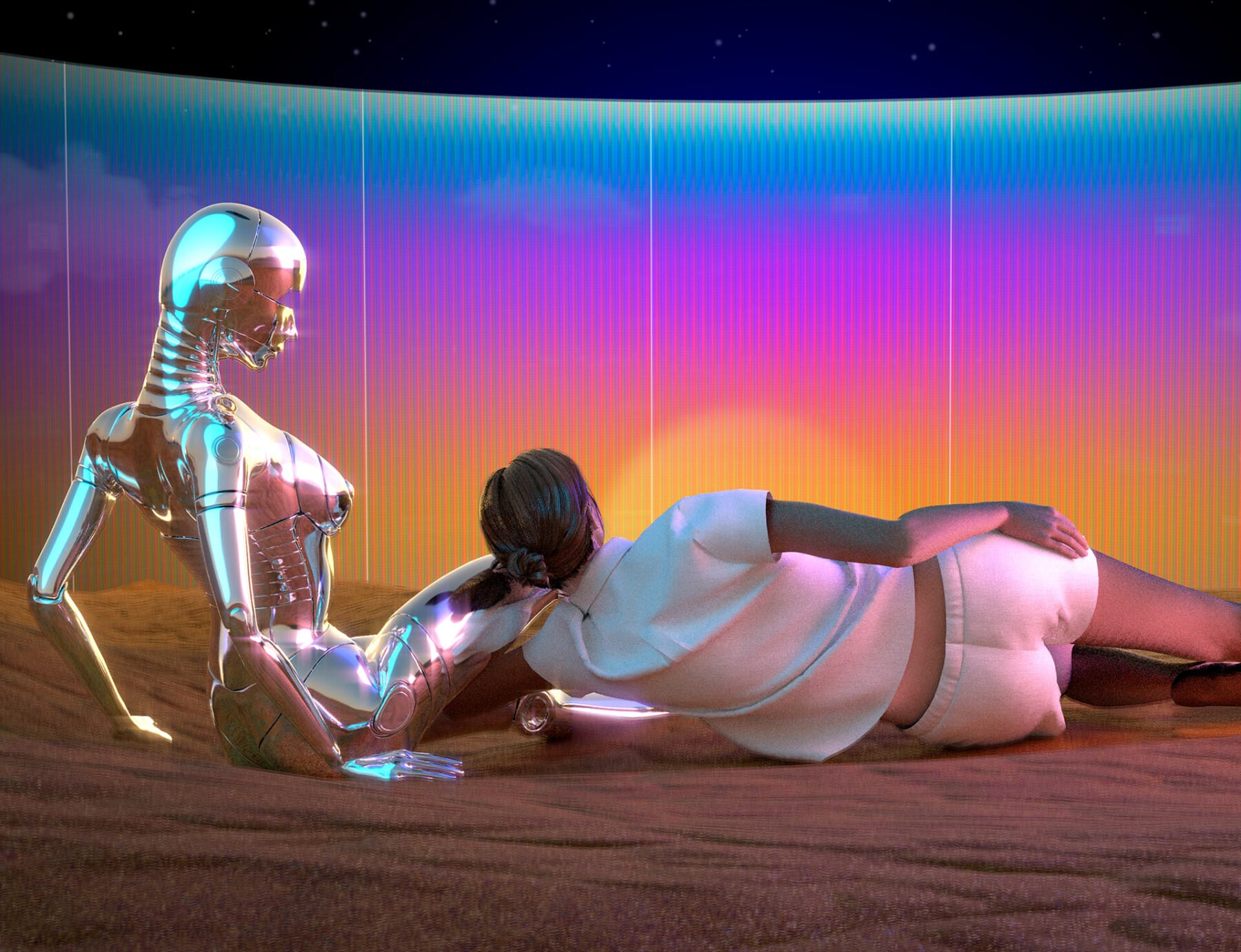
Who’s the new girl and why does she love the robot? Is the new girl the type who always gets the joke and has a rejoinder that keeps the whole room laughing? Who plays tennis, has a dog who runs with her through the park? The type you’d want at your cookout? Who you’d root for?
No, she is not.
So why was she at Vacationland for Singles (terraform area .0469), far from her secret research lab, clearly making eyes at the robot?
She did not join in the fun on disco night or go jogging after flying objects on the beach with new friends. From the first day she was mooning up and down the sand alone and then stationing herself at the cantina to watch the robot click click click and serve drinks for hours, until it disappeared at dinner, likely going to its charging station, whereupon the girl would sulk back to her room, only to reappear in the morning, set herself up at the cantina with her device, and anxiously wait for the robot to arrive.
What a disaster, this girl—Dylan was her name. Even if it was an especially nice-looking robot.
Maybe that’s what everyone was thinking. Maybe that’s what Dylan herself was thinking—I’m such a loser, falling for a robot (though that’s not what she was thinking)—but it didn’t matter what they were thinking, because Melanie was not a robot and couldn’t believe everyone thought she was. Partly it was the skin treatments. She’d had all the best ones since she was nine and it was true her skin had a metallic sheen—legacy of a life left behind.
She didn’t try to convince them otherwise. She wore her professionalism like a suit. Let them believe whatever they liked. But Melanie was a woman of blood and guts and shit and water, and she’d never told them what she was or was not, because they had not asked. Guests dreamed it all up on their own and passed it on as new people arrived. She didn’t care. Who would even want to be human anyway? But something in Melanie was snapping lately as she watched the guests dropping their towels onto the mat for her to retrieve, brushing sand off their abs, grabbing a power drink, and walking off, heads turned away, hands raised to friends cavorting in the waves. So when that skinny girl-dweeb, Dylan, came wandering up to the station, gawking like a boy, Melanie couldn’t stop herself. “What, you like plastic?” and the girl actually said this: “Plastic is my second-favorite substance.”
Melanie’s assigned room was outside the reach of the terraform, a short walk beyond the barrier, in the utility building behind the washing machines, silent but for the machine hum. A few clothes hung on a rack. A mini-kitchen folded out of the wall. (She wasn’t allowed to eat with the clients.) But there was a wide skylight, and if the garbage compactor wasn’t on, the room was quiet, airy, and bright. Each dawn, she crossed the terraform barrier and was on the beach, her feet in the mystical water. It was a good job. She’d been lucky to get it. There were so few left. Really, a robot could do what she did.
She was back, asking for a lemon bubble. Melanie wasn’t a robot-maid. “The machine works,” she said, and turned away.
“Oh, I just thought—” the girl began and stopped. She moved over to the machine and pressed the button, stood there meekly like a folded umbrella. She reminded Melanie of someone—who? Melanie’s memory was trash. The girl raised her lemon bubble in an awkward mock cheers. Melanie melted a little. Cheersing a robot! Melanie wasn’t a rock, you know. She laughed. After that, it went better.
“Why don’t you enjoy the—” Melanie pointed with her chin to the water and the guests in the waves.
“I hate the ocean.”
“People over there. You might get a date.”
“I hate people. I don’t want a date.”
“I can get behind that.”
The girl drained her drink. “I like sand.” She turned and looked at the sand. “Not that I see any here.”
“You’re not making sense. But that’s all right. That’s sand right there.”
“Not real sand.”
“Realer than the rest of this place.” Melanie tilted her head up. “Sky’s not real.”
The girl shrugged. “The food seems real.”
“Do I seem real?” Melanie said, because she seemed like she might know. Melanie felt the girl’s eyes on her arms, her breasts, her face.
“You’re better than real,” she said.
A deep truth about Melanie: She had a time bomb in her face. Several. Not the way all human faces are time bombs—the sinking, the sagging, the drying up, the dropping, the dying, and finally dead. No, her face had fiberglass implanted below the surface of her skin in such a way that it couldn’t be removed, and that had exploded in 34 percent of individuals who’d been stupid enough to pay to have it put in. That wasn’t the only piece of her vulnerable to spontaneous combustion. She had permanent metals, acrylics, nanomaterials—filler implants that were almost as old as she was and that anchored onto disintegrating bone. The entire apparatus held up a fortress of other fillers. Each year you could see it all deflate a few hundredths of an inch. It would one day collapse. She held her body, especially her head, carefully, moved with economical right-angle precision.
Melanie was not a robot and couldn’t believe everyone thought she was.
The celebrity surgeon had always said, “Oh, you’ll thank me for this later. I’m the best surgeon in the world. I’m earning the mug, the T-shirt. You’ll be so grateful you didn’t wind up on a stunt show.” Celebrity Plastics, fifteen seasons. Melanie had been on seven of them, the most frequently recurring guest on the show. How the surgeon would laugh if she could see Melanie now, growing old alone, waiting on strangers, because what, according to the show, had been the point of all the surgeries and fiberglass and metals and treatments, if not love, or at least power?
Melanie had chosen this path and been chosen. Plucked by a producer out of one of the post-depop group homes where she’d lived with fifty other kids, sleeping on a mat in a row, life of a prisoner, child of the times. Promised food, fame, and so on, be a so-called star. Her first day, she’d walked into the softly lit studio: clean, classy, imitation wood running over the floor, a ceiling of painted sky, a forest of lights and silver mics. On the set, the celebrity surgeon herself was tossing her hair, posing in a pair of adorable glasses. “Plastic is the stuff of human ingenuity,” she was saying, “of invention, of creativity. We built a civilization out of it, and you can build a self out of it. Make yourself new. Leave the past behind. That wasn’t you anyway. A bunch of cells that died and were replaced and that you have no control over? With plastic, you decide who you are, what you are.”
Melanie was spellbound. She knew she would do whatever the surgeon wanted.
Six seasons later, the world before the world of the show seemed so faded and degraded, she barely remembered it, and she batted it away when she did.
But then there was the incident with the beads. “I don’t know,” said Melanie. Beads injected into her face? For the first time she had a bad feeling, a doubt. “Beads?” It just didn’t sound right.
The celebrity surgeon uncocked her head, syringe aloft. “Melanie, do you know how lucky you are? Only a handful of injectors know how to use this material. I’m the top company injector.” Really, that should have been a warning—if the celebrity surgeon was the top injector, how many injectors could there have been?
Later, when the company was “discontinuing use” of the beads, the surgeon herself brought the documents to her to sign—a legal “nonresponsibility” release, a post-treatment waiver, a nondisclosure agreement.
“Wait.” Melanie didn’t understand. She was in the recovery room, watching old episodes of Celebrity Plastics with the props assistant. She was trying to read the documents, which had words like disfigurement and deformity, but the surgeon kept leaning over and sticking her finger on the screen, scrolling.
Celebrity Surgeon: Just pull up the signature box.
Melanie: Shouldn’t I read it?
Celebrity Surgeon [in gentle-explain voice]: Sure, if you want to read all that. [Finger, scrolling]
Later, it made so much sense.
The problems it could cause decades down the line. You put that in your face, and it’s supposed to stay there fifty, seventy years—what do you think is going to happen? It couldn’t be removed surgically (though the surgeon had initially said it could), because it was made up of thousands of little “nonabsorbable” beads that dispersed and migrated to different parts of your face. Each bead had a membrane that might pop, blow up at any moment. Even if you looked pretty good now—and you did, you better believe it—decades from now, there you’d be, in a nursing home, making eyes at the widow in the next wheelchair. Just as that cute old-people romance began to bloom and you thought you might have a reprieve from the slow drag downward (who knew that ego and desire lasted so, so long, longer even than your own face? But they do) and kapow, your face would burst and become “disfigured” and that would be the end of that. Not even the lonely widow would want that.
Melanie should have known. She’d been morbidly stupid and now the best she could hope for was that death would get her before the nonabsorbable beads did, and that the beads, thousands of them, would go into the grave with her, where they would be free to leak from their protective human shell at last, sink into the earth, contaminate it, a small sin compared to all the other contamination on the planet and beyond.
She’d signed the nonresponsibility documents. Of course she’d signed—and taken the payout. Then she’d walked out the door, not looked back.
From there it had been a long stumble down. She’d fallen apart for a while, drifted.
The last traditional filler she’d had—and she’d had plenty since Celebrity Plastics and the beads—was “medically experimental.” She’d run through all her money, so she’d volunteered for a study, allowed a new new material to be injected, a different nanotechnology, made into a liquid. Really? Was that a good idea? Apparently. In her defense, she couldn’t go natural at this stage. No free to be you and me for Melanie. The research, which she read feverishly online at night, scrolling and scrolling, warned that if you let anything get loose in there, the nonabsorbable beads could migrate, get stuck somewhere they weren’t supposed to, explode. So you had to stay on top of it—lifts, neo-tech, whatever it took. Keep it all tucked in tight.
Besides, she’d begun to look slightly lopsided with all that heavy permanent filler.
A decade later, come to find out, that substance had never made it to market due to complications: bits of metal spontaneously emerging, pushing their way out of 17 percent of faces, ripping the flesh, scarring, requiring multiple surgeries, unfathomable bills. So that was another potential problem area.
She might die like all animals, the way any normal human does. She might get lucky: cellular disintegration. Life, then death.
Her final procedure was the Regenerator. She had it installed in her face. It was going to solve all her problems. Yes, the accompanying brochure had actually said that, It will solve all your problems, and it seemed she’d believed it enough to go along. The Regenerator was a CRISPR technology, which was what people used to reconfigure the DNA of extinct animals as if she were a dead wolf. It took apart the decaying DNA and replaced the rotted bits with new sequences. Each of her cells was running through the system, altering and refreshing like a screen. So in a sense she was a robot, or being turned into one, cell by cell.
She could feel the Regenerator in there. She could see its outline in certain lights. It gave a mechanical slant to her jaw. The Regenerator was a problem. She had to go back for follow-ups so the surgeons could study her living cellular matter and talk about her as if she were a slab of decomposing meat. They’d do an ultrasound on her face, knife open her chin for an adjustment, and then plaster it back together like papier-mâché.
Glimmers of insight hovered in the dark parts of her mind and acted the same way as a hazy dawn that you try not to wake and see. But daylight comes, no matter how tightly you close your eyes.
That was the end, finally. No more, ever again. Come what may.
She fell through the days. She felt herself sliding so far from human that humans didn’t recognize her as one of their own. Meanwhile, around her, women were aging all over the place, in their skin, their muscles, their hair and bones, all of it fading, dying, decomposing in front of her eyes, and Melanie had to admit she found it beautiful. She regretted she wouldn’t see her own natural disintegration. She got the job at Vacationland, held herself steady in all ways a self can be so held.
They were in bed, Melanie and the girl—Dylan was her name. Outside the window, the sun was beginning to rise. The tide was pulling the ocean up the sand over and over. How things had gone this far, Melanie didn’t know. She didn’t sleep with the guests, yet here she was, unclothed. Dylan had to know. No way she didn’t know. But she kept not knowing. They’d been sleeping together for a week and still she didn’t know.
Melanie got out of the bed and drew on her dress. She was conscious of her arms, her lips, her jaw.
“Stay,” said Dylan.
Melanie tossed her hair (the celebrity surgeon rippling through her) and laughed. She put on her sandals.
Dylan reached out a hand. “I command you to stay. Does that work?”
“Not with this robot.”
Dylan rolled over the covers, grinning.
“Walk with me.” Melanie picked up Dylan’s ball of jeans and threw them at her. Something fell out, dropped to the floor. Small and blue. Melanie reached down. A compass. She turned it over in her hand. She held it up.
“My mother’s,” said Dylan.
She didn’t know what she was doing with this girl. She supposed she’d always been a little self-destructive. Or maybe it was the opposite. Maybe she’d always had a thimbleful of hope. Because you never knew. Surely there was a chance it would all stay where it was supposed to. She might make it to the grave with no explosive incidents. She might die like all animals, the way any normal human does. She might get lucky: cellular disintegration. Life, then death.
She put the compass on the nightstand, and they walked down to the beach. The waves were folding, turning, lifting, revealing pink and orange tints. “I love you,” Dylan said. And though nothing around Melanie was real—not the waves she was watching, not the muscles in her face, not the blue in the sky, which had a filmed hue projected onto it to mask the sulfur, not even the horizon, which was enhanced and colored, and though it didn’t make sense for a robot to love, it was illogical—what could Melanie do? Melanie was real, or 98 percent real, and Dylan was real. So Melanie said (and to her surprise she meant it), “I love you too.”
Excerpted from Earth 7 by Deb Olin Unferth. Copyright © 2026 by Deb Olin Unferth. Reprinted with the permission of Graywolf Press.