, April 3, 2026
Papers, Please
The toll of age verification laws on digital sex work
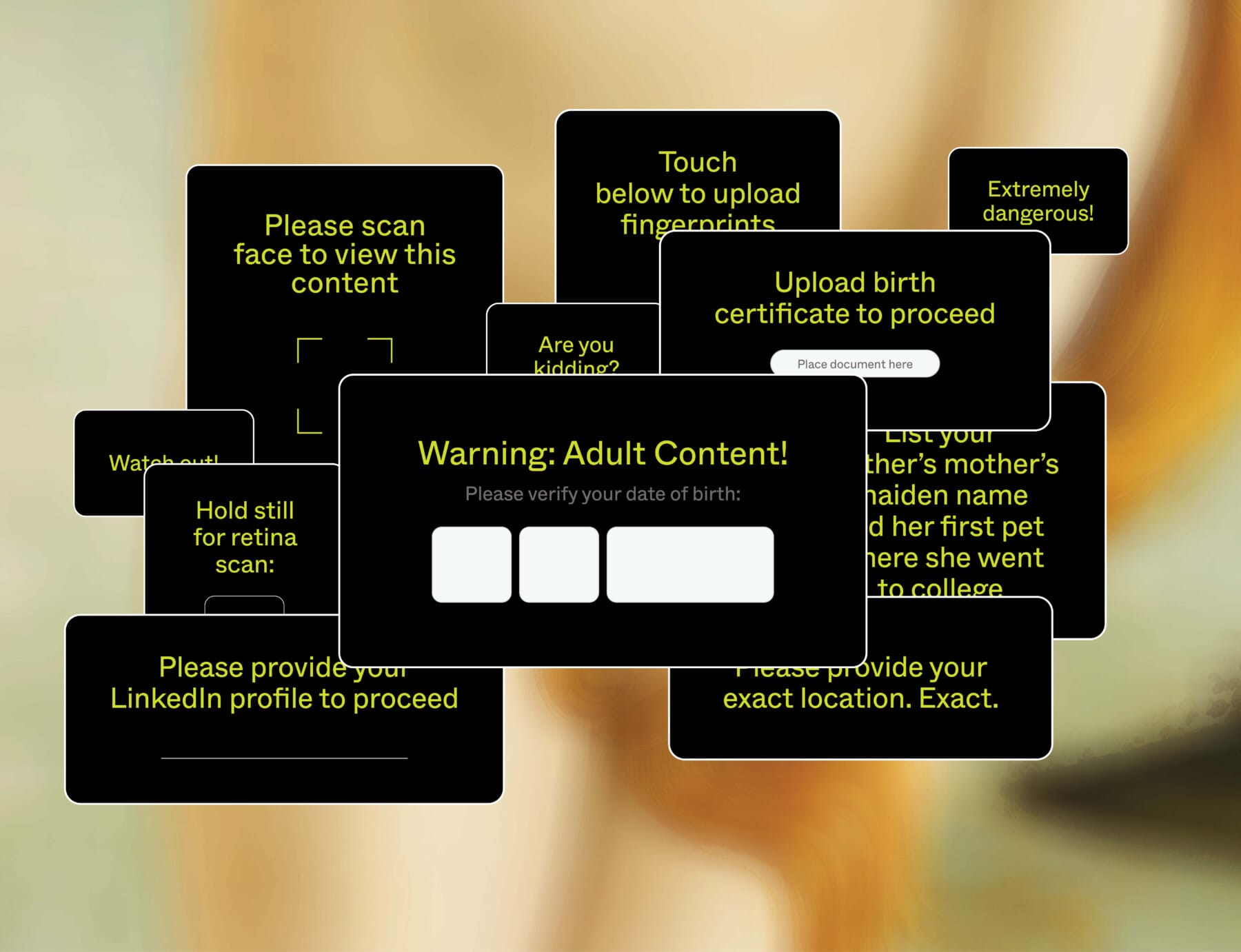
THE ASSUMPTION THAT the adult entertainment industry is “recession-proof” is looking more dubious by the day. Though the United States and much of the world are not technically in a recession, the affordability crisis tied to high inflation and stagnant wages has left people feeling strained. For digital sex workers, these issues are compounded. Nearly 50 percent of the U.S. population now lives in states with age verification laws that target adult content on the internet. These laws restrict freedom of expression for adult consumers, but they are proving even more costly for the people who actually work in the online adult entertainment industry.
Over 45 percent of sex workers have seen a noticeable drop in their income, according to a 2025 survey by the adult industry market intelligence firm SWR Data. Nearly 98 percent of creators who experienced a decrease attribute at least some of this to the “war on porn,” which includes age verification laws. The average income for an online sex worker, according to SWR, clocks in around $58,700 annually—but 38 percent of respondents report making only between $10,000 and $40,000 annually. More than half of these creators have income from outside of the adult industry, while about 35 percent are solely dependent on adult work as a means of economic survival. So when it comes to age verification laws, clearly much more is at stake than the freedom of the consumer.
Attempts to regulate online porn have long collided with free expression, especially since the Supreme Court dismantled key parts of the Communications Decency Act of 1996. The current wave began in Louisiana, where Republican Representative Laurie Schlegel sponsored the first state age verification law in 2022. When it took effect in 2023, users had to prove they were eighteen to access adult sites. Pornhub responded with ID checks, which led to traffic plummeting 80 percent; meanwhile, searches for virtual private networks (VPNs) that would enable users to circumvent age verification spiked. Supporters of the law claimed a win. Critics saw censorship—clear restrictions on access that directly undercut a legal industry and the workers who rely on it.
This model soon became a national strategy as religious conservatives and Christian nationalist groups aligned with the Republican Party to advance age verification as part of a broader cultural agenda. The Heritage Foundation’s Project 2025 called for dismissing long-standing First Amendment precedent to ban what it defines as pornography. Organizations such as the American Principles Project, American Family Association, Center for Renewing America, and Ethics and Public Policy Center helped move these policies into mainstream lawmaking. Russell Vought of the Center for Renewing America, and now President Trump’s director of the Office of Management and Budget, describes the strategy as a “doing it from the back door”: making pornography sites legally liable if minors use them could lead companies to stop doing business altogether in certain states, so the thinking goes. Now covering roughly half the country, these laws operate less as neutral safeguards and more as content restrictions—shrinking a legal industry and raising serious constitutional and labor concerns for digital sex workers.
Age verification laws restrict freedom of expression for adult consumers, but they are proving even more costly for the people who actually work in the online adult entertainment industry.
Dr. Angela Jones, a professor of women, gender, and sexuality studies at Stony Brook University and author of the forthcoming book Sex in Public: The Transformative Social Power of Our Erotic Lives, has expressed concern over these laws. “Anybody who wanted to understand the harms and effects of these policies should talk directly to the people impacted,” Jones told me in an interview. They added that, even as companies spend money implementing them, age verifications simply don’t work as advertised. Jones is not alone: studies and reviews by the Open Technology Institute at New America, and a sweeping study by researchers from New York University, Stanford University, the University of Georgia, and Georgia State University indicate much the same. These researchers have concluded that such laws are pretty much toothless and can easily be circumvented by using a VPN.
The overall economic impact of age verification compliance must be understood within the broader context of expanding regulatory and compliance requirements. For example, the Federal Trade Commission (FTC) held a public workshop on age verification on the internet in January of this year amid a rash of laws requiring websites that contain significant amounts of content “harmful to minors” to verify users’ ages to prevent minors from accessing such content. The current FTC is an understaffed shell of its former self; and Trump’s consumer protection and civil antitrust agency currently has only two of the statutorily required five members, both are ideological sycophants to the agenda of Project 2025 and the White House. Many high-profile individuals backing age verification laws are either married to the broader MAGA movement or work directly for President Trump in his administration.
There is a sentiment among predominantly conservative Republicans and the far right that pornography’s accessibility is a drain on society, morally and spiritually. Take the National Center on Sexual Exploitation (NCOSE), an allied organization to Project 2025 but not a direct stakeholder to the Heritage Foundation’s efforts, which characterizes all legally produced online pornographic content as “sexual exploitation” that should be abolished. NCOSE is one of the key anti-pornography organizations to present porn as a so-called “public health crisis,” even though they lack any scientific evidence to suggest as much, including whether pornography itself is an addictive activity. Medical and scientific societies—including the American Public Health Association, the American Psychiatric Association, and the American Association of Sexuality Educators, Counselors and Therapists—don’t recognize the proposed diagnosis of pornography addiction.
Age verification is presented as a means to “protect” young people—but they’re primarily designed to hurt sex workers. “It’s like death by a thousand cuts,” Virah Payam, an independent adult performer who manages her own membership website, told me in an interview. “I have to contact a third-party company to set up [age verification], and I pay a fee every time someone uses it.” “Because many people don’t view sex work as a legitimate form of work, it allows [for] concerns of sex workers to go largely unacknowledged and unaddressed,” she continued. “I am an adult doing adult things with other consenting adults in adult-only spaces.”
Twenty-five U.S. states already require adult consumers to verify their age through facial scans or by submitting personally identifiable information to large technology corporations whenever they want to access online pornography—or content that proponents of such laws consider to be “pornographic,” even when such content isn’t even considered “harmful to minors.” The Age Verification Providers Association (AVPA) is the trade group representing a class of global companies—including Yoti, Incode, and Envoc—in the online safety industry that are responsible for designing and commercializing age verification software that many of these laws force adult platforms to purchase. The AVPA has lobbied in favor of age verification laws alongside Project 2025 organizations and its adjacent groups, including entities classified by the Southern Poverty Law Center as either anti-LGBTQ+ and anti-government hate groups. AVPA executive director Iain Corby has collaborated with these organizations and a variety of state lawmakers.
Often, LGBTQ+ subjects and reproductive rights are dragged into these debates around what is and isn’t “pornographic.” A pair of activists for the Electronic Frontier Foundation wrote a column for Ms. Magazine in early 2025, noting that age verification proposals are being weaponized in a fashion to categorize LGBTQ+ subject matter and information about reproductive care, including abortion access, as “sexual material” and “harmful to minors.” Some proposals at the state level featured quite expansive language to define sexual material to include “acts of homosexuality.”
Concerns about the implications of these laws extend even further. In early March, hundreds of computer scientists and cybersecurity experts signed an open letter criticizing the rise of age checks across the web. While the letter—featuring signatures of experts from over thirty other countries and those of dozens hailing from the United States—focuses on mainstream platforms, they point to rising concerns of overall “security, privacy, and safety of the internet.” The letter characterizes this tech, also known as “age assurance,” as a tactic for the “centralization of power.” The letter notes, “Those deciding which age-based controls need to exist, and those enforcing them gain a tremendous influence on what content is accessible to whom on the internet.” They also note the efforts to attack methods to get around age checks, such as VPNs.
For example, lawmakers in Utah approved a measure to levy a 2 percent tax on all online adult content purchased in the state’s digital space. That bill requires some of the revenues to be diverted to support age-assurance compliance and social media regulatory enforcement by the state’s consumer protection officials. Provisions also explicitly ban the use of VPNs or platforms with adult entertainment content from communicating how to use a VPN. In Indiana, a lawsuit filed by the office of Attorney General Todd Rokita, a conservative Republican, accuses Pornhub’s parent companies of neglecting to block web traffic spoofed by VPNs and of violating local age-checking statutes—even though the age verification law in Indiana doesn’t explicitly ban the use of VPN servers.
The age verification industry was summoned to Congress. AVPA responded to the experts—including a similar joint letter from the Koch-brothers-funded Americans for Prosperity, the Software & Information Industry Association, and the non-profit Center for Democracy and Technology—by toeing the same marketing line that age assurance is a workable solution. Using Australia as an example, AVPA and its member companies saw a boon in revenue generation and market opportunity with the country’s ban on social media apps for minors under sixteen.
The association’s executive director, Iain Corby, argues, “The debate should not be framed as mandatory ID uploads versus complete anonymity. There is a separate path: proportionate, standards-based, privacy-enhancing age assurance. . . . The policy challenge is to ensure interoperability, accountability and competition while avoiding [market] fragmentation and excessive compliance costs.” And costs, paired with the artificially designed vendors marketplace, are created to benefit only a few companies and the special interests that back them: at least, far right and extremist stakeholders, here, in the United States. This could be viewed as the “centralization of power” highlighted by the scientists and the cybersecurity experts. AVPA’s letter and communication from software industry interests and the Koch brothers’ network were among the materials debated in the GOP-held House Energy and Commerce Committee last month in a hearing on age verification proposals.
“The only point [of these laws] is to restrict access to content,” Riana Pfefferkorn, an attorney and policy fellow at Stanford University’s Institute for Human-Centered Artificial Intelligence, told me. “I think that the ubiquity of [age verification] lately has warped people’s views of what online safety means, so that now everything is just like, ‘Why don’t we just do [age verification]? Won’t that fix it?’” she continued. She was alluding to the use of AI to generate adult content, as well as the trend of users on X requesting that the platform’s AI assistant, Grok, non-consensually undress photos of potentially underage girls. In response to outcry, X chose to paywall access to its AI tools.
But Grok has done more than undress girls: it has also doxed sex workers. Siri Dahl, a popular adult performer and activist, was doxed by Grok in February: her full legal name and birthday were exposed after a user asked the AI model to identify her in a pirated video making the rounds on the platform. Dahl shared the experience of her being doxed with tech news outlet 404 Media. In an interview, Dahl characterized her doxing as a very clear abuse of technology. But Dahl is also suffering from the rise of age verification laws, which have affected her earnings and overall income stability in recent years. “It’s kind of impossible for me to know in terms of metrics, exactly, how much of traffic loss or income losses is due to age verification laws,” she told me in an interview. There are very few measures to accurately measure the loss of total income for content creators and adult industry performers in general in response to specific legislation.
The online adult industry, like any digital content industry, relies on web traffic and marketing strategies to monetize video, photo, and audio content. This is standard for adult content creators. “Pornhub is probably the easiest [platform to use as an example],” Dahl explained. “At one point, I was making pretty good money on that platform . . . before they had to start blocking half the states in the country . . . And now the traffic drop is so massive that I can’t even justify spending a lot of time uploading, because I don’t really make ad revenue.” Dahl added that adult studio work is becoming harder to come by: “Across the board, studios are also shooting a lot less. Production is way down.”
Cherie DeVille is another high-profile adult star who has taken a stand against age verification laws in outlets like Daily Beast and Rolling Stone. “More and more workers will be harmed, because nobody wants to upload their ID to a porn site to watch porn,” DeVille told me. She added, “Statistically, when these laws take effect, it drives . . . more traffic to an illegal site with no oversight or accountability to our laws. They will just go watch porn on free tube sites based in countries that don’t follow American laws.” For example, the UK implemented age verification laws through the Online Safety Act, passed by Parliament in 2023. Under the act, age verification is required for online content classified as “legal but harmful,” which covers pornography. As the national law entered official force last July, Aylo announced that Pornhub’s traffic in the United Kingdom dropped by 77 percent in a matter of several months. Presumably, those users just went elsewhere.
“It’s very simple,” said Chloe Corrupt, a trans content creator and clip artist, in an email. “Age verification adds a cost of doing business that established major studios can bear, and both independent creators and those attempting to get new studios off the ground cannot. . . . Consumers will simply migrate to non-compliant clip sites because tube site consumers have been conditioned to expect free porn with minimal gatekeeping . . . The full scope of [the overall] loss of income is an unknown quantity and will vary widely from creator to creator.” Her assessment is commonplace among the nearly two dozen adult creators and sex workers I spoke to for this story. Corrupt framed the issue as an artificial structural barrier, one that reshapes the industry to determine who can survive in a saturated and highly competitive marketplace.
As platforms like OnlyFans, Pornhub, xHamster, and Chaturbate ultimately rely on large creator communities—and even larger audiences—the added costs to comply (or not comply) with age verification laws is significant. For example, Multi Media LLC, Chaturbate’s parent company, was fined by Texas Attorney General Ken Paxton in 2024 to pay a civil penalty of $675,000 for violating HB 1181, the state’s porn age verification law that would be later disputed before the U.S. Supreme Court.
The fetish star, creator, and erotic wrestler Daisy Ducati reported, “Since these new laws have started to be passed, I have seen my income drop by at least 50 percent on online platforms, and I have had a harder time booking with studios as a performer because many studios are forced to cut back [on] production. Unfortunately, in this case, things seem to be slowing down industry-wide and nowhere feels safe from the effects of constantly changing [legal] rules.” For a recent analogue, think back to the aftermath of the controversial FOSTA-SESTA law. During President Trump’s first term, anti-pornography special interest groups successfully pushed for the controversial law to ostensibly fight sex trafficking by cutting legal protections for online platforms. FOSTA-SESTA pushed many adult content creators and digital sex workers off mainstream platforms—forcing them into more dangerous working conditions while stripping them of stable, reliable sources of income. One of the few high-profile prosecutions often associated with the broader federal crackdown that culminated in FOSTA-SESTA was the government’s campaign against the now-defunct classified website Backpage.com, a popular venue for online sex workers to interact with and screen clients. Federal prosecutors indicted Michael Lacey and James Larkin, among other executives, on charges including facilitating prostitution and sex trafficking.
Age verification laws are an artificial structural barrier that reshapes the industry to determine who can survive in a saturated and highly competitive marketplace.
The age verification laws are having a similar impact. Blair Hopkins, executive director of sex workers’ rights group SWOP Behind Bars, told me that age verification laws are chilling speech at an alarming rate. “You have to make sure that the regulations and the legislation that [lawmakers are now] building around that industry, first and foremost, consider new laborers in it, not, first and foremost, consider the consumers,” Hopkins explained over the phone. Consider an age verification law adopted in Texas. The Free Speech Coalition, a trade group that represents the adult entertainment industry, sued Texas in federal court in 2024. The lawsuit made it to the U.S. Supreme Court, where the conservatives ruled, 6-3, in favor of upholding the age verification law as constitutional but under a lower level of scrutiny. As such, the court adopted a belief that age verification is an “incidental” burden to access pornography, despite clear evidence indicating such regulations serve as de facto censorship of adult content.
“I’d say that these current laws aren’t really as much about how sex workers are expendable,” observed Vanniall, another independent trans content creator, in an email.
They already took down Backpage, they already made our life online hell with FOSTA-SESTA, they already debank us and control our content through third parties like Mastercard. These age verification laws actually show the state sees a lot of use for sex workers, as they have in the past, they prevent us as both simultaneously convenient scapegoats to protect children from and “vulnerable” women that need constant minding. But the point isn’t to control sex workers, the point is to control everyone, using sex workers as a motivation and a distraction [to do so].
Vanniall sees all of this as part of a long-standing pattern of legislation and regulation negatively shaping the online pornography industry and digital sex work as a profession. More often than not, the highest costs are borne not by the major platforms and studios but by independent creators.
Adult performers Fuck Buck and Summer Hart of the Las Vegas-based SWAID Collective offer a final warning. Buck reiterated the scapegoating of sex workers, calling existing age verification laws an aggravation to the “existential problems threatening the viability and safety of sex work.” “While at the same time, [these laws are] doing very little to achieve their stated goals of reducing harm,” he said. Hart agreed: “Age verification drives consumers away from safe, legitimate, legal pornography like what I make, and towards sites that have never complied with the law. It helps give the hosts of dangerous, abusive materials a boost, and hurts the people who have always tried to keep things safe and legal.”
Undermining workers’ safety and autonomy is a direct and indirect consequence of age verification, which serves as a tool of marginalization. As the political scientist Samantha Majic of the John Jay College of Criminal Justice explained, “[We need to] make sure people can work safely and with dignity, whether they are working on OnlyFans or in a factory.” Dr. Majic isn’t wrong. Age verification laws claim to protect the public, but in practice, they reshape the conditions of the digital labor necessary for tens of thousands of adult creators to earn a living. The result is fewer safe, regulated spaces for online sex work and more political power concentrated in the hands of platforms and, most importantly, conservative regulators and lawmakers. For the workers caught in this crossfire, the financial and labor costs are mounting. It is social control of the highest order, and as these laws spread, sex workers will be targeted.