, March 26, 2026
Known Horrors
The conspiracy theories are not helping
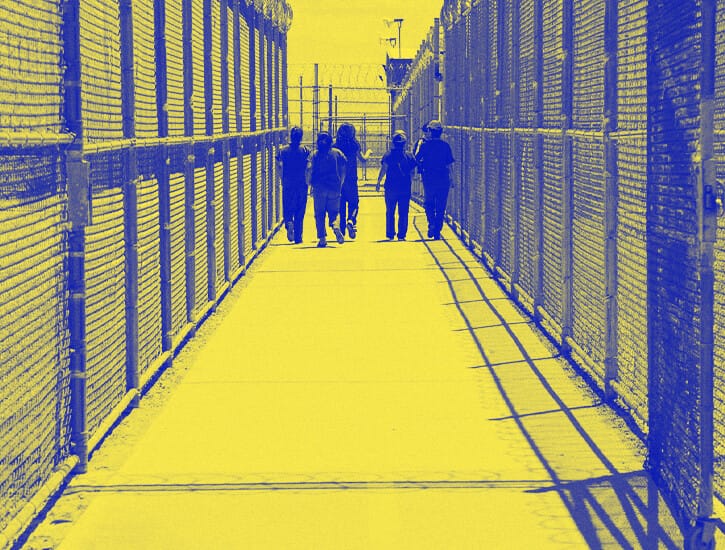
Detainees at the Eloy detention center in Arizona. | ICE
The Department of Homeland Security is on a shopping spree. Documents released last month indicate officials plan to spend an estimated $38 billion acquiring warehouses across the country and retrofitting them into mega detention centers, multiplying ICE’s capacity to detain people as the agency strives to fill arrest quotas as part of President Trump’s mass deportation scheme. Some floor plans have drawn comparisons to slave ships, and there is a case to be made they should be called concentration camps.
This is—no question—a moral atrocity. Yet one of the side-effects of such aggressive moves is that they trigger conspiracy theories and fears on the left that the administration has plans that would somehow be even worse. On Bluesky, American Immigration Council senior fellow Aaron Reichlin-Melnick recently spent an afternoon parrying some of the dozens of overheated comments that suggested that the warehouses would be used primarily as work camps or even extermination centers à la the Third Reich, with Trump’s promises of mass deportation acting as cover. One Arizona legislator called a facility planned in their state “a death camp.” Reichlin-Melnick didn’t deny the possibility of such a dystopian future, but cautioned “that we are so far away from it that to fixate on that remote possibility when the imminent horrors of mass deportation are staring us in the face is to take our eyes off of the ball.”
Let’s be clear: people will die in these facilities. Last year was the deadliest for ICE detainees in decades, and this year could be worse, given the marked uptick in arrests. Earlier this month, for instance, a Haitian man died of what appeared to be a treatable tooth infection at a privately run facility in Arizona. There is not, however, any evidence that the horrors the administration has plainly laid out are hiding some hypothetical other, worse atrocities—and the wild speculation only sparks confusion and paralysis.
The conspiracist impulse reminds me of the media’s fixation on “kids in cages” and forced hysterectomies during Trump’s first term, abominations in their own right that were magnified into funhouse-mirror versions of themselves to the detriment of the very real terrors that surrounded them—as I wrote at the time. The fear-driven theories of secret malevolent forces are, of course, a feature of the modern age and are perhaps more rampant on the right than on the left. You see a lot of these tendencies in the response to the Jeffrey Epstein scandals, where the shock of a massive and relatively well-known sex trafficking ring protected and patronized by the upper echelons of our government, academic, cultural, and corporate institutions seems to already be wearing off, and people are clamoring for more, speculating that the financier’s cabal were practicing cannibals or perhaps that Epstein orchestrated the Covid-19 pandemic.
The facts of social media monetization have made conspiracism not only entertaining but profitable.
I’m not sure what animates this particular pathology, though it seems to me that it’s a result at least in part of the imperatives of our social media attention economy, where conspiracism has become a coin of the realm. If our algorithmically driven consumption is indeed like a drug, then it stands to reason that its consumers would crave just a bit more, a deeper horror, a more obscene explanation. Plus, there’s a perennial gamesmanship to the mechanics of social media, with posters trying to one-up each other; on Instagram and Bluesky and TikTok, every user can be both reporter and analyst, competing for engagement in a gamified news environment.
I don’t mean small or independent outlets and reporters who are often doing excellent work in areas where more mainstream media are failing to probe deeply enough. The issue is that we’ve conflated the aesthetics of journalism with its underlying processes. Posting “BREAKING” or riffing wildly over public documents does not make someone a fact-finder; it’s the underlying tenets and practices that make journalistic work worthwhile, whether it’s coming out of the New York Times or Marisa Kabas’s newsletter The Handbasket. The facts of social media monetization have made conspiracism not only entertaining but profitable, while careful reporting is complex and expensive.
Even when there’s no financial incentive, there is a certain egocentrism at play, which is unsurprising in the context of a society economically and culturally oriented around every individual being a protagonist. There is a desire to be the one person clever enough to find the really bad stuff, deciphering the clues and making the extrapolations like Robert Langdon in The Da Vinci Code. I’m sure it’s a fun game, but none of this is a game. There are tens of thousands of real people who are—barring some intervention—going to be crammed into these new ICE facilities, and they are going to be harmed in ways that are an unambiguous indictment of our decaying society. This is bad enough on its own. We need not distract from this horror by inventing the theory that these will become slave labor camps, as some have posited.
The survivors of Epstein’s global trafficking ring—only a small fraction of whom we really know about, given how prolific he and his elite pedophile buddies were—have barely received anything resembling justice. That justice is not going to come as a result of parsing supposed code words like “grape soda and pizza,” euphemisms that were unnecessary when, by most accounts, Epstein and pals openly committed their crimes in full view of fellow elites and staff that they expected, correctly, would either participate or look away. Now, the people who participated in or facilitated it, including laundering Epstein’s reputation, seem to at most be losing just fractions of their immense wealth and power.
The story of the Epstein saga is one of sexual predation, of course, but it is also one of corruption and impunity, an indictment of a class of people that have insulated themselves in something resembling the old-school divine right of nobility, where the rules simply don’t apply. Perhaps the conspiracism is an effort to find something bad enough that it will break through, because the possibility that we are really just going to move on from this is too horrific to accept. But all the fantasy does is muddy the waters.
The overtone of the escalating ICE detention apparatus is similar: defense and tech conglomerates are competing with each other to provide the means for Trump’s detention and deportation schemes. A former executive at the private prison conglomerate GEO Group is literally helping write some of the planning documents for the mega-warehouses. GEO and fellow detention company CoreCivic both had big stock spikes in the immediate aftermath of Trump’s election, only blunted recently because detention was not expanding fast enough for Wall Street’s appetite.
The defense contractor Palantir has been showered with cash to build out DHS’s surveillance and targeting tools while it also provides the military technology to strike Iran. Contractors like Aramark and Amentum Services are lining up to provide substandard food and medical care, respectively, in ICE facilities. This kind of coziness between immigration enforcement and the corporate sector is nothing new, but it’s reaching new extremes under Trump: lots of people are going to make lots of money off the coming gulags and the tools to fill them, a deep rot that is widely documented and even gloated about by those at the helm.
Every moment we spend talking about things that aren’t real is a moment that we are not spending talking about all this very real grotesquerie. To combat any given problem, you have to be clear-eyed about its dimensions and particulars. How much post-9/11 anger and disorientation was wasted on “jet fuel can’t melt steel beams” conspiracism as opposed to organizing against the surveillance state and the warmongering and war profiteering that resulted? Bush didn’t engineer 9/11, but he and his cadre of ravenous neocons certainly took full advantage of the attack.
It’s been in vogue lately to say that the Pizzagate peddlers were in some way right, or at least onto something, because ultimately there was a network of elite pedophiles protecting each other at the highest levels. But what did these conspiracists actually achieve? A true believer opening fire in a pizzeria popular with children? Hillary Clinton somehow still being a focus of Epstein inquiries despite being at best a bit player, while most of the Epstein heavy hitters walk away?
It wasn’t the conspiracists who brought down Epstein; it was people like Julie K. Brown, whose series of carefully reported stories for the Miami Herald forced the issues back into the limelight while significantly expanding our public understanding of the mechanisms that Epstein used not only to carry out his crimes but to evade any accountability. She did this not by pinging theories back and forth across the telephone game of social media, but by painstakingly tracking down survivors, gaining their trust, putting public documents together with other sources, questioning officials. She found a conspiracy indeed—with diligence, determination, and with the help of fact-checkers. If anything, all the noise probably hampered the totality of the scheme coming to light.
I can already sense some of the rebuttals here, likely along the lines that I’m a rube who refuses to see that everything is actually so much worse than we can perceive, how there are shadowy actors pulling the strings, and it’s all connected. Well, yeah, I’ve also watched Fallout, but that’s not the way the real world works. It’s messy, people send emails without hidden meanings, events often unfold without some grand underlying design; as the saying goes, three can keep a secret if two of them are dead.
Our overseers across tech, government, and finance have largely stopped caring about subtlety or shame.
Horrors abound, and they’re for the most part pretty out in the open. Our overseers across tech, government, and finance have largely stopped caring about subtlety or shame, preferring instead to vice-signal and buy, cower, or torpedo the mechanisms to hold them accountable, including the media. Trump talks openly about his corruption and authoritarianism: “No other president can do the shit I’m doing,” he gushed at a Republican retreat days after launching a historically unpopular war against Iran. Corporations, smelling nihilism in the water, gleefully talk about consolidation, profiteering, surveillance, and making everyone from artists to coders obsolete. The new elite has abandoned pretense and adopted the credo: Well, what are you going to do about it?
Will the Trump administration try to turn its warehouse camps into mass extermination sites? It’s within the realm of possibility, and if there are indications of that at any point it will be incumbent on us as a society to stop it by any means necessary. Yet while Trump’s upper echelon likes to present itself as a unified front of true believers, there are many people within the government who are not on board with their designs, and the administration leaks like a sieve. We’ll find out if the plans change, but there’s no reason to think they will. If anything, it’s more often malign incompetence—rather than explicit directives—that have led to the death of detainees in ICE facilities since Trump returned to the White House.
People like Stephen Miller have been abundantly clear about their aims. He is a white nationalist Great Replacement crank who has spent years dreaming about a program of mass deportation to “return” non-white people to their countries of heritage; it’s the whole remigration schtick that he and others have managed to push openly into the GOP mainstream. DHS has been laying the groundwork for this program for months, including not just the warehouses but strong-arming other countries in the Global South to accept rapid third-country removals (though the latter has now been blocked by a judge).
Even these efforts have been so spectacularly unpopular and illegal that many have at least partly collapsed. Florida’s Alligator Alcatraz, for instance, was touted as a model for other states, but the facility remains mired in litigation and local opposition. The administration was only able to send a relatively small number of people to the hellish CECOT mega-prison in El Salvador before that was blocked, and a judge has ordered that a good chunk of the Venezuelans sent there be returned to the United States. The Twin Cities came together to organize against mass DHS deployments while strong disapproval of Trump’s immigration approach climbed fifteen points in less than a year. Even deep-red localities are coming out in opposition to ICE’s warehouses.
Why would Miller et al., in this context, take even worse steps and risk losing the support of those who can accept round-ups and deportation but not “death camps”? Why would we disbelieve them when they are already openly bragging about horrors of the sort that would leave a permanent moral stain on all of us? Why do we need more? It is not for the benefit of those who have suffered, and will suffer.