, January 21, 2026
If You Read This You Are Gay
For the terminally online, politics à la carte
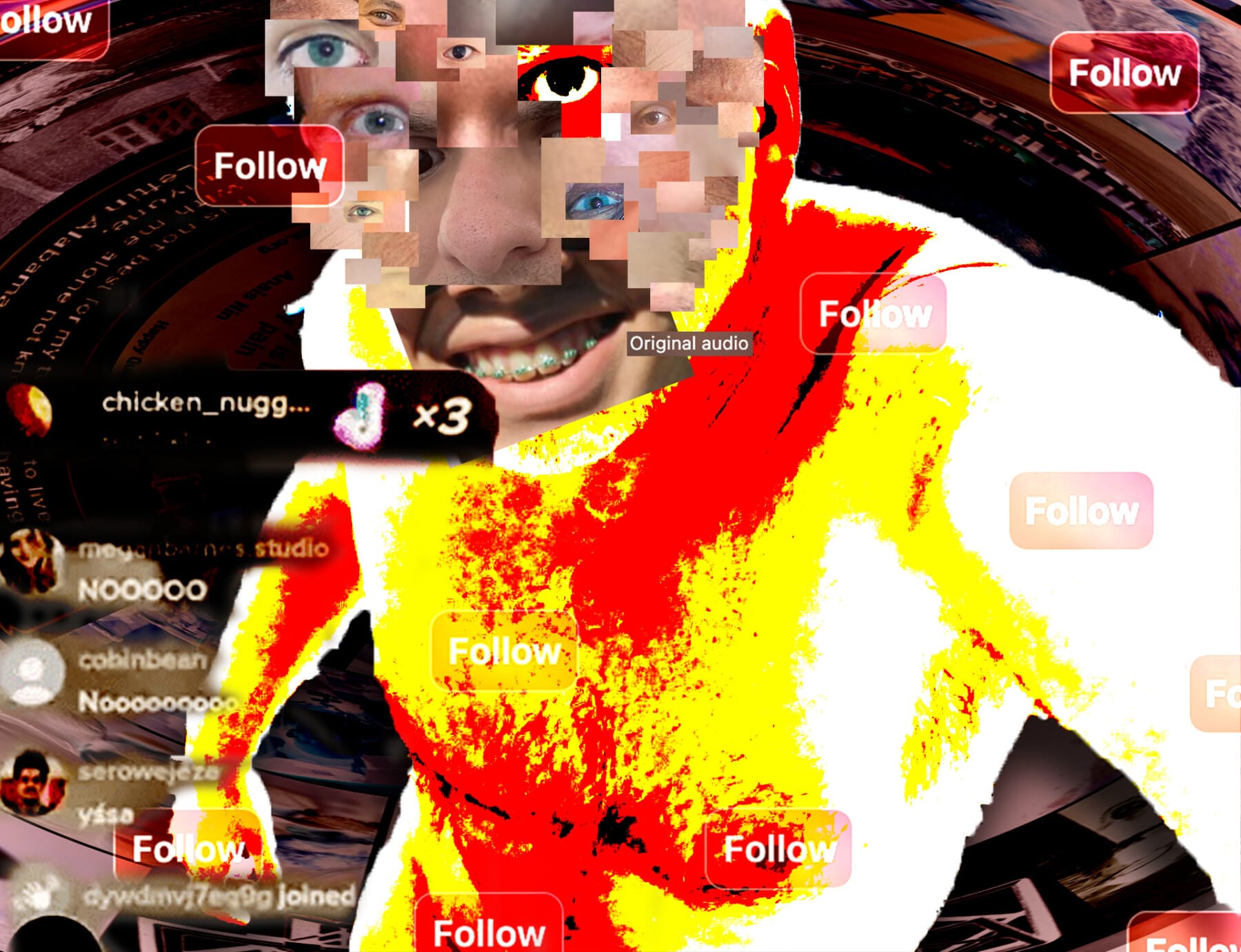
I had just finished teaching a room of college freshman about the rhetorical correlation between logos, ethos, and pathos when I saw the video from Utah Valley University.
In it, a young man with a carefully groomed mustache and sunglasses addresses his audience. “It’s your boy Eldertiktok,” he shouts. “There was just a gunshot, at Charlie Kirk, we’re in Utah . . . this is not a joke.” For a split second, the camera flits away from his face, tracking a horde of scrambling spectators. And then he turns his phone back on himself, raising it high in the air so that he can strike a positively pouty fish gape pose before breaking into a full-fledged grin and letting his tongue waggle and slide along his lower lip. “It’s your boy Eldertiktok,” he says again, calmer this time. “I am not playing with y’all, make sure you go to church on Sunday, read the Book of Mormon, this is not a drill.” On he goes, begging us to pray, turning his hat backwards, cocking it slightly, and imploring us to follow his page, before throwing up a peace sign.
Within hours, the original video had been deleted, scrubbed from the internet; his just-as-hastily-posted, tear-stained apology video was ridiculed, and most of his accounts were blocked or made private. It didn’t help that on X, a screenshot confirmed that he’d walked up to the empty tent in which Kirk had been brutally slain and allegedly grabbed a few handfuls of Turning Point USA merch. But for a moment, he’d been an oracle, a symptom of and a symbol for our time, a conduit that allowed the medium and the message to collapse upon themselves in a display of spectacular banality.
It was easy to assume things about Eldertiktok, to label him—villain, clown, grifter—in ways that felt inadequate.
I was desperate for more. I wanted to get to know this indiscreet young man, who surely wasn’t much older than my students. Sure enough, when I typed “Eldertiktok” into Google, I quickly found one of his accounts that remained for whatever reason: his YouTube channel. And what I found surprised me, not so much for its edginess as for its relative innocuousness and obscurity. “Mental health is fake? Watch to find out!” (467 views). “Other churches are FAKE?! Which ones are real??” (398 views). There was one video entitled “Polynesian Culture is TOXIC!…When it comes to S*xual Ab*se,” that had over eighteen thousand views, and it stopped me in my tracks. In it, Eldertiktok sits with another Polynesian TikToker named Zabrina Peters, and the two of them discuss motherhood, mental health, anxiety, depression, shame, generational trauma, and sexual abuse. “The biggest problem in Polynesian culture right now is we’re not talking. At all,” Eldertiktok says at the end of the video. It was a moment of genuine vulnerability that sliced through the algorithmic incoherence. I felt relief. I felt narrative possibility. “I kind of think I like Eldertiktok??” I confessed to an especially online close friend.
Unlike the majority of posters, who seemed pearl-clutchingly offended by Eldertiktok’s behavior, I found my own emotional response to be relatively pliable, like a glob of mercury leaking from a broken thermometer. Just as the outsized, hagiographic reaction to Kirk’s gory demise felt alienating and imprecise, so did the almost exclusively one-note takes on Eldertiktok. It was easy to assume things about Eldertiktok, to label him—villain, clown, grifter—in ways that felt inadequate.
The man I’d encountered on YouTube wasn’t a right-wing troll but a blurry bundle of unrelated signifiers: a clout-chasing, self-help espousing, Utah-based Polynesian Mormon who occasionally adopts a blaccent and seemed to be attracted to Kirk’s events less because of Kirk’s exact views and more because of his big-tent, “prove me wrong,” capitalist-striver atmosphere. Not quite extremist, not quite harmless, and seemingly assembled from random parts, some of which felt surprisingly sincere, he was an ideal mascot for our horseshoe era, a moment of peak narrative incohesion.
If Eldertiktok reveals how quickly we impose labels on disarray, Kirk’s alleged assassin, Tyler Robinson, shows us just how far that impulse can go, illustrating our desire to force ideological coherence onto a young man whose act was wildly consequential but may have been void of clear motive. He is a Discord-surfing son of Trump voters who dropped out of Utah State University after one semester, played pornographic video games like Furry Shades of Gay, and carved memed-out messages like “Notices bulge OwO what’s this?” and “If you read This, you are GAY lmao” into the bullet casings he would then allegedly load into his grandfather’s Mauser model 98.
It makes sense that many people online—both mainstream and decidedly nonconformist—assumed that Robinson was a “Groyper,” or acolyte of Kirk’s archrival, the white nationalist live streamer Nick Fuentes. Fuentes, perhaps the biggest beneficiary of Kirk’s death due to the dizzying amount of exposure it has garnered him, is both mainstream and nonconformist himself, a self-styled outsider who’s been banned from YouTube but has 632,000 followers on the streaming platform Rumble, from which he posts near nightly fireside chats with titles like “Americans Are SICK of the Jewish Lobby” and “It’s Time To Demythologize Hitler and The Holocaust.” Like Kirk, he hails from the Chicago suburbs, dropped out of college, and has assembled a rabid, rapidly expanding legion of supporters, mostly disaffected young men looking for one-shot answers to society’s shortcomings. His ideology has always been slightly more fringe than Kirk’s normie conservatism: while Kirk’s views on topics like gay rights, trans rights, Islam, and affirmative action grew increasingly chauvinistic as the 2020s wore on, Fuentes trafficked in flagrant xenophobia from the start, diverging from conventional right-wing orthodoxy mainly in his vehement opposition to Israel, a stance rooted in his America First logic that resonates with young men increasingly inclined to assemble their politics à la carte.
What a beautiful time to be teaching required freshman English. On my way to class, I would flit between my lesson plans and my phone, bouncing from Joan Didion’s thoughts on social performance to videos of a cyborgian Charlie Kirk being awoken by Alex Jones in the dead of night before flying over a frozen tundra. I felt almost hypocritical asking my students to aim for rhetorical clarity as we all watched the world play its endless game of Mad Libs. “We tell ourselves stories in order to live,” they read out loud, but nobody knew who Sharon Tate was, or Huey Newton, and the stories we were telling ourselves had become increasingly incoherent. The world inside my phone was mocking the principles inside my classroom, and I was caught in the middle, feeling too green to establish authority and too ancient to keep up. When one of my students asked me how old I was, and another added that I had “Gen Z vibes,” I couldn’t help but laugh. This was not the paradoxical lens I’d asked them to look through.
Of course, there were moments when the kids—and even the project of ongoing literacy—seemed quite alright. James Baldwin still invoked an almost pious reverence. A discussion of John Berger’s musings on “publicity images” yielded incisive observations about surveillance-generated advertising before drifting toward unchecked admiration for early 2000s Nickelodeon commercials. One student, a journalism major, approached me about the Didion essay I’d assigned, leaving me feeling vindicated about my tendency to teach extensively researched but inventively written nonfiction, which always seemed to contain more pathos and ethos than logos-tinged argument. Still, I was worried that most students felt overwhelmed by the uncertainty that fueled this sort of essay. It was telling that their most promising moments usually occurred in one-on-one conversations and not during group discussions—how were they to practice often-embarrassing inquiry and flexible modes of analysis when they all had access to personalized, antisocial chatbots that quickly, privately, and decisively answered their most uncomfortable questions?
Almost my entire teaching career had transpired during Israel’s genocidal siege of Gaza, and it was unspeakably chilling to watch the American surveillance apparatus turn upon and then literally disappear student activists like Mahmoud Khalil and Rümeysa Öztürk. The same campus environment that birthed the student intifada was also the laboratory in which Kirk established and built Turning Point USA, “the most organized, active, and powerful conservative grassroots activist network,” with chapters, by their count, at eight hundred colleges and universities. Though Turning Point doesn’t appear all that “organized” during the Erika Kirk era, prioritizing pomp and pyrotechnics, beneath the clout-concerned, tear-stained circus act rests a very real, very tangible goal: to pummel America’s youth with exceedingly conservative values, whether “irl” or with a bevy of short-form videos. Scattershot efforts, carried out at a national scale, have produced scattershot but real results: even if many of TPUSA’s college-age content consumers don’t necessarily fit into tidy ideological boxes, their insecurities have been stoked and then exploited.
Academia is once again doubling as both battleground and stage. In November at Berkeley, as Kirk’s phantom “American Comeback” tour made its final stopover, Rob Schneider, the event’s replacement headliner, thanked “Antifa for the welcoming,” referring to protesters as “goons” who had “infiltrated academia.” Despite so-called antifa being more of a decentralized ideology than a tangible bogeyman, the university still readily capitulated, condemning “attempts to use violence or intimidation to prevent lawful expression or chill free speech,” an affordance notably not extended to international students advocating for Palestinian self-determination.
While Kirk’s people claimed to defend “free speech” on campuses, the actual infrastructure for historical perspective was being dismantled from within.
Some nights, when I was alone in my apartment, I found myself morbidly drawn to chauvinistic streamers like Fuentes, who seemed to be instigating and celebrating the total wreckage of reason. I told myself it was for class, for historical context, for Eldertiktok. I wanted to write about these men, to face down my fear of becoming transformed by the people I was watching. The only problem was I didn’t know where to start. There were so many streams, and they were all so long. I watched Nick Fuentes scowl and scoff and facepalm and decline to denounce Hitler; I watched a balding Myron Gaines scold and smirk and tell a table of women that he could go cheat on his (completely hypothetical) “wife, come back, and love her the same”; I watched Myron and Sneako watch Candace Owens watching footage of the tunnels beneath a synagogue six blocks from my apartment; I watched the Nelk boys bungle an interview with Benjamin Netanyahu; I watched the Nelk boys talk to Sneako and Myron and Hasan Piker about bungling an interview with Benjamin Netanyahu; I talked to the one person in my life who is young enough to know who the Nelk boys are and he told me they’re “washed” now; I watched Adin Ross betting on blackjack with Drake; and I watched Adin Ross fail to pronounce the word fascist.
Each time I pressed play, my stomach would kick flip and my skin would crawl and I’d wonder if I was doing the “right” research, pausing the extended, never-ending videos almost at random, not quite sure what I should try to catch in my butterfly net. I desperately wanted to pin everything down and label it before I could absorb or critique it, maybe so that I wouldn’t stand a chance at absorbing it, let alone critiquing it. I was doing exactly what I lamented my students were doing.
What do we lose when curiosity and conversation are replaced with completely passive, unidirectional consumption? The brain-dead opportunists I was watching were addressing the much-hyped male motivational crisis by streaming into eternity, by spewing the same bile over and over in an endlessly administered slurry. This could be it, I thought, a new nightly ritual; you could drown yourself in media and still never get to the bottom of the well, reaching for signifiers as they float past, assembling them into something that feels like a system of thought but lacks any sense of cohesion. When I paused one video, an especially sordid episode of Fresh & Fit, I got a pop-up ad: “Feeling Overwhelmed?” it asked. “You’re not alone.” It was as if a magnet was pulling me toward the lowest common denominator. “Fascism is quite literally birthed inside a cramped and carpeted dorm room,” I typed. “Fascism is birthed when lonely people try to speed-run connection and become part of a cresting wave they know to be bigger than themselves.”
Around this time, in early November, Joel Towers, president of the New School (and recipient of a high six-figure salary), announced that the university would be undergoing a drastic “restructuring,” a haphazard effort to curb its well-publicized financial shortcomings. Forty percent of full-time faculty received coercive “voluntary separation” buyouts and several “low demand” academic majors were “indefinitely discontinued” without explanation. It wasn’t just Turning Point USA storming the gates; an institution that had once been a bastion of analytical thought had slashed its history department, capitulating to the same contextless, à la carte absurdity I’d been tracking online. While Kirk’s people claimed to defend “free speech” on campuses, the actual infrastructure for historical perspective was being dismantled from within.
Back in the classroom, I felt like I was keeping a corrosive secret. How do you teach empathy or ethical responsibility when the dominant modes are distraction, detachment, self-promotion, and speed? History was racing through my phone like a horse without a jockey, and I was practically begging my students to slow down—to eschew the express-delivered convenience of LLMs, to practice research, close reading, and critical analysis, to prioritize curiosity, associative connections, and casual conversation.
In September, when I’d heard about the missives that Tyler Robinson carved into his bullets, I immediately jumped back to being bullied in middle school, thinking, “If you read at all, you are gay.” Even though I had thought—as I rewatched clips of Eldertiktok or searched for clues about Robinson—that I wanted clarity and order and cleanly-applied labels, I was beginning to realize that I needed to reshape my logic and reconsider the meandering, spiraling, oblong forms I admired as a reader, teacher, and writer. These forms insist that you hold contradictions long enough for connections to emerge organically, insist that you reject instant algorithmic associations, insist that you undertake the much slower work of watching one idea complicate another.
In an era when reading itself can feel indulgent, I needed to remind myself that it would only be through sustained attention that I could retain any thematic undergirding, any defense against a world that had abandoned causality entirely. In myself and in my students and in Eldertiktok and in us all watching ourselves watch Eldertiktok, I cannot unsee how a desire for coherence is an expression of grief.