, December 2, 2025
Ready for War
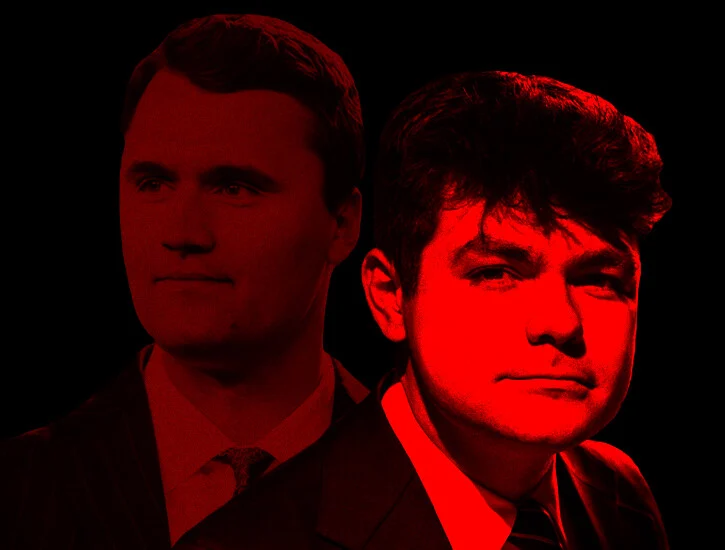
Is Nick Fuentes the successor to Charlie Kirk?
The Baffler
In October 2019, Charlie Kirk’s Culture War tour came to Ohio State University. Before a packed auditorium, the right-wing provocateur welcomed Rob Smith to the stage as his special guest. A black, gay military veteran with runway model looks, Smith was an influencer affiliated with Kirk’s Turning Point USA—and he wanted to set the record straight. He used to be a leftist, until he realized “this idea of tolerance and inclusivity on the left is garbage.” Nothing revealed their dishonesty more than someone like him, Smith explained, a queer person of color with political views that didn’t match the precepts of what he called “the intersectionality cult.”
Then the Q&A portion began. A stream of mostly young men lined up, eager for their chance at the microphone. Would Kirk support a policy that benefitted America but was bad for Israel? False choice, Kirk answered. How does promoting anal sex help the right win the culture war? Kirk deferred to the gay man onstage, and Smith said the question, asked in bad faith, was irrelevant to the conservative movement. Kirk maintained an air of ease until a pipsqueak in a MAGA hat asked how it would be possible for “white European ideals” to be preserved in a future America when white people would become a numerical minority.
“I find that to be a racist question. I reject the idea behind it,” Kirk shot back. But then he started squirming in his chair. He tried changing the subject. President Trump had been smeared as a racist, Kirk said, but in reality he’d earned more votes from black and Latino people than John McCain and Mitt Romney. “Combined,” added Smith, incorrectly. Kirk parried a few more jabs by pointing to his conservative bonafides, but the young men wouldn’t relent. They appeared to be organized, and several of them spoke the name of the man who put them up for the job. Kirk refused to utter it out loud, dismissing him as an “ internet troll” who “believes in white ethnonationalism.”
The exchange—the opening salvo of “The Groyper Wars”—crystallized two competing visions for the future of the American right. There was Kirk’s big tent, born in the Tea Party ferment of the Obama years, where young, attractive people of color were not only welcome but coveted, doubly so if they were liberal apostates. And then there were the Groypers, acolytes of the white nationalist Nick Fuentes, who preferred their movement leaders to be Catholic theocrats well-versed in Holocaust revisionism and skull measurements. The Groypers were generally younger and played by a new set of political rules forged in the fires of Charlottesville. They were ready to say without qualms who the future of America should belong to.
But despite their growing influence, the Groypers generally remained on the fringes until Kirk’s alleged assassin Tyler Robinson was assumed to be one by some online commentators. Just days before what became Kirk’s last campus tour stop at Utah Valley University, he told a reporter that his most important job was to hold the MAGA coalition together, would-be Groypers included. In a way this was Kirk admitting what was obvious to anyone paying attention: he’d lost the war. In the intervening years Kirk had inched closer and closer to Fuentes, until their rhetoric became all but indistinguishable. It had become “undeniable” that there was a war being waged on white people and that the “great replacement” was well underway on the southern border. A month before his death, Kirk argued that “the great replacement of white people is far more sinister” than the Republican-led redistricting fight in Texas.
Kirk’s turn from a colorblind conservatism that at least pretended to police its fringes toward unambiguous white nationalism follows the same trajectory of many so-called “normie Republicans” in the Trump era. But this phenomenon has coincided with another development, which seemingly presents a vexing contradiction. As the right has become even more forthrightly racist during the Trump era—with a young vanguard who gleefully liken themselves to Nazis behind closed doors—their base has become more racially diverse. During the 2024 election, Trump promised mass expulsions of nonwhite immigrants and the destruction of antidiscrimination laws. He then proceeded to double his support among black voters, put up double digit gains with Latino and Asian voters, and improve his numbers with young people, including a nearly fifteen point swing with young men. For the moment, the divergent visions of racial politics on view in the auditorium at Ohio State appear to have reached an uneasy détente—the question is how long it can last.
The Groyper Wars go unmentioned in Raising Them Right: The Untold Story of America’s Ultraconservative Youth Movement And Its Plot For Power, a 2022 book by the journalist Kyle Spencer. It’s an unfortunate omission because Spencer provides an otherwise valuable account of Kirk’s evolution—from a teenage Tea Partier in suburban Chicago all the way to a member of Trump’s inner circle. Along the way, he worked to counter the Obama-era assumption that the so-called “browning of America” would coincide with the growth of a new kind of egalitarian liberalism. Sure, an authoritarian nativist politics might have purchase with some segments of the country, but it’d easily be crushed by a permanent, proudly multicultural majority. Kirk, however, believed that the youth, as Spencer writes, “may in fact be more up for grabs than the left has acknowledged.”
While Kirk and the broader right’s growing radicalization is inseparable from the upheavals of 2020, the Groyper Wars were a sort of prelude.
When Kirk cofounded Turning Point in 2012, conservatives were soul-searching. Obama’s second decisive victory led the Republican National Committee, at the time led by future Trump chief-of-staff Reince Priebus, to draft a document known as the “RNC Autopsy.” It warned of an emerging Democratic coalition that would become unstoppable if Republicans couldn’t hold sway with a younger, more diverse electorate. Spencer chronicles how during these early years of Turning Point, Kirk charmed one geriatric white conservative donor after another. He promised them that if they cut the checks, he could form a bulwark against the onset of millennial socialism and make conservatism cool with the kids.
After Trump took the White House in 2016, Kirk quickly positioned Turning Point as the insurgent youth movement behind the president, even if he’d supported other candidates during the primary. The organization’s foot soldiers were confident, brash, and unafraid to offend liberal pieties. They were also embarrassing themselves. There were the affirmative action bake sales, where cookies were sold at different prices for different racial groups. To protest the idea of safe spaces, a Turning Point member at Kent State University installed himself in a playpen where he wore a baby diaper and sucked on a pacifier. The incident provided fodder for the online left for at least a half decade. Allegations of racism would plague the group just as it was getting off the ground. In 2017, the New Yorker’s Jane Mayer reported that the organization’s national field director Crystal Clanton once sent a text that read: “I HATE BLACK PEOPLE. Like fuck them all.” (In an incredible turn of events, after Clanton was let go, she was informally adopted by Ginni and Clarence Thomas. She is now a Supreme Court clerk for Justice Thomas and has since claimed the entire scandal was made up and orchestrated by a spurned Turning Point employee.)
The Clanton scandal, along with several other snafus involving Turning Point employees caught with racist posts, risked making Turning Point a permanent punchline. The turbulence taught Kirk an important lesson, one that Trump has also learned over the last decade: it’s entirely possible to be tagged as a racist and still retain, or even increase, your popularity among people of color. Later in 2017, Kirk found his redemption at Restoration Weekend, an annual conference put on by the New Left radical turned arch racial reactionary David Horowitz, where he first saw Candace Owens, then an up-and-coming YouTuber under the name Red Pill Black, speak on a panel titled “How Leftism Creates Conservatives.” Kirk hired her on the spot and would soon parade her before donors as a “black truth-telling woman.” With Owens at his side, Kirk had the perfect foil to accusations that he and his organization were harboring a secret white nationalist agenda. Here was a self-described champion of the oppression Olympics, who could appropriate anti-racist rhetoric for reactionary ends.
Owens had been a victim of a racist hate crime as a high school student in Stamford, Connecticut—which became widely publicized when it was revealed that the governor’s son was involved. But as she would recall years later, the incident made her resent how liberals, in her case the NAACP, could capitalize on racism. “If I was a leftist or if I was a true Democrat, I would relish in victimhood. I would love that. I would say I’m black, I’m a woman, I can’t do anything and it’s all your fault. That situation in high school would be the pinnacle of my life,” she said in 2018. The experience of feeling like a pawn in someone else’s game ultimately led to her political transformation. But it’s just as likely that the episode made the former theater kid cannily adept at harnessing scandal and performative outrage for her own gain. As Cardi B once said, “When me and Candace Owens got into an argument, I gave that bitch 2 million followers.”
If Owens’s antics hadn’t already made this clear, they would in the days after George Floyd’s murder, when she posted an eighteen-minute video to Facebook, highlighting Floyd’s criminal record and struggles with drug addiction. She would not “play a part of the broken black culture that always wants to martyr criminals.” The video was viewed over one hundred million times. The next day, Owens was at the White House for a meeting with Mike Pence.
Toward the end of Raising Of Them Right, Spencer writes that, beginning in 2020, Kirk started becoming “alarmingly comfortable mixing fact and fiction.” Whether that meant spreading conspiracy theories about the 2020 election or spreading junk science that Covid masks made you sicker, Kirk’s “grasp of reality seemed shaky at best,” writes Spencer. “He seemed not only okay with it, but liberated by it.” Across public speeches, podcasts and interviews, Kirk called George Floyd a scumbag, raised the specter of anti-white racism, and warned of threats from “prowling blacks,” and Haitian immigrants spouting “demonic voodoo.”
While Kirk and the broader right’s growing radicalization is inseparable from the upheavals of 2020, the Groyper Wars were a sort of prelude. One of the incidents that helped incite them was when a Turning Point brand ambassador named Ashley St. Clair appeared in a group photo that included Fuentes. St. Clair, who is now reportedly the mother of one of Elon Musk’s fourteen children (that we know of), was axed from Turning Point immediately. As far as I can tell, St. Clair was the last time Kirk issued a disciplinary action for a racism-related incident. As the Biden years began, conservatives were waging a counterrevolution with a unifying tactical credo: no enemies to the right. Ever the team player, Kirk stopped trying to police the border separating Turning Point from the Groypers, and they grew ever more intertwined. This shift did not go unnoticed. “I took your baby, Turning Points USA, and I fucked it,” Fuentes bragged this past August. “In the last seven years, who has moved closer to who?”
The first year of Trump’s second administration has seemed like an attempt to do everything possible to squander the Republican Party’s younger, more diverse coalition. They’re sending masked thugs into cities to round up brown people without due process. They’re overhauling the country’s refugee program to reserve spots for Afrikaners and AfD members. They’re purging the disproportionately nonwhite federal workforce. Perhaps most consequentially, after winning an election driven by concerns over cost-of-living, they’re stripping Medicaid and overseeing an economy teetering on the brink of a recession. The Trump 2024 electorate may prove to be a tenuous coalition––a short-lived blip reflecting a unique moment of post-pandemic economic turmoil. But the trends that give rise to the phenomenon are more entrenched than one election cycle. The fact that it could exist in the first place should provoke serious contemplation, which save for a few scholars and writers, is largely absent from left-wing discourse.
One reason that Kirk was keen to upend the idea of a permanent Obama coalition is because he’d been politicized in its shadow. Kirk grew up in a rapidly diversifying suburb of Chicago, and Obama was elected just as he began his freshman year at a high school that had just become majority-minority. He would, save for one semester at community college, forgo higher education to start Turning Point after he was rejected from West Point, where, in his account, he lost out to an affirmative action candidate. To highlight this origin story is not to say that Kirk was always just a racist. It is to say that his particular biography prepared him to be receptive to the politics of white resentment and at the same time made him aware that the demographic shifts in America would likely put a hard ceiling on the practicality of such a movement. Kirk, writes Spencer, may have hated Obama, but he was “in awe” of how his 2008 campaign leveraged the internet and youthful energy into a cultural force. In fact, Turning Point was explicitly pitched and built as a conservative mirror image of Obamamania.
Fuentes, who also happens to be from a Chicago suburb, was politicized in a wholly different context. He turned eighteen just a few months before Trump’s 2016 election flipped the Obama era on its head. In a similar way that many liberal millennials saw Obama’s failure to deliver lasting structural change and became socialists, Fuentes saw Trump’s first term as a missed opportunity and saw the representatives of that establishment like Kirk as the obstacle blocking an unfettered expression of the MAGA base. What can be missed with Fuentes is that he frequently and skillfully connects his vision of white male Christian supremacy to an authentic sense of discontent felt acutely by Gen Z: a threadbare social fabric, horrendous economic prospects, and a stagnant culture. Kirk hoped to harness that discontent into a disciplined political movement that could broaden Republican appeal. Fuentes believes optics are for cucks; he wants to unleash the hordes.
Since Kirk’s death in September, the New York Times has run more than half a dozen news stories and opinion pieces on Fuentes and his followers, including a piece by Michelle Goldberg that positions him as the clear successor to Kirk. In a Times profile, Trump administration officials refused to comment on Fuentes “out of fear, they said, of inviting online attacks from him and his zealous followers.” He now commands a viewership of over half a million—and his reach is only growing. He is a more compelling broadcaster than Kirk ever was, with a finger closer to the pulse of the hardcore MAGA base and a better grasp of the nihilistic humor that is the lingua franca of the Gen-Z internet. His entrance onto the main stage wouldn’t have been possible without the genocide in Gaza providing an opening for his actually antisemitic contempt of Israel to take root––a taboo that Kirk seemed unwilling to break and one that has caused serious friction in his absence.
Kirk said it was his life’s mission to smooth the divisions within the conservative movement. Fuentes wants to inflame them.
But to be a true successor, Fuentes will have to become more than a talented propagandist. He has nothing close to the institution-building skills, coalitional instincts, or longstanding relationships with conservative donor networks that made Kirk a GOP kingmaker. Where Kirk sought to build bridges, Fuentes throws bombs. Kirk said it was his life’s mission to smooth the divisions within the conservative movement. Fuentes wants to inflame them. According to Fuentes, we are in the midst of “Groyper War Two.” This time, Trump himself and JD Vance are its targets. “When I was a teenager, I thought he was a Caesar-like figure who was going to save Western civilization,” Fuentes told the New York Times. “Now I view him as incompetent, corrupt and compromised.”
In October, Fuentes charmed former foe Tucker Carlson (who’d previously called him a “weird little gay kid living in his basement in Chicago”) for two hours in an appearance on Carlson’s podcast. It set off a maelstrom within the GOP. Kevin Roberts, leader of the right’s premier think tank, the Heritage Foundation, defended the choice to platform a widely known antisemite. “I disagree with and even abhor things that Nick Fuentes said,” added Roberts, “but canceling him is not the answer either.” Roberts’s comments roiled Heritage internally, according to reports from the New York Post and CNN, causing a flood of resignations. Roberts has since apologized and tried to restore order, but tensions in the conservative movement are growing more pronounced. “If we are labeled on the same side as Nick Fuentes, then we deserve to lose,” a Heritage staffer said in a private chat obtained by the Post, only to add later, “Talking with some of the interns I think that there are a growing number of them who actually agree” with Fuentes.
At the end of their interview, Carlson asks Fuentes about where he sees the country heading. Fuentes was worried about the deployment of ICE to Chicago. The opposition from the state and municipal government, had the ingredients of a “full blown civil war.” Carlson asks, if he was the president, what would he do about it? “Maybe this is controversial, but they have to crush the other side.”
A few days after the deployment to Chicago, the Department of Homeland Security released a video in remembrance of Kirk. It opens with a soft acoustic guitar and a montage of Kirk speaking at colleges and spending time with his family. DHS assistant security Micah Bock narrates. He calls Kirk the “heartbeat of a movement” who showed so many “that we can fight for our country’s future.” Around the one minute mark, the tone darkens, the music shifts to dramatic strings, and the stakes of the fight being waged in Kirk’s memory becomes clear. “We will not shy away from doing what needs to be done to secure our citizens and protect the homeland,” says Bock. It might’ve been dedicated to Kirk’s legacy, but it was made in Fuentes’s image.