, March 4, 2026
Ceding Ground
Mamdani goes soft on the NYPD
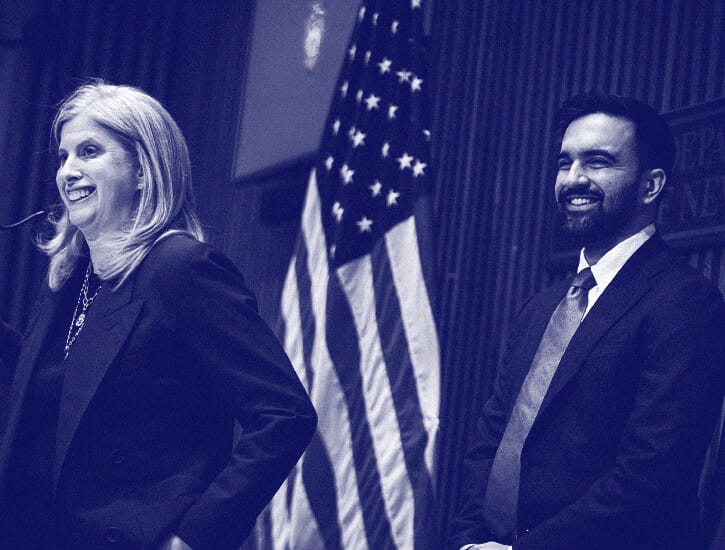
Jessica Tisch and Zohran Mamdani. | Flickr /The Baffler
We’re fewer than one hundred days into Zohran Mamdani’s mayoralty, and New York City’s finest have already managed to shoot and kill two people. On January 26, they shot and wounded a third, twenty-two-year-old Jabez Chakraborty, in his family’s Queens home after he allegedly approached officers with a knife. Mamdani issued terse statements following the first two incidents and received brickbats from the NYPD—anonymously sourced through the tabloids, of course—for his alleged lack of support, so the mayor took a softer tact when it came to the third, writing on X of the “officer-involved shooting” that he was “grateful to the first responders who put themselves on the line each day to keep our communities safe.” The young man’s family issued their own statement four days later, claiming they had called for mental health assistance—not the police—and said the NYPD had treated them like suspects.
The Chakraborty shooting illustrates key fissures that are emerging between Mamdani’s leftist base and his administration. During his campaign, Mamdani vowed to build a new $1 billion Department of Community Safety that would handle nonviolent calls for service and mental health episodes—like the call made by the Chakraborty family to 911—an initiative he instructed his team to “speed up” work on in the wake of the shooting. But he’s otherwise kept policing and public safety on the backburner; usually a deft communicator, Mamdani becomes uncharacteristically tongue-tied when it comes to the NYPD.
Consider his justifications for retaining Eric Adams’s fourth and final police commissioner, billionaire scion Jessica Tisch. When pressed on the controversial decision at a Hellgate-hosted forum last fall, Mamdani responded: “I think there is quite a bit that applies in this answer, not only to Commissioner Tisch but also to anyone working underneath the Adams administration, and that is the question, ‘What is the directive of the mayor?’ And I have made this decision as a decision to further my very public agenda of delivering safety and justice. And so that means this is a decision to build on what she has done.” What has she done? Mamdani pointed to her efforts to reduce crime (which had already been falling on par with national trends) and to root out “corruption and incompetence” at the highest levels of the department (which is not borne out by the facts).
But he left out some of her other notable accomplishments: reviving stop-and-frisk, cracking down on low-level “quality of life” offenses, advocating for the rollback of bail reform, extending leniency to violent cops, and most dangerously for Mamdani, allowing the department to quietly collaborate with Immigration and Customs Enforcement. Why, the panel moderators wanted to know, did Mamdani think she’d change her tune? “I think everyone will follow my lead,” he replied. “I’ll be the mayor.”
Since becoming police commissioner in November 2024, Jessica Tisch has done little to disrupt the wretched status quo.
By declining to appoint a new police commissioner like every previous mayor for more than sixty years, Mamdani not only ceded control of the single most powerful city agency to an ideological opponent but infuriated his base. New York City Kremlinologists have theorized that the neophyte mayor wanted to ensure his broader agenda would face less opposition from Governor Kathy Hochul, an avowed opponent of taxing the rich and a Clinton-style tough on crime Democrat. Moreover, Mamdani’s centrist advisors like Obama alum Patrick Gaspard view aggressive police reform—or even proactive oversight measures—as anathema after the pandemic-era backlash to the George Floyd uprising. However, in New York City, abdicating criminal justice policy to a retrograde, reactionary police department with a dismal record on brutality, racism, and civil liberties is a fraught prospect.
Mamdani’s decision to keep Tisch also flew in the face of her family’s vehement opposition to his candidacy. Tisch’s relatives, including her parents, donated a total of $1.3 million to a pro-Cuomo political action committee that ran racially inflammatory attack ads, and Tisch’s brother Benjamin, the CEO of Loews Corporation, called Mamdani an “enemy” of the Jewish people at a December charity gala. (A characterization Jessica later privately apologized to Mamdani for, though her public statement placed all emphasis on understanding the “fear” some Jewish New Yorkers might have toward her boss.)
The Tisch family’s philanthropy has emblazoned their name on university buildings, hospitals, and museum galas, and has also ensconced conservative academics in elite universities such as British historian and imperial nostalgist Niall Ferguson, the former Laurence A. Tisch professor of history at Harvard. As befits their position among New York City’s real estate elite, the Tisches are well-acquainted with President Donald Trump and his clan. (Trump, for his part, praised Mamdani for keeping Tisch on following their bizarrely chummy encounter at the White House last November.) The family’s other social ties skew to the right—Jessica was recently photographed dining with Sid Rosenberg, a bigoted radio host who has repeatedly referred to Mamdani as a terrorist sympathizer but praised Tisch as a “great lady!” And the most recent release of Epstein-related documents by the Justice Department appear to implicate her cousin Steve, a co-owner of the New York Giants, in the disgraced financier’s human trafficking ring.
The family’s philanthropy also secured Tisch her initial appointment to the NYPD in the late 2000s, according to reporting by late NYPD scribe Leonard Levitt. A phone call from one of her relatives on the board of the New York City Police Foundation board (her uncles Andrew and Alex have long held seats on the police nonprofit) to then-commissioner Ray Kelly secured her a spot as a counterterrorism analyst in the agency’s Intelligence Division focusing on radical Islam, despite her lack of any law enforcement training or language skills (in a 2024 Wall Street Journal interview, Tisch claimed “a friend” made the call). The Police Foundation—established in the 1970s to purchase radios, bulletproof vests, and other equipment for officers during the depths of New York City’s financial crisis—now bankrolls overseas detective postings, the purchase of surveillance equipment, and is widely criticized as an unaccountable end-run around city contracting rules that provides unfair advantage to companies which donate to the firm, such as the body camera provider Axon.
For generations, the family has also used the fortune from the Loews hotel and film theater fortune to back Israel. Jessica’s father James, for instance, served as the head of the Jewish Agency, which paid for Jews to migrate to British-occupied Palestine more than a decade before the creation of Israel. Jessica’s own Zionism, which she demonstrated by wearing a blue star of David to her swearing-in ceremony, has also manifested in her remarks about October 7 (which she called “a war against us”) and her headlining of a controversial “counterterrorism” training for NYPD officers where keffiyehs and watermelons—symbols of Pro-Palestinian solitary—were depicted as extremism indicators.
During Tisch’s tenure, the NYPD has built out a surveillance and intelligence gathering operation that rivals that of many foreign nations. This shift is critical in understanding the NYPD’s aggressive and unconstitutional approach toward Muslims and Middle Easterners. Take the mosque-raking program, through which the NYPD infiltrated Muslim communities in the city and throughout the Northeast under the pretext of preventing a future 9/11. The initiative, which officially ran from 2003 through 2014, was designed by an official from the CIA. In 2007, the agency published “Radicalization in the West,” which purported to show how seemingly harmless people could be turned toward terrorism. Focusing entirely on terrorist incidents linked to Muslims, the report was debunked by outside academics, civil libertarians, and former law enforcement for justifying the NYPD’s blanket surveillance of one ethnicity (which allegedly continues to this day) by claiming that “enclaves of ethnic populations that are largely Muslim often serve as ‘ideological sanctuaries’ for the seeds of radical thought.” As part of the agency’s counterterrorism training in the early 2010s, nearly 1,500 officers were shown The Third Jihad, an incendiary documentary that claimed Muslims immigrants had come to the United States to “infiltrate and dominate” society.
Tisch worked for the Intelligence Division until 2014, eventually rising to the role of deputy commissioner, where she masterminded the NYPD’s buildout of a sprawling surveillance network of cameras, gunshot detectors, license plate readers, and “smart” video analytics software, all underwritten by the federal government to the tune of $3 billion. Initially intended specifically for Lower and Midtown Manhattan as an anti-terrorism measure, Tisch rebranded the network as the “Domain Awareness System,” forged a partnership to license it for profit with IBM, and shifted the focus from terrorism to “all-crimes,” a familiar trajectory of mission creep for American policing during the war on terror. The Domain Awareness System has been used to monitor peaceful protesters, subject public housing residents to 24/7 surveillance, and provide a steady pipeline of sensitive information to federal law enforcement. (Last month, Tisch announced plans to expand and update the Domain Awareness System to give officers access to more granular information, even as a lawsuit over the constitutionality of the program works its way through federal civil court.)
In 2014, Tisch was transferred to the NYPD’s Department of Information Technology as deputy commissioner, where she continued her work expanding and enlarging the Domain Awareness System. When Mayor Bill De Blasio brought back Commissioner Bill Bratton in 2013, the one-time Giuliani favorite brought his fascination with Minority Report-style crime forecasting software he’d helped develop while running the Los Angeles Police Department in the 2000s along with UCLA scientists who’d repurposed battlefield casualty prediction programs for domestic law enforcement. Tisch fully bought into that project and helped develop the NYPD’s own internal prediction tools, which are anathema to much of the American progressive criminal justice reform movement. It was in this role where Tisch committed one of her more glaring gaffes: ordering the purchase of thirty-six thousand Windows phones over the objections of other department officials for the entire NYPD in 2016 at a cost of $160 million, only for Windows to discontinue the device the following year, forcing the NYPD to junk the devices and replace them with iPhones. While Tisch claimed the entire debacle cost the NYPD nothing thanks to buildouts in the contract, it raised questions about her judgement and technological savvy.
Since becoming police commissioner in November 2024, Tisch has done little to disrupt the wretched status quo. While Mamdani claims that she is a competent manager who was “cracking down” on high-level police corruption under Adams, this belies reality. Under her leadership, for instance, senior officials implicated in abuses like former chief of department and alleged sexual predator Jeffrey Maddrey were allowed to retire with their full pension rather than face departmental charges and termination.
Tisch continues to overturn confirmed findings of discipline from the NYPD trial room, including the termination verdict against Lieutenant Jonathan Rivera pronounced by an NYPD administrative judge for killing unarmed Allan Feliz during a traffic stop and a detective who assaulted a woman after she unintentionally bumped him outside a concert. The NYPD’s stop and frisk practices, which engendered massive backlash under Mayor Bloomberg and have been scrutinized by a federal judge for twelve years, have increased under Tisch’s leadership. More alarmingly, almost 30 percent of stop-and-frisks conducted by NYPD officers are not documented according to the most recent annual report by the NYPD’s court-appointed monitor.
Tisch is also under heavy internal scrutiny over the department’s handling of a fatal crash on January 22 in which a politically connected female sergeant slammed into another car while driving the wrong way on the Taconic State Parkway after attending a booze-soaked NYPD social event. The sergeant, Tiffany Howell, was charged by Westchester County authorities with homicide on earlier this month—and per news reports, her blood alcohol level was more than three times the legal limit. Like Maddrey and the other corrupt Adams-era brass, the sergeant was initially allowed to file for retirement and her pension (though she has since withdrawn those requests).
Even on police oversight, Mamdani is either moving at a snail’s pace or ceding ground.
Overtime costs and police-related legal settlements have soared too, with taxpayers shilling out $1.1 billion on extra pay for cops and $117 million in misconduct-related settlements in 2025, the fourth straight year when police misconduct-related payouts passed $100 million. The Adams administration saw widespread overtime fraud within the agency—including Maddrey, who allegedly paid female cops he raped in his 1 Police Plaza Office with overtime cash and then took a cut of the payout for himself. Tisch’s predecessor Thomas Donlon called the NYPD’s brass a “criminal enterprise” in a massive lawsuit he filed against the city last year, and claimed Tisch did nothing when informed of his concerns once she took control of the department.
On quotidian policing tasks, Mamdani has signaled his approval of Tisch’s approach and policies from overstaffed transit patrols to criminal summons for cyclists, even as the NYPD’s Adams-era practice of stopping and searching black and brown drivers is now the target of a class action lawsuit with echoes of the court proceedings that curtailed Bloomberg’s racial stop-and-frisk dragnet. While Mamdani has reiterated his promise to disband the Strategic Response Group—a combined counterterrorism/anti-demonstration unit implicated in dozens of violent protest responses since its creation in 2015—Tisch has dug in her heels in opposition. Civilian complaints are the highest they’ve been since the early 2010s, and the NYPD is in hot water for handing over arrestee information to ICE, including the data of two pro-Palestine demonstrators placed in deportation proceedings by the feds last year thanks to NYPD arrest information.
Even on police oversight, Mamdani is either moving at a snail’s pace or ceding ground. Just over two months into his administration, Mamdani’s team have not touched the Civilian Complaint Review Board, where an Eric Adams-selected chair and key board members are undermining the investigative work of the NYPD’s external disciplinary watchdog. Conservative city council speaker Julie Menin, who caucused her way to the head of the city’s legislative body last fall while Mamdani and his advisors spent their post-election political capital on congressional primaries, has vowed to slow-walk the mayor’s non-police Department of Safety, and she refused to overturn Eric Adams’ veto of a bill that would give the CCRB direct access to the NYPD’s body camera footage, which has long compromised numerous misconduct investigations.
Other policy moves raise questions about the level of interest the media darling mayor has in police accountability. For instance: Jocelyn Strauber, the Department of Investigation commissioner whose agency’s probe into straw donors and illegal campaign funding schemes led to the federal indictment of former mayor Eric Adams and several of his top aides in 2024, left her role in early January after being informed she would not be kept on. (Last month, Mamdani nominated former federal prosecutor Nadia Shihata to replace her.) And when Mamdani released his preliminary budget proposal last month, there was no money earmarked for his promised Department of Community Safety. (The Mamdani administration did not respond to repeated requests for comment.)
While the learning curve for running a city of 8.5 million may be steep, the NYPD is too broken an agency to abdicate its management to a dedicated proponent of the status quo. But Mamdani doesn’t seem to mind.