, January 2, 2026
Among the Prophets
Science fiction and the art of prediction
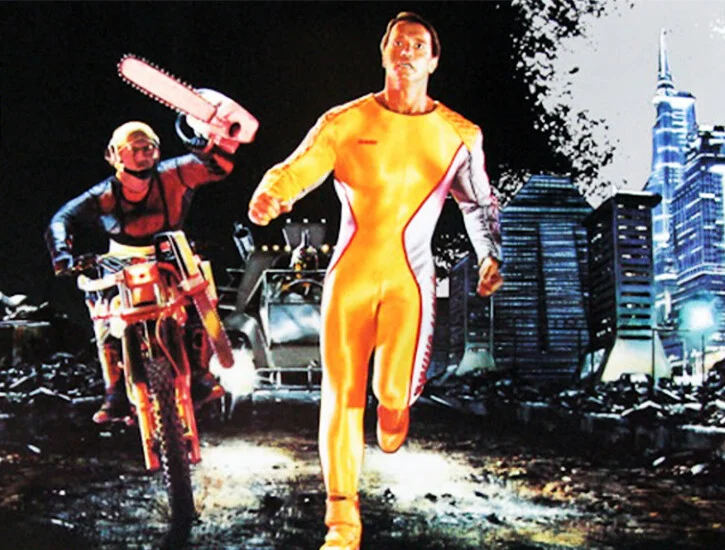
The Running Man (1987). | Tri-Star Pictures
In David Fincher’s most mainstream film, The Social Network, an aggrieved ex of Mark Zuckerberg tells him that “the internet isn’t written in pencil, Mark, it’s written in ink.” Disappearing ink perhaps, given how difficult it has become to search for useful or accurate information, let alone its source, amid the hallucinatory derangements of artificial intelligence. Media literacy has never been more important. Society has never been lazier.
For the past few months, I’ve been researching how science fiction has been used as a guide for predicting the future. This has included reading interviews and speeches, the testimony of would-be prophets. Naturally, certain quotes pop up like weeds—but, in the case of the more platitudinal selections, no one can seem to agree on who actually said them. “Prediction is very difficult, especially about the future” was either coined by Danish physicist Niels Bohr or mythic Yankees catcher Yogi Berra. It’s entirely possible both men did, in fact, say some variation of the quote, though it’s more likely that Bohr, who was forty years older, said it first. But then again, he may not have said it at all.
The origin of the less elegant but more popular “We can predict everything, except the future” is similarly elusive. In 2012, user1202136 on the Stack Exchange forum for English etymology asked about the quote’s source, a question that’s been viewed four thousand times. The highest-rated answer, provided by a user going by Sven Yargs—who, according to his profile, has answered 3,444 other questions—is exhaustive in its detail: “The earliest instance of that approximate wording that I could find in a Google Books search is from David Redburn, ‘The ‘Graying’ of the World’s Population,’ in Social Gerontology (1998): ‘An oft-stated demographer’s joke comments, ‘it is easy to predict everything except the future’ and while this is demographic humor, or lack of it, it does relate the trepidation with which population specialists approach projections.’”
This is the first in a string of around ten related usages or permutations of the quotation that Yargas offers, two of which include testimony from people who purport, for instance, that Bohr and Berra often used it, along with a former New Zealand prime minister, a former manager of the Yankees, and a historian of Protestantism. Many of the examples utilize that nifty linguistic distancing from fact that accompanies family legends: “As so-and-so always said . . .” Yargas sagely concludes that the problem isn’t who said it but who didn’t. User1202136’s question, accidentally philosophical in its simple quest for attribution, yielded an equally philosophical answer. In the process, another idiom seems to emerge: We can repeat anything, but we can’t source it.
There’s been endless discussion over what the political turmoil of recent years might mean for the future of the country, for art: Has the future finally arrived? Have we regressed into the past? Is the arrow of time also the arrow of progress? In tandem, there’s been renewed interest in written works, specifically science fiction novels, from previous centuries that were seemingly accurate in their predictions. Margaret Cavendish’s The Blazing World (1666) was an early predictor of the submarine, while Albert Robida’s Electric Life (1890) foresaw the television, and Arthur C. Clarke’s Imperial Earth (1975) imagined the search engine.
If the future can’t be predicted, then maybe it can be gamed out, run through a series of thought experiments.
But, really, there’s no point debating the accuracy of these prophecies. Authoritarian governments, divided nations, media-addled citizens, dazzling technological conveniences—limited ingredients, different dishes. In 2022, a critic for the Guardian wrote that Margaret Atwood’s The Handmaid’s Tale “arose out of an acute sense of the then-present; she was responding to nuggets of misogynistic authoritarianism cropping up in the news.” Hannah Sage Kay writes in The Los Angeles Review of Books about Star Trek: Deep Space Nine, “It’s consequently easy to marvel at Star Trek for its prescience . . . though what DS9 foretold was not a far-off future of technological advancement but instead a grim allegory of the present and immediate future.”
It’s not accuracy of circumstance that matters so much as an accuracy of feeling; audiences crave allegories. At odds with the outspoken desire for that which is novel and original in art, audiences also have a hunger for the familiar or at least the spectacularly plausible. If the future can’t be predicted, then maybe it can be gamed out, run through a series of thought experiments. This doesn’t mean that the task of prediction goes away. Nor that science fiction is merely a remix of elements. Rather, in lieu of concrete knowledge about what may come, something like comfort is achieved when the absurdity of the real begins to look like the far-fetched What If of the imaginary.
Maybe there’s some perverse pleasure in saying: “There are no surprises.” Literary critic Mark McGurl writes in his book Everything and Less: The Novel in the Age of Amazon that, according to the company, “all fiction is genre fiction in that it caters to a generic desire.” That desire is one of endless repetition, a “demand to be read a favorite story again and again.” It’s not hard to believe that readers harbor dreams of apocalypse and ruin prophesied like a trial run for reality, authored and sanctioned as a possible version to contend with, a balm against the unknown.
Here’s a dubious quote that Stack Exchange’s Sven Yargas would appreciate, from an interview with the science fiction writer Connie Willis: “Ed Bryant, who was also a Colorado writer, described science fiction one time, he said ‘In 1898 any idiot could have predicted the automobile. It would have taken a true futurist to predict the interstate highway system. But it takes the science fiction writer to predict the traffic jam.’” Who knows if Bryant really said that? Who knows where Willis heard it? The only place it appears online is in the interview. It’s the having been said that matters. In a time of blinkered political imagination and social paranoia, Willis might be right.
I thought of Ed Bryant’s quote—and Yogi Berra’s and Niels Bohr’s and user1202136—while reading The Running Man by Richard Bachman, a pulp science fiction novel published in 1982, set in 2025. The Running Man was the last of Bachman’s novels to be published before the author’s true identity was revealed: Stephen King, who had been using the pseudonym as something of a literary petri dish between 1977 and 1984. The Bachman books—Thinner, Rage, The Long Walk, The Running Man, and Roadwork—are early works by King. (King would later “discover” two more Bachman novels in 1996 and 2007.) What Bachman published was angry, opinionated, and breathless in its sketching of a mercenary, crumbling world. In an essay attached to more recent editions of The Running Man, King writes, “Dark-toned, despairing even when he is laughing (despairing most when he is laughing, in fact), Richard Bachman isn’t a fellow I’d want to be all the time . . . but it’s good to have that option, that window on the world, polarized though it may be.”
More than forty years on, The Running Man’s success lies, in part, in that it’s a sturdy fable about the shittiness of the world, a pulp novel with a distinctly socioeconomic outlook. It focuses on perennial themes of American discontent: white male rage, the desensitization to and hunger for violence, the frustration with yet desire for revolution. Set in a totalitarian United States where the populace is enthralled by a series of brutal reality shows run by the Network, poverty is high and pollution blankets the land. The novel boasts canny similarities to the present: over-armed and trigger-happy police, telemedicine, rampant disinformation, sensationalist news, entertainment holograms. One feature of The Running Man’s world is the ubiquitous Free-Vee, essentially a high-concept television much like the hypnotic parlor walls in Ray Bradbury’s Fahrenheit 451, that runs the Network’s highly addictive and cruel programming constantly.
Drab, violent, and bereft of anything resembling hope, The Running Man is a vehicle for righteous anger, not at some vague imbalance in the world, but the very structure of it. The Network’s carnival of cruelty could fairly be seen as a predecessor to the battle royale genre, though its repressive methods are more in line with Jerry Springer than The Hunger Games. One show called Treadmill to Bucks features contestants with chronic heart, liver, or lung disease. For every minute the contestant stays on the treadmill while answering the host’s questions, they win ten dollars (King’s predictive powers don’t account for inflation). Every two minutes comes a bonus question worth fifty dollars. Miss a question, lose fifty dollars—and be forced to walk faster until you drop.
Meanwhile, the blockbuster titular show, which the novel’s protagonist Ben Richards enters in order to afford to buy medicine for his ailing daughter, sets a contestant on a nationwide game of hide-and-seek, where every hour Richards isn’t caught by the Network’s Hunters, he earns one hundred dollars. Bonus Benjamins for every cop or Hunter he kills. Through audiovisual manipulation of photos and video, the Running Man’s host, Bobby Thompson, frames Richards as a libidinous murderer on a psychotic rampage, inciting the in-studio crowd to jeer and boo, while urging the audience watching at home to report any information they might have about Richards’ whereabouts to the Network.
Five years after The Running Man’s publication and two years after Bachman was outed as King by a bookstore clerk in D.C., Arnold Schwarzenegger would star as Ben Richards in an adaptation of the novel. Instead of the King everyman hampered by circumstance, Richards turns into a brawny, principled cop who refuses an order to kill unarmed rioters in California. Banished to a labor prison camp, Richards escapes and goes on the run, is framed for murder, and coerced into joining the Running Man TV show, increasing the show’s ratings. Instead of the wide open cover of America, the game is sequestered to an abandoned area of Los Angeles, where Richards is hunted by a band of villains that look like evil Power Rangers. A resistance network links up with Richards, including a fugitive named Amber. The resistance topples the Games Network. The evil is vanquished, and Richards and Amber share a triumphant kiss.
Any wrinkle that would distinguish the film politically or aesthetically has been sacrificed for a bland, unchallenging everymovie.
In Schwarzenegger’s oeuvre, The Running Man is mid-tier fare. Ditto for King’s many, many television and movie adaptations. The most famous King adaptations, apart from Stanley Kubrick’s The Shining, have tended toward the sentimental, as rose-tinted portraits of small-town America with a dark underbelly. In more recent years, remakes of It, Salem’s Lot, Pet Sematary, along with the adaptation of The Shining’s sequel Doctor Sleep, have trafficked in a nostalgia for classic horror cinema of which King has long been an indelible component. It would be too rich to venture that any of the films made from King’s fiction were done so under strictly admiring, earnest pretenses, cinematic efforts to translate literature to image. But, as with most mainstream filmmaking this decade, preexisting IP is stock and trade. Connie Willis’s 1995 novel Remake anticipated this eventuality, a future where entertainment is churned out and the same stories get told over and over, just with different faces.
It’s fitting then that a jaunty new adaptation of The Running Man arrived this year, starring perennial striver Glen Powell as Richards. This version of Richards, while refreshingly enraged, is also in an interracial relationship and the father of a biracial child. The host of the Running Man show, also black, traffics in the same sensationalist invective about external intruders as Trump’s cabinet, all while scare-tactic advertisements show conspicuously white would-be criminals terrorizing the populace. The marriage of Hollywood and literature is rarely elegant, especially when that which is politically minded is reworked for the screen. The allegory becomes too blatant to swallow or take seriously because it is too specific to a time and place. The new Running Man has no specificity. Any wrinkle that would distinguish the film politically or aesthetically has been sacrificed for a bland, unchallenging everymovie.
What is supposed to give the audience comfort—the ra-ra congealing of mass discontent into a wave of resistance, the caricature of the powerful as spray-tanned assholes with gleaming dentures, the easy solidarity of the oppressed—instead reads as condescending. Too, the idea that this is a studio’s idea of comfort rankles, one that exhibits no rage, just an all too familiar liberal smugness about evil corporate execs getting what’s due to them. For all the genre tropes employed in King’s novel, its resonance stems from how convincingly he posits that the future will actually feel the same as the present. The unknown becomes known. Proceed accordingly.
I keep returning to that quote, the one that may or may not have been first said by David Redburn: “We can predict everything, except the future.” It’s the sort of pithy comment deployed at the end of a despairing tirade. Like the numerous permutations of “Those who don’t learn from history are doomed to repeat it,” but not true or smart. It’s deceptive in its vagueness. Everything? Isn’t the very act of prediction specifically about the future? If one thinks on it long enough, the quote seems to say: “We can’t actually predict anything.” User1202136 was right to ask who said it first. It’s a ridiculous thing to say, and it’s not true.
Of course, no one knows when to take the prophet seriously or how far away their visions of the future are. At the end of the novel version of The Running Man, when Ben Richards realizes he’s lost everything, he decides to fly the hijacked plane directly into the Network’s skyscraper. Mortally wounded from a shootout, entrails dragging behind him on the floor, Richards does not save the world nor incite lasting rebellion. It’s uncertain whether or not what he’s accomplished will change anything—or for how long. There’s only blood and metal. The novel’s final sentence as the plane crashes into the tower rings backwards and forwards from 1982 to 2001 to now, a boldly austere and truncated conclusion to one of King’s darkest experiments: “The explosion was tremendous, lighting up the night like the wrath of God, and it rained fire twenty blocks away.”