The child was small for her age and skinny for her age. She was, overall, a shy, dull child. The other parents were startled by her violence. Where had she found the strength, the confidence? They spoke about it as about some new precocity—startling in one so young. But to bite off the top of an ear, they had to concede, is always startling. You don’t have to be a genius. You don’t have to be an outgoing child.
They were unclear as to how the Wolf Game began, but the Andersons’ back porch was of apparent significance. The children liked to arrange themselves down the long, wooden staircase—squatting, knees up, hands on the floor in front of them like watchdogs. How had this happened? They were not, any of the parents, aware of the illustrated educational book series in the library about a heroine raised by a wolf pack in Alaska, how the books used her as a frame through which to view the inner workings of real wolf packs. Their rigid hierarchies. Had the parents known, it would not have made a difference. They would not have remembered how appealing a rigid hierarchy is to a group of children. How soothing a little icy, ruled world.
In that country there were no people, no cities. It was a place ruled by animals.
No, the Wolf Game only attracted the parents’ concern when their children were seen walking on all fours—not on hands and knees but, distressingly, on hands and feet, bony butts high in the air—around the school parking lot. Growling and grunting at one another. Two children gnashed a donut to pieces between them. Their cheeks shimmered in the afternoon sun, flushed, feverish, soiled with bright red jelly and flecks of sugar, like snow.
Their long, pretty hair kept getting matted. Tangles so dense, so airless, they needed to be cut away. Detangling sprays could be purchased, but there was something wrong with the game. Something wrong with how, when the children were asked rather innocently, “What is happening now in your game?” a child answered, coldly, “The alpha needs a new mate.” And when you pressed the child, when you said, perhaps, “Oh dear, what happened to his first mate? Is that his wife?” the child answered, suddenly energetic, “She died and only the alphas are allowed to breed because the gene pool must be kept pure and it is almost January and all the females will soon be in estrus.” It unsettled the parents to look up from an email or an open dishwasher and see a satanic-looking circle of children in the yard solemnly regarding the two kids at the center as they rolled, clutching and kicking, in the grass. The toll the game took on the children was itself disturbing. They sat around the table after playing, sharing a quesadilla with vacant, glassy eyes.
Mrs. Searle disclosed to the children, with incongruous cheer, that she “wasn’t a fan” of the Wolf Game and asked that they play something else at her house. After a tidy pause, she said that if they could think of nothing else, she would let them watch a show. No alternatives were considered. The children huddled around an iPad watching YouTube all afternoon. Mrs. Searle felt a little guilty, but at least she did not feel creeped out or nauseous. There was something unwholesome about the Wolf Game that made her question the home lives of the other children. A number of recent documentaries ran through her mind, always with the same markers. The attractive family with the nice house by the beach and the alarming secret beneath the veneer of normalcy. And, of course, the shocked friends—though, in retrospect, perhaps there had been certain signs. It occurred to her that the Wolf Game could be one such sign. But of what? She combed through her mental file cabinet of coastal suburban depravity. For their part, the children were engrossed in a YouTube video called WOLF PACK HUNTS A HARE uploaded by NatGeo. Next time, they were saying, one of them had better be a hare if any of this was to make any sense at all.
There came a chilly evening after a hot August day. By sunset, the clouds hung as fat and low as fat ripe plums. And beneath the deep purple, a narrow strip of brilliant orange ran along the surface of the sea. It looked to the children almost as though the ocean were a lake beneath a night sky and that the line of orange was land across the water. They were sitting on the Andersons’ back porch, keeping watch, looking at the golden country across the lake. In that country there were no people, no cities. It was a place ruled by animals. Well, maybe there was one person, a girl, the sole survivor of a plane crash. She had grown up among the animals, could speak to them and be understood. The children could not agree, at first, which of them would be the girl; eventually it was decided that they would take turns. The oldest child suggested that these turns go from oldest to youngest. The younger children were incensed. A chorus of whining, songlike howls ascended the steps in order of age. The youngest, only a pup, was either crying or pretending to cry. The third youngest paced on all fours along her middling step and half-growled that the way real wolves would choose was by a test of dominance.
Three of the parents were inside the house, uncorking a bottle of dry white wine. Mr. Anderson, Mrs. Anderson, and Mrs. Lennox, whose husband, she believed, was having an affair.
“It’s so boring,” she said. “Such a classic. He’s always out of town on business. I’m bored every time I think about it. I’m pretty sure it’s someone in New York. The strangest thing is, I don’t really mind. I mean, it doesn’t make me feel ill or betrayed. I want him to tell me so that I can tell him I don’t really care. That we can just have it be aboveboard. But then when I think about how much I don’t care, I wonder why we’re still married. I mean, if I don’t care at all, if I’m even a little relieved, I mean, isn’t that a bad sign?”
“A bad sign of what?”
“Unclear. That I don’t care about him, maybe?”
“Do you care about him?”
“Obviously I do. But maybe I don’t think of him as my husband anymore. I mean, I think of him legally as my husband, but I don’t think about him as my boyfriend. Do you know what I mean?”
“No. Go on.”
It was decided that the fourth youngest would be the hare because she was physically and emotionally passive and did not wish to compete for dominance. She was also a fast runner. She offered to take the last turn, but the others insisted that she should take the third, following the two most dominant. After all, she was willing to be the hare and deserved some reward. She shrugged. She stood on her hind legs in the middle of the yard and surveyed the landscape. Her hands were tucked, like paws, to her chest. A breeze caught her thin yellow hair and lifted it off her shoulders. Her baggy T-shirt, purple, from camp, nearly reached her knees.
“It is easy to spot a hare, but less easy to catch one,” said the oldest in the dispassionate British voice of the YouTube narrator.
The children clambered down the steps toward the hare.
“Why don’t you just confront him, or not confront, but talk to him about it?” asked Mr. Anderson.
Mrs. Lennox sighed. “It’s really childish, but I want him to tell me.”
“But what if it isn’t true?”
“It is true. I found some emails.”
“Oh,” said Mr. Anderson.
“What?” asked Mrs. Anderson.
“It’s like, if he tells me, without feeling trapped or caught, if he just tells me because he wants to, then I know we’re still friends. Maybe we’re not married and in love, but we’re married and friends. I don’t think you can just be married.” Mrs. Lennox’s eyes were far away.
“What?” asked Mrs. Anderson.
She was not bad, and nothing bad was going to happen to her. It was good for her to win. She was supposed to, and they wanted her to.
What separated Mr. Anderson from his wife and Mrs. Lennox, in that moment, was that Mr. Lennox had told him about the affair already. He’d said that love of the other and love of the self were two different things. If you desired someone, and thought about them all the time, both naked and clothed, and were always emailing them, that was love of the self. What you wanted was to feel good, through them. If you really loved the other, you wanted them to feel good, through you. Occasionally this looked like mutual satisfaction, but most of the time it was self-sacrificial. Mr. Lennox didn’t love the woman in New Jersey. He loved his wife, which was why he had not told her about the woman in New Jersey.
The children, at first, made a wide circle around the hare.
“The hare is quick and agile!” shouted the British narrator, running, a little out of breath. “She is excellent at changing her direction! If she keeps darting leftward and rightward she will outlast the pack!”
The hare was indeed good at changing direction. She kept low to the ground, darted this way and that, her bare feet twisting, pressing, silent in the grass. The wolves struggled to keep pace.
She smiled, toothy and coarse. A child fell, shouted, “No fair!” but it was clear to the wolves that the fallen child was simply not dominant. Their circle shrank around the hare. Some of the wolves began running in the other direction from the bulk of the pack. The hare was surprised, and she paused briefly to recalibrate. At that moment, a small, skinny wolf leapt through the air, tackling her prey in the chilly golden evening. Goosebumps ran up both their arms. The scream was delayed from shock. When it finally came, it was guttural, broken.
The others froze and looked at the two children in the grass. The wolf was breathing very heavily, the skin around her mouth stained a bright, unreal shade of red. The hare’s mouth was wide open in a horrible squarish shape, and she rolled back and forth with one hand cupped to the side of her head. The parents ran down the steps. One of the children said something about dominance, another chimed in about a melee, another the hunt. Chloe Lennox was rushed to the hospital by Mr. Anderson and Mrs. Lennox.
Mrs. Anderson laid out the large foam pads and sleeping bags in the living room and put on a cartoon for the children, which was perhaps a little too young for them. But at least it contained no real animals. The children did not put on pajamas, they only crawled onto the floor-beds together, whining and sniffling. Speaking in nonsense, as far as Mrs. Anderson could tell. But it was not long before they settled down. Their tangled expressions relaxed. They were soft and blank.
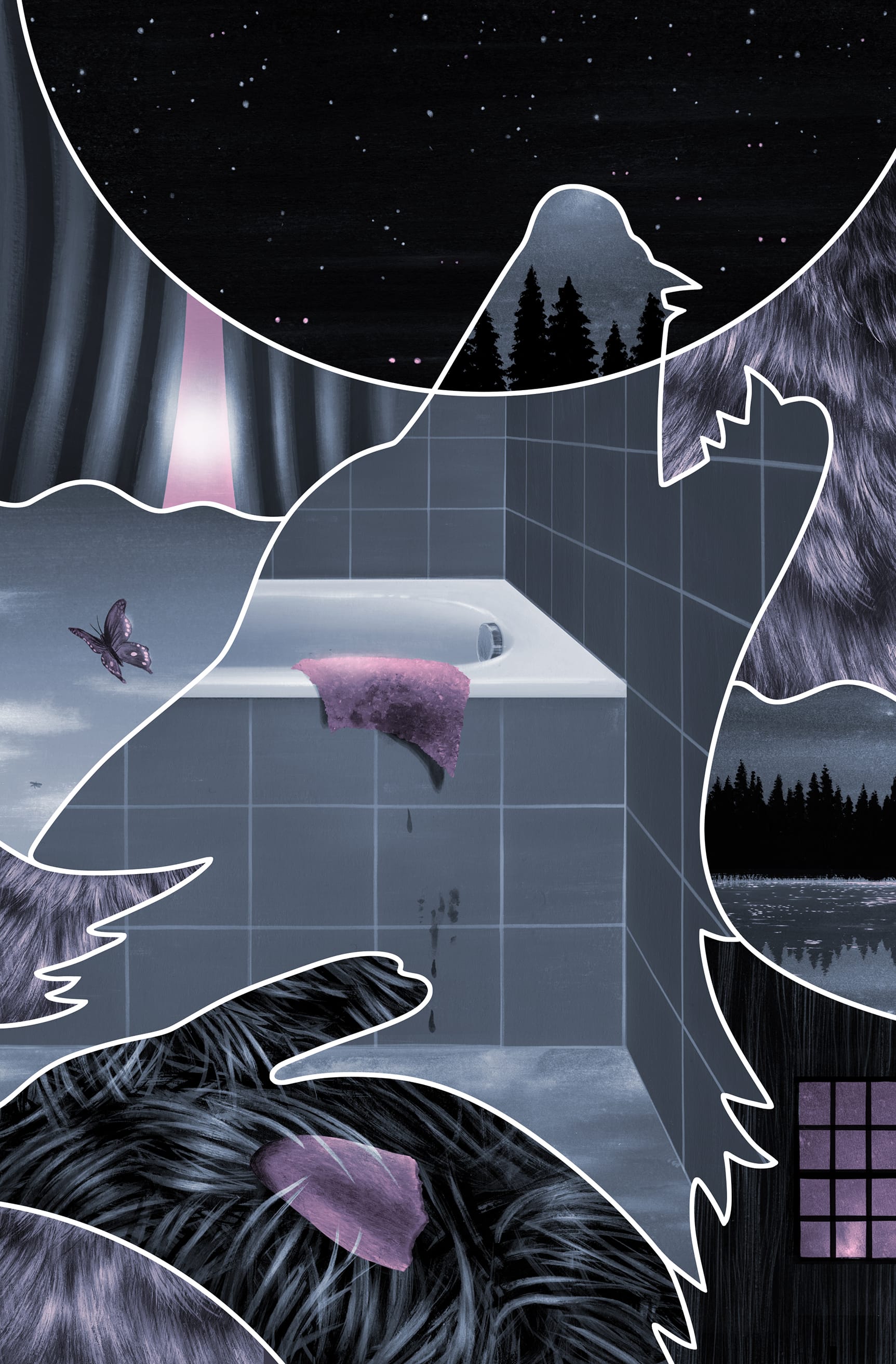
Mrs. Anderson went into the bathroom to wash the blood from the child’s mouth. She sat on the rim of the bathtub, and the child stood opposite her, holding very still and gentle beneath the dragging washcloth. The child’s large eyes were red-rimmed and puffy from crying. Her bangs stuck to her forehead. But she didn’t smell of sweat. Children, thought Mrs. Anderson, so rarely smell of sweat. What do they smell of? Bread, a little. No, not bread. The child’s knees shook and her belly stuck out severely. When Mrs. Anderson removed the washcloth, the child said, in a voice so high and warbly as to be a little grating: “Am I still their friend?”
“Yes, probably.”
“Am I still sleeping here?”
“Yes.”
“Am I still her?”
“What?”
“Am I the first turn girl?”
“Um.”
Then the child threw up. Mrs. Anderson patted her back and said, “Oh. That’s OK. You’re OK.”
The child felt better. Mrs. Anderson was pretty. The child closed her eyes and pictured the golden land of which she alone was the girl. She could hear the voices of the animals in her mind, and they, like Mrs. Anderson, were saying that it was OK what she had done. It was OK, she was not bad, and nothing bad was going to happen to her. It was good for her to win. She was supposed to, and they wanted her to. The backs of the animals were fuzzy and warm, and the girl could climb up and hold onto their backs and grip the hair like reins while they ran through the trees.
The back was so small and bony, and it shook, and so did the body, and Mrs. Anderson folded it into her own on the edge of the tub. But she felt nothing, really, other than a sickening, profound confusion. Like waking from a dream and believing yourself to be, for a moment, in another bedroom from another place. Someplace softer, more familiar. Your new bedroom, when it emerges from the old one, frightens and disorients you. The way its shadows seem to watch. The small body was hot and irritating and stifling and wild, and Mrs. Anderson tried, in the dark, to locate its name.