With tens of thousands of active and abandoned oil wells scattered across an area the size of Great Britain, the Permian Basin produces an average of 6.7 million barrels of crude oil and 29.1 billion cubic feet of natural gas per day. But while the region, which spans western Texas and southeastern New Mexico, accounts for roughly 6 to 7 percent of the global supply of hydrocarbons, its environmental impact is even more disproportionate: The Permian Basin is the world’s largest emitter of methane, a greenhouse gas, the effect of which on warming, ton for ton over twenty years, is more than eighty times as severe as that of carbon dioxide. Scientists believe that methane alone accounts for nearly one-third of the increase in global temperatures since the dawn of the Industrial Revolution. Despite the catastrophic risk, emissions have increased by nearly 30 percent since 1990.
For as long as hydrocarbons continue to be extracted from the Permian Basin, methane will continue to be emitted into the atmosphere in ever-larger quantities. Whether the gas is released through intentional “venting” (in which unwanted methane is unceremoniously pumped into the air), escapes via ineffective “flaring” (a supposedly safer disposal method in which excess gas is set on fire to turn it into carbon dioxide), or simply seeps through leaks in drilling machinery or storage containers, greenhouse emissions are as inevitable a consequence of producing fossil fuels as of consuming them.
“That oil and gas pollution is invisible is the only reason they have gotten away with all of this,” explains Sharon Wilson, a fifth-generation Texan known as the Methane Hunter. Using specialized cameras that can capture light far beyond the visible spectrum as it is absorbed by colorless gases, environmental organizations like Earthworks and Wilson’s Oilfield Witness have documented the vast quantities of methane that the oil and gas industry routinely releases into the atmosphere. The freshly painted industrial parks that seem like clean and well-ordered facilities to the naked eye are revealed as engines of destruction as soon as one looks at them through the right photographic equipment.
Language, too, has played a role in masking the polluting nature of the industry. Natural gas was coined in the early nineteenth century to distinguish the flammable gas extracted from the ground from the one manufactured by processing coal. At a time when cities were smothered by visible shrouds of black soot, branding the colorless, odorless fuel that bubbled to the surface in places like Fredonia, New York, as a healthier alternative to what was then known as “town gas” was remarkably easy. Today we know that the mixture of hydrocarbons sold as natural gas is composed mostly of methane, but the notion that this substance—which would be more clearly described as “fossil gas”—is cleaner than other hydrocarbons survives to this day.
The supposed cleanliness of the gas has not made turning a profit straightforward. For the upstream sector—the outfits that extract hydrocarbons from the ground, including most of those operating in the Permian Basin, versus the refiners and retail distributors that make up the downstream component—fossil gas can be less a prized commodity than an annoying byproduct of crude oil extraction. It’s incredibly abundant and thus extremely cheap, but so difficult to store that at times producers have been willing to pay buyers to take it off their hands. The price of fossil gas at the Waha Hub, the trading spot in Pecos County where Permian gas is priced, fell below zero for thirty-eight out of the first fifty-one days of 2026.
The business of fossil gas, then, is a game of logistics: Its value depends on moving it from the site of production to places where demand exceeds supply. This is where the midstream sector comes into play. Transporting gas is often profitable, even when producing it is not. Midstream firms in Texas have built a network of thousands of miles of steel pipelines—up to eighty inches wide, generally buried at least six feet underground—along with compression stations every fifty to a hundred miles to keep the gas flowing. At the end of the line, the gas is liquefied, loaded onto gargantuan tankers as long as two football fields, and shipped to regasification plants on the other side of the globe. At every step of the way, gas escapes into the atmosphere: Midstream transport accounts for roughly half of the methane emissions associated with fossil gas.
Since 2016, when the Standing Rock protests against the Dakota Access Pipeline catapulted opposition to fossil fuel infrastructure into the American political mainstream, hundreds of miles of fossil gas transmissions pipelines have been built in Texas. Local communities have protested, but the media has for the most part ignored them. Building new export terminals on the West Coast has, meanwhile, become increasingly difficult. In Oregon, protests and lawsuits forced Pembina, a Canadian midstream company, to cancel the Jordan Cove Energy Project, which consisted of a liquefaction plant and maritime terminal in Coos Bay and the Pacific Connector Pipeline. A similar project by Oregon LNG was canceled in 2016. Spooked away from the Pacific Northwest, and with California’s deepwater ports sitting next to densely populated urban areas ill-suited for gas terminals, the midstream companies found themselves without a viable location on the West Coast of the United States.
It was then that the midstream turned its attention to Mexico. Moving fossil gas out of Texas through the so-called back door south of the border offered a solution to the industry’s pressing need to reach the Pacific and secure access to buyers in Asia. The Mexican route had an additional advantage over shipping gas from ports on the Gulf of Mexico: It would allow firms to avoid the Panama Canal, which had become geopolitically contentious thanks to the Trump administration’s erratic revival of gunboat diplomacy. Then came the illegal kidnapping of Nicolás Maduro in Venezuela and the unprovoked war in Iran, both of which disrupted the suppliers on which Asian markets had traditionally relied, making the prospect of moving fossil gas through Mexico even more attractive.
The rapid growth of transnational energy infrastructure in Mexico has highlighted deep-seated contradictions in the politics of a country that nationalized its oil and gas industries in 1938 and only opened the energy sector to foreign and private investment in 2014. The ruling party, Morena, emphasizes “energy sovereignty,” yet the nation’s electrical grid increasingly runs on Texan gas. This ideologically inconvenient reality has allowed some local politicians to frame the new gas projects as a welcome development that will guarantee clean and affordable energy for their constituencies. The truth, however, is that neither the proposed terminals on the Gulf of California nor the pipelines supplying them will deliver much gas to Mexican consumers. For the firms behind the projects, Mexico is just a territory to be crossed.
To follow the pipeline as it makes this crossing is to see fossil capital make its violent, often unlawful way through the landscapes surrounding one of the most unequal borders in the world. The negative impact of the new fossil infrastructure will be felt all the way from the Mexican border with Texas to the coast of Sonora. The inland regions along the path of the pipelines will pay the social and environmental costs of moving pressurized methane across an entire continent just as much as the coastal communities near the liquefaction plants. Along the way, energy companies will pay rent to the landowner, taxes to the municipal government, piso to the dueños de la plaza—protection money to the criminal groups in control of a given area—and dubious “shared social benefits” to Indigenous communities. The only compensation most of the people who live in these territories can expect in return for the destruction is a certain number of jobs: most of them temporary, many of them dangerous, and none of them sustainable.
But along the path of fossil gas from Texas to Sinaloa can also be found the many courageous people who are fighting to protect their world: their forests, water sources, monumental rocks, prairie dogs, whales, and columnar cacti. But, above all, they are fighting to protect their way of life, those activities like fishing or ranching that for centuries have guaranteed them a livelihood and an identity. Even if they’re not aware of it, all of them are protagonists in the global struggle against climate change. As Mexico goes, arguably, so will the rest of the globe.
Split the Difference
In historical and cultural terms, Northern Mexico and the American Southwest share as much with each other as with the rest of their respective nations. In the expansive cultural region that we might call Aridoamerica, where Indigenous powers like the Comanche once ruled, the ethos of the desert settler has flourished, giving rise to a worldview that celebrates the myth of the strong, self-reliant man who confronts the hostility of the landscape and, through ingenuity and hard work, finds ways to exploit the barren land. The silhouette of a cowboy riding behind a herd of cattle functions as a moral icon on both sides of the border. The oil and gas industry has benefited from this regional identity, burnishing its own image by appealing to the selfless sacrifice of its workers: men who, like frontiersmen or pioneers, spend weeks or months toiling in the wilderness far from home.
For the firms behind the pipelines, Mexico is just a territory to be crossed.
Even in this receptive cultural environment, the depredations of the fracking industry—which has abandoned hundreds of “zombie wells” on leased land and contaminated the aquifers on which ranchers depend—have begun to take a toll. While the toxicity of this American sacrificial zone disproportionately affects Indigenous and Mexican American communities, it has not spared white landowners, some of whom have joined the opposition to the oil and gas industry. “You can have the most ardent supporter of Trump, and as soon as there’s an oil and gas facility by them, and they start breathing that stuff, they’re on the phone call with me,” Sharon Wilson told me. Some of these unlikely activists are people like Hawk Dunlap, a former oilman turned environmental activist who in 2026 ran an unsuccessful campaign in the Republican primary for a seat on the Texas Railroad Commission, and Schuyler Wight, a rancher who for years has flown to Austin nearly every month to attend the commission’s public hearings and remind officials of the dangers that zombie wells pose to his and his neighbors’ cattle. Though neither fits the stereotypes we tend to associate with environmentalists, their strong attachment to their Texan identity finds a new expression in the defense of the land.
The effects of fracking in Texas—air pollution, contamination of aquifers, and earthquakes—don’t stop at the border with Mexico, of course. The implications are easily visible just east of the vast binational urban sprawl formed by Ciudad Juárez and El Paso. On the American bank of the river, the narrow green band that stands out against the aridity of Texas and Chihuahua is known as the Upper Rio Grande Valley. On the Mexican bank, the area has a different name: Valle de Juárez. Its fields were once famously bountiful, but today they are used exclusively to grow fodder for cattle because they are irrigated with wastewater from Ciudad Juárez’s sewage system, contaminated with the toxic waste of the maquiladoras—light and medium manufacturing sweatshops that produce everything from auto parts to household appliances and medical devices, most of them destined for export to the United States.
At the heart of the Valle lie the lands of the San Isidro ejido, a form of communal landownership that was revitalized by the Mexican Revolution. It’s here that two major pipelines enter Mexico: the Comanche Trail, belonging to Carso Energy, the oil and gas subsidiary of Mexican billionaire Carlos Slim’s conglomerate, and the Roadrunner, owned jointly by ONEOK and Fermaca. The volume carried by these ducts is enough to make San Isidro the fourth-most important transnational crossing point for fossil gas along the U.S.-Mexico border. Yet the local population is for the most part unaware that these facilities could be harming their health—they are simply too concerned with their dwindling access to water, the lack of public transportation, and the constant threat of violence on the part of both organized crime and law enforcement.
Those two groups have become increasingly blurred in recent decades thanks to two large-scale social developments that proved transformative for life in the borderlands: the militarization of the Mexican government’s anti-drug-trafficking efforts and the intensification of the American crackdown on undocumented migration. The result is that the smuggling rings of the 1990s, relatively flexible organizations that focused on marijuana and cocaine, have been replaced by the armed groups commonly known as cartels. These organizations control vast territories, collect their own taxes and road tolls, and accumulate capital through a diversified portfolio of extractive activities—including the extortion of migrants left increasingly vulnerable by draconian U.S. policies.
Even if the presence of armed groups has made social resistance more difficult, however, the fact remains that communities on both banks of the Rio Grande share a strong tradition of binational struggle in defense of the environment and public health. One of the most important borderland movements in recent memory, the Alianza Ecológica Internacional del Río Bravo, or Rio Bravo International Ecological Alliance, was founded in the early nineties at a forum that brought together Mexican and American land defenders. They joined forces against the nuclear waste dump that the Texas Low-Level Radioactive Waste Disposal Authority—a strong contender for the government agency with the most comically dystopian name in all of North America—intended to establish in Sierra Blanca, a town of three hundred people some eighty miles east of El Paso. The protests brought together students, ranchers, housewives, shopkeepers, and the regional dance troupes known as matachines. Soon afterward, two weeks before George W. Bush was reelected governor of Texas, the permit for the nuclear waste dump was denied. Nearly thirty years later, community members on the Mexican side of the border still hold an annual ceremony on October 22 to commemorate their common victory.
In today’s Mexico, however, social struggles in defense of the environment face more complicated set of challenges. In late 2006, the administration of President Felipe Calderón launched a massive military offensive against drug trafficking. Two decades later, it’s clear that this strategy had the perverse effect of transforming smuggling rings into far more dangerous paramilitary organizations and also opened the door for agents of the state to execute or disappear thousands of civilians under the pretense that they were criminals. The violence that ensued, perpetrated by both state and criminal forces, has left in its wake 360,000 homicide victims and more than 130,000 disappearances, including hundreds of journalists, human rights defenders, and environmental activists.
The Valle de Juárez suffered the consequences earlier and more intensely than almost any other part of Mexico. In 2008, the region became a central battleground between two criminal organizations fighting for control of the border. The case of the Reyes Salazar family sheds light on the mixture of political and criminal violence that the “war on drug trafficking” unleashed not just on the region but on the whole of Mexico. The Reyes Salazars, led by matriarch Sara, played a central role in the Sierra Blanca protests and other social struggles. But the family would later become notorious for a tragedy apparently unrelated to their environmental activism. In 2008, one of Sara’s adult grandsons was murdered; the dead man’s brother was later apprehended by the military on the presumption that he was involved with one of the groups fighting for the ability to charge migrants and smugglers for access to the border. Josefina Reyes Salazar, the mother of both young men, grew indignant with the army’s refusal to confirm the whereabouts of her missing son and launched a protest against the Mexican military’s violation of his due process and, more generally, its involvement in civilian law enforcement—hunger strikes, letters to political authorities, confrontations with army officers—until she, too, was murdered. Over the following months, four of Josefina’s relatives, who had continued her protest, were also killed. The surviving members of the family were forced to seek asylum in the United States.
Few regions of Mexico have experienced forced displacement on a comparable scale. “Between the censuses of 2010 and 2020, the area’s population was nearly cut in half,” Brenda Irán, a sociologist at the Centro de Investigación y Docencia in Chihuahua City, told me. The San Isidro ejido had 3,843 inhabitants in 2010; a decade later, only 2,065 remained. Some of those displaced, however, retain economic ties to their land. “There are people who moved to Texas during the violence but still cross into Mexico to work their parcels in the ejido,” Leobardo García Galindo, a local educator and activist, told me.
At the same time that the violence of the so-called war on drug trafficking was starting to unfold in Mexico, the so-called shale revolution that would lead to the fracking boom was beginning in Texas. Between 2009 and 2014, the number of active wells in the Permian Basin went from 92 to 565. The result was that, just as the militarization of anti-narcotics and anti-migration enforcement led to ever more murders and disappearances in the region, Mexican and American politicians were busy enacting policies designed to facilitate the entry of Texan gas into Mexico.
In 2016, construction began on the cross-border pipelines entering Mexico through San Isidro. The residents of the ejido, most of whom work low-paying jobs in the maquiladoras and rely on their employer’s private transport because public transit no longer operates in the area due to high levels of violence, agreed to sell or lease their land to the midstream firms. The construction of the pipelines has brought them some economic benefits: right-of-way payments, land purchases, a temporary influx of customers for restaurants and food stalls, and employment opportunities. Furthermore, after years of displacement, shoot-outs, and curfews, what’s left of the community often doesn’t see the pipeline as a danger.
The result is a vicious cycle. With social resistance effectively neutralized, the oil and gas industry can move ahead with ambitious projects that accelerate climate change, intensifying the droughts and environmental degradation that have pushed many to try their luck beyond the border. Mexico Pacific’s proposal for its Saguaro Connector pipeline, for example, shows that the company plans to cross into Mexico at a point south of Sierra Blanca, where a new border wall is also slated to be built. As immigration enforcement grows harsher, the criminal organizations that administer and exploit access to the border from Mexico also become increasingly militarized. The new border wall and the planned pipeline are bound to strengthen the military-criminal complex that administers the border and exacerbate the violence it produces.
Medium Sour
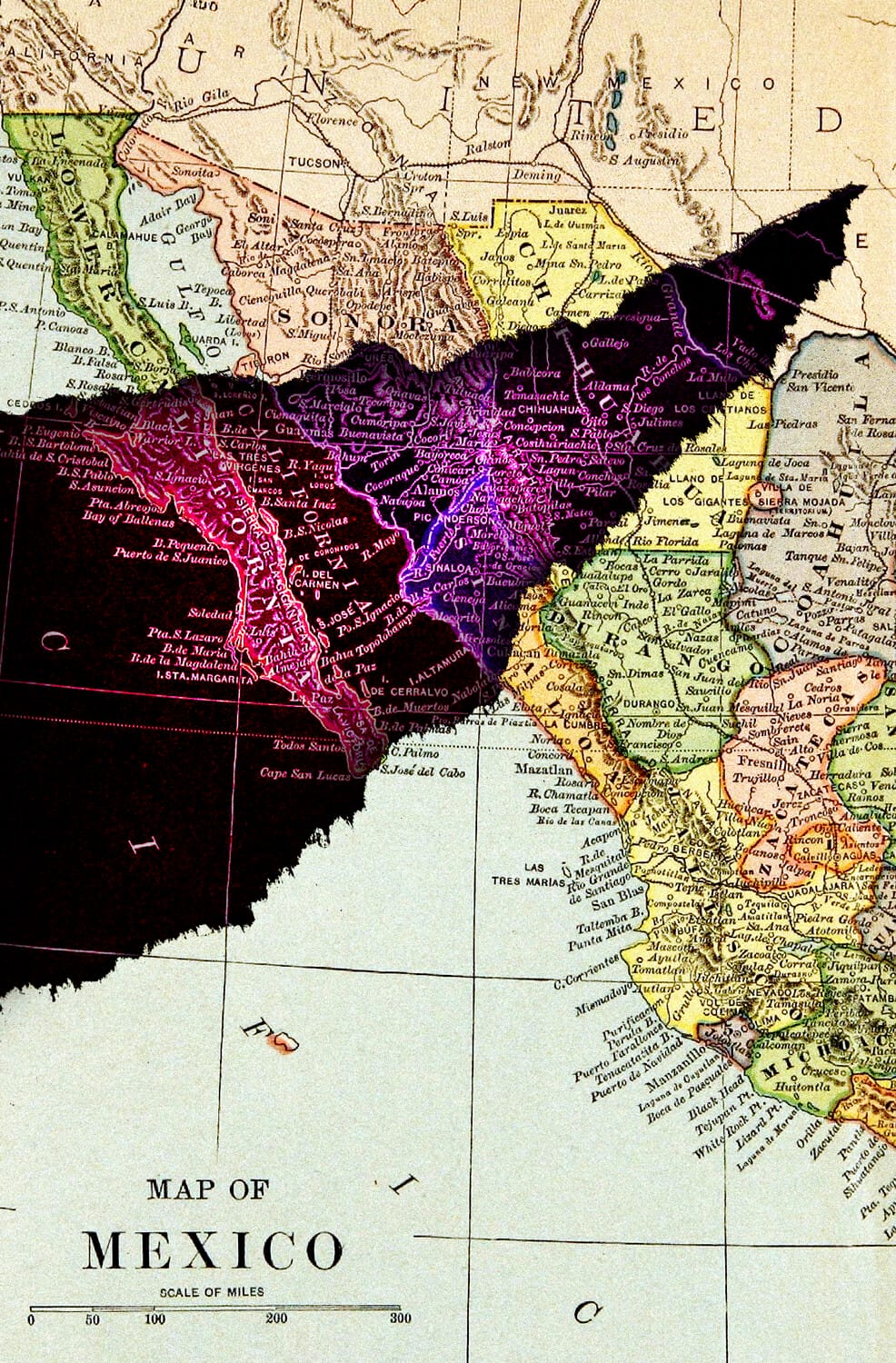
Some three hundred miles southwest of Ciudad Juárez, however, people have found ways to resist fossil fuel infrastructure even in the presence of organized crime. In late 2013, the Indigenous Rarámuri people who live in scattered villages and rancherías on the Sierra Tarahumara noticed the sudden appearance of a wide road cutting through their dense conifer forests. No one had explained to them what was going on, let alone “asked for permission”—the phrase often used by communities to refer to the formal consultations that companies wishing to build on Indigenous land are legally obliged to conduct before any work begins. The mystery loggers were clearing the way for the Topolobampo Pipeline, a 355-mile duct meant to move Texan gas over the western Sierra Madre to the Sinaloan port of Topolobampo on the Gulf of California. The company behind the project was TransCanada, now known as TC Energy, an oil and gas behemoth that at the time was also developing the controversial Keystone XL Pipeline on the U.S.-Canada border.
Alarmed, several Rarámuri communities sent delegates to Father Javier “El Pato” Ávila, a Jesuit priest who has lived in the Sierra Tarahumara since 1975 and leads the Commission for Solidarity and the Defense of Human Rights, the first human rights commission in northwestern Mexico. A figure of moral authority both in the Sierra and in Chihuahua City, Father Ávila would become a key mediator between the local government, TC Energy, and the Rarámuri communities.
TC Energy’s strategy in the Sierra Tarahumara, Father Ávila told me, followed Pancho Villa’s famous maxim: Mátalos y después veriguas (Kill ’em first, then ask questions). The pipeline had the blessing of the Mexican federal government, which had awarded the project to TC Energy through a public tender. The company had negotiated right-of-way agreements with most of the ranchers and ejidos along the route. But neither the government nor the company had consulted the seventy-five Rarámuri communities that would be affected.
Over the past decade, appealing to the “right to be”—codified in the binding international treaty that emerged from the Indigenous and Tribal Peoples Convention of 1989—has become part of the repertoire of tactics that Indigenous communities deploy to resist such projects. The right to consultation requires governments to organize free, informed, and culturally appropriate deliberative processes before any work begins; the community’s decision is legally binding. TC Energy had flagrantly broken the law, but the Rarámuri were not the kind to give up without a fight and demanded their consultation. By the time construction began in earnest, several Indigenous communities had organized the Caravan for Justice in the Sierra Tarahumara, a political organizing effort that brought together dozens of Rarámuri communities with two central demands: legal recognition of their territorial rights and an end to illegal logging in their forests.
Both the Rarámuri communities and the civil society organizations advising them were aware that participating in a belated consultation risked lending legitimacy to a project already underway. “They felt they’d already been run over,” Fátima Valdivia, a lawyer who founded the legal nonprofit Center for Education and Defense of Human and Indigenous Rights, or CECADDHI, which offered legal representation to ten Rarámuri communities, told me. “They didn’t feel they could say no. The pipeline was already there.” Still, several communities decided to participate, feeling it was important to establish a precedent in which the Rarámuri were recognized as legal subjects.
The communities had a nonnegotiable condition: that TC Energy halt construction entirely during the consultation period. While every day the bulldozers sat still was a net loss, the company eventually agreed. To break the deadlock, it deployed a team of “social responsibility” consultants tasked with selling the project to local communities. The result was an outrageous conflict of interest all too common in these consultations: The people charged with informing the Rarámuri of the benefits and risks of the pipeline were not independent experts but specialized professionals on TC Energy’s payroll. An account of one of these meetings, published by CECADDHI, included the following exchange between a TC Energy representative and a participant:
“Do you farm?”
“Yes, I farm.”
“Do you use fertilizer?”
“Yes, I do.”
“Well, there you go! This pipeline will carry natural gas that will be converted into electricity, which will be used by companies that make fertilizers—and that means fertilizer will be cheaper.”
The vocabulary of social responsibility is rich in expressions that frame a deeply unequal negotiation as equitable and friendly: “cultivating agreements,” “constructing a shared ‘Us.’ ” The consultants companies hire are often trained sociologists or anthropologists who invoke concepts like “differentiated impacts” or “intersectionality.” When push comes to shove, however, the high-minded platitudes of social science deployed in the service of capitalism give way to an economic negotiation.
“We prefer not to think of it as a payment,” a veteran social responsibility consultant told me anonymously. “We prefer the term ‘shared social benefits,’” a turn of phrase adopted by both the companies and the Mexican government. The concrete form of these benefits varies widely depending on the community’s capacity to organize. “There are communities in Oaxaca and Tabasco that arrive at the first meeting with an itemized breakdown of how much keeping the machinery idle is costing the company,” the consultant went on. “That’s their point of departure for the negotiation.”
The consultation of the seventy-five Rarámuri communities yielded mixed results, stoking animosity among different groups. In some communities, the siriame—the Rarámuri’s traditional political authorities—hastened to certify their approval of the pipeline; in exchange, they received sacks of cement, rolls of barbed wire, and solar panels. “The company arrives to ‘solve’ certain needs,” Valdivia told me. “But those needs are rooted in an original inequality. If the company can get away with paying them three cents, it will do just that. The problem is that people are often desperately in need of a few cents.”
There were also cases of communities that chose to override the decisions of their siriames and pursued legal remedies, which allowed them to negotiate with TC Energy from a less unequal position. These communities established trusts to administer the payments they received. Though the economic benefits were larger, the money sowed conflict and social division within the Indigenous communities themselves and between the Rarámuri and the mestizo communal landowners of neighboring ejidos. Ten years later, Father Ávila told me, the wounds opened by the pipeline have yet to heal.
But not all communities agreed to give their consent in exchange for money. Bosques de San Elías Repechique, the village that first organized against TC Energy, held out until the end, forcing the company to reroute the pipeline to avoid crossing the villagers’ land.
According to many of the people who spoke with me over the course of my reporting for this story, energy corporations that do business in the country are all but certain to encounter criminal organizations that demand of them the same thing they expect from any other business operating in the territories under their control: payment of piso. In the case of the Sierra Tarahumara, some of my interlocutors suggested that in recent years criminal organizations have grown increasingly powerful in the region.
If they had tried to build the pipeline today instead of ten years ago, it would have been much more expensive, Father Ávila told me. “They wouldn’t have let them pass without paying their due,” the piso charged by the armed groups. When I suggested to a social responsibility consultant that paying protection might yield certain advantages for them, they cut me short. “We’re all victims of organized crime,” the consultant said. “Let’s not quarrel among victims”—an odd formulation from a business contributing to climate change, the greatest threat humanity faces today. From the perspective of the Rarámuri people, in any case, midstream companies and organized crime have something important in common: They both raze their forests. Carlos Castillo, a biologist who serves as Northwest Mexico program director for the nonprofit Wildlands Network, told me that one of the central concerns in the Sierra today is the possibility that the ever more frequent wildfires that blaze through the region could one day reach a fossil gas transport facility. The companies’ argument that such a situation wouldn’t pose significant risks, he said, was hard to believe.
Gulf Wars
Following the westward path of the pipelines beyond the Sierra toward the coast, one finds that the transformation of Mexico into a hub for maritime U.S. energy exports has already begun. The American energy conglomerate Sempra went as far as to retrofit the Costa Azul Terminal in Baja California—originally designed to regasify fossil gas imported from Asia—into a liquefaction plant that this year will begin processing Texan gas for export to Asian markets. Several other oil and gas firms are also planning to build new maritime terminals and liquefaction plants on the Gulf of California.
From the perspective of the Rarámuri, midstream companies and organized crime have something in common: They both raze their forests.
If all of the major projects the midstream industry hopes to establish on the northwestern coast of Mexico are built, the result will be nothing less than the industrialization of one of the world’s most diverse and well-preserved marine ecosystems. Unlike the Gulf of Mexico, which the oil and gas industry has exploited and contaminated for around ninety years, the ecosystems of the Gulf of California are still relatively healthy. Overfishing and rising ocean temperatures have reduced some species’ populations, but the absence of large urban centers along its shores and the sparseness of heavy maritime traffic have allowed it to endure as a natural refuge for both resident and migratory species, including the endangered blue whale, the largest mammal that has ever existed. The increase in tanker traffic required by the operation of these LNG plants poses a direct threat to cetaceans—not only through the risk of lethal collisions, but because the noise these vessels radiate into the water interferes with whales’ communications and alters their behavior in aspects as crucial as feeding, reproduction, and calf rearing. More recently, a Mexican federal court issued a temporary injunction that requires the government to prevent gas tankers from entering the Gulf of California to supply the Saguaro Project. Although the underlying legal case remains ongoing, the ruling represents a major victory for environmentalists fighting the fossil fuel industry in the region.
At the southern end of the Gulf, in Sinaloa’s port of Topolobampo, Sempra had proposed Vista Pacífico: a floating liquefaction plant and fossil gas export terminal aimed at Asian demand. The project had secured export permits from the U.S. Department of Energy and commercial agreements with several clients. Nonetheless, in March 2026, Sempra announced its cancellation. Earlier that year, the Natural Resources Defense Council had published a briefing alerting potential investors to the “elevated financial, regulatory, governance, and reputational risk” of the project, noting that it would sit within a UNESCO World Heritage Site and contradicted Sempra’s own commitment to become a “net-zero emissions” corporation by 2050. The cancellation of Vista Pacífico was an important victory for civil society organizations and local communities. Much like the success of the binational protests against the Sierra Blanca nuclear waste dump, it demonstrates that these projects are more uncertain than they appear, even in today’s energy chaos. If the crisis provoked by President Donald Trump in the Strait of Hormuz has added urgency to the search for routes capable of supplying Asian hydrocarbon markets without passing through the Middle East, the industry also faces rising costs and mounting risks for projects like Vista Pacífico, including volatile tariff policy and the rise of solar and wind power. From an economic standpoint, one of the dangers these projects carry is that of stranded assets: infrastructure representing, in this case, investments of between $5 and $15 billion that could quickly become obsolete as the world transitions toward renewable energy.
Although the cancellation of Vista Pacífico is encouraging, other midstream firms are still marching ahead with major infrastructure projects on the Gulf of California. Even if only one of them were to be built, the damage to the ecosystem would be catastrophic. A little farther north, in the port of Guaymas, Sonora, a joint venture between Singapore’s LNG Alliance and Texas-based Epcilon has been seeking since 2020 to develop AMIGO LNG, a floating gas liquefaction plant that, according to the company, would be the largest in the world. The firms involved hold commercial agreements with clients in Malaysia, Nigeria, and Oman, but their U.S. export permit expires in 2027, and they have yet to raise enough funds to make a final investment decision. In early 2026, the company signed a memorandum of understanding with the Sheinbaum administration, apparently to generate confidence among potential investors.
Like other similar projects, AMIGO LNG isn’t without legal and administrative irregularities. Its environmental impact statement contemplated a different pipeline from the one it now intends to use to supply the terminal. A recent white paper by the Institute for Energy Economics and Financial Analysis argued that if the Guaymas terminal were to receive the volume of gas that its environmental impact assessment projects via the Sásabe-Guaymas pipeline, the gas supply to electricity generation plants in northwestern Sonora would have to be substantially shortchanged. This is an illustration of one of the dangers of export projects: They not only fail to lower the cost of energy generation in Mexico but actively jeopardize it.
That is precisely one of the grievances of the residents of Puerto Libertad, Sonora, the northernmost port on the Gulf of California, where Mexico Pacific is planning Saguaro Energy, a massive liquefaction and LNG export plant. Puerto Libertad was founded as a fishing village, but in the late 1980s the Mexican Federal Electricity Commission built a thermoelectric power plant there that today supplies electricity to the region. Yet when the lights go out in Puerto Libertad, residents must wait—sometimes for several days—for technicians from Caborca, a town two hours away, to respond. With summer temperatures increasingly reaching 120 degrees Fahrenheit over an ever-growing number of months, air conditioning in Sonora is a matter of public health.
Beyond energy insecurity, the hundreds of families who make their living from small-scale coastal fishing dread the prospect the prospect that the construction of Saguaro Energy’s dock, and the maritime traffic it would generate, could drastically reduce the output of their fisheries. They fear the loss not just of their livelihood, but of their identity as gente de mar—seafolk—that is, like the fate of the whales, bound up with the survival of the marine world from which they draw their livelihoods. Even if the plant absorbed some of them as low-skilled workers, the end of fishing would see many swell the ranks of undocumented migrants or be dragged into criminal organizations.
For now, LNG Alliance and its U.S. partners are pressing forward with AMIGO LNG. Unless activists are able to replicate their success in Topolobampo, the Gulf of California will soon host its first major facility designed to bring Texan fossil gas to buyers on the other side of the globe. All along the route of the pipelines, however, I encountered people and organizations who refuse to accept the destruction of their lands and ways of life as an inevitability. They are stronger and more successful than one might imagine. Although the Saguaro project by Mexico Pacific and the Sierra Madre Pipeline that would supply it have not been formally canceled, at present they are stalled, thanks in part to the pressure and attrition applied by grassroots organizations in Mexico and the United States. There’s no question the fight is uphill, but to despair would be cowardly. If groups as disparate as the rancher-environmentalists of Texas, the educator-activists of the Valle de Juárez, the Rarámuri communities of the Sierra Madre, the seafolk of Sonora, and many others are willing to stand up to capital in defense of nature, what’s our excuse?