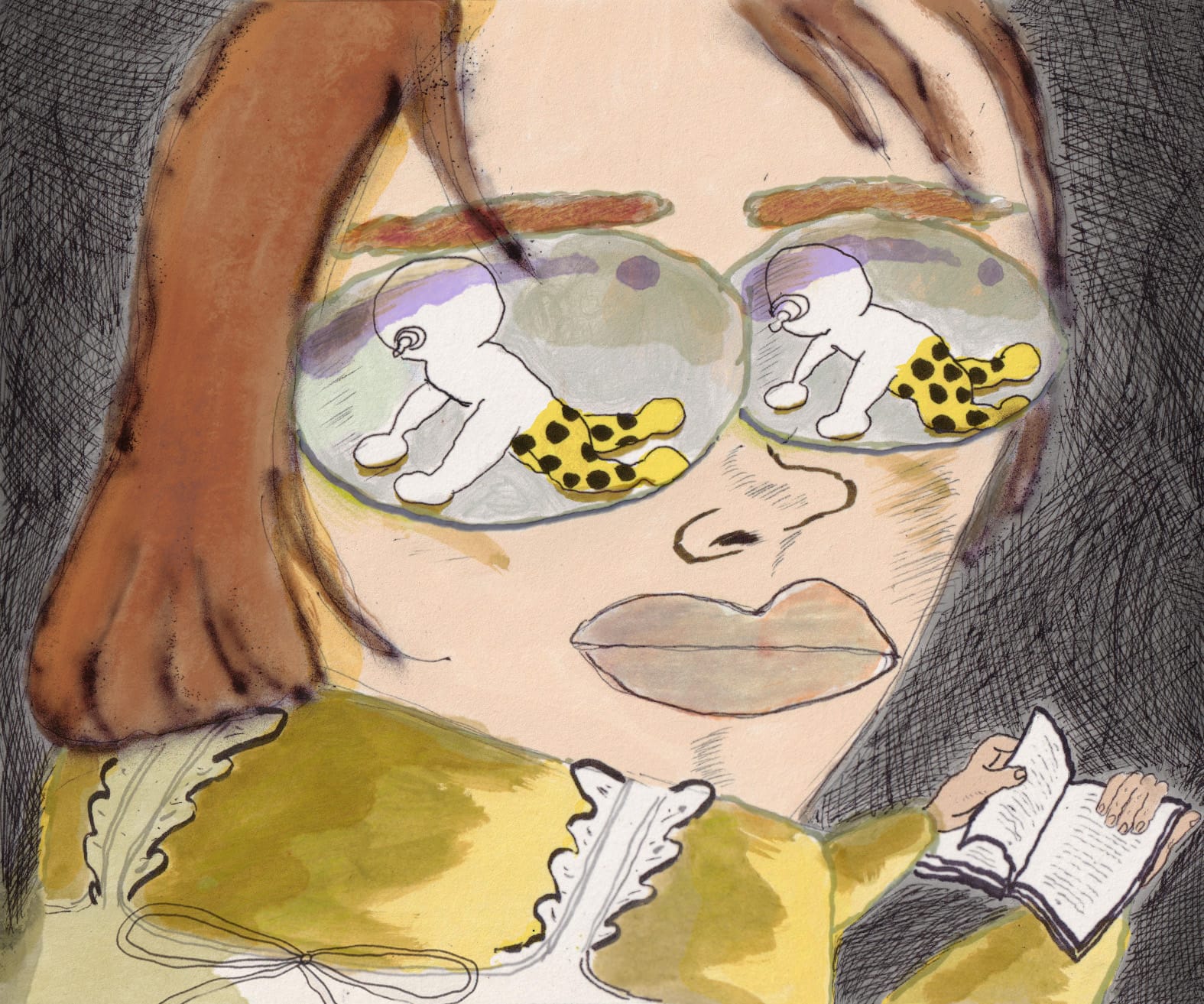
When I found out I was pregnant last May, I commenced a program of reading. I needed to know what was coming. During the six months that I had been trying, I had avoided stories about pregnancy and small children at all costs. If a TV show introduced a pregnancy plotline, I switched it off. If somebody recommended a book tangentially connected to motherhood, I made a point to quickly forget the title. When I saw acquaintances on Instagram post birth announcements, I muted their activity. The more other people were becoming pregnant and having babies, the more pregnancy began to seem like a finite resource, one that may well not extend its rewards to me. (I’d left it until thirty-five, my thyroid didn’t work, I drank too much in my twenties, hadn’t earned it, etc.) I constructed for myself a provisional world where I could keep trying without losing hope that one day, on the other side of a luteal cycle, I, too, would get what I wanted. By the time the positive test result materialized, I had been living in a narrative dead zone.
I hadn’t always hidden from motherhood stories. During my twenties I had read Rachel Cusk’s memoir A Life’s Work, a book so divisive when it was published in 2001 that Cusk later recalled being “accused of child-hating, of postnatal depression, of shameless greed, of irresponsibility, of pretentiousness, of selfishness, of doom-mongering and, most often, of being too intellectual.” I’d read and liked pregnancy memoirs (Maggie Nelson’s The Argonauts), novels about motherhood (Ariana Harwicz’s Die, My Love), as well as novels about not mothering (Sheila Heti’s Motherhood). I read histories (Sarah Knott’s Mother Is a Verb) and critical inquiries (Mothers by Jacqueline Rose). I felt reasonably confident back then that I knew what I was getting into.
I found out I was pregnant when a doctor emailed me at the end of the day on a Friday. I had visited several days earlier to complain about a lingering chest infection and persistent, but suddenly overwhelming, fatigue. I had burst into tears on the examination table; the weeping alone should have been a clue. Once the first wave of giddy happiness had eased, I realized that, for all my casual reading in my twenties, I’d had no skin in the game. I knew that early motherhood had the ability to fundamentally alter one’s personality, and I knew the cultural baggage that came with it. But what I wanted was to come away unscathed; I was afraid of losing who I was, but I also wanted a baby. I wanted to know about peers getting pregnant while still living with roommates, kids sleeping in their parents’ rooms until their teen years for lack of space in tiny rentals, friends taking out extra credit cards to afford their health insurance copays and working three or four insecure jobs at once on endless short-term contracts—how women right now were experiencing new motherhood. I wanted to know what it was like to give birth in the increasingly precarious social and economic conditions that the postpandemic years have turbocharged, amid epidemics of atomization and loneliness with no seeming solution, in which the reliability of facts has been trashed. I went to the bookstore.
Tales from the -Hood
In those early weeks, when I noticed myself avoiding the word mother, even in my own thoughts, I turned to Egyptian Canadian poet Iman Mersal, who writes that narratives about motherhood generally involve “the melding of two distinct selves, a love unlimited and unconditional.” In her book How to Mend (translated from the Arabic by Robin Moger), Mersal sets out to dismantle the dominant narratives of motherhood. You do not enter new motherhood with a clean slate; you enter a territory in which mothers are instrumentalized to illustrate sociopolitical narratives, and becoming a mother thrusts you into the narrative space crowded out by Virgin Mothers, Angels in the House, Crack Moms, and Mommies Dearest, forcing you to measure yourself against them.
Was creating new life in the face of rising authoritarianism, a casually accepted genocide, and climate collapse inherently cruel?
Mersal takes particular issue with contemporary feminism’s neglect of motherhood. According to Mersal, feminist activists, in the course of battling for women’s rights in the workplace and in the law, for paid time off after birth and for affordable childcare, have generalized women as a group and neglected more private, subjective experiences of motherhood. This has produced “one of the crises of Western feminism,” in which speaking about motherhood as a “special” experience that might imply a meaningful difference in male and female experience is interpreted as “detract[ing] from the coherence of calls for gender equality.” Mersal concludes that, “until feminist theories take account of the violence, rage, and frustration inherent in motherhood, you will have to narrate your own experience or learn to take refuge in a narrative that will help you see that you are not alone.”
Reading Mersal, I began to think about this problem in relation to the specific form of twenty-first-century feminism that had been dominant over the course of my own adult life. Most women having children right now—millennials and Gen Z—have been brought up in a culture of #GirlBossing, “The Future Is Female” T-shirts, and relentlessly pink-coded hypercapitalist rhetoric that’s part business-school dictum and part self-help drivel. Motherhood had been reclaimed by an ideological tradition I wanted nothing to do with—one that made me nervous about the kinds of dresses I liked wearing because they had been co-opted by tradwives, the modern conservative movement’s vision of acceptable motherhood.
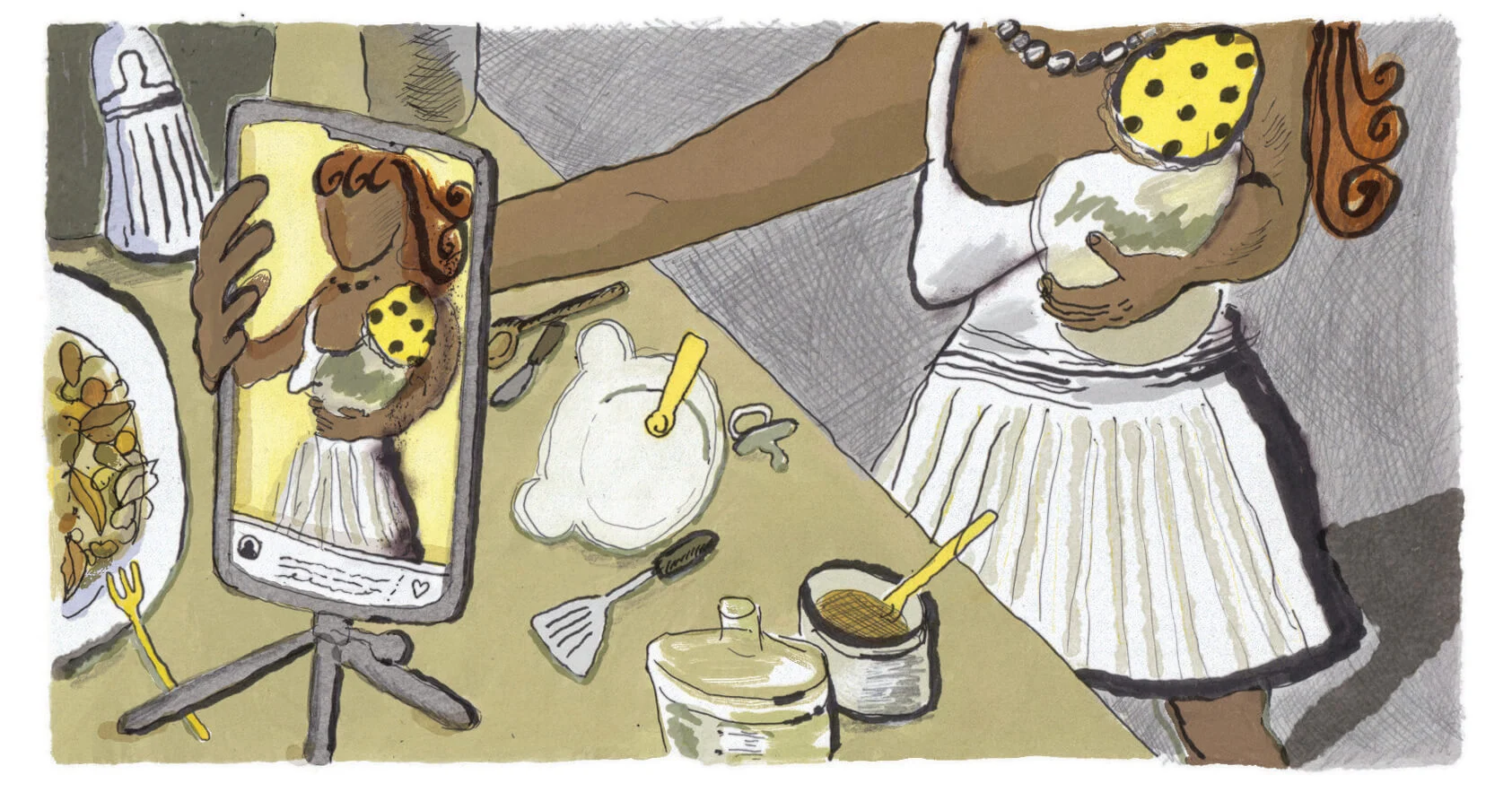
An indexical figure of post-Covid online life, the tradwife insists on a return to a prelapsarian past. Most of these women who have made their families the subject of their Instagram and TikTok streams are, of course, monetizing their lives, slipping ads into their content, and speaking of “exciting new business opportunities.” As journalist Amanda Hess points out in her book Second Life, which contextualizes pregnancy and new motherhood as it’s lived online, in these videos, “no figures from outside [the tradwife’s] heterosexual nuclear family appeared. Presumably she had neighbors, surely she had some help, but the content elbowed them out of the frame to zoom in on her virtuosic solo performance.” In the tradwife, the contemporary practice of motherhood adheres to the same achievement-oriented model of success as any other job under late capitalism; the difference with mothering is that the work is meant to remain invisible. Any dissatisfaction is a moral failure.
While I was reading Second Life, I discovered that the online world Hess spoke about was becoming the grand master of my anxieties: a story in the Guardian about a woman whose pelvic floor prolapsed after childbirth, who now finds sex agonizing and can’t even go for a run; an interview in which Jennifer Lawrence spoke about her own dark and lonely postpartum months; a report about a man who had bombed an IVF clinic in Palm Springs leaving behind a manifesto arguing it was cruel to bring more human beings into a harsh and meaningless world. Eight, ten weeks in, I read these things in bed at night, my face illuminated by the blue glow of my phone as my husband slept soundly beside me. Were sex and running over for me? Would I be lonely? Was creating new life in the face of rising authoritarianism, a casually accepted genocide, and climate collapse inherently cruel? But in most online (and offline) spaces, whether medical, therapeutic, or woo-woo, I was warned that negative thinking would “harm the baby.” Online strangers insisted this was going to be “the best time of my life.” My body held “ancient wisdom.” Prenatal yoga classes had me put a hand to my not-yet-showing stomach and dedicate “my practice” to the fetus while reciting mantras like “I am the best mother my baby could wish for.” Doctors refused me painkillers, telling me that the best medicine was “the joy you will experience in becoming a mother in a few months.” The relentless positivity was terribly alienating.
In Second Life, Hess details what are now digital commonplaces: the period-tracking apps that turn into pregnancy companions, the algorithmic ads suddenly addressing you as “Mama,” the smart baby technologies that essentially gamify infants for their parents, and the way the internet gives voice to—and sometimes legitimates—previously fringe ideas like freebirthing. Even in the first weeks of pregnancy, I could see my experiences documented in Hess’s book. “I asked the internet how you push a baby out. I asked the internet how much it hurts,” Hess writes. I’ve asked it the same things. Hess expresses the profoundly weird loneliness of contemporary pregnancy, in which the internet knew I was pregnant before my family or my friends: I was getting ads for maternity wear and prenatal supplements before I’d even seen the ob-gyn.
Second Life reflects the disjuncture between the internet and the unbearably cloistered reality of offline life. Regarding the labor of childcare in the early years of her son’s life, Hess writes, “It was the isolation of the work that made it so inefficient, depressing, and dull.” But on her phone, Hess “found my isolation transformed. My social feeds were stacked with videos that eroticized the secluded mother. Robed in a prairie dress, she stood in a kitchen as white as a near-death experience, whispering ASMR incantations into my ears.” The isolation Hess writes about alarmed me, but it was also consoling; during the first twelve weeks, the books I was reading were the only community I had. I wasn’t telling people I was pregnant (aside from doctors, several waiters, and a security guard at London City Airport) because there is a much higher risk of miscarriage in the first trimester of pregnancy (80 percent of miscarriages occur in those weeks), and I didn’t want to have to face everyone I knew and explain that I’d miscarried if I did. I had not known the decision to stay silent would make the first trimester so lonely. I spent insomniac nights in the darkness with a small purple reading light attached to a book, trying to lull myself to sleep.
The problem was that the only books I wanted to read were about pregnancy or mothering, and in novels like Olga Ravn’s My Work (translated from the Danish by Sophia Hersi Smith and Jennifer Russell) I could make out dark presentiments of my possible future. Like its contemporaries, My Work attests to an experience of devastating change: “When the child left my body, the whole world transformed, not a single living thing could be understood the same way again . . . I was no longer the same.” Anna, Ravn’s protagonist, is overcome with anxiety the moment her baby is born. She can’t sleep, either, she feels like she’s drowning, she has to remind herself to breathe. She loves the child desperately, but she also holds a “drawer of knives in her mind” and slowly becomes intimate with “the thought that she can kill herself.” Anna enters therapy, with long sections of the book given over to the outpatient treatment she receives. Echoing Mersal, she gradually comes to regard “the story of the happy mother” as a fiction that strips away the role of mother from the woman because she can never inhabit it comfortably. Nobody can live a fiction.
I felt like Ravn’s Anna expressed an essential truth otherwise unspoken in the dominant narratives, but it frightened me to read it. “This is why no one wants to read the books of mothers,” Ravn writes. “No one wants to know her. To see her become real. But if we don’t look, we live stunted half lives, each isolated in loneliness.” Toward the novel’s end, I underlined the quote “This book will be a container, a vessel for what a mother is not allowed to be: torn, in doubt, distraught, unhappy.” I wrote in the margin “motherhood as a Lars von Trier film?” It was not, arguably, a good time for me to be reading the book. I was overcome with a paralyzing fatigue, making it difficult for me to work, exercise, or maintain even the most meager of conversations. I spent days riddled with nausea, brought to vomiting by the semen smell of the flowering linden trees growing along our street. I canceled social occasions because it was too hard to lie to friends. I still wasn’t sleeping.
Work, Achieve, Consume
Toward the end of June, I managed to walk with my husband to the Saturday farmers market. We bought apricots and rainbow chard, and my husband took them home while I sat on a bench in the park, too exhausted to walk back. I had a book in my bag, and because I couldn’t do anything other than sit, I began reading Ayşegül Savaş’s The Wilderness, finishing the slim book on that bench over the course of the afternoon. The wilderness that Savaş refers to is the first forty days after childbirth. Savaş, a Turkish anglophone writer living in France, is drawn to traditional Turkish stories about this interval, “considered one of extreme fragility for mother and baby alike.” The new mother is susceptible to air currents that occasionally herald the arrival of a demon called the Scarlet Woman, who becomes the prism through which Savaş contemplates her first days of motherhood. She details sweating through towels and shedding the hairs on her forearms, bleeding nipples, bloodstained breast milk, and the panic she experiences when family and friends text to congratulate her and insist that she “must be so happy.” In fact, Savaş’s days are lonely: “For us, there are no extra hands to help and to hold . . . no lighthearted cousins with whom to chatter. No other human scents our baby can trust.”
“Your body knows when to go into labor at exactly the right time,” the instructor purred over a New Agey Spotify playlist.
Around this time, I was in a prenatal yoga class where we were told to lie down while the instructor told us we knew just what to do. “Your body knows when to go into labor at exactly the right time,” the instructor purred over a New Agey Spotify playlist. My head started to whirr: What about women who go into labor at twenty-four weeks and lose their babies? I could see other women around me on the floor calmed by the instructor’s reassurances. I wished like hell I was one of them, but I couldn’t stop thinking about what we weren’t being told. If part of me felt like I was being unnecessarily alarmed by some of the books I was reading, at least writers like Savaş weren’t bullshitting me. “I frantically try to remember all the phrases I’ve heard about new motherhood,” Savaş writes. “But it seems I have never really listened to mothers, that I have never penetrated the meaning of what they were saying.” She draws on the theorist Jack Halberstam to frame new motherhood as a type of wildness, specifically “unbeing.” This I marked with an exclamation point. Why, I wondered, was the common through line in all these books the radical alteration in a woman’s sense of self? Why was every story one of isolation? It was after reading The Wilderness that my nightmares began. I woke up in the middle of the night on the first of July, shouting “Panther!” into the darkness. There was, I explained to my husband, a panther in our bedroom, stalking me.
During the time of the panther, I began Louisa Hall’s Reproduction, about a woman trying to get pregnant while writing a book about Mary Shelley. Reproduction takes on several resonances in the book: becoming and staying pregnant, art making, and the limits of scientific knowledge. Hall’s protagonist, too, frames the journey to motherhood as one of lonely discovery, “the last man, setting off in his ship to find a new country.” It was while reading Reproduction that we told our family and friends I was pregnant. I was, at eleven weeks, not quite out of the first trimester, but it was my father’s birthday, and I wanted to give him the news as a gift. I was, upon telling my family about the pregnancy, phenomenally happy. But a few nights later, I read about Hall’s protagonist’s miscarriage, an event that happens at twelve weeks. I lay awake, paralyzed with the fear that I had jinxed it.
At the end of August, after months of programmatic (but by no means exhaustive) reading, I came to Matrescence by Lucy Jones, the book that consoled, exasperated, and frightened me the most. Matrescence (by which Jones means “mother becoming”) is frank about everything I suspected we, as pregnant people, weren’t being told: the way your sense of smell changes, the way pregnancy physically alters the brain, the prevalence of traumatic childbirth. “From the moment I was pregnant,” Jones writes, “I didn’t just feel different. I was different. I am different. On a cellular level. I would never be singular again.” I wrote in the margin the word terrifying.
Jones uses her own experience to illuminate the neurological and biological findings we’re only recently beginning to understand. But in many ways, I found Matrescence an odd book: its first page, for instance, is an illustration of a human egg meeting with a sperm composed entirely in letters of the alphabet. The second page is a prologue on the subject of slime molds. Sometimes Jones pauses to offer an aside on the mysteries of eel reproduction, fungal networks, or the collection of individual organisms that make up the Portuguese man-of-war. On one page the words “this is how big it needs to be” frame a tight circular vacancy that takes up nearly the entire paperback page in width. It is the only representation of how dilated you need to be to push a baby out of your body that I had seen. I carried the book around for a week and showed the dilation word illustration to every friend I encountered. Those of us who hadn’t had kids yet were horrified. But a friend with an eleven-year-old shrugged and said, “Yeah. Obviously.” It felt like one more crucial thing I could uncover only from my reading—nobody else was going to tell me.
Jones articulates the books’ common cry—“As time passed, this new isolation and alienation chipped away at my sense of self”—but goes further in tying these feelings to issues larger than the individual and her singular aloneness. In most developed countries, it has become harder to have children. Rent and housing costs have risen higher than wages, and jobs have become increasingly insecure and unreliable. I was intimately familiar with this instability: the reason I had left New York, my home for over a decade, was because I couldn’t afford to have a baby if I stayed. I am, according to Guardian Australia, a “mid-career” writer still being asked to work for free because it will “look good,” cobbling together abysmally paid teaching work to keep my head just above water. As Jones writes, “The intense competition fostered by predatory capitalism has resulted in a culture of increasing busyness, presenteeism and overwork, which corrodes social relations.” When women have children, they are met with intensely gender-normative narratives, in which being a good mother means putting the child above all else. The cultural expectations of motherhood clash with the hypercapitalist culture that has raised us and told us to work, achieve, and consume. “Mothers have been stripped,” Jones writes, “of collective care structures and public services.” No wonder we’re all so lonely.
The Personal Is Political
At the beginning of autumn, I wound up my reading. My pregnancy itself had become louder and more operatically eventful (the eerie reawakening of old injuries, the debilitating dizziness of persistent anemia, being thrown into the curb by a moving cab and landing, catlike, in the only position that could preserve both my and the baby’s life). I felt, if not prepared, then aware of the territory ahead of me: what to look out for, what not to be surprised by. What these books had revealed was a commonality of experience in which childbirth often leaves women traumatized. Women are then sent home to look after newborns, per Jones, “while burdened with loneliness, lack of sleep, and a shedload of impossible cultural expectations, including the imperative to enjoy every minute of it.” Jones, like Mersal, points to motherhood as a blind spot of contemporary feminism. Second-wave feminists worked to emancipate women from the role of housewife, but in doing so, Jones writes, birthing and caring for young children was thrown into the same category as housework, “neglecting the fact that it can be more emotionally and ecologically complex, embodied and demanding than laundry, cooking or even the relationship with a husband or partner.” As a consequence, contemporary feminism ends up “neglecting the maternal experience as an important site of meaning for many women.” Into this vacuum slides right-wing populism and the tradwife in her prairie dress.
The longer I’ve been pregnant, the closer I draw to actual motherhood, the more I’ve thought about something I heard the Australian writer Helen Garner express at a conference I attended in July, reflecting on her involvement in second-wave feminism: “We were naive back then,” said Garner. “We thought if we just explained it to the blokes, then everything would be fixed. We thought we were going to change the world,” she qualified somewhat sadly. This was the era when the slogan “The personal is political” was coined, and consciousness-raising groups met to share private experiences that would transform into political action. Perhaps my own program of reading was a kind of personal consciousness-raising: here were women talking their way out of isolation and, in aggregate, telling a story that might make more women than me feel less alone.
But the truth is I don’t yet know. I can’t assess whether what Jones calls “the anxiety, the lie-exploding romance, the guilt, the transcendence, the terror, the psychedelia, the loss of control, the rupture of self” reflects or diverges from my own experience because I’ve still not yet encountered new motherhood. As I write to you from November, baby knocking firmly at my ribs, I still have a couple of months left before I find out for myself.