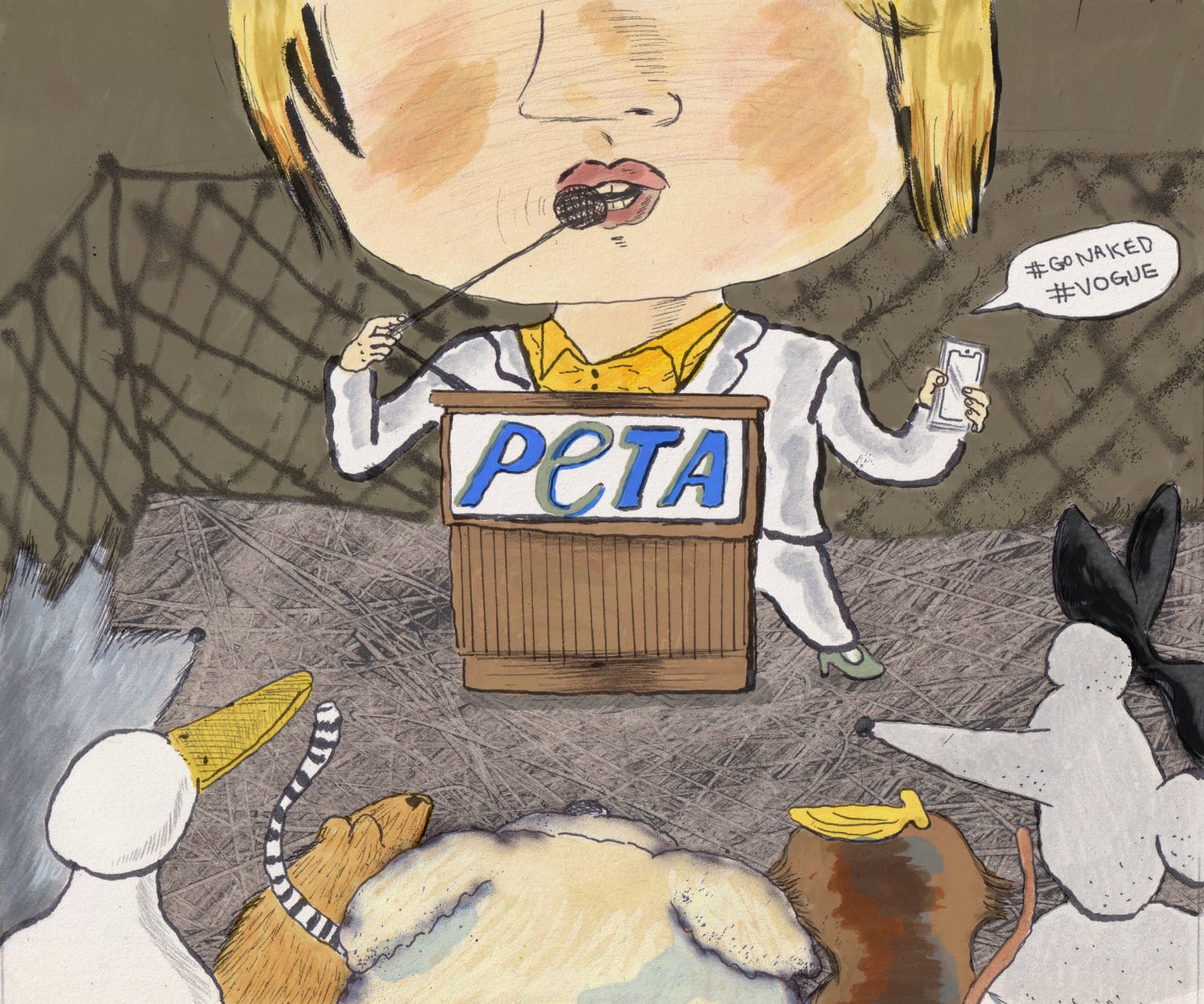
In October 2022, Francisco M. Lebron-Cruz was fired from his job as a turkey catcher. Then he was criminally charged. Footage had circulated online of Lebron-Cruz and eleven of his coworkers kicking, throwing, and otherwise abusing birds at Plainville Farms, a meat-processing plant in Pennsylvania whose packaging boasts that its fowl are “humanely raised.” Posing as a fellow worker, an informant for People for the Ethical Treatment of Animals (PETA), the world’s largest and best-known animal rights organization, had smuggled a camera onto the premises and circulated the resulting tape to major news outlets. As a result of PETA’s campaign, Plainville Farms launched what it called an “aggressive internal investigation,” firing Lebron-Cruz and the other men, who were subsequently charged with 141 counts of animal cruelty. While Lebron-Cruz was convicted and forced to serve one year’s probation, Plainville Farms survived. In 2024 alone, it slaughtered an estimated five and a half million birds, up more than 80 percent from the previous year.
Targeting corporations by scapegoating workers is hardly a PETA innovation, but the strategy has thrived under surveillance capitalism, and few gadflies have exploited the conditions of Big Tech more skillfully than PETA. Founded in 1980 by activists Alex Pacheco and Ingrid Newkirk, the organization quickly gained notoriety for its bullish ethos, drawn from its close ties to the Animal Liberation Front (ALF), a militant group whose actions include bombing fur retailers, setting fire to laboratories at the University of Arizona, and “liberating” six thousand captive mink from a UK farm, two-thirds of whom were either recaptured or killed. In 1984, for example, Newkirk collaborated with the ALF to disseminate footage of animal abuse occurring at the University of Pennsylvania’s Head Injury Clinic, leading it to suspend all primate research. Yet it was not until the 1990s—by which point PETA was commanding an annual budget of nearly $10 million—that the organization started to recognize the power of the broadly circulated image. In 1990, PETA’s “I’d Rather Go Naked than Wear Fur” ads, depicting members of the Go-Go’s posing nude, proliferated on billboards and print media globally.
Undercover investigations, meanwhile, continued: the same year, PETA tricked Carolina Biological Supply Company, a leading distributor of science-teaching materials, into hiring two PETA informants. In the video clips PETA later distributed to cable news networks, cats PETA claimed had been alive are shown on an embalming table, immobilized. A judge ultimately dismissed the charges against Carolina Biological Supply, finding PETA’s evidence unreliable, but other companies were not spared. Long before targeting Plainville employees, PETA released surreptitiously obtained footage of farmers at Belcross Farms beating, skinning, and maiming animals in 1998, leading to felony convictions for three laborers. PETA’s subsequent exposé of a West Virginia slaughterhouse in 2004 put eleven more workers on the chopping block.
“The image is the most powerful tool we have,” Newkirk told director Matthew Galkin in his 2007 documentary I Am an Animal. Tracy Reiman, who joined PETA as a customer service representative and took over as president last year, concurs. “Social media is driven by images and video, and it has given people a window into the suffering that’s otherwise hidden behind closed doors,” Reiman told me. Between blasting images of violence against infant monkeys, sheep, and hens to its followers, taking animatronic cows and elephants to elementary schools, stationing vegan ice cream giveaways outside ice cream parlors, and loosing a robotic calf named Charli XC Cow into malls to ask leather wearers, “Are you wearing my mother?,” many of Reiman’s recent campaigns have sustained the combative approach that earned Newkirk her reputation as an “extremist.” But bad publicity is still publicity, and if PETA looked yesterday like a radical organization with a weakness for the burlesque, its techniques only reflect contemporary America, where corporations sustain themselves on a libidinal economy of likes, politicians cater to the social media tycoons who juice the algorithm in their favor, and large language models convert consciousness itself into a commodity.
A Boy Is a Dog Is a Pig
The idea for PETA came to Newkirk, an auto-racing and sumo-wrestling enthusiast working for the Humane Society in Washington, D.C., when she read Peter Singer’s 1975 book Animal Liberation on a train ride up the East Coast. A manifesto inspired in part by Animal Machines, Ruth Harrison’s 1964 exposé of factory-farming practices, Singer’s book challenged a status quo best encapsulated by the work of early modern philosopher René Descartes. Descartes—who dissected carcasses from the butcher shop “as an aid to explaining what imagination, memory, etc. consist in”—notoriously defined nonhuman animals as unfeeling “machines.” Not so, Singer contended.
If PETA looked yesterday like a radical organization with a weakness for the burlesque, its techniques only reflect contemporary America.
Marshaling the fervor of the sixties, when equality seemed a matter of rooting out racism and sexism, Singer added what he called “speciesism” to the mix. He grounded his case in the doctrine of utilitarianism hatched by English social reformer Jeremy Bentham. Inventor of the panopticon, an architectural design predicated on surveillance and psychological manipulation, Bentham argued that moral correctness consisted in “utility” for the greatest number. His famous dictum for defining consciousness—“The question is not, Can they reason? nor, Can they talk? but, Can they suffer?”—received an update in Singer’s hands: the “greatest number” would now include not just human beings but anything capable of sensation. Newkirk was persuaded. “When it comes to pain, love, joy, loneliness, and fear,” she wrote, “a rat is a pig is a dog is a boy.” A movement was born.
PETA launched from a converted warehouse in 1980. Newkirk and cofounder Alex Pacheco began by infiltrating the laboratory of the prominent neuroscientist Edward Taub, whose therapies have helped stroke survivors recover from paralysis. Taub, who was convicted of animal cruelty thanks to PETA’s efforts, eventually wiggled out of legal trouble, but disturbing images of his monkeys missing fingers, peering out from shadowy cages, and immobilized in restraints could not be unseen, and what became known as the “Silver Spring monkey case” drew national attention.
While the case spurred PETA’s most substantive achievement—the passage of a 1985 amendment to the Animal Welfare Act expanding protections for lab animals—it also emboldened vaccine skeptics. That animal studies had helped scientists abolish diseases like polio was, Newkirk told an interviewer in 1985, “a misconception.” She went further: “I believe that we’re now beginning to learn—and many people are stopping to vaccinate their children—that we have wreaked havoc on our immune system by such a dependency on animal-based vaccines in our youth. We have injected animal proteins into our bodies that have lain dormant for years and are now crossing the species barrier and doing all sorts of things.”
As PETA nurtured conspiracy theories about vaccines, it continued to expose sordid treatment of animals in farms, circuses, and labs. But a shift was taking place. By the 1990s, print media was ceding authority, byte by byte, to the digital realm. PETA responded in kind. Buying up numerous internet domains, the organization broadened its efforts to the staging of what Newkirk characterizes as “gimmicks,” a three-dimensional precursor to clickbait. Placing barely clad pregnant actors in a cage in London to protest the use of gestation crates, mounting billboards juxtaposing the words “Save the Whales . . . Go Vegetarian” with an image of an overweight woman in a bikini, and binding actors to Styrofoam trays with cling wrap to make them resemble meat, PETA packaged the abysmal situation of animals into content engineered to titillate and offend. After all, as Susan Sontag observed in 2003, “Consumers droop. They need to be stimulated, jump-started, again and again. Content is no more than one of these stimulants.”
Dan Mathews, PETA’s former senior vice president, channeled this insight into many of the organization’s signature campaigns. Eschewing what he called the “dreary” route of more conventional activism, Mathews once distributed leaflets depicting dismembered animal figurines to children entering fast-food chains. He also persuaded Pamela Anderson, Naomi Campbell, and Cindy Crawford to go nearly nude for the aforementioned “I’d Rather Go Naked than Wear Fur” campaign and spray-painted kills animals onto a Calvin Klein logo. (Mathews later charmed Klein into a meeting, and the two became friendly.) “I’m from the generation that knows that a lot of people aren’t even watching the news anymore,” he told Alec Baldwin in a 2013 podcast. “There was cable, then there was the internet. There’s so much competition for people’s attention. . . . That’s what PETA is all about. We’re here to show you things you really don’t want to see.”
“Holocaust on Your Plate” read the organization’s most notorious ad, launched as a traveling exhibit in the United States and Europe, which juxtaposes a photograph of a Nazi-operated train with a cow-crammed cattle chute. In another widely condemned provocation, PETA erected billboards in 2000 in Wisconsin and Pennsylvania’s dairy country that featured a milk mustache photoshopped onto Rudy Giuliani, who was then suffering from prostate cancer, with the tagline “Got prostate cancer?” Another billboard, unveiled in New Jersey in 2008, baselessly announced that “studies have shown a link between cow’s milk and autism.” It was these sorts of histrionic gestures in the service of a minority view, combined with PETA’s hostility toward science, that led critics to call the organization “outrageous,” “hypocritical,” and “radical.”
But major brands bought in. Wary of alienating consumers, corporations targeted by PETA—including the Gap, Calvin Klein, and H&M—phased out fur. Facebook has reportedly shut down pages dedicated to rehoming animals, responding to claims from PETA that they were being sold for profit. Courts, meanwhile, have applied norms developed in physical space to regulate speech in cyberspace, buttressing PETA campaigns. After the National Institutes of Health (NIH) applied keyword filters to prevent PETA from overwhelming its posts with comments, for example, PETA sued the agency for “unconstitutional . . . restrictions on their participation in a public forum” and won.
Pigs in Cyberspace
Though PETA came to prominence by engineering memes and viral moments, it has nonetheless identified its latest villain in the self-styled meme lord who bought Twitter: Elon Musk. At Neuralink, the biotech branch of Musk’s fiefdom, scientists experiment on animals in order to eliminate what Musk calls the “bandwidth issue” preventing the human cortex from synching with artificial intelligence. One of Neuralink’s coin-sized devices has already enabled a quadriplegic patient to move a cursor with his thoughts, but this is unsatisfactory progress for its founder. Unlike competitors such as Synchron, which has pulled ahead with less funding and less invasive technologies, Musk, who has reportedly asked his employees to pick up the pace by imagining a bomb strapped to their heads, intends to develop the first commercially available chip—and fast. As in government, where Musk’s evisceration of the United States Agency for International Development has already resulted in the preventable deaths of over a quarter of a million children, this aggressive approach to innovation has likewise accrued a body count. More than one thousand sheep, pigs, monkeys, rats, and mice have died in the United States serving as test subjects for Musk’s chip.
As PETA nurtured conspiracy theories about vaccines, it continued to expose sordid treatment of animals at farms, circuses, and labs.
But that’s just a drop in the bucket: well over 100 million animals die every year worldwide for initiatives in biotech and biomedical science, but such studies typically follow methodical protocols. At Neuralink, however, despite Musk’s claim that the monkeys selected for experimentation were already “close to death,” a Reuters investigation found otherwise and attributed multiple accidents to the breakneck pace of his mandates. In 2021, for example, twenty-five pigs at a Neuralink facility had devices of the wrong size implanted in their brains. Veterinary records obtained by Wired revealed that a young monkey yanked out another chip that had been faultily installed, causing an infection that led Neuralink to euthanize the animal. When another monkey tried but failed to remove her own chip, her remaining life was spent in a state of terror, huddled in a corner of her cage, gripping the hands of her cellmate, and shaking uncontrollably at the sight of lab workers.
Employees complained. At least two left the organization over its animal-testing practices. The Physicians Committee for Responsible Medicine wrote to the Securities and Exchange Commission requesting an investigation of comments Musk had made that it claimed he knew to be false. PETA took a different approach. In a press release, then-president Newkirk announced that, pursuant to her final will and testament, a chunk of her heart would be mailed to Musk upon her death. “He doesn’t seem to have a heart, so I’m going to give him a part of mine,” she said.
The potential of agenda-driven media to provoke recognition drives PETA’s philosophy. It is also its blind spot. Images, as Sontag long ago pointed out, do not persuade. They “reiterate. They simplify. They agitate. They create the illusion of consensus.” PETA claims 10 million members today, but an estimated 1.2 trillion animals still die each year for food alone, and the organization has had little impact on animal welfare law. Yet PETA still trusts its audience will change its behavior in response to what they see on their handheld devices displaying PETA’s images. If PETA’s notorious fat-shaming ads stoked misogyny, all the better, since outrage is just another form of attention, and anyone paying attention to the plight of other beings will inevitably become outraged.
The naivete of this as a strategy would be poignant if it hadn’t so effectively associated animal advocacy—already a tough sell to omnivores—with extremism for three decades. Yet in a moment of high desensitization, when the transformation of “news” into a seemingly continuous snuff film only foments violence, it is touching, almost kitsch, to encounter an organization that trusts a meme to change minds and widen hearts. “Every day, countless people are joining the army of the kind,” Reiman told me, invoking a phrase PETA members often use to describe the organization. “We are averaging 100 million impressions each month on our social media pages.” It does not seem to occur to PETA’s senior leadership that attention and recognition are not the same.
“The spectacle,” wrote Guy Debord, “is the sun which never sets over the empire of modern passivity.” Substitute “spectacle” with “phone screen” and you will have some idea of the impact of those 100 million user impressions on the lives of animals today. Indeed, the actual sun still rises and sets on the facts: despite its digital dominance, PETA alone has changed little for nonhuman beings. The chief provisions for combating harm to animals in the United States—the 1973 Endangered Species Act and the 1966 Animal Welfare Act—were penned before PETA’s inception, and while the Silver Spring monkey case provoked an amendment to the latter, extending protections for the subjects of animal testing, it excludes birds, mice, and rats. That’s a considerable oversight since rodents comprise about 95 percent of the animal species used in U.S. research.
Scratch a little at PETA’s victories, meanwhile, and you’ll find varnish under your nail. While Reiman is credited with pressuring SeaWorld to end its orca-breeding program, for instance, NPR found that it was the Humane Society of the United States (now the Humane World for Animals) that actually negotiated an end to the program. (When PETA sued SeaWorld on the inflammatory grounds that “the orcas’ plight constituted slavery in violation of the 13th Amendment,” it lost.) And while Ringling Bros. and Barnum & Bailey Circus closed in 2017 and has since reopened without animals—a development similarly touted as a win by PETA—it was reportedly the award-winning 2013 documentary Blackfish that helped inspire the parent company of Ringling Bros. to phase out their use, not to mention the punishing economics of carting exotic animals across the country on mile-long trains. That beef sales have remained relatively stable over PETA’s tenure, despite a rising population, might suggest that PETA’s campaigns are working. But a 2023 Gallup poll found a slight decline in vegetarianism since 1999; the number of vegans in the United States has also shrunk.
As its partial explanation for Ringling Bros.’ closure demonstrates, the very technologies PETA strategically exploits may incidentally be improving animals’ lives, making some of PETA’s purported victories a case of the tail wagging the dog. For example, the soaring availability of avocado toast—reflecting a rise in vegetarian-friendly options at restaurants generally—may have more to do with social media–turbocharged wellness cults than concern for animals. In other words: MAHA and animal rescue influencers may be doing as much for animals as PETA.
So Like Us
But PETA has notched some accomplishments since Trump has returned to the White House. The NIH, for instance, has gutted research involving primates. It should come as no surprise, then, that having once targeted an NIH director personally, PETA recently sent a bouquet of flowers to Jay Bhattacharya, the agency’s new director. “Director Dr. Jay Bhattacharya’s announcement that the NIH would shift from outdated experiments on animals and prioritize cutting-edge human-relevant research earned PETA’s thanks,” Reiman told me. (Less than three months after stating his commitment to reducing the use of animals in research, Bhattacharya approved $12 million in dog studies.)
The naivete of this as a strategy would be poignant if it hadn’t so effectively associated animal advocacy—already a tough sell to omnivores—with extremism for three decades.
As Emily Trunnell, PETA’s director of scientific advancement and outreach, told Fox News: “Curiosity-driven research . . . never results in anything meaningful for human health.” That claim is false, however. Our modern world is predicated on basic—as opposed to applied—research. For example, Ozempic, the drug primed to eliminate obesity, emerged from a curiosity about lizard venom. The work of PETA enemy Margaret Livingstone, whose biological research frequently relies on animal testing, has informed therapies for Alzheimer’s disease, tremor, and the lethal brain cancer glioblastoma. And the early findings of Edward Taub, PETA’s villain in the Silver Spring monkey case, underpins constraint-induced movement therapy, a treatment that has restored mobility to countless stroke survivors. But facts that fail to command user engagement have a way of dissolving in PETA’s world and, increasingly, ours. Earlier this year, Trump promised millions of his followers on Truth Social in a since-deleted post that every American would soon be granted access to “Medbeds,” a piece of furniture said to heal wounds, cure diseases, and regenerate limbs. This, of course, has yet to materialize.
PETA, meanwhile, has released an AI-authored revision of the Book of Genesis—billed as a “can’t be missed animal rights message filled with vegan teachings”—for $3.99. The book PETA has revised lionizes the individual human being, regardless of nationality, ethnicity, or creed. Trust in the political power of the “human” broadly defined also underpins Peter Singer’s philosophy in Animal Liberation, PETA’s aforementioned credo, which proposes extending the rights of man to all animals. But as Hannah Arendt long ago observed, being human has never guaranteed protection. What matters is having papers. In an essay later published in The Origins of Totalitarianism, Arendt noted: “The survivors of the extermination camps, the inmates of concentration and internment camps, and even the comparatively happy stateless people could see . . . that the abstract nakedness of being nothing but human was their greatest danger.” Arendt was writing in the aftermath of her displacement after the Second World War, the catastrophe that inspired the establishment of some of the international agencies now abandoned by the United States. But as Congress continues to enable freedom of reach to eclipse freedom of speech, the alleged interests of fetuses—sharpened by imaging technology—overwhelm those of pregnant individuals, and millions of Americans face a choice between their health and their financial solvency, her words have never seemed more relevant.
Consider the site of Musk’s new Neuralink offices, which executives reportedly boast will host a “Monkey Disneyland.” It’s a fitting term for humanity online. Personhood in so-called meatspace, by contrast, is growing more precarious, no matter your species. A few weeks ago, I was on a Zoom call with the owner of a ranch in my area, pursuing details about a writers residency. “There’s only one rule,” said the owner: when leaving the writer’s cottage, I would need to wear a bright orange vest. “We have lots of deer here,” she explained. “We aren’t contracting with any hunters right now, but periodically we do cull the population.” The vest would help the ranch’s foreman differentiate me from excess deer, but there was another reason I would have to wear it. Border patrol could see the ranch from their tower, the owner continued, and it was not a good idea, nowadays, to be anyone wandering these roads. “You look concerned,” she said. I sat up straighter in my Zoom tile. I did want this opportunity. “I’m just thinking about the moment we’re in,” I said. She nodded. “Well, it’s important that they understand you’re one of us.”