, March 6, 2026
A Healthy, Vigorous National Life
George Templeton Strong’s Civil War diaries
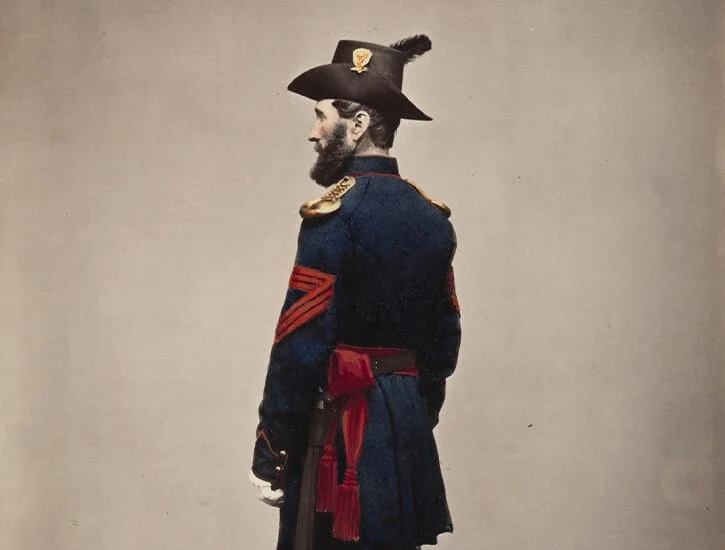
Quartermaster sergeant of the Union Army by Oliver H. Willard (1866). | Metropolitan Museum of Art
George Templeton Strong: Civil War Diaries, edited by Geoff Wisner. Library of America, 701 pages. 2026.
A nineteenth-century Manhattan lawyer of considerable public influence, George Templeton Strong was in most ways a man typical of his time, place, and situation. Guided by a duty-minded, if naturally conservative outlook, Strong’s dedication to civic life in the upper crust was colored by a long list of common prejudices and, in the antebellum period, a typically Northern sense that the question of slavery was more irksome than morally pressing. Yet, as it became clear in 1860 that civil war was likely, he noted in his diary that the nation had entered the “most momentous days in the History of the World.”
Strong began his diary at the age of fifteen and kept up the practice until his death forty years later in 1875. Writing nearly daily, he not only left behind a detailed account of the minutiae of his life but sketched a portrait of both a growing metropolis and a country increasingly in a state of crisis. In prose that, in its frequent allusiveness, its delight in wordplay, and its interruption of blocky, diaristic fragments with long, sinuous disquisitions, seems self-consciously crafted to be read by others, Strong explored his evolving feelings on the issues of the day, communicating his sense, in the years leading up to 1861, that something momentous was brewing and that he would be there to record it and, maybe, to play an active part himself in the unfolding catastrophe.
And he did. During the war, he joined the newly formed Sanitary Commission, for which he served as treasurer and core member of the standing committee. Founded in response to the immense public health crisis brought on by a war that not only featured mass slaughter on a scale never before seen on U.S. soil but the outbreak of numerous diseases that would kill far more people than musket or cannon, the Commission aimed to bring a centralized, coordinated approach to the administration of health services. Commission members distributed supplies, set up makeshift hospitals on boats and other conveyances, and established soldier’s homes. Strong’s involvement with the Commission would provide him with his most deeply felt expression of civic responsibility, while his wartime experiences caused him to rethink some of his previously unchallenged orthodoxies.
Fittingly then, these war years are the focus of a major new volume of Strong’s diary, brought out by the Library of America in a typically comprehensive volume edited by Geoff Wisner. While Strong’s complete four-million-word diary is housed at the New York Historical Society, the only previous publication of any of this material was in a four-volume set that appeared in 1952. Overlapping significantly with volume three of that edition, Library of America’s Civil War Diaries consists of about 45 percent never-before-published material, and focuses explicitly on selections that relate to Strong’s response to the war, while still retaining charming little bits about family business or the author’s attendance at his beloved concerts.
Running from November 1860 through the end of 1865, from Lincoln’s first election to the early months of Reconstruction when Strong still placed his hopes in Andrew Johnson’s wobbly hands, the diary traces the path of a sober-minded, constitutionally conservative man in confronting a series of events that demand anything but a conventional response. Watching him navigate this new territory—overcoming bouts of depression and frequent “sick headache,” pushing himself hard to perform tasks that he hopes benefit the national interest but that he fears are useless, and adjusting his views on slavery and abolition—is to observe a concerned citizen do his best to adapt as the political world changed rapidly and shockingly, a sobering object lesson for today’s reader.
Edmund Wilson notes in Patriotic Gore, his magisterial study of the literature of the Civil War, that “one of the main elements in [the American literature of the 1850s] was supplied by the diaries that writers kept. . . The diary provided a basis for many of the published books of Emerson, Thoreau, and Hawthorne; and Whitman, in Specimen Days, reverts to the diary form.” The diary was a medium taken up by many women during the mid-nineteenth century, and Wilson devotes a key chapter to the wartime efforts of a trio of upper-class Confederate matriarchs, the most notable of which is surely Mary Chesnut’s volume, published posthumously—ever the fate of the diarist—in 1905. Chesnut, the wife of a senator and Confederate army officer, offered a wide-ranging and not uncritical view of a Southern slaveholder class in crisis, shrewdly mixing modes and bringing a decisively literary sensibility to the form, in a way similar to what, unbeknownst to anyone, George Templeton Strong was accomplishing some seven hundred miles to the north. Chesnut’s diary “is an extraordinary document,” writes Wilson, “in its informal department, a masterpiece.”
What saves this congenital conservative is his penchant for self-reflection and his willingness to at least partially revise his views.
Strong’s diary is likewise a generous piece of literary minded documentage, a mixture of historically significant reporting, boulevardier wit, soulful reflection and self-doubt, and often trenchant social commentary. Much of the book, though, is devoted to the processes of newsgathering and media criticism, twin tasks in which the war makes Strong an expert. In Civil War New York, news came hot and heavy but, then as now, it wasn’t always reliable. There were a handful of daily papers in the city, from the Herald to the Tribune to the New-York Daily Times (the original name for today’s Paper of Record) and each would publish several “extras” throughout the day, printing a new update whenever any news of value came over the wires.
In addition, there were numerous bulletin boards set up throughout Manhattan, each offering passersby a quick update on the war progress. Strong, a news junkie, would run out at any time of day to grab an extra, personally stop into news offices and use his connections to get the latest dirt, or head out to the corner of Pine and William Streets to consult the Commercial Advertiser’s Bulletin Board. After hearing the latest update, he would then weigh the news against the reliability of the source, how it matched up with facts he knew with certainty, and how it fit in with the likely course of events, accepting or rejecting it according to his personal process of triage.
The diary form naturally promotes certain types of writing—particularly the blow-by-blow account of a day’s minutiae or, on the other end of the spectrum, long meditative passages on personal feelings or issues of the day—but it is not ideally suited for narrative set pieces. Nonetheless, Strong offers up a few and the most thrilling occurs in an April 1865 entry, as he desperately seeks news about the potential fall of Richmond. Waking up to discover nothing momentous in the morning papers and being only a little more enlightened by two further dispatches, he takes a bus downtown to check out his favorite bulletin board. On arriving, he reads that the city of Petersburgh, Virginia, was taken by the Union Army, and as he continues inside, he sees a man painting letters on a sheet of brown paper, preparing the next post. Glancing down, Strong sees the words “Richmond is. . .” on the sheet and then has to wait while the man slowly paints each subsequent letter, finally spelling out the word “captured.” With his now finely developed sense of what news can be trusted and what is idle conjecture—“News continues very good. May it prove true, also,” he fretted earlier—he confirms the validity of the post and races off to spread the good word.
Strong’s social commentary is one of the backbones of the volume, a valuable compendium of what a man of a specific class, race, time, and place thought about the events happening in his country but not, except peripherally, in his town. This commentary invariably comes filtered through a rather long list of prejudices, many of which are hardly surprising coming from a well-connected professional man in mid-nineteenth-century Manhattan. And as the late Library of America cofounder Daniel Aaron noted, Strong’s “antipathies . . . make up an enormous and various list.” In addition to his distaste for the Irish (which comes through with particular venom during his discussion of the Draft Riots of 1863) and virtually all Mediterranean immigrants, he has it out for “spiritualists, abolitionists (until 1860), organ grinders, Yankees (with significant exceptions), politicians, mosquitoes, Unitarians, Southerners, Democrats, and transcendentalists.” At least he knew what he didn’t like.
Unlike Walt Whitman’s populist embrace of the teeming masses, expressed in his accounts of his own Civil War experiences as a volunteer nurse, Strong can’t even contemplate a trip to Coney Island (“infested with it’s [sic] summer crowd of human scum”) without wrinkling his nose. This snobbery is not confined to the faceless masses, but even manifests itself during his several meetings with Abraham Lincoln—a man who earns Strong’s political sympathies and grudging respect, but for whom he cannot conceal a deep distaste. “He is a barbarian,” he writes about the president, “Scythian – Yahoo – or Gorilla, in respect of outside polish . . . but a most sensible straightforward honest old codger. . . His evident integrity and simplicity of purpose would compensate for worse grammar than his, & for even more intense provincialism and rusticity.”
What saves this congenital conservative is his penchant for self-reflection and his willingness to at least partially revise his views. What really changed him was the war itself. Involved as Strong was in numerous civil pursuits, the outbreak of hostilities granted him permission to focus his wandering attention on a single worthy task, his work with the Sanitary Commission. This narrowing of purpose mirrored, for Strong, that of his nation. In his characteristic stance of irony toward all, he deplored the antebellum culture of not only the South but his home half of the country as well. While those below the Mason-Dixon line were vulgar and barbaric, his fellow Northerners were soulless, financially-obsessed zombies and the only true remedy he saw for this state of affairs was a massive bloodletting.
Strong’s civil war diaries serve as a sober admonition of a coming disunion that is, in the present day, felt by many across the American landscape.
Reflecting back on the first year of the war on the final day of 1861, Strong writes, “Only ‘through much tribulation’ can a young People attain healthy vigorous National life. The results of many years spent in selfish devotion to prosperous easy money-making must be purged out of our system before we are well, and a drastic dose of European War may be the prescription Providence is going to administer.” His own devotion to money-making, necessitated by the world he was born into and the demands of raising three young children, are similarly reduced in importance when set beside his personal war efforts, and it’s perhaps no coincidence that his personal fortunes took a significant hit over the half decade of combat.
Somewhere over the course of the war, too, Strong decided that a “healthy vigorous National life” meant a nation where slavery no longer existed. Nonetheless, he is canny about not putting forth his own views explicitly, always hedging his statements or falling back behind the collective “we.” After defining the Northern position up to 1850, his own view no doubt included, as “not hostility to slavery, but indifference to it, & reluctance to discuss it,” a “disagreeable subject with which we had nothing to do,” he allows his views to evolve throughout the course of the war, defining one of the Library of America collection’s ongoing throughlines. Here, for example, is Strong’s already divided view from February 1861:
My judgment (wrong very probably) condemns Abolitionism, & sanctions the claims of Slaveholders to use the labor of their slaves according to the settled laws of the communities into which both Master & slave were born – the “state of life in which it has pleased God to place” them both. I censure Slaveholders, of course, for refusing to provide by law, against evils (such as separation of families) which probably occur but seldom… Thus have I thought of Slavery. But the moral insanity of Slaveholders, & the baseness that men reputed honorable and hightoned commit or applaud because perpetrated in the interest of Slavery, make me distrust my judgment.
Rather than opposition to slavery itself, Strong registers disgust at the supposedly chivalrous men of the South, men he already held in contempt for their undignified behavior, and an ongoing annoyance at the fact that their way of life is making him have to consider a disagreeable question. Even as his views progress, he still seems most opposed to slavery for the baseness it brings out in the perpetrators (he takes to gleefully calling them “woman-floggers”) and for precipitating the great national tragedy then unfolding before his eyes.
By September 1861, though, he seems already to realize that a lasting peace to the war necessitates at least the reformation if not the extirpation on slavery. Using the collective pronoun, he notes that “we are fast drifting into Abolition notions that would have horrified us a year ago.” By 1864, he has developed a wider understanding of the evils of the institution, noting that “fornication, adultery, & Rape are features of the Institution for which [the] men are fighting,” but even here his concerns are more for the poor whites and (rich) white women who he feels are debased economically and sexually, respectively, by slavery, rather than the men and women whose enslavement stood as the defining feature of Southern society.
Ultimately, he comes to support a total surrender of the South, in which the North would dictate whatever terms it sees fit and treat their enemy as a vanquished territory, not a collection of wayward states. This means the approval of the Thirteenth Amendment (whose ratification he appears to cheer) and the implementation of a robust Reconstruction program. But anticipating the post-1877 Compromise landscape and the subsequent introduction of Jim Crow Laws, he sounds a sardonic warning. As he reflects on the likely readmission of ousted Southern politicians to Congress, he writes, “I suppose that the next step is then to be another amendment of State Constitutions kicking [the freed people] out into the cold again.” Of course, his warning would come true, the returned lawmakers doing just that, as ten of the eleven former Confederate states rewrote their state charters in the 1890s and 1900s with the specific goal of disenfranchising Black voters.
In working out his evolving views across the freedom of the private page, in coming to see that only a comprehensive aftermath could prevent catastrophic rupture in the future, his civil war diaries serve as a sober admonition of a coming disunion that is, in the present day, felt by many across the American landscape—not only survivalists and preppers, but clear-minded historians, award-winning filmmakers, or anyone checking daily updates from Minneapolis—to be alarmingly near at hand.