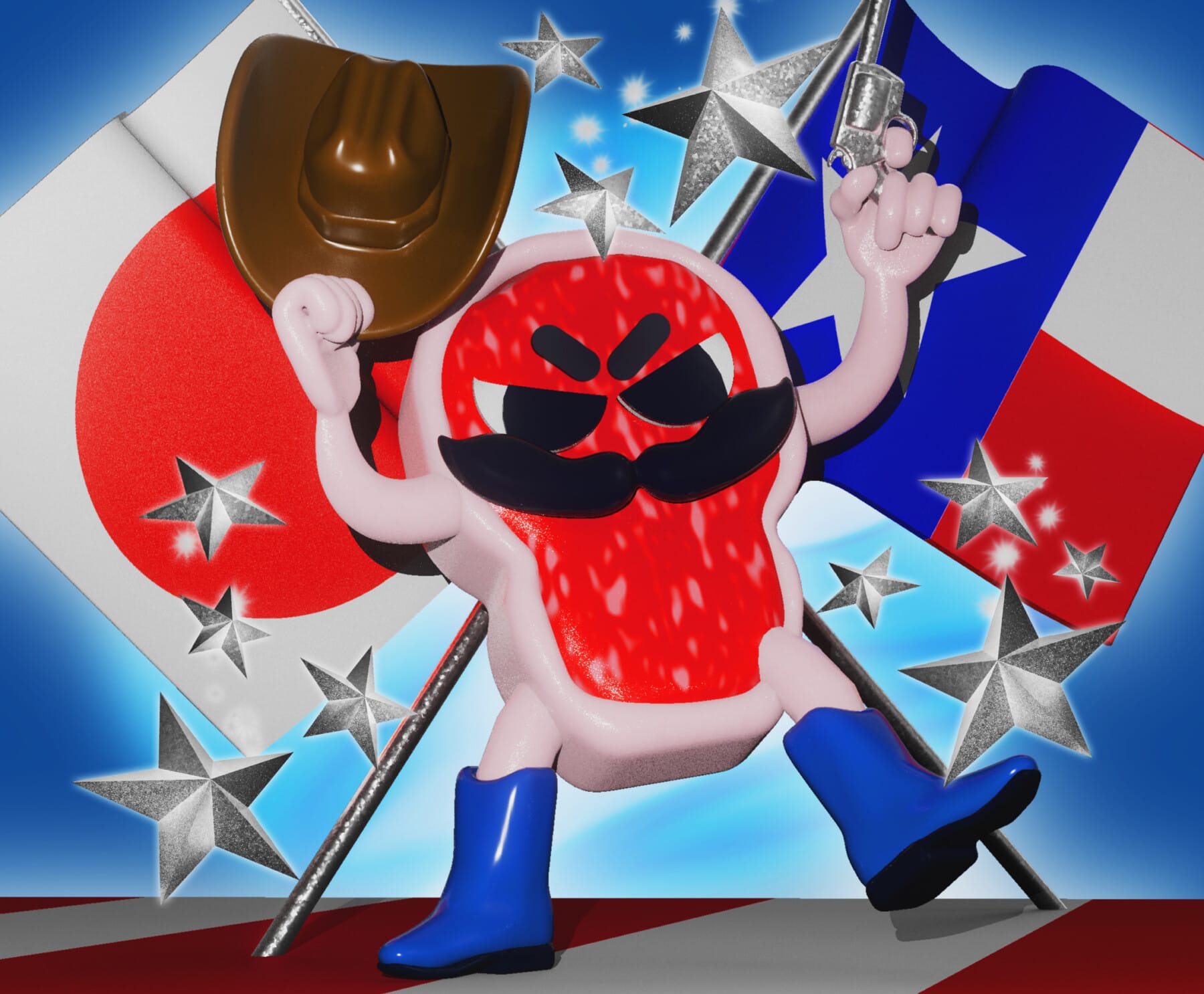
I knew that Ayumi had no feelings about the American toothpick flag stuck into my steak. We were at a down-market, bistro-ish steak house after strolling in Kagurazaka. She put up with my commentary—she’s the mother of my child—but I also knew that she preferred I cut a slice before the filet cooled, which she could chew until it turned grainy in her cheek and needed to be rehydrated with a slug of cabernet sauvignon.
The American flags that fly on the streets and steaks of Tokyo are mostly benign symbols. The American flag on my meat is only meant to suggest West Texas ranchland or barbecues on television shows or approval by hearty American appetites. I know that the middle-aged rockabilly cosplay couple who opened a hard-shells-and-orange-cheese taco place down the alley fly the Stars and Stripes for the same reason that they exhibit a pyrogravure Elvis and computer art banner of a Route 66 sign. I know that even the military surplus shops in Ameyoko—which exist because of the postwar black market, of which living memory has mostly evaporated—do not wish to make any statements on American imperialism. The flag is a symbol often only as potent as a Trader Joe’s tote bag or a thrifted Georgetown Hoyas jacket. It is a nonproprietary logo for all the conveniences of global capitalism—a cool, recognizable, utterly meaningless nonthing.
Perhaps I’m the only one who cares. But my heart bleeds, medium rare. I’m a vulgar Third Worldist. My political awakening came from a Christian ethics teacher at Vanier Collegiate in Moose Jaw who was convinced that Óscar Romero was hit with the help of the CIA, and by a subscription to Workers Vanguard gifted by a friend on the message board I Love Music. The American flag is the bodies on the road at My Lai. I balked when invited by friends in Nanjing to get lunch at a branch of Ajisen Ramen; living over the ashes of the firebombing of Tokyo, I find it disloyal not to feel discomfited by the Red, White, and Blue.
It would not be impossible to explain my discomfort in Japanese terms. Except for national holidays, when buses fly twin Hinomaru on their front bumpers, the only Japanese flag I can reliably spot is hanging toward the top of an office-residential block near Iriya Station, at the offices of an organized crime group whose legitimate operations seem to involve patriotic education. After the flag was unbanned by the Americans in 1949, pacifist activists rejected it as a remnant of the Empire; the nationalists tried to hold on to it, along with any other patriotic symbol (the Hinomaru is far less controversial than the Kyokujitsu-ki, the Imperial Japanese Army and Navy insignia with sixteen rays around the red sun, which remains in use by the Japan Self-Defense Forces, albeit with modifications). Public opinion did not fully align with either side. Today the general attitude toward the flag remains hard to sum up: It’s not totally peculiar to see it in an official context—flying over the ward office or a school—or at a sporting event, but there is ongoing sensitivity around the sort of patriotic displays that pass without comment in other countries, or in Japan about other countries’ flags.
“The Japanese flag is boring,” Ayumi said, when asked for her opinion. She seems to tolerate my anti-Americanism, which—even if it seems at least partly rational to Americans themselves, or to Chinese or Egyptian or British friends—tends to strike most people in this country as bizarre or misguided. Perhaps it’s a historical reflex: In imperial years, true nationalist (or, later, pan-Asianist) opposition to Anglo-American imperialism was ultimately overwhelmed by a worshipful awe of the blond beast, fear of Korean or Chinese infiltration, and hatred of Russia; such opposition could be easily replaced, after the Empire of Japan’s extirpation by American forces, with anticommunism. In this, too, there was something like the wartime arrangement: alliance with a modernizing, dynamic Western power—the United States instead of Nazi Germany—and ostensibly freedom-loving neighbors—again, an occupied Korea and a puppet-regime Taiwan—against a supposedly despotic Asiatic culture.
Left-wing Japanese anti-Americanism, organized in the 1960s around opposition to the United States-Japan Security Treaty and Japan’s complicity in war crimes in Southeast Asia, burned out by the following decade. The left-wing rebels struggled against each other to death—uchigeba, or internal violence, was the neologism, the most famous example of which took place in 1972 among disagreeing members of the United Red Army on Mount Asama, wherein the leadership beat eight members to death and left six tied to trees to die of exposure—or fled to Lebanon a long time ago, mostly leaving agitation against base expansion in Okinawa to local activists.
Today, the few true-blue right-wing nationalists and their online allies can be energized by reports of Vietnamese pig rustling, Kurdish refugees hanging out too late in city parks, and Chinese property speculation, but they don’t seem reliably interested in polychlorinated biphenyls discharged by American forces into the groundwater, sexual assaults on local girls by Marines, or the grander humiliation of an eighty-plus-year occupation. Meanwhile, the center is controlled by the Liberal Democratic Party, whose freshly elected Prime Minister Takaichi Sanae has been given to hawkish statements on China that suggest that the fight against global communism is still underway. Except when some muckraking journalist goes out to interview locals angered by an unannounced diversion over their neighborhood, it doesn’t seem worth remarking on the fact that Black Hawk helicopters fly over Tokyo regularly, shuttling between the Zama and the base in Minato Ward. Japan lost a military and political struggle to the United States in the 1940s, and it was defeated again economically in the 1990s, so it’s perfectly understandable that a mood of mild pro-Americanism dominates in a tranquil economic and military satellite.
It is mild, after all. Japan has become steadily less American, culturally, it seems to me. If the nascent anti-Americanism of the postwar Japanese left wasn’t passed down, neither was the enthusiasm for Coca-Cola, the Righteous Brothers, and democracy. Japanese ebullience faded over three decades of economic stagnation; American cultural stagnation has come along at right about the same time. Japan is too poor to import Americana, and the yen is too weak to make it easy for young people to screw off to Hawaii. American cities can seem, from a distance, to be frightening, miserable places.
I often wonder if this has produced a less fine-grained understanding of Americans. I would never try to deceive an older, more committed Americanophile that I’m from the United States, but I manage fine with the younger generations, despite never having held American citizenship. I have no roots in the country: My ancestors were Norwegian homesteaders in Saskatchewan, United Empire Loyalists in Bay of Quinte, poor Scottish miners on Vancouver Island, and rugged Maritimers of indeterminate ancestry. I haven’t spent more than twenty-four hours straight in the United States since a childhood trip driving around the Midwest.
But I was always American in the way that all anglophone Canadians are. Moreover, I am, like so many anti-Americans who exist in its cultural orbit, profoundly in love with America. I cried on 9/11. The song playing when I lost my virginity in the back seat of a 1992 Chevrolet Beretta GT was “Dipset Anthem.” I named my son after a character in a David Foster Wallace story. If I were allowed to order a death row final meal, it would be three Arby’s Beef ’n Cheddars, mozzarella sticks, and a large Mello Yello with lots of ice.
And I like Texas beef. At the bistro, I ordered the filet to satisfy a mild craving for chewy, bloody meat. Apart from the paper flag and a sheen of grease, it was undecorated and just beyond medium rare.
“Mm-hmm. She was from Texas,” I said.
“How can you tell?” Ayumi asked. I couldn’t. It all tastes the same, anyway. Texas beef is a category at this point. When American beef disappeared from and then became scarce in the Japanese market after concern over bovine spongiform encephalopathy cases, nobody here seemed that concerned that their steaks were Australian or Canadian. A side of beef flown in from West Texas, Queensland, or Alberta is about the same thing—moderately grainy, pleasantly sweet and mineral in flavor, conservatively marbled with clean, white fat—produced and moved by the same global agribusiness and logistics machinery stretching from Northern Saskatchewan to New South Wales.
“I’m sure it’s from Texas!” I take my time chewing. “She was from the Panhandle, finished at Tulia. She had a good life. Imagine that—all that sunshine out there. The meat tastes even better coming out of a drought.” This too was only fantasy, like the idea that nothing happened at My Lai.
I am American, I realized, because I hate the flag and love the beef.
Temu Texana
Beef is an imposition as improbable as the American bases. History and geography suggest that whale, and maybe sika venison, should be the primary red meat consumed on these islands. (The former is unfashionable and, outside of former whaling centers, eaten by all but the very elderly as a novelty; the latter is harvested only by a few hunters, who sell their small harvest for a premium price to local ryokan.) Even if they were not protected by Buddhist dietary restrictions, the draft cattle imported from the Asian mainland 1,500 years or so back were bred and fed for labor instead of well-marbled flesh and probably wouldn’t have made for good eating.
Beef was imported again finally by the Meiji government, which brought in herds of foreign cattle 150 years ago to contribute milk and meat to the project of improving the Japanese race to the level of the Anglo-Saxon. When supplies ran out and Japan starved and lost the war, the Americans flooded the market with products from their own heartland. The Japanese forgot how to feed themselves, and food self-sufficiency began to evaporate. With state rationing ongoing until 1951, Japan continued to starve in the postwar years and only survived by food imports and emergency planning of agricultural quotas; food self-sufficiency on a caloric basis peaked around 1960 at 78 percent, which fell to 56 percent by 1985 and now sits at 38 percent. Now even the local cattle—crossbreeds, mostly, with little of the indigenous genetics—are fed on alfalfa and timothy hay and soybeans shipped from the Great Plains. You might have been priced out of purchasing a tin of corned beef in the 1970s, but you could afford the Nozaki-brand “New Meat,” which continues to replace most of the beef with South American horsemeat.
Japan is too poor to import Americana, and the yen is too weak to make it easy for young people to screw off to Hawaii.
A big American T-bone was still a luxury until Japan dismantled its remaining protections on food imports. There are remnants of that moment when suddenly American steak became middle class. I recently visited The Texas, a 1980s-style budget steak house on the border of Taito Ward and Asakusa Ward, stuck in the shell of a failed Chinese restaurant under a cram school on a busy highway running out to the suburbs. This branch was opened just a few years back, but it belongs to a chain that started in the late 1980s and still mimics the style introduced to Japan in that decade—which is to say, in the sense that the decorator had probably studied Google Image Search results for “Texas steakhouse.” At the same time, why uphold authenticity some 6,500 miles away? Whoever ordered a near-psychedelic Red Man Chewing Tobacco poster with a peach-colored chief floating over nonsense words probably just liked that it had a Native American man on it; they didn’t care about the spelling errors or miscoloration. When they typed “American flag wall art” into an online shopping portal, they didn’t understand that they were getting products algorithmically generated for MMA podcasters and suburban gun clubs, putting up software-generated quasi-fascist iconography and Temu Texana next to fictional “Wanted” posters and Coca-Cola signs, crossed six-guns and a wagon wheel, an American flag with 1776 in bloody red letters over the stars, a neon longhorn, a polished plastic-and-wood eagle silhouette in red, white, and blue . . .
If you love a chewy, bloody skirt or a stewed bottom round, I don’t think you would like Wagyu.
I like The Texas. It makes me think of the first time I was allowed to order a whole steak for myself, at Bonanza on the Trans-Canada Highway, and instructed on cutting it up with my knife in my right hand and my fork in my left. Of when I was eighteen and drove from Moose Jaw to Norman to meet a girl who I met on Internet Relay Chat, passing herds of cattle that moved like sandy plumes over the scrub. Of taking a job at a slaughterhouse on the edge of town during the half year I was forced to take off from college, spending six months affixing elastic bands around the esophagi of just-decapitated heifers to stop their stomach contents from falling to the floor.
It makes me think of the Texas Roadhouse in an air-conditioned mall in Shanghai. I ate steak and potatoes on the edge of Lujiazui, China’s most prosperous, skyscraper-choked financial district, just as the United States entered its own Century of Humiliation. It was a chance to enjoy the sort of America that will be eaten alive by China: the America of steak bloody rare and Spam and B-52s and Playboy and laying rubber in front of the Dairy Queen.
This sort of Americana does not necessarily capture the interest of young people in Japan any longer. A snapshot of Tokyo at this very moment could be a single woman in a malatang shop sweating over hot pot and dressed head to toe in Chinese-manufactured athleisure, swiping TikTok clips (and so not, say, at Starbucks wearing Gap with a DVD player with Friends on it).
But at The Texas, the waiters still wear cowboy hats. Medium steaks come served on the preheated cast-iron platters ubiquitous in restaurants serving yoshoku, or adapted Western cuisine, with canned corn as a side. Nowadays, the meat is probably from Australia, which is a bit cheaper, and it tastes mostly of the bouillon powder in the pats of compound margarine melting on top.
Raising the Steaks
American beef can be luxurious again, if only because Japan is broke and the yen is weak. A couple of slabs of USDA Prime, with all the trimmings, with a couple of glasses of red, at a decent place is going to set you back between two and three hundred bucks.
If you want something a little less pricey but still luxurious, a cheesesteak from the most reputable place in town goes for just under three thousand yen—more expensive than a bowl of ramen, and even a New York Style Pepperoni Lover from Domino’s. I went in on a whim, the first time. Nihonbashi Philly is on the southeast side of Tokyo Station, which, until a few years ago, when hipper clientele started moving in, looked untouched since 1988, with corporate blocks, upscale wine bars to service parties of office workers, and an improbable number of massage parlors open only after dusk.
It’s a cute place, run like the Portland-themed bar in Harajuku by an Americanophile who seems to be dedicated to the cultural products of the City of Brotherly Love. Kosuke Chujo, according to regular reports by the Philadelphia Inquirer, travels regularly to Philadelphia to collect Eagles paraphernalia, crate-dive Philadelphia soul records, and study cheesesteaks. The meat is American, I assume, because the shop was selected to be showcased on United States Meat Export Federation advertisements.
Philly Tokyo serves flank steak or something else that’s lean, malleted thin, and fried with onions. It’s fine—better, I think, than Wagyu. Originally denoting beef from genetically pure indigenous herds (wa for Japan and gyu for cattle), the term now generally refers to meat from local cattle breeds that were long ago crossbred with European cows: local Japanese Black for the marbling, Ayrshire for the mass. Domestically produced, A5-Grade Wagyu comes in fatty slabs that barely resemble a recognizable cut of steak. The ideal is a block of snow, flecked with red, and resembles chutoro, or fatty tuna, more than it does beef. If you like chutoro, you will like Wagyu. If you love a chewy, bloody skirt or a stewed bottom round, I don’t think you would like Wagyu. It can’t be cooked for too long, or it will melt away to nothing. It can’t be cooked for too short a time, or the fat running through it will remain firm.
In Japan, I suspect Wagyu is primarily for the elderly, who, because of some epigenetic memory of starvation, like exquisitely fatty things: chutoro, but also quivering blobs of pork belly and mayonnaise on toast. Wagyu is tender enough to be cooked medium rare and still enjoyed by someone with false teeth, and the elderly are the only ones who can afford it at the supermarket. It’s for tourists too, of course: Most of the premium Wagyu shops in the city seem to be marketing themselves to foreign visitors who won’t blanch at a forty-dollar chunk of fat, devouring it, as they do the natto on the hotel breakfast buffet or the sugary egg salad sandwiches from 7-Eleven, as a novelty as much as a culinary experience.
The number of beef farms has collapsed over the past couple of decades. Their decline was inaugurated by the 1988 Japanese Beef Market Access Agreement, which substantially increased the importation of American cattle. But even without competition from American imports, these farmers see that their inputs—labor, feed, utilities—keep getting more expensive. High-end beef, if it does exist, will probably be hawked to the tourists or shipped out to Shanghai and Baku. That same future might see the majority of Wagyu come from farms outside Japan. Wagyu is itself now a slightly meaningless category, globally. There is Australian Wagyu. There is American Wagyu. The Texas Wagyu Association includes farms throughout the entire country.
There are alternatives: Despite the best efforts of the U.S. Meat Export Federation, it seems more likely that Kyodo Senpaku—the company that first commercialized whale meat purchased as a byproduct of the Institute of Cetacean Research hunts, now operating less clandestinely—and the right-wing-aligned promoters of cetacean eating will win out. If they figure out how to produce whale and shark without the risk of heavy metal toxicity, it might take off.
Or the government might someday get around to culling and canning the boars in Aomori or the invasive muntjac in Chiba. Horse—less feed needed than beef, with reduced methane outputs—is probably more in keeping with the Sustainable Development Goals that are endlessly promoted here. If anyone has a taste for red meat, they will probably someday be satisfying it with equine tartare and whale-meat dumplings. It’s not glamorous, but it’s cheap, and it won’t come with the American flag stuck in it.