, April 29, 2026
We Bought an Orchestra
The rise of pay-to-play in classical music
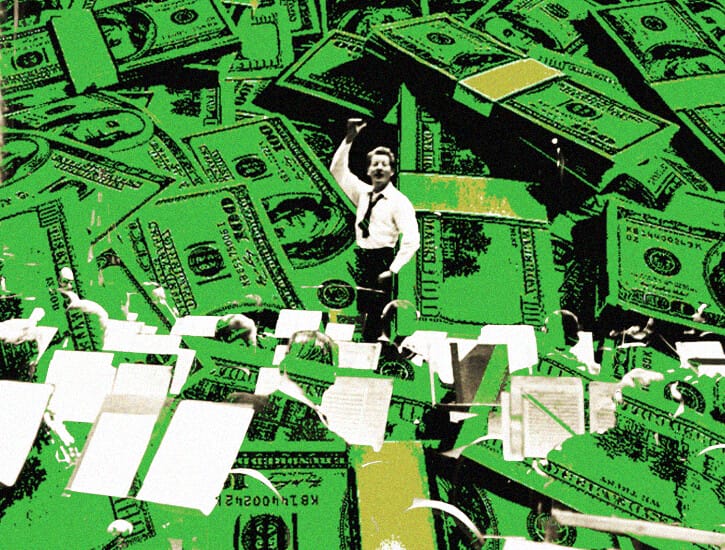
The Baffler
On the evening of February 18, the Deutsch-Romantisches Orchester (DRO) gave a performance in Berlin’s Funkhaus, a one-time radio broadcasting center converted into a chic concert hall. It was a classical concert like any other—except for the guest list, five-course banquet, and glaring mismatch between the skill levels of the professional instrumentalists and their conductor, a relatively unknown young musician named Marina Quasha.
Just after 7:00 p.m., Quasha strode to the podium in the cavernous concert hall. A kind of gray mist hovered above the orchestra. She gave the audience a tiny combination bow-nod. She then raised her hands and launched into conducting the overture to Verdi’s opera Rigoletto, followed by arias selected from Tosca and Macbeth, and, finally, Brahms’s First Symphony. Her work smacked of inexperience: Beautiful individual solos were undermined by an overall loud, blunt, and sludgy sound, a sign of missing vision and restraint. She let phrases that needed distinction bleed together and neglected the subtle countermelodies that give the music richness. Her hands beat timid time, and the musicians often ignored her tempo—they barely even looked at her.
After the concert, attendees and musicians alike filed into the banquet hall, where three long tables with thin candles, handwritten place cards, and elegant menus waited. Amid the chatter, a musician gushed about the DRO’s innovative approach to reaching new audiences, as if we weren’t at an invitation-only concert followed by a luxurious dinner. Others, commenting on Quasha’s conducting ability, offered a masterclass in the art of the polite non-compliment. “It’s quite an exciting project.” “She has something in her heart.” “We all have room to grow.” Perhaps they felt reluctant to bite the hand feeding them—and me—Gillardeau No. 3 oysters and citron caviar.
In between courses, Quasha popped by where I was sitting and mentioned that she was going to Malta, where she was applying for citizenship in the hopes of competing for the country in horse show jumping at the 2028 Olympics. “You can imagine that she is very liquid,” someone told me after she walked away.
Later, I forwarded a recording of the concert to two musicians whose ears I trust without telling them who made it. The first, a pianist, sent me a list of six general problems and thirty-seven significant but more specific issues including timestamps. “The moments when the music mostly plays itself were fine,” he said, “but the parts that actually required conducting skills were sorely lacking.” The second, an accomplished conductor, told me, “I sense that the orchestra doesn’t trust the conductor—the tempo fluctuates unusually in places where it doesn’t make musical sense. At many critical moments . . . that require the conductor to navigate a transition, the orchestra regularly falls apart.” Nevertheless, he said, he could tell the conductor was working with “an expensive instrument.”
Expensive, indeed: Quasha later told me the Funkhaus concert had cost over $290,000. Seventy-seven percent of orchestras in the United States had annual budgets under $300,000 in 2022, according to the League of American Orchestras. Why did all this energy, skill, and money flow into a concert led by a conducting neophyte? The answer lies in a concerning trend new to classical music: the rise of pay-to-play, boutique musical experiences for the ultra-wealthy.
Classical music has always been dependent on elite patronage. In Europe’s monarchies, royals and nobility kept musicians as glorified servants. They were also often amateur musicians in their own right, musical skill being a sign of cultivation: Louis XIV played lute and guitar; King Frederick II of Prussia practiced flute and composed sonatas when he wasn’t busy lusting after his valet de chambre; no fewer than four Habsburg emperors wrote music. Music patronage took on a more democratic flavor in the twentieth century. In the United States, robber barons like Andrew Carnegie built concert halls to launder their reputations but also to give their fellow citizens places to hear great musicians perform. European governments developed sophisticated, if flawed, bureaucracies that funneled taxpayer money to trained artists. While the meritocracy so essential to the field’s aura was never perfect, in recent decades most anyone making a career in classical music was extremely skilled. Perhaps they were skilled because they had parents who were wealthy or musical or both, but they were skilled, nonetheless.
The philosophy behind the DRO is something of a grab bag, reflective of both Quasha’s idiosyncratic aesthetic ideas and business-forward mentality.
The musical adventuring of socialite-turned-soprano Florence Foster Jenkins and financial-publisher-turned-conductor Gilbert Kaplan and conductor-turned-Valium-baron Paul Sacher show that rich people never really lost their desire to prove themselves in the musical realm. But the last decade or so has seen a striking rise in pay-to-play arrangements, a situation that recalls the days when orchestras belonged to princes. These experiences allow people with money but little musical ability to roleplay composer and conductor—for a price. This development flows naturally from this era’s extreme inequality as well as classical music’s precarious state, even in such historically generous countries as Germany. It risks reshaping the art itself to align with the whims of wealthy dilettantes.
Examples abound. In 2012, Alexey Kononenko, a former mathematician at the mysterious hedge fund Renaissance Technologies, began a career as a composer. Despite never having learned to play an instrument, a rudimentary grasp of music theory, and a ratio of inspiration to imitation that would embarrass a large language model, Kononenko, who goes by the stage name Alexey Shor, has had his works performed all over the world by many of its best musicians. Shor has bankrolled a dizzying array of concerts, festivals, and competitions. The catch is that they must all include Shor’s own works. In May, the Orchestra dell’Accademia Nazionale di Santa Cecilia will play his Violin Concerto No. 7 in Rome under conductor Daniel Harding and violinist Gil Shaham—arguably his most prestigious concert yet. It’s the kind of high-caliber performance of which most working professional composers could only dream.
Or consider Susan Lim. Last May, the Royal Philharmonic Orchestra, the City of London Choir, and the outstanding pianist Jean-Yves Thibaudet gave a performance of a composition by the surgeon and AI booster, who hired musicians to turn her inchoate ideas about technology into music and allow herself the privilege of calling herself a “songwriter.” The work depicts a stuffed lion’s journey from to inanimate toy to sentient companion by way of lyrics like “It’s a beautiful invention / Robotics, artificial intelligence / It’s the new medication.”
Pay-to-conduct opportunities are becoming more common too. In June, the technology executive Mandle Cheung shelled out $400,000 to conduct the Toronto Symphony Orchestra in Mahler’s “Resurrection” Symphony. In November, Richard Grenell, the former president of the Trump Kennedy Center, awkwardly led the National Symphony Orchestra in a rendition of the national anthem. It was an advertisement for the since-closed Center’s fundraising initiative that would allow wealthy donors to take the baton in exchange for large donations. “With a large contribution, you can conduct the National Anthem at @kencen—an unforgettable, once-in-a-lifetime experience!” read the social media copy. And then there is the Quasha’s Deutsch-Romantisches Orchester in Berlin, a city of almost four million people that already has four full-time professional symphony orchestras and three full-time professional opera orchestras.
All this make-believe art making has an uncanny quality. The concerts look and sound a lot like normal concerts, with professional musicians picking up the wealthy dabbler’s slack. The overall effect is hard to localize at first, but it boils down to this: Rich people are building their own classical music world, one where the long years of intense training, fierce competition, and harrowing precarity musicians endure to master their craft matter less than access to cold, hard cash.
It usually takes generations to build the kind of fortune with which to turn an orchestra into one’s personal plaything, though links to leading American politicians and the intelligence community can speed up the process. Marina Quasha’s grandfather William was a lawyer in the Philippines. He appears in Jonathan Kwitny’s 1987 investigation The Crimes of Patriots as an adviser to General LeRoy Manor. The general was caught up in the Nugan Hand affair when he admitted to illegally accepting deposits in the Philippines for an Australian bank that seemed a hell of a lot like a CIA front for money laundering, arms dealing, and drug running. Manor maintained ties to the family of U.S.-backed kleptocrat Fernando Marcos; Kwitny wrote that Manor was the one negotiating with Marcos to keep U.S. military bases in the country.
William’s son Alan, a “secretive billionaire” in the words of the New York Times, runs a sprawling network of businesses centered around a private equity firm called Quadrant Management. The firm most recently made headlines when a Times investigation revealed they were financing a company called ExThera Medical, which promoted an unproven blood-filtering therapy to cancer patients with terminal diagnoses. These patients were treated in allegedly negligent conditions at a clinic in Antigua. Six of twenty patients who participated died, the Times found.
Marina Quasha, who is twenty, was raised between Aspen and the Bahamas. She grew up playing piano, violin, viola and cello, though she eventually focused on piano. After earning a degree in business and finance in Geneva on her father’s encouragement, she started preparing for auditions in piano performance at the Royal Academy of Music in London around 2022. But she developed tendinitis in her right wrist and had to back out. Quasha quickly found another outlet. A week before the injury, she told me, “I’d heard Abbado’s recording of Mahler Five, and was like, ‘That’s what I want to do with my life.’” It was the first time she’d listened to that famous symphony. She dove into conducting, starting her studies with Oliver Hagen, who teaches at Juilliard’s Preparatory Division, then Gianluca Marcianò, whom she assisted in performances in Spain, Italy, the United Kingdom, and Oman. When I asked Marcianò about Quasha’s conducting ability, he told me, “You have to consider that she started very recently.”
In August 2024, she fell in with the Berlin Philharmonic while the ensemble was performing at the Lucerne Festival. What happened there is disputed. Quasha told me the orchestra’s players committee, an administrative body representing the musicians, invited her to work with them. The orchestra denies this, saying she asked if she could observe rehearsals. “It is a common practice that, upon request, conducting students are permitted to observe the orchestra’s rehearsals from time to time,” a representative for the Berlin Philharmonic said. Quasha appeared to be under the impression that she was being groomed for the Berlin Philharmonic music directorship—a post that has eluded some of the world’s best conductors. “I presume that they want to find someone to replace their chief conductor when he leaves in about ten years and wanted to shape the person themselves versus having to find someone,” she told me. “And they wanted someone that had a business background, not a music background, because they recognized that they were in a bit of a financial situation and that they would need to get out of it.” “That is not true,” said a representative for the orchestra.
Quasha stopped coming to the Berlin Philharmonic in the summer of 2025. In our interview, she described an acrimonious split. The Deutsch-Romantisches Orchester, or German Romantic Orchestra, emerged seemingly out of nowhere shortly thereafter. The Berlin Philharmonic is “a little bit upset that I left and took a few of their players with me,” she said. The orchestra denies this, and though some former members of the Berlin Philharmonic play with her orchestra, none have explicitly left the Philharmonic for the DRO. Asked later about this discrepancy, she declined to comment, also walking back her sharp criticism of the Berlin Philharmonic. “I have too much respect for them to want to be seen to be the least bit critical of them as an orchestra,” she said. “The work I did there was observational and an incredibly valuable learning period for which I’m truly grateful.” The DRO does pay its musicians better than substitutes who work with the Berlin Philharmonic, but Quasha declined to give specific figures: “It’s not polite to discuss exact money and figures, and one should never discuss their salary.”
The DRO played its first ever concert last October at the Philharmonie, the home of the Berlin Philharmonic, and featured Wenzel Fuchs, the Philharmonic’s solo clarinetist. The registered promoter for that concert? Quadrant Management. Marina Quasha told me that this was just pro forma and that the orchestra has no connections to her father’s businesses. Instead, it is financed by a roster of entirely anonymous and mainly American donors. “It’s usually just people in New York, California, that are in business, finance, usually entrepreneurs that happen to make a lot of money in the year and don’t want to pay the taxes,” she told me shortly after the February concert, though she acknowledged that these donors were members of her father’s circle. “I was like, ‘Hey, I want to start orchestra,’” she said. “He’s like, ‘I could know some people that would be interested in funding it.’” She also got moral support from her family. “I feel very lucky to have parents who do indeed believe in what I’m doing, as many musicians struggle with support of their career from their parents.”
The philosophy behind the DRO is something of a grab bag, reflective of both Quasha’s idiosyncratic aesthetic ideas and business-forward mentality. Quasha’s hero is Herbert von Karajan, the Berlin Philharmonic’s imperious chief conductor from 1956 to 1989, but she doesn’t like the acoustics of the concert hall that was built for him. She is a trained pianist, but instead of studying scores at the piano like most conductors, she plays through the parts on every single orchestral instrument (except the harp and organ). She finds that “a lot of modern music is just very atonal and lacks melodies,” though she makes an exception for the composer Ricardo Mollá. She knows that as a conductor, she has “a lot of work to do.” But she plans to continue to lead the DRO regularly, she said, “because I can shape the sound to be what I want it to be long term.”
She envisions the DRO as a kind of exclusive club. She had an epiphany while talking to her father. “I was like, ‘Alan, I think maybe we’ve all been approaching orchestras totally wrong, and it could be viewed as more of a luxury brand versus an orchestra, in the way you approach the business plan and the marketing of it,” she said. Concretely, that would mean “you invite the same people every time, so you can build this community, kind of like how SoHo House started with a community of creative individuals.” Eventually, the group’s concert-banquets will be attended by artists, businesspeople, and athletes, she said.
According to Quasha, the DRO, which has as of now played three concerts, with its fourth later this month, is planning to build its own “state of the art” concert hall for about €2 million. (The temporary Isarphilharmonie in Munich—considered an efficient project—cost €40 million.) When Quasha and I spoke, it was scheduled to break ground near the Funkhaus in the middle of March and open for concerts this September. It would be constructed in the shoebox style and have a kind of skybox, “a glass box that kind of looks into the stage, and where you can open the windows on it and hear everything,” Quasha said.
“We were thinking it could be nice to make that kind of a restaurant-style thing, so people can also go sit up there and eat and watch the concert,” she continued. I asked her if that would distract from the music. “It depends on the food, I think,” she answered. “If it’s like a big steak that you have to focus on and dig into, maybe not. But if it’s light tapas, finger food, little bites, I think then it is easier. Little grilled cheese bites could work so nicely, or chicken nuggets.”
The construction timeline seemed ambitious: At the time, a ground-breaking in mid-March would have been just a few weeks away, and the government in the Berlin neighborhood where Quasha was planning to build hadn’t heard of the project. She couldn’t tell me the name of her architect, instead referring me to Jan Urbiks and Andreas Allen, who run a boutique audio production studio and full-service creative agency called Urbiks Music. On March 10, they clarified that they were in negotiations with existing venues to turn them into concert halls by “going into an existing space and just building the shell inside,” Urbiks said. When I followed up in April, Quasha told me the hall was scheduled to open in 2030 or 2031.
However it plays out, Quasha wants to scale up—and rapidly—from one concert every few months to four a month, the same as a full-time professional orchestra. Quasha, Allen said, is ambitious enough to “make things happen very, very quickly, and not dwell on blockers.” This language of efficiency, speed, and renewal is reminiscent of the Silicon Valley tendency to gut and repackage public services as products they control—an old meme by now. The DRO, too, offers a yassified version of something that already exists. “At the end of the day, everything is business, especially an orchestra,” Quasha said.
Oligarchy ruins everything, even Brahms’s First Symphony—assuming we get on the guest list to hear it in the first place.
All these grand plans are jarring considering the increasingly precarious situation of established orchestras. Berlin, long a haven for the arts, saw 12 percent budget cuts across the entire cultural sector in 2025, with further cuts in the offing. In the United Kingdom, recent funding interventions have wreaked havoc on a long list of venerable and excellent music groups. In the United States, the Boston Symphony Orchestra has seen a 40 percent decline in ticket sales over the last two decades. The artistic director of the Portland Opera, Alfrelynn Roberts, recently told me her company may have to produce its next season without any sets. The Metropolitan Opera is reduced to fruitlessly begging the Saudis for money—and is trying to sell its Marc Chagall paintings—to help cover a budgetary shortfall.
At least Quasha is giving some musicians sorely needed well-paid gigs. But pay-to-play schemes for wealthy dilettantes risk undermining the important thing in classical music that is still largely working—its commitment to artistic excellence—hollowing it out completely in the process. The danger is partly political: Will cash-strapped governments like Germany’s see projects like the DRO and decide they don’t need to pay for its uniquely diverse publicly funded network of 129 professional orchestras if a rich person is happy to pick up the tab for starting their own?
The aesthetic consequences are even more depressing. As Quasha and her ilk build a parallel classical music system where cash is king, meritocracy loses its place as the field’s ideal. That confirms what skeptics have always suspected—that classical music is less ravishing art than playground for the elite. It’s vertiginously unfair to the many young conductors plying their trade with real ability under incredible pressure for almost no money in the hopes that their ability will someday allow them to survive. But it’s also bad news for us listeners. The music made under this system is so much worse than the one where the rich stay in the background, and the best musicians rise, however unevenly, to the top. Oligarchy ruins everything, even Brahms’s First Symphony—assuming we get on the guest list to hear it in the first place.
Like the February concert, a Deutsch-Romantisches Orchester rehearsal in March felt strangely mediocre yet awash in money. The orchestra was working with an audio system so sensitive it could isolate individual players, stereoscopic video compatible with the most advanced virtual reality technology currently available, and even more of Berlin’s best musicians than in February. The recording setup was a “very high sensitivity version of the Karajan sound,” Allen told the players at the break.
One thing money can’t buy, though, is rhythm. Quasha rehearsed the bassoon solo in measure 56 of the third movement of Tchaikovsky’s Fifth Symphony, a spot with a slightly tricky syncopation. Try as she might, she couldn’t get the players to take her tempo.
“We’re starting to rush,” she said.
They played it again, still ahead of her.
“We’re still finding it, but we’re getting better.”
The musicians nodded. They didn’t change a thing.