, May 7, 2026
Topical Malady
Wallace Shawn’s class revolt
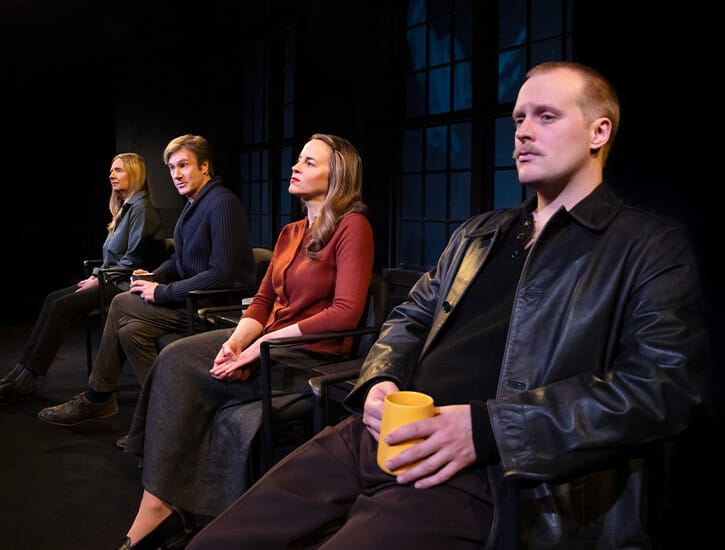
Production still from What We Did Before Our Moth Days. | Courtesy the production
What We Did Before Our Moth Days by Wallace Shawn. Greenwich House Theater, New York City. Through May 24
The Fever by Wallace Shawn. Greenwich House Theater, New York City. Through May 24.
Wallace Shawn has called a secret meeting of the bourgeoisie. Not for the vulgar elites but the cultivated kind. These are people Shawn abhors, adores, and recognizes as his own: intellectuals and aesthetes, artists with expendable incomes. These are people who keep up to date on global politics and furnish their homes with tasteful objects from around the world. But don’t think for a moment they don’t care about the plight of the less fortunate! They give generously to charity, acknowledge life’s injustices and empathize with those who suffer. Behind these closed doors, one member addresses the bunch. He’s not quite Shawn, but he’s not not Shawn. He’s traveled to a series of poor, unnamed countries in Latin America and returned with stories of leftist insurgency and its sweeping counterrevolutionary repression. But something is not right. This traveler is afflicted—not by germs or disease but a psychic malady. He’s trying to get away from something. Away with something. They all are. You’re in attendance, so it would appear that you’re one of them. You’re getting away with something too.
This is the indictment at the heart of Wallace Shawn’s The Fever, a twisting two-hour confession charting the deterioration of an unnamed narrator who, after being gifted Marx’s Capital and traveling to Latin America, attempts to reconcile the (irreconcilable) contradictions of his class position. It’s an indictment because, for Shawn, the play lives not in the script alone but in the “battlefield” of each audience member’s mind. His implied agreement with bourgeois spectators has been integral to the one-man show since its earliest stagings in friends’ living rooms in 1990. Then, Shawn directly addressed the well-to-do artists he ran with. Now, revived on the occasion of his newest play, What We Did Before Our Moth Days, The Fever seeks out new swaths of wealthy New Yorkers in whom to wage the psychic battles of class war.
If The Fever marks the breakdown of bourgeois morality, then Moth Days reflects its endlessly elastic capacity to rationalize contradiction. The play tells the story of four “intelligent and somewhat gentle middle class” characters—son, mother, father, and long-standing mistress—performing from a vague afterlife at the age they were when Dick (Josh Hamilton), the play’s mild-mannered patriarch, dies at forty-five. Onstage, they monologue to the audience as if from an analytic couch or witness stand. But Shawn is not asking us to diagnose or to judge them. He invites us to relive their greatest pleasures and betrayals while witnessing the way they warp and replay life from the bardo.
Dick and Elle (Maria Dizzia) are high school sweethearts from “decent” backgrounds. Through marriage and parenthood, their electric teenage love settles into something temperate, mostly durable. Dick becomes a successful novelist, Elle a high school English teacher. Tim (John Early), their son, is a troubled yet endearing twenty-five-year-old whose perversions poke at his parents’ veneer of respectability. When Dick falls for Elaine (Hope Davis), a “trashier” novelist—“Darling, I’m in terrible trouble, I’ve fallen in love with someone else. Please help me,” he begs—the shock gives way to quiet accommodation. The family structure endures, even as love corrodes.
If The Fever marks the breakdown of bourgeois morality, then Moth Days reflects its endlessly elastic capacity to rationalize contradiction.
In the introduction to his 2009 collection Essays, Shawn speaks to his artistic impulse to occupy perspectives other than his own. Since 1970, he has written plays and screenplays, “in each one of which a person who isn’t [him] speaks, and then another person who isn’t [him] replies, and then a third one enters or the first one speaks again, and so it goes until the end of the piece.” The formula describes Moth Days nearly verbatim—except these characters address the audience, not each other. It’s true of The Fever in an internalized manner. Competing characteristics of bourgeois ideology—righteousness, indifference, empathy, antagonism—form, in the narrator, a dialogical, self-fracturing stream of consciousness. Across both works, Shawn pushes the boundaries of monologic speech, as if to dissect the bourgeois “art” of self-fashioning.
The set of The Fever is sparse and intimate, mimicking the living rooms where it was first performed. Shawn sits in a chair beside a table with a steaming thermos of tea—more fireside chat than Marxist polemic. But Shawn, eighty-two, is as much consummate actor as avant-garde playwright. Before we know it, he’s become his self-insertion, tugging—first gently, then with force—at the proverbial Persian rug beneath us.
“I’m traveling,” he begins, transporting viewers to a strange hotel room in a poor country, where no socialist revolution has taken place. The lamp is broken. The electricity is out anyway. A large insect slips itself into a hole too small for it to fit in. The narrator vomits and recalls a rosy childhood. How tenderly his parents loved him! They taught him to appreciate gardens and music and fresh linens, and to avoid germs, dampness, and bad neighborhoods at the far edge of town. He delivers a belabored description of what it is to unwrap a “delicate, precious, and breakable” present from a loved one on Christmas morning. “My friends and I were the delicate, precious, breakable children, and we always knew it,” he recollects. “We knew it because of the way we were wrapped.”
Time is capricious in The Fever, in accordance with the twists and turns of cognitive dissonance and unsettled memories. Back in the narrator’s home country, the first volume of Capital is delivered anonymously to his doorstep, as if by some Marxist stork. He awakens to Marx’s notion of “commodity fetishism”: Under capitalism, the social relations of production are obscured within the objects of production. “‘I like this coat,’ we say, ‘It’s not expensive,’ as if that were a fact about the coat and not the end of a story about all the workers who made it and sold it.” Relationships between people are disguised as relationships between things.
The narrator’s nascent materialist analysis lasts several uncanny days. As it turns out, his beloved city flaunts exploitation, like one big marionette performance—puppets concealing the hands of both craftsmen and practitioners. Art dulls. Friends become tedious. Even intimacy feels mechanical: in his arms, a lover is like a doll, “electrically warmed.” He too grows numb and affectless. His most precious qualities harden into something lifeless inside of him.
In a recent New York Times profile, Shawn describes the air of secrecy that pervaded his childhood home. “A lot of people grow up in families where there’s a secret. Fewer grow up in families where there’s a secret that a lot of people know but the kids don’t know.” The open secret he refers to was the decades-long affair between his father—longtime New Yorker editor, William Shawn—and one of his staff writers, with whom he even raised an adopted child. This was a widely known fact, even to Shawn’s mother. And yet, it wasn’t for another three decades that Shawn and his siblings learned of their father’s affair through a friend’s offhanded mention of it.
Perhaps growing up in the shadow of dually unnamed realities—the relations of his parents and of class society at large—opened the chasm, from a young age, between life’s inner truths and outer appearances. If Moth Days traces this biographical lineage, then The Fever draws on an intellectual one: the ever-fraught relationship between Marx and Freud, both preoccupied with the obscure forces that govern social and psychic life. While Marx analyzed the exploitation foundational to the capitalist mode of production, Freud theorized the protective processes by which unconscious thoughts return in veiled form. From both thinkers, Shawn inherits not just theoretical armature but the suspicion that what appears natural is, in fact, structured by forces hidden in plain sight.
In spiraling monologues, the Moth Days characters thread a delicate needle between knowing and not-knowing, free will and fate. Dick, for one, insists on the “unconscious” nature of his more disagreeable behaviors, while also repudiating the Freudian posture that every last detail of his love affair—especially the fumbles and happenstances—suggests he knew very well what he was doing all along. Tim, meanwhile—who embodies the sort of diseased underside of his father’s suffocating decency—neutralizes his immoral impulses with charm and matter-of-factness. The play’s true determinist, Tim delivers an absurdist cosmology about the origin of the universe, in which nothing—not the speed of the wind, the temperature of the water, nor the position of the elements—was arbitrary. The result is a world of fixed, preordained selves with inviolable characteristics. “The book of your life,” he says, “was written many billions of years ago. It was written, completed, and closed. And then locked. You’re in no position to read it, but you’re destined to live it.”
There is a distinctly upper-middle-class quality to this performance of self. The more the characters excavate their psychic hollows, the more they pile fresh earth on the parts of themselves they prefer not to know about, any hints at class consciousness sublimated to interior drama before they can rupture into crisis.
The narrator of The Fever, too, invests in self-narrative. But, as if by counterpart to Moth Days, he briefly glimpses the violence that undergirds his position. From his (imagined) prison cell, he speculates that perhaps in the days of Freud, what was “hidden and unconscious” to people was their inner lives. Perhaps all they could see was their “outward circumstance.” “But something’s been hidden from me too,” he laments. “And I think it’s the part that’s there on the surface, what anyone in the world could see about me if they saw me out the window of a passing train.” In a sly inversion, he expresses Freudian disavowal as Marxian fetishism: What is repressed is not unconscious desire but the most surface-level facts of bourgeois existence. He recognizes the fragility of his class privilege within a global system of exploitation—only to recoil from this recognition and choose warped class allegiance over the dissolution of self.
Like his intellectual forebears, Shawn is a dialectical thinker. And, like any dutiful child of dysfunctional parents, he does not pledge full allegiance to either mommy or daddy. Instead, he stages a topsy-turvy world, where reality is affirmed in its negation—where people cement into things and things animate into people. Yet the questions that propel The Fever move beyond theoretical hat-tipping. Shawn invites us to reflect, more broadly, on the political stakes of our psychic investments. He asks: Which of today’s political realities rest comfortably within the frame of bourgeois liberalism and which press against its brittle edges? How much can self-narrative stretch to accommodate structural violence before snapping under the weight of internal contradiction?
The crisis he stages is less moral than material: If class society were truly abolished and its attendant distortions relinquished, then the “selves” built upon its misrecognitions would simultaneously destruct. As Shawn remarks in Essays: “When one hasn’t noticed that it’s one’s own boot that’s standing on the suffering person’s neck, one can be calmly sympathetic to the suffering person and hope that over time things will work out well for them.”
The narrator of The Fever speaks from a distinct historical threshold—no time or place is named, yet several haunt the text. By 1990, the Reagan Administration had violently suppressed popular leftist insurgency in Nicaragua and El Salvador, and the Soviet Union stood on the brink of collapse. The First Intifada was underway in occupied Palestine while, at home, a second wave of neoliberalism consolidated a new social order. These global upheavals impelled Shawn to see suffering not as humanitarian spectacle nor historical inevitability, but as anti-imperialist imperative.
So long as class society persists—so long as violence can be reframed as the militarized defense of freedom—Shawn’s psychic economy will reproduce in new forms.
Today, audiences receive The Fever from a different historical vantage point, having endured additional cycles of Western military intervention and capitalist crisis and recovery. Liberal democracies continue to allege their human rights commitments while underwriting genocidal regimes. Ruling elites sustain the contradictions through familiar logics of mystification and fetishism, naturalizing economic exploitation and global domination through narratives of cultural supremacy and nationalism. So long as class society persists—so long as violence can be reframed as the militarized defense of freedom—Shawn’s psychic economy will reproduce in new forms. In this way, the fever dramatized in The Fever functions as both diagnosis and diagnostic instrument, interpreting the points at which a story told to explain reality becomes instead a fiction that insulates from it.
Rarely what is pushed aside goes away entirely. It squeezes through the cracks of consciousness, resurfacing, insect-like, as new symptoms of a preexisting condition. By the time the narrator of The Fever realizes he is sick and goes searching for a remedy, he has already mistaken his symptom for root cause. He has come to realize that his life, as it stands, is “irredeemably corrupt.” But in himself, he finds no meaningful desire to betray his own class interests. On the contrary, he discovers his true, fanatic devotion to the status quo. Rather than confront the structures that manufacture scarcity and suffering, he naturalizes the poor people whose subjugation he depends on. “So we have everything, but there’s one difficulty we just can’t overcome, a curse: We can’t escape our connection to the poor. We need the poor . . . Without the poor to do awful work, we would spend our lives doing awful work.”
Denial begets tacit confession: that none of this comes as any revelation. The ruling class knows, all too well, that the force it authorizes to maintain class society. Shawn externalizes this re-entrenchment through the narrator’s fear of his own undoing. Marxist guerillas will carve him up on the torture table; the poor will rise, seize what is theirs, and exact their bloody revenge. “They want change. And so we say, Yes. Change. But not violent change! . . . Change that will help you, but that won’t hurt us!” To the narrator, violence returns as the fantasy of its reversal.
Because, for Shawn, complicity is a structural condition not a moral failing. Capital subsumes and seduces through the realization—or promise—of its material advantages. The bourgeois condition persists, whether its subjects feel indifference, empathy, or vitriolic hatred toward the poor and working classes. Shawn’s genius lies in his ability to inhabit this state of contradiction without submitting to the narrative pressures of resolution. “What is happening,” the narrator cries out before surrendering to the sweet sleep of disavowal. “I’m still falling.”
Will we become like the Moth Days ruptured family: gentle and intelligent, but condemned to recite their life stories before a live audience for eternity? Or will we become The Fever’s afflicted witness: suspended in the reactionary liminality between “traveling” and “falling”? While Shawn makes clear that bourgeois self-narrative cannot stretch enough to encompass revolutionary transformation, he does—however subtly—gesture toward an alternative. From occasional ruptures in the moral status quo emerge the conditions for genuine reckoning. As an audience in attendance tonight—a living, thinking, feeling audience, a political body—it falls to us to pick up where Shawn leaves off. Can we shed the bonds of bourgeois morality and look self-annihilation in the face? Do we dare take up arms against our lives as they stand? For it may be that, when the fever breaks, we wake up to a cure.