, February 26, 2026
The Good Rich Man?
Not all privilege is intolerable
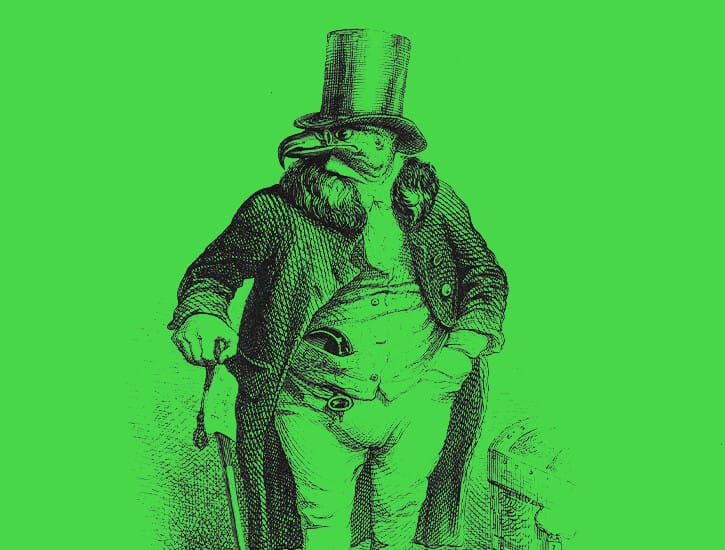
From Scenes from the Private and Public Life of Animals illusrated by J. J. Grandville. | Metropolitan Museum/The Baffler
Evidence of gross and increasing economic inequality in America is easily available and has been for years. The facts and figures are well-known, and yet they are probably still shocking, as they deserve to be. Repeating them here is unnecessary. Given how much worldly evil has been caused by the pursuit of financial self-interest by the managers of hedge funds and private equity funds and billionaires helping elect corrupt, self-dealing politicians, following the money begets the expectation that what will follow can only be an exposé.
I have great respect for the exposé genre, but that genre can’t do all the work if you begin by distinguishing, as I do, between having a lot of money and merely having some money—say, enough to live on, or even a bit more than that, enough to feel that you are not one illness or car crash away from financial disaster. That distinction may also seem uncontroversial, but keeping it in mind will help clear away some of the confusion that surrounds words like privilege and elite, words which arguably get in the way of actual efforts to achieve more equality. Some elites are firefighters. Not all privilege is intolerable. Paradoxical as it may seem, the main effect of finger-pointing at elites is often to divert attention away from money and from the rich and powerful who benefit most from our political system and have the most control over it.
Doug Henwood, one of the few leftist thinkers to examine in serious detail what the left still calls the ruling class, rejects “conceptions of a ruling class that center on PC-obsessed, organic food-eating urban elites.” He goes on, “That set has some influence, especially among the liberal wing of the consciousness industry, but it doesn’t shape the political economy.” It’s the shaping of the political economy, he argues, that ought to be decisive in defining who does and doesn’t belong to the ruling class: “The ruling class consists of a politically engaged capitalist class, operating through lobbying groups. Financial support for politicians, think tanks, and publicity, that meshes with a senior political class that directs the machinery of the state.” To put this another way: the characteristic members of the ruling class are not skilled, educated, credentialed professionals like lawyers, doctors, and consultants. The ruling class is made up of the owners of the firms for which those skilled professionals work.
If privileged is understood as applicable to anyone who is not desperately needy, the word is leading us astray.
Henwood argues, therefore, against lambasting the “privilege” (he puts the word privilege in quotation marks) of so-called elites. They do not belong to the ruling class as he defines it. Indeed, they may be capable of serving as oppositional thinkers and activists, people ready to cast a cold eye on that ruling class and encourage those who want to do away with it and the economic inequality it depends on: “Growing up bourgeois confers some advantages—time to study, as well as exposure to the nature of power—often denied to people further down the social hierarchy.” It does the cause of equality no good, he implies, if these advantages are treated as incriminating evidence of a privilege that no one should enjoy rather than as signifiers of a well-being that one day will hopefully be available to any and all.
If privileged is understood as applicable to anyone who is not desperately needy, the word is leading us astray. It encourages us to measure economic inequality by the wrong yardstick. That is the implicit premise of the Urban Institute’s 2024 report on “The True Cost of Economic Security.” Rather than testifying to “acute need,” the report casts a broader net, looking for those who may be “just getting by” but are not “economically secure.” Economic security stands for what it takes to live sustainably, or, as the report puts it, to thrive. Madeline Leung Coleman underlines the report’s findings for New York City: “Over 60% of New Yorkers do not meet the threshold. Of families with children, it’s 72%.” These figures are more significant than the usual poverty statistics because they take in more of the daily struggle of a large proportion of American households. But they matter for another reason, more relevant here: because they recognize economic security as something other than privilege—that is, as a morally defensible goal. In other words, they recognize the positive value of having some rather than a lot of money. Let us describe this criterion as a quantity of income and savings (more than half of all Americans have no retirement savings at all) that could be mentioned in neighborly gossip without embarrassment. Or as managing well enough.
Embarrassment is probably the first reaction to anyone asking what you, or anyone else, lives on. There are unwritten rules against asking. There even appear to be unwritten rules about people, unasked, telling you what they live on, or how much they make, as Edmund Wilson does in The Cold War and the Income Tax and as Walter Benn Michaels does in The Trouble with Diversity. When they choose to divulge, are they implying that they need have no shame because they deserve what they get? Or are they implying on the contrary that shame is unnecessary and misplaced because money is not a good measure of what anyone deserves? Is there egalitarian dissent lurking behind the naming of amounts? Or does it depend on the amounts? ($175,000 per year for Michaels, an academic, writing in 2006.)
It would be useful to begin shining some light into that murkiness. The moral and political perplexity that surrounds sources of income can be illustrated by a brief discussion of the exotic word rentier. What is a rentier? Often it is a landlord, someone who takes in rent from property they own. Often it is not an individual landlord but a corporation that owns a lot of real estate and takes in rent from lots of people. And often the property that produces the rent is not real estate but other investments, like stocks and bonds, and the form the rent takes is interest, dividends, and capital gains. A more restricted definition of the rentier makes the return on accumulated wealth, perhaps wealth accumulated by a parent or grandparent, into a larger proportion of the rentier’s total income and thus also a decisive fact about their selfhood. In that case, the rentier becomes someone who “lives on” income from property or investments, whether or not they also work—a rentier does not live on air. In other words, they are someone who does not depend on income from the work that they may also perform. They live off money that was accumulated by someone else and passed on to them, and that fact defines the sort of person they become.
Until quite recently, the rentier in this more tightly defined sense was a recognized sociological figure, and one that entered significantly into analyses of the nature of modern capitalism. (Lenin saw the rentier as representative of capitalism in its imperialist stage.) But if the rentier was representative, it was also a source of moral and political confusion. Based on self-interest, Max Weber observed, rentiers ought to be hated by workers. But they aren’t. Instead, workers tend to direct their anger at industrialists.
It is not the rentier, the share-holder, and the banker who suffer the ill will of the worker, but almost exclusively the manufacturer and the business executives who are the direct opposites of workers in price wars. This is so in spite of the fact that it is precisely the cash boxes of the rentier, the share-holder, and the banker into which the more or less “unearned” gains flow, rather than into the pockets of the manufacturers or the business executives.
Perversely, political emotion does not tend to follow the actual accumulation of money, even when the rentier’s money might be perceived as more obviously unearned than the money of hardworking business executives. That perversity seems relevant to contemporary anti-elitism, which is directed more at the educated than at the rich. But it also suggests, even more perversely, the existence of a zone of tolerance in which the educated—say, economically noncompetitive academics and artists—might be protected from economic resentment.
In his own time, Weber saw the concept of the rentier as necessary to explain the survival of artists and academics, at least to the extent that both are perceived as, at the same time, parasites and rebels: “Modern charismatic movements of artistic origin represent ‘independents without gainful employment’ (in everyday language, rentiers).” The word rentier appears in George Orwell’s much-admired essay on the novelist Charles Dickens. Orwell notices that Dickens, though he goes out of his way to remind Victorian readers of the poverty in their midst, doesn’t often present characters at work. He links this disinclination to represent work with Dickens’s penchant for characters who don’t have to work—those who enjoy what was then called “an independence.” Orwell expresses his disappointment that, with the possible exception of David Copperfield, “one cannot point to a single one of his central characters who is primarily interested in his job. . . . The feeling, ‘This is what I came into the world to do. Everything else is uninteresting. I will do this even if it means starvation,’ which turns men of differing temperaments into scientists, inventors, artists, priests, explorers and revolutionaries—this motif is almost entirely absent from Dickens’s books.”
Organizers, activists, and politicians need not be wealthy, and for the good of society probably should not be.
When Orwell evokes the rentier, however, it is not as a mere antithesis of virtuous industry, hence a cheap target of ridicule. Rather, like Weber, he associates the figure with a certain political confusion. The rentier emerges in Dickens, he says, as a replacement for “the good rich man,” a figure who “is usually a ‘merchant,’ and is always a superhumanly kind-hearted old gentleman who ‘trots’ to and fro, raising his employees’ wages, patting children on the head, getting debtors out of jail and, in general, acting the fairy godmother. Of course he is a pure dream figure. . . . Even Dickens must have reflected occasionally that anyone who was so anxious to give his money away would never have acquired it in the first place.”
In the later, darker novels, Orwell goes on, “the good rich man has dwindled from a ‘merchant’ to a rentier. This is significant. A rentier is part of the possessing class, he can and, almost without knowing it, does make other people work for him, but he has very little direct power. Unlike Scrooge or the Cheerybles, he cannot put everything right by raising everybody’s wages.” Someone who cannot put everything right, though it is hinted that he might want to; someone who makes other people work for him, but not directly or consciously—these characteristics do not preclude satire, but they also suggest a more widely shared predicament, one with which Orwell himself seems to feel an uneasy intimacy. The situation of Dickens’s rentier as Orwell sees him, well-intentioned but unable to perform the magic that would end the exploitation of which he is a reluctant beneficiary, neatly matches Orwell’s account of the situation of his likely left-wing readers—and, though he is less clear on this point, his own situation as well.
It has never been a secret that Orwell enjoyed a certain number of well-heeled benefactors, the sources of the money he lived on, though never luxuriously—those on whom Orwell’s portrait of the rentier would also fit the category of the full-time organizer or activist. Or politician, as Weber suggests. Weber famously argued in “Politics as a Vocation” that the politician would have to be a rentier, which is to say independently wealthy. This is not self-evident. Organizers, activists, and politicians need not be wealthy, and for the good of society probably should not be. Weber ignored the likelihood that being independently wealthy would give political leaders an interest in protecting and maintaining the state of society that generated their income.
But he was right that they could not be expected to work a normal nine to-five, five-days-a-week schedule and still perform the public duties that define them. The same holds for organizers, activists—and even students. Like the rentier, such social categories need to be supported, if only temporarily, out of some portion of society’s economic surplus. Who makes those decisions? Are they made invisibly by the market, or are they made in open, democratic discussion? How much money is distributed? These questions are inevitably controversial. But it is normal, which is to say uncontroversial, for some social categories or functions to be separated from paid wages. That is not necessarily an example of privilege.
From Who’s Allowed to Protest? Used with permission of the publisher, Melville House Publishing. Copyright © 2026 by Bruce Robbins.