, April 30, 2026
The Culture We Deserve
Gwendoline Riley’s new novel asks what can be saved from the disappearing world
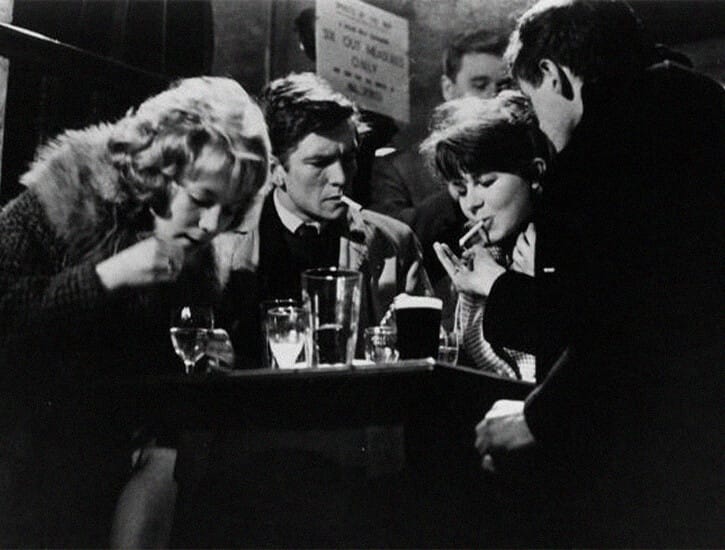
Still from The Loneliness of the Long Distance Runner (1962). | British Lion Films
The Palm House by Gwendoline Riley. New York Review Books. 224 pages. 2026.
In Gwendoline Riley’s novels, the sky is skin-close. It’s always raining, has just rained, or will begin to rain soon. Her atmosphere cavorts and settles in the nerves. Her world gathers in silver leaf puddles, rain skipping like jacks, draughty cafes and darkling pubs where the literati sulk. “You realize they don’t have a clue what we are or what we mean,” says one of the wistful misfits in the heart of her new novel, The Palm House, to which his pubmate replies, “But do we want them to know? Maybe not.”
The British novelist Gwendoline Riley published her first novel at twenty-two and, in 2018, the Times Literary Supplement named her one of the twenty best British and Irish novelists. For the past twenty-five years and in six slim, diaristic novels, Riley’s narrators have prowled a damp English corner of the Earth, armed with bone-dry observations and cool numbness, characteristically soused for good measure. Riley’s “plots,” such as they are, span the uncontrived events of everyday life interlaced with recollections from the past that trundle down like loose objects falling from an attic closet. Time and time again, Riley circles around moments that must be weathered before the break of a stasis, before a surmise hardens into something like understanding: the past that rattles its cage, the nettling sigils of family, the muddled prosiness of ubiquitous drinking, the search for a place to belong. Many of her close relationships are drily observed purely through dialogue, needing no further exposition to play faintly to the tune of Peggy Lee’s “Is That All There Is?” She catalogues fleeting ordinary locales with an archivist’s touch, drawing out what makes them so common-felt, pickling them in jam jars against a fading world.
For the past twenty-five years and in six slim, diaristic novels, Riley’s narrators have prowled a damp English corner of the Earth, armed with bone-dry observations and cool numbness, characteristically soused for good measure.
The Palm House, her seventh novel, turns this method toward cultural and institutional decay and the question of what, if anything, can be saved. It’s tender for a Riley novel, offering a quiet redemption in enduring friendships, where understanding can still take root in rare, flickering moments. In the iodine light of a sky cindered with Saharan sand, we meet Laura Miller, a writer edging into midlife, and Edmund Putnam, a longtime editor whose professional life is starting to come undone. They’re old friends, mutual witnesses to each other, meeting up in a pub for drinks and crisps. Putnam has spent the last twenty-five years as an editor at Sequence, a “tweedy,” “young fogey-ish” lit mag turned engagé. He has just handed in his notice. The cause is a new editor, “Shove,” a sports-page warhorse sent by the board to make the magazine more like The New Yorker. Sequence, with established remit and let’s-save-the-youth-club pep, begins filling with a “reliable quotient of underthought dreck.” What follows is not merely an office satire but a study of friendship, exhaustion, and the cheapening of a world whose custodians can no longer defend it from the encroachment of a bloodless, focus-grouped order—Levittown domesticity by way of Amazon fulfillment center, in which nothing is tended beyond appearances.
Shove is not a villain in any grand sense. He is worse: a perfectly ordinary agent of cultural dilution. He arrives not as a critical adversary but with a cheery, boisterous, well-meaning affability. He’s careful not to disparage the ideas of those around him, only introducing general-purpose maxims—articles mustn’t be “boring.” What follows is a slow hollowing. The sharp, learned, critical lens begins to cloud. In one of his editorials, we hear “The Waste Land” repackaged as consumer trivia: “April is the cruellest month, as poet T.S. Eliot once famously wrote.” It’s the practice of gesturing toward seriousness without ever quite inhabiting it. Putnam, meanwhile, belongs to an earlier world and its distinct intellectual tradition. Thirty years ago in this same pub, he had been wasted on “The Waste Land,” running lines with a curious figure named Barry, now lost to history, a magpie sort drawn equally to Samuel Johnson, communism, amphetamine and bovver boots. “I don’t know if it mattered to Barry the same way it did to me—books, poems, plays, all that—but he responded to it. He got it. And you look for that, at that age. Don’t you? Or I did.”
It’s the difference between a poem as lived experience and a brand. Yet Putnam’s intellectual rigor and idealism do not provide immunity against what comes next, and he point-blank refuses to participate in a world curdling principle to performance. Without his work, he becomes “another bloke knocking about the Western world.” This is Riley’s gift, to render the morbid praxis of self-pity and grievance through precise, impressionistic flecks of dialogue. Riley’s narrators, watchful and quietly appalled, bear witness time and again to the performative self; the grandiosity, the complaint, suffering as a kind of claim.
“Never mind carrying a cross, it felt at times as if Putnam had decided to wear a coffin when he came out for a drink. It was as if he were wearing this coffin and daring us all to say something about it. I imagined a coffin propped up near our table and Putnam occasionally bashing open the lid to shout,
‘Don’t mind me!’
‘Don’t mind me in my coffin, will you?’”
Sitting across from him is Laura—younger, unsettled, trying without flourish to live in the world as it is. Her concerns are less abstract and more immediate: a flat overrun by centipedes, a hologrammatic actor boyfriend who seems to be playing the part of himself, a way to make ends meet. When she finds work at a pop-history magazine, Putnam dismisses it as unserious. “It’s only a matter of time before they find a cat that looks like Neville Chamberlain.” Where Putnam withdraws into wounded snark, she makes do. When he lashes out at her—“And they’re interchangeable, are they? . . . This word, that word, doesn’t matter”—she lets it pass, offering the non-committal murmurs that keep things moving.
Like all Riley’s narrators, Laura recognizes the gleam of “ancient, pagan malice” of such panegyrics. She tries to bash against it with practicality and logic. When literary jobs, predictably, fail to materialize “by a dint of a natural justice in which I’d never elsewhere heard him express any faith,” Putnam’s disappointment hardens into something like triumph. Watching him, Laura cannot help but wonder: “Putnam was forty-nine! And as well as living had he not spent a good proportion of those years reading, thinking, watching films? Had none of that given him an inkling for how to face life? Some model of elegant survival?”
But elegant survival requires a means of skirting precarity. The soot-furred, lorry-frenzied London of Putnam’s youth has given way to the post-Wagamama reality of Laura’s. Laura moves from a series of temporary rooms, from a university cluster flat, to a Shepherd’s Bush share where the girls drift past each other in towel turbans with headphones in, not speaking, to the rented flat overrun by insects. Around her, the same entropy works on everything. Her actor’s decaying family mansion, stalled in legal limbo, is lived in as a slum, a host to bad parties with absurd people full of idle malice, with Miss Havisham bathrooms and holes in the walls where live wires push through. Her mother’s International Language Academy up in Liverpool resolves to a room in an infill block near Moorfields, its promise reduced to an A4 printout sellotaped to the door. Laura’s possessions equate to a suitcase and two bin bags, impedimenta she lugs around from door to door. Yet the promise and lure of the city keeps her. When Laura names streets and intersections, it’s with the air of incantation. She talks herself out of leaving “when there was still so much I hadn’t seen in London,” moved by the sound of her own boots on the cobblestones.
Against this backdrop of provisional lives, Putnam suggests a trip out to Kew, where he grew up, to see the ancient cycad of the Palm House and to visit his father. That historic Victorian glasshouse, opened in 1848, its iron ribcage from British naval origins arched over lush botany and its glass roof catching the sun as Virginia Woolf once saw it in Kew Gardens, preserving preservation itself, waits at the novel’s edge. Inside, rare plants are kept alive, against time and hostile conditions, a fantasy of continuity, of inheritance, of tradition. The pair never make it there.
The Palm House is digressive, arranged like an emptied pocket, with spareness that can come off as thinness, as much blank space as ellipsis. Scenes accrete with puzzling relation, the past and the present drift up and overlay one another. Pub conversations give way to a childhood holiday in Dubrovnik where Laura, her mother, and grandmother mistake the cheapest local work shoes for a fashion trend and get heckled on the street. In a palmist’s caravan, a young woman ignores Laura’s fortune to somehow rid her of the warts that have blighted her hands for years. The veins of tenderness in Riley’s novels come from unexpected hands.
Riley seems to be asking what, if anything, can we keep of the disappearing world—traditions, relationships, a way of being—and is clear-eyed in the face of nostalgia: Things weren’t always better. The deepest emotional weight of the novel settles in two scenes, one very loud and one almost imperceptible. The first is a truly shocking sequence involving a teenage crush of Laura’s, a standup comedian whose whole persona is vulnerability, who is constantly “besieged and . . . thwarted” on account of being “sensitive . . . alive to beauty and cruelty . . . as if he had no skin.” At fifteen, Laura tunes in to his self-deprecating bits on Radio 1. She sends him mixtapes and waits around behind stage doors. When she’s invited behind the curtain, what follows is an assault. It’s agonizing, rendered with dispassionate clarity and remove. Young Laura in older Laura’s recollections is like a car accident she passed on the motorway.
The second scene is the finest in the novel. It’s suffused with a hushed quiet. Laura and Putnam visit Milano’s, an old cafe frequented by his father, who has recently passed. Martin was a teacher who grew vegetables and refused to replace anything that still worked. Now, in the same booth, Putnam orders eggs and chips, his father’s order. The conversation drifts; the menu’s humble bacon butty has become a panini. The old house must be sold; no one on a reasonable income could come near it now. The young all drift to Hastings. He remembers a likable waitress who was friendly with them, dark-haired, Polish, sexy. Martin had taken a shy liking to her, having lived alone for decades in homage to his late wife’s memory. He would bring her courgettes from the garden; she would smile at them as if to say you have a nice dad. He remembers one visit, when she produced photos of her big family, and his father, obliged to admire them, put on his specs and smiled gamely, his hope quietly checked. Putnam remembers his father’s appreciation of her “food, and care. Someone being pleased to see him.” How he admitted, simply “I had hopes.” They finish their meal. Outside, it’s begun to rain. Laura waits on a bench with an umbrella while Putnam wanders down to the sea with a plastic canister. He returns drenched. The scene ends.
The British literary tradition has weathered a hundred years of speculation of its imminent demise. Kulturpessimismus, the belief that generally things are going to the dogs, is a beloved old chestnut. There was in fact a real Sequence magazine, founded in 1946 by Oxford students that ran for fourteen issues and focused on film criticism, before its founders—Karel Reisz, Tony Richardson, and Lindsay Anderson among them—left to make the films that would go on to shape the British New Wave with kitchen sink dramas like The Loneliness of the Long Distance Runner, Saturday Night and Sunday Morning (Riley appears to recognize her heritage; a collection of her short stories is titled Tuesday Nights and Wednesday Mornings). An editor’s note in the seventh issue reported that the Oxford proctors had banned Buñuel’s Un Chien Andalou from campus screening, thus sparing “adolescent Oxford the dangerous discovery that life is surreal.” In the fifth issue, a young Lindsay Anderson noted that the critic who treats every film as a dreary procession of lost opportunities risks the irrefutable reply that the films are supposed to make money. They fulfill their function. It is the role of the critic and the artist, not the industry, to go against all that is well-pedigreed, right-minded, and hopelessly inert.
At the novel’s close, Shove’s improvements prove futile, and he’s dispatched elsewhere by the board to start a podcast; “the body rejected the graft.” Putnam is restored to Sequence. Laura buys a studio flat; the ancient boiler may even chug out a few more years. The board, those mute systems of progress and consolidation, rolls on like a tide of zeitgeist. Sequence persists, putting out its signal for what Jacques Barzun called the culture we deserve.
Riley seems to be asking what, if anything, can we keep of the disappearing world—traditions, relationships, a way of being—and is clear-eyed in the face of nostalgia: Things weren’t always better.
There is a thrilling element to Riley’s work that is amniotic-dark. All roads lead back to Mother Dearest, beginning with the very first words of her 2002 debut, Cold Water, dedicated “for my Mum.” Rain and weather, gutters and litter, alleys and flowers pushing out of cracked curbstones, the passing visions of Belham, Stalybridge, Pimlico, Merseyside—murky, as if seen from a train—are suffused with a susurrating darkness that seems to melt and reassemble into the looming, enigmatic shadow cast by a primal relation. In every novel, Riley’s variation-on-a-theme narrator matures alongside her, with the mother-shadow nearby. Her previous novel, 2021’s My Phantoms, studies this shadow at its full evening cast. It’s a withering gospel of everyday non-connection, offering no parables, no clarity, except perhaps the bare truth of the damage of generational gaps and varying degrees of self-knowledge. In The Palm House, Laura’s mother flits in, speaking in bright tropes like, “Right, that’s it. I’m shutting up shop now. I don’t want to hear from anybody unless it’s an absolute emergency” or “So you’re on your own, OK! You’re fending for yourselves tonight!” as though withdrawing something that was never in fact shared. No response is required, her family realizes “this show ran regardless.” At times her slogans slip into nonsense. “Speak-a to Charlie!” she cries at no one in particular, in a put-on accent. She’s inchoate, always lensed for maximum glare. Hers is a world where “sod’s law was the natural law,” everything is subject to a screwball fatalism. Putnam dismisses this attitude in one word “Northern.” Yet it’s the same condition is his own undoing: language as mere repetition, a life organized to keep real contact at bay. In 1977 Anne Duchêne in her TLS piece “Brave Are the Lonely” described Barbara Pym’s characters as “people living like mice in the wainscoting of life, never invited to its table.” Laura’s mother would regard such an invitation with suspicion.
First Love’s poorly married narrator writes, “There should be more to getting along with people than negotiating with this jumpy primordial goo.” But there often—isn’t. Riley’s sense of impasse recurs, the swirling language that never connects, the startling ellipsis between people that simply must be lived with. It’s strange what we expect from people. Deep inside ourselves. The only thing that can be preserved is what we hold onto, stubbornly, past the point of reason. The commitment to remain in someone’s bad season with them and the faith that language, between the right people, can still carry meaning.