, May 20, 2026
Boy Girl Problems
The trans killer myth in Katherine Packert Burke’s All Us Saints
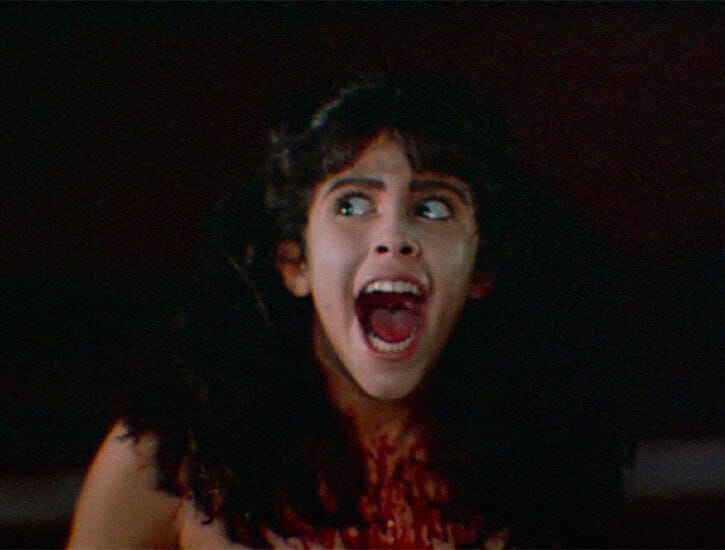
Still from Sleepaway Camp (1983). | United Film Distribution Company
All Us Saints by Katherine Packert Burke. Bloomsbury Publishing, 272 pages. May 2026.
Katherine Packert Burke’s second novel All Us Saints is structured like a chamber play. Trading in the autofictional, referential, hyper-contemporary context of her first novel, Still Life, Burke turns her attention to a Gothic haunted house soaked in blood. “Certain places are wrong,” she writes in the prologue. Her new book is not, however, a traditional horror novel: The killer, for starters, is long gone. Years after their brother Roland St. Cloud killed three young girls, his surviving family members flock to the scene of the crime. This is their annual Freudian ritual, a superstitious act of remembrance. If every year they pay homage to their “tranny” brother and his victims, perhaps darkness will be kept at bay.
Hollywood predictably capitalizes on the St. Clouds’s tragedy with a Scream-esque movie franchise. True crime books chart the rise of a new urban legend. In response to the publicity, Roland’s playwright parents commit suicide. The surviving members of the tribe include Roland’s twin Edna, a photographer whose career took off based on photos she took of the crime scene, Calla, his younger sister and a sexually frustrated failing playwright, and James, the dead-end youngest child. In the first act of the novel, we’re also introduced to Edna’s husband Roger, who wrote a smash hit true-crime biography based on the family, and Edna and Roger’s precocious daughter Wren. The novel’s two acts are comprised of relatively short third-person vignettes, each focusing on a different member of the clan’s own personal torment in the house of horrors on the occasion of their yearly retreat.
Can we reform monstrosity in a world where the myth of the trans killer is alive and well?
Standards of the trans killer genre include Sleepaway Camp’s Angela, The Silence of the Lambs’s Buffalo Bill, Dressed to Kill’s Bobbi, A Blade in the Dark’s Linda, and the trans-masc fury of 1972’s Private Parts. Even Hitchcock’s Psycho contains a deranged swipe at male-to-female transition. But rather than reverting to these films’ game of cat and mouse, All Us Saints reveals its murdering tranny at the outset. Instead of shock value, Burke wants us to focus on the context that made a killer. What is his family up to—and what were they up to when he went off the deep end? The survivors, for their part, are forced to wonder if Roland really was trans—or if there was any indication of his/her rage. (Which pronoun is appropriate? Burke uses he, even as characters occasionally refer to Roland as a woman.) In the traditional trans-as-monstrous canon, the uncanny man-trying-on-womanhood is introduced at a slant early on to spook the viewer. These killers feel cursed by their transness. They reason they must be monsters. Rage becomes the primary conduit for their embodiment. If you can’t be beautiful, be tortured. Or better yet, be the one who does the torturing. The dissonance between projection and product unleashes a monster.
“Like the monster,” Susan Stryker writes in her landmark essay “My Words to Victor Frankenstein Above the Village of Chamounix,” “I am too often perceived as less than fully human due to the means of my embodiment; like the monster’s as well . . . my exclusion from human community fuels a deep and abiding rage.” The piece was an early inspiration for the nascent field of trans studies, asking how to use monstrosity as a model of transformation. “I want to lay claim to the dark power of my monstrous identity without using it as a weapon against others or being wounded by it myself,” she writes. But can we reform monstrosity in a world where the myth of the trans killer is alive and well—something that comes up in the aftermath of every mass shooting—despite the fact that there have only ever been a handful in history?
“He covets. That’s his nature,” Hannibal Lecter declares, diagnosing the psychology of Buffalo Bill for the benefit of Agent Clarice Starling. The Silence of the Lambs attempts to distance itself from transphobia by having Lecter assert that Buffalo Bill is not a real transsexual—but Lecter is on to something about gender. He goes on to say that to covet, one has first to see something every day. For Roland, the soft femininity he covets comes in the form of the beautiful Beatrice, one of his eventual victims. What the public doesn’t know, however, is that Bea regularly sexually assaults Roland. She can tell that he’s different, that he wishes he was like her. “Are you a man yet?” she taunts him while pushing her pussy into his face.
This isn’t the only sexual violence Roland suffers. Roland is a doll maker, the prototypical trans killer hobby, and the man who instructs him in the craft molests him—the act of creation turning from a refuge and outlet to a sadistic nightmare. He tells Roland that he’s used to people like him. “I’d meet them in the rain, dresses gathered around their cocks . . . they were so beautiful. So eager for my touch . . . You’ll be such a pretty girl,” he hisses. “My pretty girl.” Afterwards, he runs to his sister Edna, but she is unimpressed by his trauma. To be feminine, his sister seems to suggest, is to be an open wound. There is no escape. “Is that all?” Edna asks flatly before turning away. Roland’s sorrow quickly alchemizes into rage. “She doesn’t deserve it, I think, and there is another flash. She doesn’t deserve any of it. The pain or the joy.” Burke makes sure we get the message—at one point Roland goes to the movies and watches The Silence of the Lambs.
Roland would like to make puppets, which his mentor says have a soul, but he resorts to carving little wooden figurines instead. “You can make a doll from anything,” Roland reflects. “If I have to let the dolls change my body as I change theirs, so be it.” The objects he carves slowly shift from deer and beautiful women to knotty hags and drawing dollhouses, forcing his figures to face the wall Blair Witch-style. His little martyrs are his whole life. In Private Parts, the trans man injects his own blood into a blow-up doll with a hypodermic needle, watching the crimson flood the water like ejaculate. Roland just needs a knife.
During the final moments of her life, Beatrice tries to destroy Roland’s dolls in a burst of petty cruelty that finally sets Roland off. He has already started to unravel, not even able to try on the dress he steals from his sister, who he fumes doesn’t deserve the joys of girlhood. The dress recalls the recurrent imagery of wigs on the floor in films like Brian De Palma’s over-the-top Dressed to Kill. The carnivalesque garishness isn’t incidental—Roland is described as wearing “a clownish drag of lipstick.” Others refer to him as “that horrible faggot clown.” Absent from his own story, we are asked to interpret the sensational narratives that have sprung up to make sense of Roland or fall back on the crude cultural norm that interprets transness and monstrosity from the outside rather than from trans people themselves. Finally comes the intermission, titled “The Monster Speaks,” after trans Spanish writer Paul Preciado’s query, and we are primed for a new piece of the puzzle from Roland himself:
I could have been any man. I could have been a hermit at the known world’s edge. I could have thrived in the era of martyrs and fools. I could have been a saint, insane and kind. There is little distance between saints and monsters. It is a matter of timing, I think, and faith, and that’s all. But in this life, I have no place.
Burke’s is a twisted, imaginative empathy that subverts the cis gaze and flips the trans-as-monstrous trope by introducing the prurient perception of others before giving us the interiority of Roland himself. It’s a disorienting take on a familiar villain. Burke insists on letting the villain speak for himself, refusing to reduce her killer to simply another case study without any thoughts of his own. Perhaps the murderer is a scapegoat as well as a criminal. Maybe he’s not the only one culpable if we take a wider view of social ills. In All Us Saints, the author force-feeds us the painful bullying, transphobia, and sibling rivalry in addition to the more inflammatory urban myth. This is not forgiveness; it’s a seance.
Burke’s novel teeters between the texture of a Gothic melodrama and the standard lit-fic MFA novel. The prose is clean, not crowded, and the references to the modern world run the gamut from Sarah Lawrence and Tarkovsky to Artforum and Christian Marclay’s The Clock. (It is, admittedly, hard to imagine the slacker James watching Solaris.) Action takes place mostly through dialogue. It is only in the final few pages anything strictly contemporaneous actually occurs: In the year-long break between the two acts, Calla has started dating a lesbian townie singer-songwriter named Sarah, a secret TERF who seeks to burn down the St. Cloud house. Later on, her transphobic lyrics are discovered and transcribed by true crime chronicler Roger. In the second half of the book, he’s left a paranoid Edna for another woman. He couldn’t take the eerie house anymore, especially after a bizarre wind blew all the doors open during last year’s ritual. The stage is reset for the final violent denouement.
All Us Saints’ two-act structure cleverly exploits doubles and parallels. As in Burke’s debut, metatextual elements abound. There’s a desire by the family and the public to recreate or dramatize the crime in order to understand it, to “domesticate it through analysis.” Perhaps then they will feel like they understand the mind of the killer. Nowhere is this clearer than in The Neighborhood, a video game that digitally recreates the family home, to which Wren and Calla are hopelessly addicted. Art, Calla believes, is a “shell game.” Nothing more. She believes art is always just a way to paper over “war and capital.” Her jaded belief is that recreations and doubles do nothing—even as she continues to immerse herself in a virtual simulacrum house that vexes her.
Burke holds us responsible for our willingness to be dazzled by the spectacle of violence.
This is a novel about obsession, about the need for answers and origins and what happens when there are no solutions. Roger, for his part, invents them. In his book Doll Parts: Isolation, Transvestism, and the St. Cloud Family, he invents a diary for Roland. He sees it as a necessary measure. “The role of the true-crime author in the twenty-first century is much like that of the fabulist in the nineteenth . . . a cautionary illumination of the world’s darkest corners. In many ways, he is a public servant,” he muses. This account is, in his mind, part of how he wooed Edna. He is “not only the man who would love her best but the narrator laureate of her traumas.” Really, Roger is a gatekeeper. He tells his daughter there are tests to see if someone is really trans “like training a method actor.” Roland, he argues, was not actually trans. Edna’s twin wasn’t someone who would be satisfied with merely the “sort of mask the transvestite wears.” Really, like all the St. Clouds, he’s a transphobe. Put all the “fairies” away, he thinks. This easy Freudian reading of Roland never quite coheres, however, and can’t easily explain the complexity of his murders.
The youngest St. Cloud, James, has gender issues of his own. He enjoys getting fucked in the ass by his girlfriend, likes wearing skirts and being called a good girl. When he meets a trans woman at a party, he has a meltdown. (Something that occurs to the St. Clouds more than you’d think. They’re terrified that the bad publicity Roland gave the trans community will come back to haunt them.) He can’t seem to imagine a way out of the small hollow life he lives. Instead of admitting he may be trans, he and his girlfriend start having threesomes. It may not be a coincidence James shares a name with the pre-trans egg from Imogen Binnie’s Nevada. Neither finds a solution to their boy-girl problems. Yet James’s sexual problems don’t make him a killer.
The only member of the family who can imagine a way out from the rubble of trauma is Edna and Roger’s daughter Wren. As she plays The Neighborhood, she attempts to understand the link between a string of murders that occur both in the virtual and real world. “A play is bounded, safe. Real life isn’t; the game isn’t.” In this way, “an image of death becomes death itself.” At the same time, Wren is one of the few St. Clouds interested in family history. She learns from Calla that the St. Clouds inherited their wealth from a distant relative who developed napalm. Perhaps, Wren wonders, there’s a link between this curse and Roland’s killing spree. “Games—all games—do something to you,” she muses. But the napalm plot is just another piece of the puzzle. Life isn’t a nineteenth-century chronicle any more than it is a video game. Each of these explanations falls short of understanding Roland’s dubious motivations. Some monsters and serial killers are allowed to remain ciphers. Others must be picked apart for their gender deviance. It’s a difficult needle to thread that Burke’s novel explores with eviscerating pluck.
Wren tries to discover the secret of The Neighborhood with a friend she makes online named Mieke. After many months, and after Wren finds out her new friend is trans, they open a seething vault that seems to be at the heart of the mystery. But there’s nothing behind the sealed door. There is no secret. She must go on living without a deeper meaning to the mysteries of life. “What would you want?” Roland echoes throughout his intermission. What would be enough? What could possibly answer the riddle of trans monstrosity?
The chasm between Roland’s self-perception and how others see him is never found in the plays his parents and older sister write about him, the photos his twin takes, or in the fever dream of a video game his niece enjoys. It’s a losing game to be understood by cis people. Instead, Burke holds us responsible for our willingness to be dazzled by the spectacle of violence. She wants us to consider the way true crime sensationalism—and the cloudy mythology surrounding the trans killer—obscures our ability to understand the context of such crimes. She’s not excusing their atrocities; she’s questioning how we shape our villains. “The only way to win is not to play,” Burke writes. Life, unlike an art exhibit or video game, is boundless.