, February 20, 2026
Something Is Missing
Kafka as he was, rather than as we might like him to be
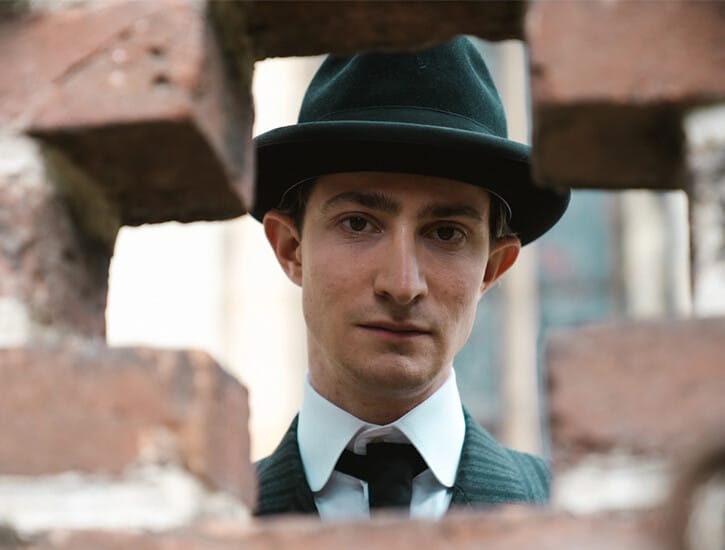
Still from Franz (2025). | Cohen Media Group
Franz directed by Agnieszka Holland. Cohen Media Group, 127 minutes. 2025.
“There are some who say the word Odradek comes from the Slavic and they look for its etymology there. There are others who say it’s a Germanic word, merely inflected by the Slavic. The doubt surrounding both versions forces one to conclude that neither is true, especially as neither is any help in finding a meaning for the word.” So begins Michael Hofmann’s translation of “The Worries of a Head of Household,” one of Kafka’s more enigmatic short stories. Odradek is a piece of household refuse that refuses to disappear. It’s a jumble of bits of wood connected at right angles; it carries old strands of tangled thread; it lurks, seemingly moving of its own accord, and even responds to simple questions. Just as neither German nor Czech gets at the essence of Odradek, a broken-down remnant with “no fixed address,” Kafka himself, born into an upwardly mobile petit bourgeois Jewish family in Prague in 1883, lay, or rather stumbled, between those two nations. Kafka writes in his famous “Letter to His Father” that Kafka père retained only an “insignificant scrap” of Judaism, and while the author’s writing almost never invokes Jewishness by name, Odradek, a “star-shaped reel of thread” that survives from generation to generation, seems to be the sort of distinctly Jewish thing that lurks behind Kafka’s work and life.
Franz tempers Kafka’s supposed universality with his persistent particularity.
In Agnieszka Holland’s ambitious but uneven biopic, Franz, this thing appears in one vignette that sees the author as a boy of about ten playing a game of hide-and-seek. Blindfolded, he wanders into the kitchen, accidentally touching the lit stove, as the family’s Czech cook and nanny (seen earlier in the film telling young Franz that the Prague ghetto will be razed and the Jews driven out of the city) looks indifferently on. Odradek then shuffles in, all strange odds and ends, prompting the nanny to react with disgust and ask where all this “vermin” is coming from. The nanny speaks Czech, Kafka speaks German, Odradek scurries in Jewish silence.
It is this multilingual, multiethnic, and particularly Jewish background that Cynthia Ozick, writing about the impossibility of translating Kafka, has lamented as inexplicably overlooked in Kafka criticism. Depicting Kafka’s life in film may be just as hard as translating the author. His brilliance lies in the unfinished—unfinished novels, seemingly unresolved stories, a relentless attempt to grasp at perfection in spare, masterful, aphoristic writing. And his life of forty years was relatively sparse. Kafka was never married, had no family of his own, dabbled in but took no definitive position on public issues.
Holland’s attempt to adapt this impossible life relies on snippets. Shifting vertiginously from Kafka the child to Kafka the adult— the lawyer, writer, failed lover and frequenter of brothels, the friend, son, vegetarian, neurotic—Franz is only smatteringly biographical. On top of this patchwork life, Holland indulges in overwrought pastiche of German expressionist cinema (Kafka’s writing room looks more Dr. Caligari’s cabinet) and gratuitous flash-forwards to contemporary Prague, in which international tourists are shown to partake of pop-Kafka kitsch (eating vegetarian Kafka burgers, lying down in the precise spot where Kafka sunbathed, etc.). In this attempt at exploring Kafka’s reception, the film risks devolving into kitsch itself, such that it sometimes seems less like a movie about Kafka and more like one about the very word “Kafkaesque,” one of those Dual Monarchy terms like “Freudian slip” that gets superficially bandied about without much attention to the source material.
But Franz, a Czech-German-Polish coproduction, is most sophisticated when it gives us the Odradek behind Kafka, when it shows us Kafka the Jew, Kafka the German writer, Kafka the Austrian subject, Kafka the Czech speaker (all delicately performed by Idan Weiss), and the tensions between those identities. Franz tempers Kafka’s supposed universality with his persistent particularity—his attention to the Czech language, his enchantment (and perhaps disenchantment) with Yiddish, his study of Hebrew, his undecided relationship to Zionism—in short, his place within the whirlpool of concerns of turn-of-the-century Austrian Bohemia.
Those concerns reached a fever pitch in Kafka’s lifetime. By the time of his birth in 1883, the restrictions on legal residence for Jews in the Austrian Empire had been abolished, and families like the Kafkas (and the Freuds) had migrated to Vienna, Berlin, and Prague. Czech and German nationalist infighting was constant in late nineteenth-century Prague, where Germans made up 14 percent or so of the population but where the German language was dominant in culture, science, and industry. In 1897, the Austrian Minister Kasimir Badeni proclaimed official bilingualism in Bohemia and Moravia in an attempt to appease the Czech-speaking population; in response, German nationalists led an uprising that culminated in Badeni’s resignation and the repeal of the policy.
The fin-de-siècle was also a time of virulent antisemitism, expressed both by anti-Catholic German nationalists like Georg Ritter von Schönerer (who was later to become a substantial influence on Adolf Hitler) and Karl Lueger, the Christian Social mayor of Vienna from 1897 to 1910, and by Czech nationalist movements like the Young Czechs. In fact, antisemitism was one of the few ideas that united German and Czech nationalists. Historian Martin Schulze Wessel has written that “German, Czech and Magyar party politicians entered negotiations about a ‘reconciliation of the peoples on the basis of anti-Semitism’” in the fall of 1883, a few months after Kafka’s birth, when the death of a Hungarian peasant girl catalyzed a blood libel trial that turned into an O. J.-level spectacle throughout the empire and beyond. Antisemitic riots would break out repeatedly throughout Kafka’s lifetime.
“I have never lived among German people. German is my mother tongue, and therefore natural to me, but I find Czech much more heartfelt,” Kafka wrote to his Czech translator and lover, Milena Jesenská. Prague’s Jewish bourgeoisie was educated almost exclusively in German (and Kafka’s German language gymnasium was three-quarters Jewish); the city’s Jewish community typically sided with Habsburg stability over the apparent turbulence of Czech nationalism. But Kafka was, unusually for a Jewish writer of his time, fluent in both languages, and, as Franz shows, Kafka’s parents (who ran a fancy goods store) and Kafka himself switched constantly between Czech and German at home and on the street; this cosmopolitanism is contrasted in the film by a visit to an uncle working as a doctor in rural Bohemia who refuses to speak German.
But though German may have been his Muttersprache, it didn’t have the warmth of Yiddish, or the Mameloshn: “Mutter” was too cold a word to describe the Jewish mother, Kafka wrote in his diaries. In fact, Kafka’s mother tongue was not quite German, at least not standardized High German. Kafka spoke Prague German, a variant with admixtures of Czech vocabulary and syntax and sprinklings of Yiddish or what was derogatively referred to as Mauscheldeutsch—Yiddish-inf(l)ected German.
Kafka’s national and linguistic complications, and particularly his relationship to Jewishness, are as central to Franz as they were to Gilles Deleuze and Félix Guattari in their 1975 book Kafka: Toward a Minor Literature, a landmark work of criticism that limned the author as a minority writer who created a literature that deterritorialized (and thus revolutionized) the German canon. The scholar David Suchoff has argued that in their renewed attention to Kafka’s particular Jewishness and multilingual background, Deleuze and Guattari disrupted the postwar consensus that Kafka, like Joyce, was a standard-bearer for international literary modernity—that he meant, in effect, everything for everyone (and thus nothing for anyone). Instead, for Delueze and Guattari (as for Holland), Kafka is transnational, not international; for this reason, the scenes in Franz of contemporary Prague as an international Kafkaland are justly absurd.
Unlike Holland, though, Deleuze and Guattari mistakenly identified Yiddish as the primary site of minority from which, they argued, Kafka “reworks” German. In reality, Yiddish was not spoken in Kafka’s home (his mother herself did not grow up speaking it). Kafka encountered the language, as Franz shows, in a state of spontaneous enrapture, attending the performances of an itinerant Yiddish theater troupe led by Yitzhak Löwy, an ex-Hasidic Polish Jew, whom Kafka would go on to befriend. And though Kafka gave a speech about Yiddish to a performance of Löwy’s (which he wrote while compulsively reading Goethe’s autobiography, in which the so-called father of German literature describes his own attempts to learn Yiddish and his visits to Frankfurt’s Jewish ghetto), the language, and its associated nostalgia for the hot-blooded Jewish life of the East left behind by Kafka’s parents’ generation, never really did it for Kafka.
If Kafka was influenced by the Hasidic tale, it was by its pared-down spiritual substance more than its cultural color. Later encounters with Yiddish left Kafka cold (as when his friend, the secular-turned-Hasidic-turned-Zionist writer and exegete of homoerotic Kabbalah Jiři Langer urged him to join promenades with the Hasidic Rebbe of Belz at the spa town of Marienbad). And in the film, Kafka’s experience of Löwy’s performance is depicted as a fleeting revery more than as a watershed moment. As Holland convincingly explores, and as Deleuze and Guattari ignored, Kafka was much more impassioned and influenced by his relationship to the Hebrew language and its attendant political concern—Zionism.
Franz shows us Kafka’s introduction, via Max Brod (Sebastian Schwarz), the writer, editor, and devoted friend whom we have to thank for access to his work, to Felice Bauer (Carol Schuler), the woman with whom he would go on to have not one but two broken engagements in the course of an epistolary romance so tortured that the character Marathe in Infinite Jest calls her “that poor girl afraid to go to the postbox for the mail.” The first subject to come up between them is Zionism. Felice tells Franz that according to Herzl, a people’s identity is their state, and that “a people without an identity will always be a problem,” which prompts Brod to point out to Kafka how “progressive” Felice is. Kafka smiles and impresses Felice with a level of Hebrew far more fluent than hers. Holland thus deftly connects two of Kafka’s most ambivalent passions—Zionism and Felice.
Just how attracted to Zionism was Kafka? Zionism, indeed seen by many at the time as a progressive movement spiritually related to various nationalisms in Russia and Austria, was a natural preoccupation of practically any intellectual Jew. It was all the rage in Kafka’s literary circles; Brod urged him repeatedly to become more involved in Zionist causes and many of the writers associated with Kafka (like Felix Weltsch and Hugo Bergmann) fled to Palestine. It was Zionism, not shtetl folklore, that served as the epicenter of Kafka’s Jewish identity and that most prominently reminded him how set apart he and his fellow Jewish German writers were from the German canon—that foregrounded “the impossibility of writing German,” as he wrote to Max Brod.
And it was Hebrew, not Yiddish, that Kafka assiduously learned, becoming practically fluent in it and using it in his correspondence. Much of his work, including “Before the Law” and “The Worries of a Head of Household,” was first published in the Zionist weekly Selbstwehr (“self-defense”). The editors of that publication went on to become involved in the more left-leaning Brit Shalom movement, which was supported by Gershom Scholem and advocated for a “nonnationalist nationalism” and for a binational Palestine. Kafka attended the Eleventh Zionist Congress in Vienna in 1913 and the lectures of the theologian and cultural Zionist Martin Buber in Prague but was turned off by Buber’s appropriation of notions like Volk and Blutgemeinschaft (“blood community”) and their application to the Jews. “Something is missing,” Kafka wrote to Felice. “What do I have in common with Jews?” Kafka asked himself in his diary. “I barely have anything in common with myself.” Yet, as Franz shows, when Kafka’s sister Ottla became romantically involved with Josef David, a Czech Catholic, Kafka voiced his disapproval.
Kafka fulminated against German nationalism, especially its promotion in literature, ridiculing the name of the “Goethe National Museum” in a letter to his friend Oskar Pollak. But Zionism was a matter of great ambivalence (and so, as Freud would have us know, of great importance) for him, though Holland’s film, perhaps in line with her politics, doesn’t dwell on Kafka’s critique of the ideology. In a later letter to Felice recommending she volunteer in a Berlin home for Jewish refugees from Russian Empire pogroms, Kafka urged her to come to terms with Zionism—“indifference is out of the question”—even if he himself did not turn out to be a Zionist. Still, Kafka dreamed about moving to Palestine before his death, from consumption, in 1924.
Just how attracted to Zionism was Kafka?
Franz doesn’t show us that death explicitly; the film’s subject is, in a sense, immortal. And it is telling that Holland chose to animate the undying Odradek rather than the moribund bug Gregor Samsa, hero of “The Metamorphosis.” For Holland, Odradek is the animating Jewish remnant inhering in a patchwork of ambiguous identities and identifications that lives, if uneasily, within Kafka, and is his legacy for literature. Franz shows us that Kafka’s work is not “beyond culture,” as Lionel Trilling put it. “The notion that he might even outlive me is almost painful to me,” the deracinated, bourgeois narrator of the story writes, anxious about this return of the repressed.
And if neither Germanic nor Slavic languages help explain Odradek, one might look to Jewish languages. The name could be read as “Oder-dik” in Yiddish, which would mean “or-ish,” “conditional-like,” the sort of aspect that by definition resists neat categorization of any kind. Or is Odradek from the Hebrew “hadar dak” (“fine majesty”), a Kabbalistic-sounding term for something like the divine contraction between words and their meaning, the spark that allows for transmission but not direct translation? Odradek wouldn’t tell us, and Kafka has provided only hints. But Franz has revealed provocative insight into the overlooked, Odradekian Kafka—Kafka as he was rather than as we might like him to be.