, January 22, 2026
No Me Importa
Is this the end of Israel and Colombia’s special relationship?
The Baffler
on january 7, Colombian President Gustavo Petro and Donald Trump shared an amicable phone call, after which Trump declared that he would “look forward to meeting him in the near future” in Washington. Somebody less demented than the U.S. president might perceive an obstacle to his offer: in September, the Department of State announced on X that it would be revoking Petro’s visa “due to his reckless and incendiary actions,” which entailed denouncing the U.S.-backed Israeli genocide in the Gaza Strip while in New York City for the United Nations General Assembly meeting. Objectively speaking, the campaign to flatten Gaza would seem rather more “incendiary”: an action that has officially produced seventy-one thousand dead, although some experts believe the toll to be as much as ten times higher. Among other remarks, Petro had taken it upon himself to critique the U.S. leader’s participation in the carnage: “If Mr. Trump continues to be complicit in genocide as he has been to date, he deserves nothing more than prison, and his army should not obey him.”
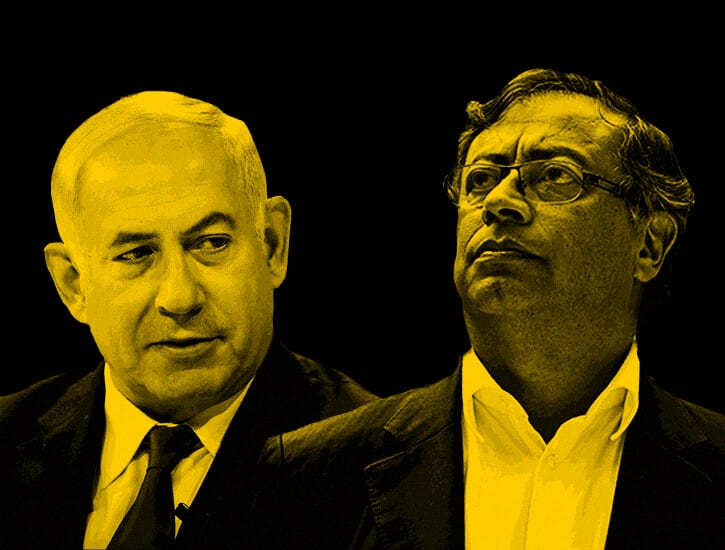
In May 2024, Petro broke diplomatic relations with Israel over the Gaza genocide; in October 2025, he expelled all remaining Israeli diplomats from Colombia and cancelled the two countries’ free trade agreement following the Israeli attack on the Global Sumud Flotilla endeavoring to deliver aid to Gaza. Petro’s response on X to the visa revocation was: “No me importa.”
It might be hard to imagine that Colombia and Israel were, not too long ago, two bellicose peas in pod—the days when Colombia proudly self-identified as “the Israel of Latin America,” as former Colombian President Juan Manuel Santos told Haaretz during his visit to Jerusalem in 2013. The moniker was incidentally coined by the late Hugo Chávez of Venezuela, who obviously did not intend it as a positive thing, and who delivered the comparison in reference to an illegal and deadly Colombian military raid into Ecuador in 2008 in pursuit of “terrorists” belonging to the leftist Revolutionary Armed Forces of Colombia (FARC). But Santos said he took the appraisal as a “compliment.”
Indeed, the old terror-fighting alibi has been relentlessly present over the years in the lethal exploits of both Israel and its appointed Latin American counterpart, both in terms of racking up American funds and in writing off the mass slaughter of civilians—who, if not cast as terrorists themselves, are unavoidable collateral damage for which their killers are not responsible. In the case of Israel, the “terrorists” are Palestinians resisting Israel’s usurpation of their land in 1948 and the ensuing nearly eight decades of ethnic cleansing and massacres, culminating in the apocalyptic Israeli onslaught in Gaza that was facilitated by a surge in U.S. aid and weaponry.
Not too long ago, Colombia proudly self-identified as “the Israel of Latin America.”
In the Colombian context, the “terrorist” role has most prominently been occupied by the FARC, the guerrilla movement that arose in the 1960s as a result of ferocious domestic inequality. But the label can also be liberally applied to social justice activists, trade unionists, campesinos who inhabit resource-rich territory, and anyone else who stands in the way of right-wing designs. During the two-term reign of U.S. buddy Álvaro Uribe, who governed from 2002 to 2010, potentially more than ten thousand civilians were murdered by members of the Colombian army, who passed the corpses off as guerrillas in exchange for bonus pay, vacation time, and other perks—while the government invoked the alleged counterterror success streak to appeal for yet more American financial assistance. The gruesome episode came to be known as the “false positives” scandal. From 2006 to 2009, Uribe’s defense minister was none other than impending president and Israel fanboy Juan Manuel Santos.
Colombia has the benefit of being on the front lines of the eternal U.S. “war on drugs,” which has translated into gobs more money for successive Colombian administrations and abusive state security forces. This, however, is a war that is engineered not to be won. In their 2011 book Cocaine, Death Squads, and the War on Terror: U.S. Imperialism and Class Struggle in Colombia, scholars Oliver Villar and Drew Cottle observe that the “cocaine decade” of the 1980s—the glory days of the Medellín cartel’s Pablo Escobar—“saw the consolidation of the Colombian drug trade as a source of profit for U.S. capital via banks that were established to launder and invest drug money in legitimate U.S. corporations.” So while the United States maintained that it was “at war with drugs and terrorists” in Colombia, in actuality “the economic relations between U.S. imperialism and the Colombian narco-bourgeoisie permitted cocaine production to flourish . . . and the cocaine market to expand within the United States and Western Europe.”
In 2000, the latest escalation of the Colombian drug problem was unleashed in the form of Plan Colombia—America’s turn-of-the-century militarized non-solution to narco-trafficking under the veneer of “development”—swiftly propelling the South American nation to the position of third-largest recipient of U.S. aid in the world (after Egypt and, of course, in the top spot, Israel). A 2003 NBC News article headlined “‘Plan Colombia’ Gets Expensive” reminded readers that Colombia’s conflict had been “shaped” by left-wing guerrillas “battling the government, which has been often supported by right-wing paramilitaries, known as the AUC”: the Autodefensas Unidas de Colombia, or United Self-Defense Forces of Colombia, responsible for a litany of massacres and wanton human rights abuses.
And this is where hypocrisy soared to new heights—and where Chávez’s future comparison to Israel preemptively rang true. It so happens that the AUC was designated as a Foreign Terrorist Organization in 2001 by the United States, meaning that the U.S. government was knowingly flooding with funds a Colombian administration engaged in active collaboration with folks the United States considered terrorists. And what do you know: Carlos Castaño, who cofounded the AUC in 1997, got the whole “autodefensa” idea from Israel! In his biography Mi Confesión, Castaño himself boasted of having copied “the autodefensa concept . . . from the Israelites [sic],” marveling at the fact that “every citizen of that nation is a potential militant.” After all, there is no one better than the Israelis at casting maniacal slaughter as self-defense. They are also pretty good at forcibly displacing people en masse, another of the AUC’s functions.
Castaño studied and trained in Israel in the early 1980s and was more or less obsessed with the country, describing its history as “deliciosa” and citing the late Israeli Prime Minister Golda Meir—source of the idea that there’s no such thing as Palestinians—as one of the two best women ever, alongside his own mother. In Colombia Castaño also trained with Yair Klein, who appeared on a 1991 United States Defense Intelligence Agency (DIA) report listing the “more important Colombian narco-terrorists contracted by the Colombian narcotic cartels for security, transportation, distribution, collection and enforcement of narcotics operations in both the U.S. and Colombia.” In the report Klein was described as a “retired Israeli army colonel, mercenary and expert in military tactics,” who had supplied “advisors to the Medellín cartel to train the cartel paramilitary forces and selected assassin team leaders on how to unleash waves of terrorism in Colombia.” A 1990 Washington Post article similarly mentioned that Israeli mercenaries had undertaken during the previous decade to “train and arm assassins” for José Gonzalo Rodríguez Gacha, a leading figure in the Medellín cartel and an “extreme rightist who harbored the dream of building a neo-fascist state.”
Two people down from Klein on the DIA list was then-Senator Álvaro Uribe, Washington’s future ally in the war on drugs, whose bio cast him as a “close personal friend of Pablo Escobar” and someone who was “dedicated to collaboration with the Medellín cartel at high government levels.” Fast forward two decades, and Uribe followed up his blood-soaked presidency with both a scholarly stint at Georgetown University and a post as vice chairman of the UN Panel of Inquiry into the deadly May 2010 Israeli attack on humanitarian activists on board the Gaza-bound Mavi Marmara flotilla. Clearly, this was just the job for a man convinced that human rights organizations are terrorist sympathizers, and the panel determined that Israel’s illegal naval blockade of the Gaza Strip was downright legit.
For its part, the AUC officially demobilized during Uribe’s presidency, meaning it simply morphed into other paramilitary formations that continued to terrorize various sectors of the country. Carlos Castaño’s brother Vicente would go on, along with other former AUC commanders, to found what would become the Clan del Golfo, a neo-paramilitary outfit that is currently Colombia’s reigning drug trafficking organization and that also goes by a million other names, including the Autodefensas Gaitanistas de Colombia (Gaitanista Self-Defense Forces of Colombia)—a nod to the old Israeli lexicon.
Of course, it’s not just the paramilitary legacy, or the shared reliance on U.S. backing for the widespread commission of atrocities that has historically defined the Colombian-Israeli bond. As the InSight Crime website notes, the “security relationship” between the two countries “stretches back decades to when Colombian armed forces began purchasing weapons from Israel in the 1980s”—although things really started ramping up in first decade of this century. The author goes on to observe that the “partnership strengthened considerably in the 2010s when Israel’s Prime Minister Benjamin Netanyahu visited Colombia for the first time, and Israeli soldiers trained Colombian counterparts” to combat the FARC. (The bulk of the article deals with other kinds of Israeli contributions to the Colombian landscape—namely the proliferation of Israeli criminal gangs operating drug and prostitution rings.)
In Cocaine, Death Squads, and the War on Terror, Villar and Cottle pinpoint 2008 as the year that Israel became a “large supplier of military aid and technology” to Colombia. In addition to being the very year the so-called false positives scandal broke, 2008 was also the year of Chávez’s mocking analogy that was subsequently so magnanimously embraced by Santos. He was such a fan of the comparison that after assuming the Colombian presidency he appeared on an Israeli television program to declare: “We’ve even been accused of being the Israelites [sic] of Latin America, which makes me personally very proud.” Not only that, but he starred in a promotional video for a firm run by the retired Israeli general Israel Ziv, who had detected lucrative opportunities for security consulting and military training in Latin America and Africa after leaving his job as the head of operations for the Israeli army’s general staff.
But while the gringos had been more than happy to allow the Israelis to help with dirty work in Latin America during the Cold War, the United States suddenly panicked over Ziv’s territorial encroachment. A December 2009 WikiLeaks cable from the U.S. embassy in Bogotá complained that, over a period of three years, Ziv had “worked his way into the confidence of former Defense Minister Santos by promising a cheaper version” of United States government assistance “without our strings attached” through Global CST, Ziv’s security consulting firm. What’s more, Global CST “had no Latin American experience and . . . its proposals seem designed more to support Israeli equipment and services sales than to meet in-country needs.” No kidding.
Israeli mercenaries trained and armed assassins for an “extreme rightist who harbored the dream of building a neo-fascist state.”
In the end, Santos’s enthusiasm for all things “Israelite” diminished somewhat over the years, and in the final days of his presidency in 2018 Colombia recognized Palestine as a sovereign state—though to this day Santos maintains that “Israeli security must be a priority in any long-term solution” and that “recognition of the State of Palestine does not imply in any way a lack of concern for Israeli security.” In 2020, the ex-president penned an opinion piece for Haaretz in which he expressed concern “as a friend of Israel” that the vision of the country’s founders was “under attack from a hyper-nationalist government that openly scorns human rights and international law.” Santos’s far-right successor Iván Duque did not share this opinion, and that same year he and Netanyahu celebrated the launch of their bilateral free trade agreement, with the Israeli premier congratulating his Colombian counterpart: “Iván, your leadership in the fight against terrorism sets an example for the rest of Latin America.”
Given that we’ve now seen quite clearly what Netanyahu’s version of the “fight against terrorism” entails, it’s unsurprising to learn that Duque’s presidency was accompanied by a surge in massacres in the country. As of 2018, Israel was the second-largest arms supplier to the Colombian military after the United States. Shortly after the launch of the genocide in October 2023, the Netanyahu administration suspended security exports to Colombia over remarks by President Petro accusing the Israeli military of terrorism and Nazi-like behavior. Then in February 2024, Petro halted arms imports from Israel following the “flour massacre” near Gaza City in which at least 112 Palestinians were killed and more than 750 wounded while waiting for food aid. While the newly visa-less Petro may have just thrown a wrench in the works, this doesn’t change the fact that the Israeli arms industry continued to make a killing globally while simultaneously waging genocide in Gaza.
Now, Colombia has unveiled its very own domestically produced military rifle (named Miranda after the proto-Bolivarian revolutionary) to wean the armed forces off decades-long dependence on the Israeli Galil. Adding to the strife between Colombia and her former BFFs, Petro also halted arms purchases from the United States in September after Trump decertified Colombia as a drug war partner for the first time since 1997. Earlier this month, Trump took it upon himself to conduct massive illegal airstrikes on Venezuela, Colombia’s neighbor to the east, and abduct the country’s president Nicolás Maduro under the pretense of combating drug trafficking, while raising the possibility of a military operation against Colombia: “It sounds good to me.” Never one to miss an opportunity for ludicrous and bald-faced lies, Trump also announced that Petro was a “sick man who likes making cocaine and selling it to the United States,” adding that “he’s not going to be doing it for very long.”
Days before their recent détente, Petro declared that any attempt to arrest him would “unleash the people’s jaguar,” building on his previous accusation that Washington is endeavoring to install a “puppet president” in Colombia. But puppetry can be profitable, and a Colombian presidential election is coming up in May, giving Washington plenty of time to work its imperial magic. In the meantime, Israel continues to massacre Palestinians in Gaza despite the ostensible ceasefire, the United States has declared war on its own cities—and it’s far from a long shot to speculate that the old gringo-powered Colombo-Israeli special relationship may be back in business soon enough.