, February 26, 2026
Minnesota Nice
Resisting ICE in the Twin Cities
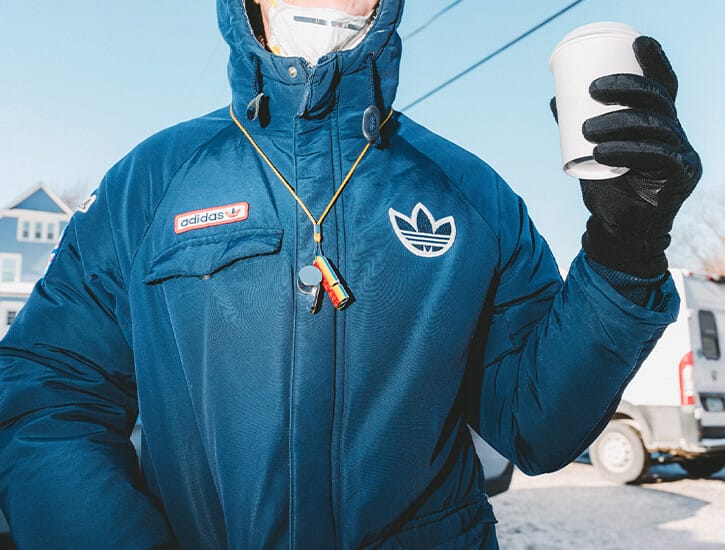
I woke to the whistles. I was staying at a friend’s house in South Minneapolis, half a mile north of where Renee Good was murdered in January, and a short drive from where I grew up in the Western suburbs. Now I live in Brooklyn, and my sleep-addled mind, accustomed to city noise, started to drift off when my host knocked on the door: ICE was in the back alley.
When I stumbled onto the street, I was greeted by around ten observers, including all of the members of the house where I was staying and their partners; a couple of self-identified moms; a twenty-year-old woman with a Keffiyeh pulled up over her nose; and the Minnesota classic: a man in a puffer jacket and basketball shorts, knees turning red in the sub-ten-degree weather. The agents had already peeled off down Chicago Avenue.
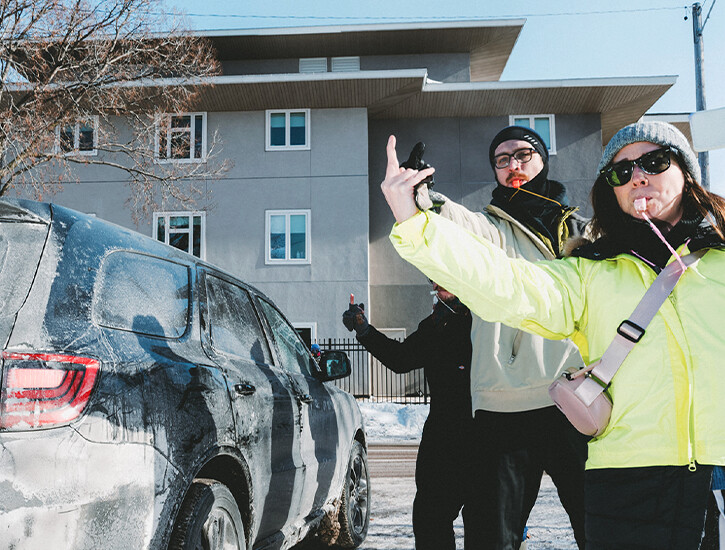
No one was taken. ICE had been harassing an observer, one woman told me. We waited another twenty minutes, watching cars as they passed, in the event the agents returned. Everyone exchanged tips: cover your eyebrows as well as your nose to evade facial recognition technology, maybe you should put on some pants. Everyone offered each other coffee. An older couple stopped to ask which way the agents went. A police officer in an unmarked SUV drove by and rolled down his window. “It’s just me, St. Paul Police,” he said. “We don’t like you either!” a friend replied.
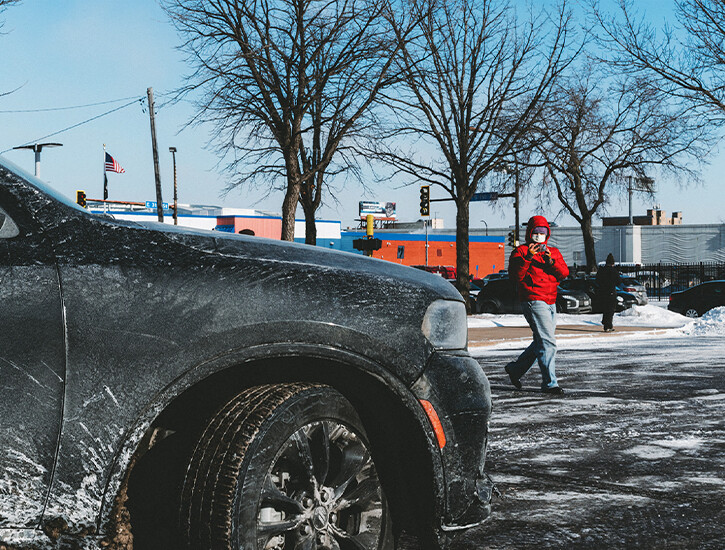
I was struck by how routine it all felt. Operation Metro Surge, the Trump administration’s “immigration enforcement” operation targeting the Twin Cities, had been in effect since the beginning of December, and residents seemed to have their response down to a science: Check cars for tinted windows or out-of-state plates; check the driver for balaclavas and tactical gear. If ICE is suspected, honk or blow whistles; if you hear honks or whistles, go outside as fast as you can. The cautious and the confrontational alike don gas masks and goggles; many wear at least some kind of face covering. Some yell at officers, some film, some stand silently and observe; if someone is taken, observers do their best to get a phone or car keys, a name of who to contact. Once the threat has passed, check in with other observers and return, as best you can, to your day.
That resistance to ICE has become routine makes it no less remarkable, or dangerous.
Minneapolis has become a symbol of the American authoritarian crisis: for months, images and videos circulated on social media and cable news of masked men storming restaurants and laundromats, teargassing peaceful protesters, grabbing civilians off the street and vanishing them into unmarked cars. Politicians on both sides of the aisle leveraged scenes from this “siege of an American city” to advance their own narrative. Minneapolis Mayor Jacob Frey decried a “terrifying line . . . being crossed” and appeared on The Daily Show to applaud the “incredible patriotic acts” of his constituents while vamping for the camera. Senator Amy Klobuchar used the crisis as a springboard for the launch of her gubernatorial campaign, condemning the Trump administration for “relish[ing] division.” The White House, meanwhile, branded peaceful protesters as “domestic terrorists” and repurposed videos of brutal detainment for “wartime recruitment” campaigns, part of a hundred-million-dollar initiative to build ICE’s ranks.
There was something fantastical about it, a new American allegory of good versus evil playing out on the streets of the Twin Cities—with party affiliation determining who you were rooting for. Masked ICE agents were either the gestapo or brave crusaders; Border Patrol commander Greg Bovino was either reminiscent of Winston Churchill or Adolf Hitler; the people of Minnesota were either community protectors or outside agitators; and Alex Pretti and Renee Good were either violent criminals or martyrs for a just cause.
When the killing of Good garnered international attention in early January, ICE had already been brutalizing and kidnapping civilians in Minneapolis for weeks. By the time I arrived in late January, almost two months of tumult had passed, and thousands had been detained. Friends and strangers told me stories of regular violence: agents detaining observers and driving them around for hours; Somali elders being abducted off the street; friends leaving ICE confrontations with broken shoulders; friends’ family members missing. Many immigrants and residents of color had gone into hiding: people were skipping errands, relying on others to bring them food and other household necessities; students were missing from school; one ER doctor told me that the hospital was barren, as fewer people were coming in unless they were seriously ill.
Yet unlike in the wake of the murder of George Floyd in 2020, when protests ground the city to a near halt, day-to-day life carried on for many. Many schools and workplaces remained open. Restaurants and cafés that I visited were full. Some immigrant-run businesses were shuttered, and a few others shifted their operations, like Modern Times Café, which had gone donation-based as a tax protest, and Pow Wow Grounds, which has served as a hub for patrollers—but most businesses limited themselves to a sign in the window and offering whistles at the checkout. In some predominantly white neighborhoods, you wouldn’t have known anything was out of the ordinary at all, save for the occasional graffiti and printouts on doors denying entry to federal agents. It is not new that some, by virtue of race and ethnicity, can live peaceful lives while others suffer inordinately at the hands of the state—it’s a feature of American immigration policy.
Amid the redoubts of normality, a wide network of organized resistance and mutual aid had sprung up.
But amid the redoubts of normality, a wide network of organized resistance and mutual aid had sprung up. The Minneapolis-St. Paul metro area has a population of about three million. Immigrants comprise a fraction of this figure—about 10 percent—but it’s as if the entire city had mobilized in their defense. Tens of thousands of people and over seven hundred businesses participated in the January general strikes. Over thirty-thousand people have participated in Immigration Defense Network ICE watch trainings, and patrol signal chats ballooned to the thousands. And those are just the people confronting ICE publicly, as opposed to those participating in underground mutual aid operations. I asked one activist how many people he knew who were helping out in some way, and he replied, “Well, everybody.”
The city boasts a long history of community aid work, spanning the political spectrum from hyper-involved church groups to anarcho-communist networks, but rarely have these groups been so unified in their goals. Tactics developed by the Black Panthers and the American Indian Movement to protect their respective communities went mainstream: My friends’ moms’ Bible study group became a school patrol, walking kids to the bus to prevent any kidnappings en route; line cooks started driving their coworkers to and from shifts; local churches became food packaging sites; Indigenous groups started patrolling to protect their community from racial profiling, some coming in from Wisconsin and South Dakota to help.
I did ICE watch shifts with communists, university lecturers, public school teachers, library workers, ER doctors. At protests, I saw teenagers in ski masks next to retirees screaming at ICE. I met James, the self-appointed security guard of Good’s memorial, who told me that it was his duty as a veteran to protect and serve and by monitoring the memorial he was following his oath. I saw punks throwing footballs over homemade ICE watch filter blockades. A woman who’d just had knee surgery told me she felt bad that “all she could do” was send money to immigrant defense funds and mutual aid groups. At the Whipple federal building, the center of ICE operations in Minnesota, I met an older woman in a hot pink hat and matching hot pink lipstick who lifted her ski goggles to reveal frost-bitten eyelids. She’d been coming out to observe agents for twelve days straight.
This is what distinguishes what’s been unfolding in Minneapolis from most mass anti-authoritarian movements of the past decade. In recent American history, organizing has often been conflated with protest—marching, posting on Instagram, calling your senators. But in Minneapolis, a vast network of resistance has formed by leveraging the skills, the care, and the sheer numbers of the community not simply to protest but often to slow or prevent ICE’s operations entirely.
On a Saturday evening in January, I paid a visit to Alex Pretti’s memorial, which rests on a busy stretch of restaurants in the heart of the city affectionately known as Eat Street, where restaurants serve Greek food, ramen, jerk chicken. But where Pretti was shot, the sidewalk was cordoned off with orange tape, protecting a memorial from oncoming traffic. There were roses on the ground and candles, incense burning, stuffed animals, American flags, and signs, some more hastily made than others: “Nurses Protect Life,” “The kids of Whittier send love.” Above the offerings, a six-foot banner stretched between a lamp post and a nearby tree: “Rest in Power Alex: Any Righteous Person Would Have Done the Same.”
Local activist Cortez Rice, warding off the cold with just a pair of gloves and a sweatshirt that read “Always Film The Police,” was speaking to a small crowd about legacies of violence—his son was killed in a shooting at age fifteen. The audience was mostly older, but all ages were represented: kids, the elderly, young-ish people, like me, who stopped as they wandered by on their way to or from dinner. When my fingers got numb, I ducked into a clothing resale store across the street that had transitioned into a warming site for mourners. Supplies lined the wall—first aid materials, granola bars, handwarmers, and water, as well as gas masks, ski goggles, and, as everywhere, whistles. On the ground sat a bin of fresh-cut flowers, donated by a woman named Miss Bertha, to be placed across the street at the memorial.
This was typical across the city. Everywhere I went, tools for protest signs, tools for survival, and tools for confrontations with ICE were available. Life carried on, but there were reminders of the crisis everywhere: anti-ICE graffiti on park benches and billboards, “know your rights” flyers in public bathrooms. The tools for direct action had become integrated into everyday life, and people were using them. Whistles, the hallmark of ICE resistance, were as common to carry as housekeys. I saw whistles for sale at coffee shops, whistles handed out at memorial sites, whistles made by 3D printers and whistles shaped like loons and whistles in iridescent purples. Almost everyone now has them, and the whistles work: despite the seeming irrationality of masked agents equipped with lethal and less-lethal munitions fearing what one friend described as “moms and trans people with whistles,” residents have found that drawing mass attention to ICE agents does often deter them from their mission and at the very least lets vulnerable populations know to avoid the area.
Many see the sacrifices they’re making for the sake of their immigrant neighbors as the only reasonable choice.
The scale of the resistance has been astonishing, but many see the sacrifices they’re making for the sake of their immigrant neighbors as the only reasonable choice. One night in early February, I visited the apartment of Sunny, a university lecturer and activist who had been conducting ICE watches in her neighborhood since early December. Her home had become something of a waystation and lending library for supplies, and upon my arrival the entryway was full of boxes. We busied ourselves opening them and sorting the contents, building a pile of respirators, a pile of ski goggles, a pile of handwarmers. There were less obvious supplies too—staplers, masking tape, dash cams, megaphones. Some boxes came with notes from across the country: “Thank you for all you are doing to fight back against injustice. I am thinking of you all and praying for your safety,” wrote one donor from Atlanta. “Stay safe and get those mfers out!” wrote another.
I told her that I was amazed at the network of involvement, and she agreed. “I think it’s a really culturally resonant message for Minnesotans. . . . This is actually just about us protecting our neighbors. . . . And I think people are so hungry to do something that matters.”
Sunny’s apartment is a few blocks out from where Alex Pretti was murdered, and she and her partner responded to the same call Alex had been answering when he was killed. They arrived at the scene not long after the shooting. I mentioned the banner hanging at the memorial, and in one of those beautiful synchronicities that characterizes life in a mid-size city, it turned out she had made it. “It’s really hard to parse through, because he was doing the most heroic thing you could do, right? He’s trying to help a woman up, he’s refusing, he’s filming. And they’re trying to beat the shit out of him and attack him, and it’s his instinct in that moment to help somebody else.” she told me. “And it’s crazy to watch, but the other part of it is . . . I think any of us would have done that.”
Indeed, most of the people I met were not lifelong activists, were not uniquely equipped to fight an armed and masked militia operating in flagrant violation of the law; they were regular people who were incorporating resistance into their day-to-day lives. Friends were using birding binoculars to surveil mysterious SUVs, mental health workers were learning makes and models of cars, schoolteachers were using wood pallets to build blockades. For the most part, the people involved are neither dangerous agitators nor holy figures—they’re just normal people, doing the work in front of them.
But fascism thrives on distraction and division, and in the public narrative, the story appears to have drawn to a close. Earlier this month, in the wake of public opinion shifting decisively against the administration’s crackdown, border czar Tom Homan announced the withdrawal of seven hundred ICE agents from the Twin Cities; about a week later, he declared an “end” to Operation Metro Surge. Public attention moved on to the latest tranche of Epstein files, the Olympics, Trump’s tariff policies, the State of the Union.
But the raids haven’t stopped and nor has the resistance. The day the supposed drawdown was announced, a friend and I went for a uniquely slow patrol. The next day, we woke up to a video of ICE breaking in a glass door to an apartment building on East Franklin Avenue and detaining a resident inside. Despite the announced end of the surge, ICE operations have continued in the cities and surrounding suburbs; per the ACLU, just shy of one thousand agents remain in the Twin Cities as of late February. But they’re moving with less flair—some report that agents have started dressing in plainclothes rather than their camouflage fatigues, conducting abductions early in the morning when there are fewer observers, sometimes disguising themselves as mutual aid workers or neighbors with broken-down cars. The community ethos that has protected the city is now being leveraged to harm it.
And meanwhile, ICE is expanding their operations to other cities, taking with them a key lesson from Minnesota: move quietly. As the residents of Minneapolis have proven, drawing attention to injustice is only half the battle—it takes a mass of righteous people putting in the work to create real change.