, December 3, 2025
I Love Rent
Chris Kraus and the aesthetics of the landlord
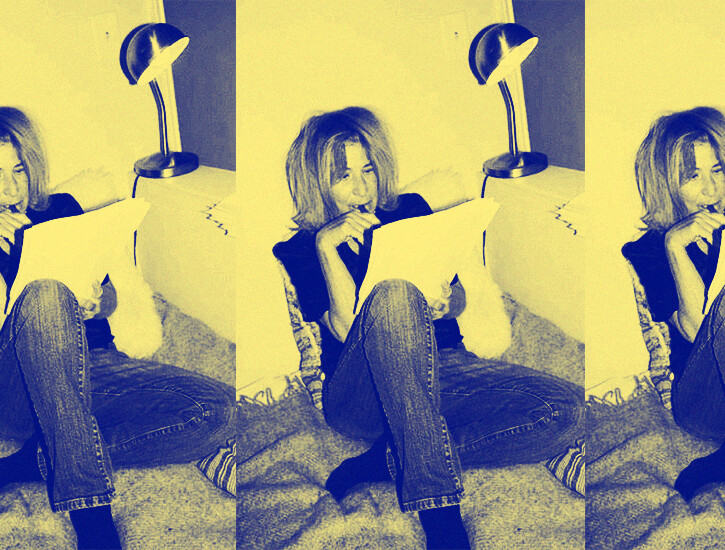
Chris Kraus, landlord. | Wikimedia Commons/The Baffler

The Four Spent the Day Together by Chris Kraus. Scribner, 320 pages. 2025.
Pour one out for the landlords: they used to own the novel too. In the nineteenth century, this was taken as a matter of course, as fiction was written by and for owners of capital. What would Tolstoy be without the urge to commune with the humble peasant’s soul? Even authors who were not themselves landlords assumed the perspective—George Eliot’s Middlemarch is, among other things, the story of a half-dozen landowning families whose lives become entangled. Dorothea Brooke’s uncle and guardian Mr. Brooke is said to be well-meaning but stingy when it comes to repairs for his tenants. “I am fond of knowing something about the people I live among,” says Dorothea, vaguely eager to help them improve their pathetic little lives. Still, this can only be a moment of character-shading for our hero, something for readers to absorb and forget as the affairs of the heart unspool.
Times have changed. Today what vital literary culture remains is kept afloat by the downwardly mobile, those in it either for the love of the game or because they can’t think of something better to do. Although the old hierarchies still exert force, margin and center blur. The novelist, critic, and editor Chris Kraus always considered herself one of the outsiders, “a lost and gauche New Zealander” adrift in New York’s downtown scene, first as a failed actor, then as a failed filmmaker, then as sidekick spouse to Sylvère Lotringer—an older professor and founder of the crucial independent press Semiotext(e)—who hobnobbed with the French intellectual elite while she sat by, brooding. Topless dancing had supported Kraus in the early, lean years, as her creative pursuits sputtered; marriage offered new stability but also a new terrain of resentment. Entering her forties, she felt she had little to show for herself.
Creative breakthrough came by purging these feelings of inferiority. 1997’s I Love Dick, Kraus’s first and still most famous novel, was an outpouring of Kraus’s insecurities, molding them into a singular new work. The book’s mostly autofictional, epistolary form traces Kraus’s desperate obsession with the cultural theorist Dick Hebdige, though it contains other things: a study of a perverse marriage, essays on artists Kraus admires, sketchy thoughts on the political situation in Guatemala. I Love Dick was also a confession of the grim side of the academic-literary grift and the indignities necessary to sustain oneself in it. Of course, not all indignities are created alike. In Dick, the Kraus character’s main income source is collecting renting from her multiple properties. From the beginning, this was a central detail of her personal account of precariat life: renting out your East Village apartment and East Hampton house (what, you don’t have one of those?) to scrape by in exile upstate, alongside the supplemental catalog essays and stipends. Kraus was an Airbnb hustler before her time, and it’s a strength of the novel that it doesn’t censor the hustle’s sour notes, as when she grumbles to herself about a house “trashed by a family of deadbeat hicks who they’d evicted before Christmas.”
It’s easy to argue that each novel of Kraus’s has been worse than the previous. It’s easy because it’s true.
At the time, these details went under the radar—there were too few readers at first, and they were largely drawn to the sex and controversy. Hebdige threatened to sue, and reviewers were dismissive of what they perceived as lightweight, gossipy transparency. But I Love Dick has stood the test of time: it is one of the great novels of the twenty-first century (even if published in the twentieth), anticipating and influencing a huge swath of contemporary fiction that has now become more familiar, and also more banal, to us. We’re inured to, perhaps even bored by, fiction comprised of life’s petty defeats in the workplace or in the author’s love life, all ripped from the personal front pages.
I Love Dick offered new ideas about how to disturb truth and fiction, both formally in its mix of confessional letters and essays, and simply in how much personal risk it was willing to take to make people uncomfortable (it’s still difficult to read someone so thoroughly embarrassing herself for a doomed passion). Few of its successors read with such raw intensity of need. Over the next two decades, Kraus’s star rose slowly along with a growing understanding of the novel’s importance. A younger, millennial audience picked it up and saw something of themselves in it: overeducated, underemployed, left-ish, and aspirational, a legion of would-be artists in a world that wouldn’t take them as seriously as they wished. Nor did it hurt that Dick became a literary meme—that famous white-and-green cover became a cliché accessory for literary and art-world knowingness. It often feels like a book more invoked than really read, a citation for smart-presenting but functionally illiterate people.
If your subject is failure, you’re more vulnerable to becoming a victim of success. Kraus as an “economic” writer peaked in her fourth novel, Summer of Hate, which was received in 2012 with far less enthusiasm. Christine Smallwood, writing in Bookforum, judged that “Kraus talks about other stories, but she can’t tell them. Demanding recognition, her novels do not recognize anything outside her own mind.” At the same time, the material operation has expanded: a large portion of the novel chronicles the Kraus-narrator (now “Catt Dunlop,” later to be “Catt Greene”) and her difficulties in buying, renovating, and running thirty-six rental units in Albuquerque.
A bit of Baudrillardian mumbo jumbo is used to justify this course of events: “Money was an abstraction. A child of the deconstructionist ‘80s, Catt’s guiding belief was in chance, process, and flux. Once set into motion, the game played itself.” Sure. Now a classic “mom-and-pop” landlord, Kraus/Catt rails against those who would rip her off: bad tenants, lazy property managers (with the half exception of Paul, an ex-convict she hires and then falls in love with), an assistant who steals from her. Occasionally Kraus makes a meager attempt to wedge in some right-thinking left politics, as when the narrator finds herself musing that “the idea of people working together, whether on a film set or construction job site, was in some way utopian.” Maybe you’ve been in a utopian boss-employee relationship, but I can’t speak to it (maybe you were the boss). Readers, who are more likely to be the tenants than ever, found themselves at a distance from this blithe entrepreneurial spirit.
After more than a decade, Kraus has returned with a new novel, The Four Spent the Day Together, which is essentially a sequel to Summer of Hate, continuing Catt’s story as she steps into a new period of fame (the 2016 launch of the Amazon series of I Love Dick figures prominently in the narrative) and personal turmoil. As the newly famous often do, she struggles with a sharpened sense of how others see her. At one point, Catt reflects on Summer of Hate’s dismal reception:
Summer of Hate, about meeting Paul and renovating the Albuquerque apartments, seemed totally damning. Accompanied by various interviews where she’d talked freely about how she made a living—a political act, she believed, given that all but the most commercially successful artists enjoyed invisible means of support—the novel became Exhibit A in their case. Observations she’d made concerning money and class, culture and race, were ridiculed. She struggled to understand where her critics were coming from. Were they opposed to all rental housing? Should it be run by the state? Did they believe that the buildings maintained themselves? Sometimes the tweets had a point, but most had no point at all beyond mindless hatred.
Kraus’s work is nothing if not self-reflexive, and its play of irony has always allowed plausible deniability between author and character. But this note of self-defense strikes a new tone, perhaps similar to a reckoning later in one’s career with a life’s work. What was all this wheeling and dealing for if not to write the books?
It’s easy to argue that each novel of Kraus’s has been worse than the previous. It’s easy because it’s true. I Love Dick remains Kraus’s most accomplished work, and it still crackles with deranged desire. 2000’s Aliens & Anorexia is full of ideas, if also overburdened by ambition and intertext, jamming together a portrait of Simone Weil, adventures in BDSM, and the adapted screenplay of one of Kraus’s failed films. Torpor tested the waters of a more conventional fictional narrative in 2006, as Kraus-and-Lotringer proxies drove through Romania on a quixotic mission to adopt a child in the post-Iron Curtain 1990s. These novels have their flaws, but all three are worth reading—they give ugly feelings a strong voice and a coherent vehicle.
Summer of Hate marked a turn. Maybe Kraus had lost the intellectual plot, maybe she had just run out of ideas. This is the cruel logic of life-writing: if your life becomes less interesting, usually your work does too. But beyond this, as I read chronologically toward The Four Spent the Day Together, I had the sense that over time Kraus’s fiction had also become gradually but fundamentally more conventional. Pseudonyms were adopted, the past tense activated, and the intelligence of Kraus’s essayism slunk offstage. On the surface, The Four seems like something new, a blending of the now-familiar life writing with a foray into true crime. But without meaning to, Kraus has returned to the novel’s traditions.
The Four Spent the Day Together is divided into three drastically different sections, which might at first seem like a formal experiment. The first is a slow, labored remembrance of Catt’s childhood in Milford, Connecticut (where, of course, Kraus spent some time as a child). It recounts the meeting of Catt’s parents, thoughts on an isolated and frustrated life in the suburbs, the family’s struggles with Catt’s sister Carla and her developmental disability, and the growing pains of Catt’s adolescence. Stuffed with detail but with little direction, one wonders what all this backstory without a story is for. Toward the beginning of I Love Dick, Kraus makes an offhand remark that she and Sylvère are “militantly opposed to psychoanalysis,” the kind of defiant, ironic potshot that gives the novel its energy. But a recurring aside in Summer of Hate is that Catt, years removed from her youth, has repented and undergone analysis. It’s hard to see the opening section of The Four, strewn with unconnected stories of getting lost as a child or being bullied, as anything but the half-digested material of that process.
The most revealing relationship in the book is Catt’s relationship with her father Jasper, a frustrated autodidact who encourages her development as an intellectual, bringing home issues of Ramparts and The New York Review of Books to discuss in the evenings: “You have the potential, her father had said once, to be an original thinker. She treasured the thought.” Jasper is a warehouse manager at a publishing house, interested but never involved in the intellectual work—one sees here the origin of feeling on the outside, looking in. On the other hand, the quiet climax of this section is appropriately oedipal, when Jasper buys Catt lingerie for her thirteenth birthday (“She saw her mother’s jaw clench.”). This moment of sexual transgression is central but never developed, a narrative opportunity that seems to fail from a lack of will to elaborate. It marks a turn toward a new rebelliousness in Catt—vandalism, some teenage sexual escapades—though it’s hard to say it’s anything surprising, nor is any particular anecdote dwelled on or developed.
There’s an opportunity to say something about genre fiction and true crime, but I’m not sure The Four Spent the Day Together merits the analysis—except, perhaps, as a question of spectatorship and arrogation.
But narrative development has never been Kraus’s strong suit. All this psychological background is new for Kraus, but not for any regular reader of fiction. After all, this is the most traditional fictional use of childhood: to explain the motivations and behaviors of the present. Accordingly, in the second section we are transported to the 2010s. Greene and her soon-to-be husband Paul, a recovering alcoholic who has become a therapist, are at their summer home in rural Minnesota. They’re in a bad way: Paul’s alcoholism, a somewhat-entertaining train wreck in Summer of Hate, has returned with force. He’s also realized he doesn’t love Catt. Catt, for her part, is coming into fame but also finds herself isolated and addicted to the internet, “seething with rage at her quote-unquote friends’ Facebook humblebrags . . . It made no difference how transparently self-serving these posts were.” Setting aside the staleness of this belated gripe—others follow, including some limp thoughts on the election of Trump—it’s reflective of a new sedentary condition. Other than Paul’s descent into binge drinking, not much is going on in Catt’s world. She wonders, “Had she used up her life? She started to think she should write about somebody else’s.”
Summer of Hate had begun this shift to depicting other consciousnesses through Paul, who is the protagonist of a large portion of that novel’s narrative—the first time that Kraus had attempted to describe an interior life other than her own (maybe Lotringer’s letters in I Love Dick are the next closest thing). One flaw of The Four is that Paul is extremely boring. Although his relapse and his taking advantage of Catt are pitiable, they’re also textbook. The dance of self-awareness is always available, of course, but it offers little to think about the relationship in a more complex way. The Sylvère Lotringer figure, here named Mikal (he was Michel in Summer of Hate, but why expect consistency?) has largely exited Catt’s life, and he is missed. He wasn’t the reason the earlier novels succeeded, but he was surely a better foil and a more complex figure. With divorce closing in, this is the first Kraus novel with no real sexual desire. Though that needn’t be a prerequisite for anyone’s novels, it always helped Kraus’s that they were sexy too.
Toward the end of the second section, Catt reads in the local newspaper about a brutal murder that has occurred on a nearby rural Minnesota trail, drawn from a real case that occurred in 2019. Two teenagers and a twenty-year-old are accused of kidnapping and murdering a man they knew named Brandon Halbach. The ostensible motive of the murder was “unwanted sexual advances and inappropriate touching” of one of the accused, the girlfriend of another suspect. But the thinking of these young people, and their recourse to such brutality, is inscrutable to Kraus, and so for the reader too. Explanations are ventured: High on meth? Struggling under the soul-crushing anomie of hollowed-out, small-town America? Kraus becomes preoccupied with what the group did during the long period leading up to Halbach’s death, when he was in their company—hence the book’s title. Is this connected to anything that has come before in the novel? Not really, other than as an escape from a failing relationship and bitter fame, a project for Catt to throw herself into.
So the task becomes writing these other lives. Based on interviews with the real-life counterparts of the accused, as well as with others in the town, Kraus peeks into a world of poverty and despair. Foster children move between houses, the girls camgirl, the boys sell drugs. Kraus’s focal point is Brittney Moran, an independent, willful girl who is shamed and ostracized by the community. Some sympathy is evident here, and a murky parallel to the first section emerges—an accumulation of facts, but perhaps not much overarching vision to breathe life into it. A tacked-on appendix recreates the text messages sent between the young people, presumably a document lending another layer of verisimilitude. But the old question of blurring the boundary between truth and fiction never felt less powerful: Kraus has nothing to say about this community. Catt thinks to herself, “It was clearly a book that had to be written and if she didn’t write, who would? Researching the lives of these kids was a way to crack open the flat frozen landscape and understand what went on inside the trailers, the abandoned community centers, the old wood-frame mine houses.” Is this noble, or merely an alibi for letting the tape of her own mind run?
Sometimes it’s useful to make the obvious connection. Stitched together, the trouble lurking under the placidity of Catt’s Milford childhood and the gruesome murder in Minnesota recall the Garden City of Truman Capote’s In Cold Blood. What can Kraus add to the story Capote told more than half a century ago? Kraus is seeking a metaphorical link between the Minnesota youths involved in the murder and her own life; all are outsiders spit out by the system, just as Paul was for Catt. Capote used the techniques of fiction to blend and embellish, creating a seamless-seeming narrative that is always propulsive. It distorted the truth for our entertainment, something Kraus seems incapable of doing even if she wanted. There’s an opportunity to say something about genre fiction and true crime, but I’m not sure The Four merits the analysis—except, perhaps, as a question of spectatorship and arrogation. True crime is the transformation of the private into the public on its most base level; gristly murders committed in the home by private citizens take on a rubbernecking afterlife in the media. Melodrama cloaks itself in moral righteousness. Kraus may be trying to reflect the abjectness of this peculiar contemporary medium, but the result is merely to once again repackage the difficult material of life into easy spectatorship of violence—a curious case to titillate yourself with at your vacation house.
What are the aesthetics of the landlord? Tolstoy wrote universally because he felt himself to be a rightful possessor. But in the contemporary, the pleasures of ownership are more ambiguous, laced with the guilt of comparing privilege. Maybe this hints at a curious connection to autofiction, which often implies that one’s own experiences are all one can “own” in writing. Writing takes possession of things, either by consent or by force. Can you own Dick Hebdige’s experience? Or a Romanian family stringing you on about a potential adoption? A group of teens who committed a gruesome murder? Kraus seems to waver at this threshold, eager to incorporate experiences that are not her own, for variety’s sake, but unwilling or unable to transform them into something that is the fruit of her own labor.
More than ever, we live in Kraus’s world, even as we feel it exhausting itself.
At one point in Aliens & Anorexia, Lotringer asks Kraus why “would anyone with so little visual imagination as you ever want to be a filmmaker?” A feeling that one lacks imagination becomes the spur for appropriation. The “craft” aspects of traditional fiction share a relationship with cinematic effects: technique is used to create illusion, to give a sense of experience more distant from first-person immediacy. Although accomplished as an art writer who can describe static objects and survey the scene, Kraus is just less skilled than her contemporaries when it comes to creating the sense of “inhabiting” the narrative; it was precisely this realization that allowed her to make other discoveries.
But it also is also the landlord’s aesthetic to become preoccupied with who possesses what to begin with. (The tenant worries too, of course, but differently.) It’s somewhat amusing how frequently this landlord affinity seeps in in unexpected places for Kraus, even in her criticism. In an essay about video installation collected in Where Art Belongs, Kraus travels to Oaxaca, where a botanist she meets there “tells me the workers he hired spend 45 minutes to straighten a single bent nail.” No matter where we travel in Kraus’s mind, the Mexicans are lazy (the same essay goes on to praise American Apparel as an artwork “breathtakingly brilliant in scope” partly for the company’s use of undocumented migrant labor to preempt unionization). In The Four, a man Kraus calls Landlord Mark is a primary source for information on the murders.
Some of the most entertaining moments in The Four come in the middle section, as Catt defends herself from micro-cancellation over the landlord charges. There is an amusing set piece at a panel for Kathy Acker in which young woke poets turn on Catt when audience pressure mounts. She’s able to get some (perhaps easy) shots in against the identity language of the 2010s, and there’s a certain frisson of literary gossip; Kraus is happy to dig into the gritty details, right down to overheard remarks and the mean tweets of small-magazine editors. Still, is this the best we can do? Anecdotes drawn from the lit-world Twitter echo chamber? There’s something dispiriting that even the most self-proclaimed outsiders are subject to the blob aggregation of the online world. Fidelity to the reality effect in the current moment demands scrolling—because that’s what everyone is really doing. This is reposted content, another kind of passive income. More than ever, we live in Kraus’s world, even as we feel it exhausting itself.
Cyril Connolly wrote of Ernest Hemingway that his “tragedy as an artist is that he had not the versatility to run away from his imitators.” The traditional literary sphere, deprived of its vitality, now regularly leans on ideas Kraus popularized, particularly the invocation of the alternative networks of theory and the art world to add extra clout. Contrast the difference between Kraus’s perceptive essay on Paul Thek in Aliens & Anorexia—it recounts the artistic journey of a man who seemed to be “living through a time when you can do no wrong, where every move’s deliberate or hilarious, and everything you do is art”—with the typical faux-literary slop about a painter thinking mushy thoughts about creativity and the human spirit.
In the absence of a Lily Briscoe, I’ll take Kraus’s concreteness. Kraus’s novels expected their readers to be smart, to know or want to know about an intellectual scene and its inhabitants. She gave the readers information that they didn’t know, and this was a kind of surplus value above the mere technique of the novel. New works will continue to be written in Kraus’s mode; for would-be it-girls and downtown boys, the directness of personal reportage can still bring readers close to what they imagine real life is. But is it a home? Another month comes around, rent is due, and the bank account is running low. The real estate market is shrinking (perhaps held onto by absentee owners who see a good investment), while the Krausian maneuver surprises less and sells less too. Maybe her followers will turn to a nice conventional fiction, out in the suburbs, where they can own a little plot.