, March 17, 2026
Stop Building Now!
Rising home prices are not the result of scarcity
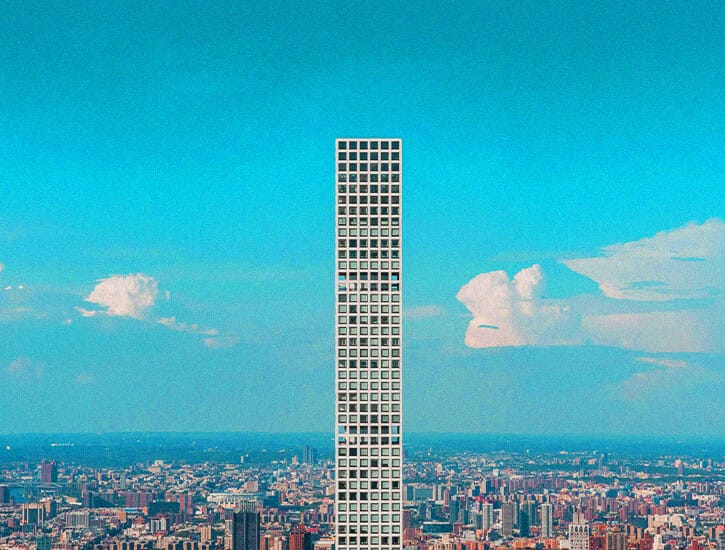
432 Park Avenue: a home not for people but for money! | Pexels
On August 17, 2023, Chinese property developer Evergrande filed for protection from its creditors under Chapter 15 of the U.S. Bankruptcy Code. A week later, Evergrande shares had plummeted by nearly 80 percent. A last attempt to hand over majority control to Chinese banks and impose losses on foreign creditors was rejected in favor of an overall winding down of the company. A court-ordered liquidation in Hong Kong eventually followed in January 2024, and all trading of stocks in the China Evergrande Group was halted. After twenty-eight years, the second-largest property developer in China at the time, and the largest in the world in 2018 with a value of over £50 billion, was no more.
Why has every major economic crisis of the twenty-first century started with real estate? The 2008 global financial crisis was the result of a housing bubble, as was the later Eurozone housing crisis, as is China’s current debt crisis marked by the fall of Evergrande. We are constructing more than any previous generation in history, only to discover that the line between our relentless urge to build and its total futility becomes ever finer. As more and more countries scramble to fund ambitious housing programs, the modernist idea of an affordable home for all seems further away than ever. In the decade prior to the fall of Evergrande, China built more homes than the United States did in the entire twentieth century. Many of them stand empty. Apart from the environmental cost, there is the cost to the plausibility of the system itself. As successive crises increasingly expose the true face of modern construction, fundamental questions arise about why we build in the first place. Are we trying to house people, or cash? The question touches the core of what architects do and why. If the legitimacy of a profession resides in the need for what it has to offer, then we will need architecture for as long as we need buildings. The question is: Do we?
At the time of its liquidation in 2024, Evergrande had 1,300 projects in more than 280 cities across China. With the accumulation of development sites came the accumulation of debt. This unfettered expansion regardless of escalating financial risks is less exceptional than one might assume. A Chinese property bubble had been growing steadily since 2005. After the fiscal reforms of the 1990s, local governments were forced to cover a substantial part of the expenditure on their allocated infrastructure development. The 2008 financial crisis only exacerbated this trend, with local governments being made responsible for 70 percent of the costs. As a result, they became ever more dependent on revenues from the land they owned. What followed was predictable: an indiscriminate selling of land-use rights to property developers.
The approach worked in part. By 2009, land values in China had tripled. Unfortunately, so had developer debts. By 2018, the central government had become so concerned that it announced it would not bail out creditors of bankrupt companies. This became official government policy in 2020, with Xi Jinping’s so-called “three red lines rule” which determined the permissible debt of developers according to three defining metrics: (1) their cash, (2) their equity and (3) their assets. After two decades of unfettered construction, the Chinese authorities had finally started to rein in the real estate market.
Evergrande was the first casualty. Just like Lehman Brothers in the United States, it was long believed that Evergrande was too big to fail. Just like Lehman Brothers, it crashed. It had crossed each of Xi’s three red lines, its fate an example of the newly enforced Chinese Communist Party creed that “property is to be lived in, not speculated on.”
Estimates of the number of empty homes in China vary. According to data from the country’s National Bureau of Statistics, at the end of August 2023 the combined floor area of unsold homes stood at 648 million square meters. Based on an average home size of 90 square meters, that would be equal to 7.2 million empty homes, roughly 17.5 percent of China’s total stock. According to Goldman Sachs, the vacancy rate for urban residential property in China is even higher at around 20 percent. And those numbers only include the number of homes left unsold; including homes sold but not lived in has led to the dazzling estimation that China’s empty stock could provide housing for over a billion people. As recently as September 2023, He Keng, a former deputy head of the National Bureau of Statistics, claimed that the total number of unfinished and finished-but-vacant apartment projects littered across China would be enough to accommodate in excess of the country’s population of 1.4 billion.
Housing shortages have been identified in practically every country of the world. But how real are they?
“Ghost towns” are no longer places once inhabited but now abandoned; in China, the image of the ghost town became equated with cities where inhabitation had never taken place. As a response to a perceived demographic need, the planning of residential quarters amounted to a preemptive strike against masses that never came. The result was a pyramid scheme, in which the provision of homes became synonymous with the incurring of debt, to be paid off only by building yet more homes.
In 2009, Al Jazeera reported on the Inner Mongolian city of Ordos Kangbashi. Following various economic setbacks, Ordos’s projected population of 1 million was successively scaled back to 500,000 and then 300,000 inhabitants. Of the apartments that were sold, few were lived in. Images of the city sent shockwaves around the world: stretches and stretches of shoulder-to-shoulder high-rise blocks, pristine but uninhabited, inserted into the landscape like a life-size model from the sales office.
Despite the lack of residents, the city went on to build prestigious projects such as the Ordos International Airport, the Ordos Museum, the Ordos Art Museum, the Ordos Library and the Ordos Sports Center Stadium, with a capacity for 60,000 (absent) spectators. The development even included a scheme by Herzog & de Meuron and Ai Weiwei for 100 villas designed by 100 international architects. Today, just five exist in various stages of completion or abandonment.
Melissa Chan, the Al Jazeera journalist who first reported on Ordos, was expelled from China in 2012. But reports on the city had sufficiently highlighted China’s vacancy rate for it to be officially recognized as a problem.
Recognition of the problem, however, hardly put an end to the practice itself. The main consequence was that Chinese developers started looking elsewhere. It was in Africa, with its massive demand for housing, that old ways found new fertile ground.
In 2008, a year before the Al Jazeera reports, Angola had launched an ambitious program to build a million homes in four years. Thanks to its oil exports, the country had been enjoying steady economic growth since the end of the civil war in 2002. A net oil importer since 1993, China had been eager to develop commercial relations with oil-rich countries. A win-win situation presented itself. Millions of internally displaced Angolans were offered the prospect of a decent home, while China was able to export its construction industry.
To help finance the program, a Chinese bank granted Angola an oil-backed loan worth around $6 billion. Work on the first of fifteen proposed new towns commenced in 2008: Nova Cidade do Kilamba, a city for half a million people, the largest new town in Africa. In 2012, shortly after completion, Nova Cidade do Kilamba made global headlines as the surreal backdrop for a BBC broadcast about an African city for half a million people that stood completely empty. In a country where two-thirds of the population live on less than two dollars a day, and with no mortgage system, apartments labeled as “social housing” costing between $120,000 and $200,000 seemed like a very bad joke.
The bulk of the apartments was eventually sold after Angola introduced a state-backed mortgage scheme, but most of them went to government employees or their friends, just as had happened earlier in Ordos. Other Angolan new towns have been completed meanwhile, further away from its capital, but it is unlikely, even for a country with a large bureaucratic apparatus like Angola, that all of them will be filled by government employees. With the current oil price at around half its 2008 value, neither the fate of Angola’s economy nor that of its ghost towns seems very hopeful.
Angola certainly isn’t alone in having a vast stock of empty homes owned by people who don’t need them and needed by people who can’t afford them. When it comes to the provision of housing, the same paradox exists all over the African continent, with or without Chinese participation. In cities such as Lagos and Abuja in Nigeria, another oil-rich country, the lack of occupancy is generously compensated for by the higher rents paid by absent corporate executives, expatriates or other high earners. Add the depreciation from wear and tear arising from short-term rents and vacancy begins to look like a sound business strategy.
In South Africa, housing construction reached an all-time high after a sudden dip in interest rates at the onset of the Covid-19 pandemic reduced monthly mortgage installments to the level of monthly rents. Two years later, a sharp rise in interest rates reversed the situation. The buyer’s market evaporated and the country was left with a surplus of newly constructed homes. Its vacancy rate rose from 5 to 11 percent.
In Kenya, what looked like a nationwide property boom helped create a mismatch between real estate prices and average wealth levels from which the country is still recovering. The problem is not limited to empty residential properties, but also affects office buildings and shopping malls, with certain units remaining empty for over three years and increasingly larger discounts having no effect whatsoever. Accra, Ghana, represents a yet more extreme case. The appreciation in value of properties in the wealthier parts of the city, often owned by diasporic Ghanaians, has been such that even the need to rent them out has become obsolete. Vacancy in itself serves as an investment. There are over a million vacant homes in Morocco, almost all of them in urban areas. The vast majority were constructed within the last five years, most of them apartments, closely followed by villas. Traditional Moroccan houses account for less than 4 percent of all vacancies. In Egypt, following an ambitious state-led push for affordable housing, official census data show that the total number of vacant housing units in the country has reached nearly 13 million units.
To regard these excessive vacancy rates exclusively as a product of China, or of China exporting its methods to Africa would, however, be misguided. In 2014, 11 million houses stood empty in Europe, of which 700,000 were in the UK, 1.8 million in Germany, 2 million in France, 2 million in Italy, 3.4 million in Spain and roughly another million each in Portugal, Greece and Ireland. In 2024 in the United States, 15 million homes were estimated to be vacant, a large share of which were second homes. In Buenos Aires in 2023, one-in-seven houses were empty as the country battled inflation, while 11 million houses were vacant in Brazil, of which 6.6 million were holiday homes.
Neither the recent fall of Evergrande nor the ongoing Chinese property crisis is an isolated phenomenon. Just as with the global financial crisis of 2008, they originate from the financialization of housing provision—a trend that has had consequences worldwide.
It can even be argued that the Chinese property crisis is a belated reaction to the crisis of 2008. There are certainly similarities. The 2008 crisis started in the United States as a mortgage crisis resulting from predatory lending to low-income homebuyers. Following government legislation encouraging the financing of affordable homes, banks came up with a plethora of financial products, so-called “subprime mortgages,” to target low-income homebuyers. The type of market that ensued, unattended by regulators, took the entire U.S. economy by surprise.
The Chinese property crisis unfolded roughly according to the same playbook: a government incentive to get the market to take over what had been a government task, followed by market forces going rampant, and finally the inevitable financial repercussions that come with a correction.
Owned but empty apartments have become an integral part of the fabric of any major city. Residences dark at night, ghost houses, sometimes entire quarters of them, can be found not just in China or Africa but throughout London, Paris, and New York. The proliferation of unoccupied residential space also covers the full array of building types, from perimeter blocks in Spain to suburban tract homes in Florida. The exemplary instance is the empty residential skyscraper. Rafael Viñoly’s 432 Park Avenue Tower is New York City’s best-selling building ever, yet few of its apartment owners choose to take up permanent residence, and some of them have never even visited the place. With no residents present, its interiors are on permanent display—a home not for people but for money. New York City, meanwhile, has the highest homelessness rate since the Great Depression.
Prior to 2008, the presence of empty properties could be put down to investment miscalculation. Now, real estate investment is in large part running on emptiness. Where vacancy used to be seen as a temporary condition that separated a building’s present from its future, it is now viewed as an investment in a building’s permanent present. Where it used to be a problem to be solved by an investor, it is now treated as the solution to an investor’s problems. In its terminal stage, the annexation of architecture by capital requires the exorcism of the human condition. As David Harvey put it in a 2016 lecture at Harvard Graduate School of Design: “It seems that we are less and less interested in creating cities for people to live in. Instead, we are creating cities for people to invest in.”
Housing shortages have been identified in practically every country of the world. But how real are they? Ambitious, state-incentivized construction programs seem to coincide with massive vacancies in practically every place they are launched.
The assumption that building more homes automatically leads to more affordable homes is increasingly being proven false.
In Germany, the Scholz government pledged to build 400,000 homes per year from 2021, a doubling of the previous target. Perhaps unsurprisingly, the German government has been slow to deliver on this promise. With the construction industry plagued by rising interest rates and energy prices, the increasing cost of building materials and an acute shortage of skilled workers, just 245,000 apartments were built in 2023, and only 210,000 in 2025. A graph showing housing completions over a ten-year period even reveals a slight drop after Scholz took office in 2021. As things stand, Germany has a shortfall of over 800,000 apartments, with 9.5 million people living in cramped conditions.
These numbers take on an interesting twist when one compares them with the country’s vacancy rates. In 2022, a national survey revealed that nearly 2 million apartments in Germany stood empty—a vacancy rate of 4.3 percent. Of these, more than half had been empty for at least a year, while a little more than a third, around 700,000, were available for occupancy within three months. Just as in China, vacancy rates in Germany included brand new properties. Of those built after 2015, a good third (34 percent) stood empty. In Hamburg and Berlin, the figure was around one in three (35 percent and 29 percent respectively), and in Saxony-Anhalt and Thuringia almost two thirds (64 percent and 68 percent). Nearly all the apartments had been empty for twelve months or more.
Moreover, it was found that on average only one in four apartments was empty because of ongoing construction or renovation work, with less than 14 percent of all vacancy in properties built after 2015 attributable to such work. Contrary to what one might expect, the age of a property bears little to no correlation to vacancy. In addition, Germany has witnessed a steady increase in empty office space, with a total of 2 million square meters of usable space vacant in the seven biggest office locations. Considering the average size of an apartment in Germany—90 square meters—this could add another 22,000 apartments to the mix. Using a Bauhaus dwelling standard of 45 square meters would double that number.
In the context of Germany’s national housing shortage, one should pay special attention to the housing stock of the former East Germany, or rather, to the methodical elimination thereof. Since 1990, around 300,000 apartments have been demolished in the former German Democratic Republic—roughly the same number as the difference (318,000 units) between what Scholz promised and what was actually built.
The Netherlands serves as another example. The country’s housing shortfall is identified as being around 400,000 homes. In 2022, the Dutch government, through a dedicated Minister of Housing and Spatial Planning, made an agreement with the provinces that 900,000 new homes would be built by 2030. Ninety thousand were built in 2022 and 88,000 in 2023. That leaves 722,000 to go in six years, or around 120,000 per year.
Meanwhile, European environmental rules have imposed strict limits on new construction projects. An impossible choice presents itself: the environment or the people. The discussion feels somewhat surreal given the fact that the population of the Netherlands has been stable for the last two decades. Most of its housing stock was built after 1970 and is in good condition. Why would they need more?
As the political sphere scrambles to find a compromise, the country polarizes. No resolution is in sight, only the successful prevention of an accurate assessment of the real situation. Since the last Dutch Planning Policy Note (Nota Ruimtelijke Ordening) from 2001, no proper inventory of the Netherlands’ housing stock has been made, so there is no clarity on the relation between the amount of space needed and what already exists. How much habitable built space (including vacant office space) exists in the Netherlands per capita? A rough calculation dividing the estimated amount of habitable built space (including vacant office space) by the current population adds up to about 75 square meters—roughly 1.5 times the metreage that the early modernists defined as the “Existenzminimum.”
In 2003, the debate took a bizarre turn when the Housing and Planning minister suggested that between 80,000 and 260,000 extra homes could be created in existing houses, apartments and vacant buildings by adding an extra floor or splitting a house into separate floors.
Germany and the Netherlands are not alone. In Europe, there are several other countries where ambitious housing programs are offset by massive vacancy rates. Ireland claims it needs to build 35,000 homes annually to keep up with population growth, yet 160,000 properties are currently unoccupied, 48,000 of which have been built since 2016. Portugal plans to construct 45,000 homes each year, while 700,000 homes sit empty.
Belgium requires 225,000 new homes while 600,000 remain unoccupied across the country. Switzerland needs 51,000 homes, yet more than 54,000 remain vacant. France has pledged to build 500,000 new homes, even though 3.1 million properties are still empty. Spain requires 600,000 homes, but faces 3.8 million vacant properties. Greece has a shortage of 210,000 homes, contrasted with 700,000 vacancies. Italy builds 60,000 homes yearly, yet 10 million homes—one in every three—remain unoccupied.
Shortages and vacancies . . . Hardly ever is a connection made between the two. Either vacant properties are not considered part of the solution because they are not for sale (often because it pays for owners to keep them empty), or they are dismissed as the wrong type of housing in the wrong place by policymakers or developers (often a combination of the two). Vacancies are thought to represent two ends of the spectrum with no relevance to mainstream requirements.
The arguments seem flimsy. Empty homes that are not for sale can either be subject to heavy taxation (as is happening in certain places) or to laws banning the phenomenon altogether. The second argument—wrong homes in the wrong place—is unconvincing given that it is commonly made by the same people who cite desperate housing shortages. Furthermore, given the increasingly footloose nature of work, “the wrong place” qualifies as a bit of a misnomer.
The planning and building of large new urban developments while significant portions of the existing built environment remain empty goes against all common sense. Much is said about sustainability and forms of sustainable building. Well-intended as the notion may be, the uncomfortable reality is that how we approach things is simply not sustainable in its current form.
Our unrelenting urge to “build away” our shortages comes with massive environmental consequences. The toll of the construction industry on the environment is well known, accounting for 50 percent of global resource extraction, 52 percent of all steel and 25 percent of all aluminum produced worldwide, and 16 percent of the world’s freshwater consumption. Buildings produce 33 percent of greenhouse gas emissions, are responsible for a third of global energy use, and consume three quarters of all electricity produced, while their demolition accounts for a third of all global waste. Furthermore, 30 percent of particulate matter emissions come from construction, while 56 percent of the occupational cancers in men are within the construction industry. It is hardly possible to overstate the impact of construction on the global ecosystem.
Back to the question posed at the beginning of this: Do we need new buildings? The assumption that building more homes automatically leads to more affordable homes is increasingly being proven false. Rising house prices are not the result of scarcity. In Western Europe, where the housing crisis is high on the political agenda, most countries have had stable populations and housing stocks for more than twenty years. In countries where the population has grown, the housing stock has grown proportionally, and in some cases even outstripped population growth. In the UK, the massive increase in housing costs has even coincided with a growth in the amount of surplus housing. The UK also belies the explanation that the rise in housing costs is the result of reduced social housing stock: despite the mass sell-off of council housing since the 1980s, the percentage of socially rented dwellings is still nearly double the EU average.
It is time to recognize that we face not a housing crisis but an affordability crisis.
Rising house prices in the UK are not the result of under-supply, but of policies that have actively encouraged prices to rise. Until the 1980s, private rents in the UK had been capped and regulated by law. Thatcher’s government changed all that. To attract capital, the rental market was deregulated, causing rents to rise and boost property values as a whole. In 2023, the real estate sector accounted for more than 13 percent of the UK’s total gross value added, two-thirds of that coming from housing. Housing-based wealth is meanwhile central to the UK economy, described by some as the country’s closest thing to a national industry.
The trend has come to apply in most European countries. Real estate is the prime business of virtually every major city in Europe. In the race between value and price, the population is both the greatest beneficiary and the greatest victim. The rise in value of one property is annulled by an even sharper rise in price of the next. And that is for those lucky enough to own property. The “richer” the city, the smaller the living space those on a median income can afford, if they can afford to live there at all . . .
Building more homes in the hope of driving down prices is proving a logic in reverse. We are building more than ever, and yet more homes do not lead to more affordable homes. It is time to recognize that we face not a housing crisis but an affordability crisis. Mistaking one for the other consistently forces us into a vicious cycle: to tackle the crisis, we build new homes; these too prove unaffordable, leading us to build yet more in turn.
More than a means to provide shelter, construction serves as a lucrative means of investment. It would be naive to expect the private parties who make their money from building our homes to go against their own interests by reducing prices. But does the same need to apply to architects? Too often architecture serves as a fig leaf for financial returns. Don’t be fooled: speculative developers do not hire architects because they are so fond of their work, but because their involvement helps them secure the necessary approvals for large development quantums. Who could argue with culture?
No longer should architects allow their work to be abused in this way. Let’s refuse to play ball and see what happens; abstain from planning and designing new buildings until the conditions have fundamentally changed. There are plenty of alternatives. The days when projects started from a tabula rasa are long gone. Few proposed building sites have no existing buildings, or existing structures of some sort. We could start by opposing their demolition and spending our creative energies inventing new ways in which existing environments could have a second (third, fourth or fifth) lease of life. Let’s not waste our time on new buildings until we run out of existing ones. The present wave of construction has nothing to do with housing the masses. Stop building, and the dirty secret will expose itself.
Excerpted from Architecture Against Architecture: A Manifesto by Reinier De Graaf. Copyright © 2026. Available from Verso Books.