, March 18, 2026
Troubled Salt Waters
Can we build a usable politics of restoration?
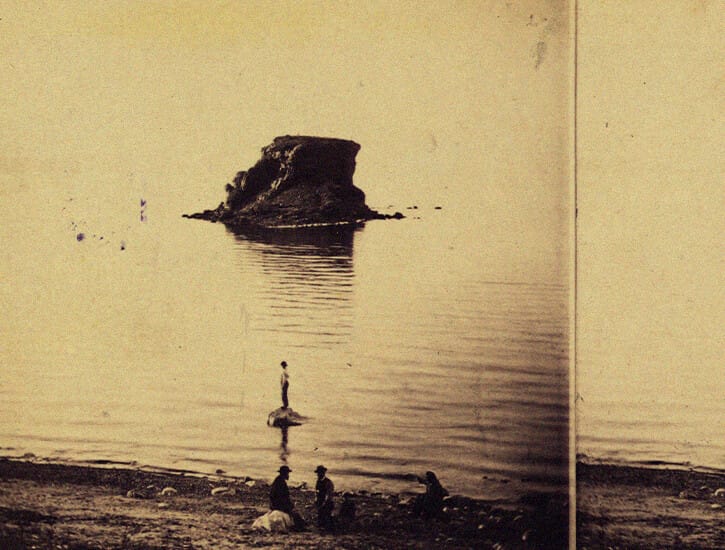
Black Rock in the Great Salt Lake, taken between 1861 and 1870. | Library of Congress
Salt Lakes: An Unnatural History by Caroline Tracey. W. W. Norton & Company, 272 pages. 2026.
When the Mormon pioneers first spied the Great Salt Lake from the foothills of the Wasatch Mountains in 1847, they saw little more than an obstacle to overcome in order to fulfill a destiny ordained by God. Orson Whitney, a historian of the LDS Church, described “a broad lake . . . dotted with mountain islands, its briny waters shimmering in the sunlight, like a silver shield.” The inhospitable lake represented a fortification against cultivation, even as the sea birds it attracted saved the settlers from losing their very first crop to a plague of locusts in what church leaders dubbed the “Miracle of the Gulls.” Nevertheless, “The fresh canyon streams are far and few,” Whitney wrote, “and the arid waste they water, glistening with beds of salt and soda, and pools of deadly alkali, scarcely allows them to reach the river, but midway, well nigh swallows and absorbs them in its thirsty sands.”
The Mormons stuck it out anyway, diverting water from those mountain streams to farms they established along the Jordan River. Another church historian named Leonard Arrington wrote that irrigation “was a form of religious worship” for the followers of Brigham Young, and “the construction of water ditches was as much a part of the Mormon religion as water baptism.” Within a few decades, the Mormons had dug one thousand miles of ditches, putting more than a quarter million acres under cultivation. Soon, the vast blocks of Salt Lake City envisioned by Young filled in with lumber mills and hotels for travelers on the new transcontinental railroad; by the turn of the twentieth century, Salt Lake was the biggest city between the Rockies and the West Coast. The Great Salt Lake presided over all this development as a place apart.
In Salt Lakes: An Unnatural History, environmental journalist Caroline Tracey calls for a reconceptualization of these unusual landmarks, one that moves them into the center of our understanding of the natural world. While mountain-fed rivers like the Rio Grande or fresh bodies of water like California’s Tulare Lake could support farms that might provide a livelihood for their new occupants, salt lakes had little revenue potential beyond the salability of the salt deposits at their rim. To appreciate these less lucrative features of the landscape, Tracey writes, a different mindset is necessary than what settlers initially brought to the region, one that meets their unusual ecology with grace and wonder. For her, salt lakes represent nothing less than a spiritual portal, starting with the way their particular chemistry allows their “glistening blue water” to “reflect the surrounding landscape like a mirror.”
Salt Lakes is less the jeremiad of an outraged conservationist than a tender bildungsroman.
Tracey’s survey ranges from the Great Salt Lake to its less famous peers around the globe, bouncing from Mono Lake in California to Mar Chiquita in Argentina and Central Asia’s Aral Sea. Each of these bodies of water, Tracey explains, sits at the lowest elevation of an arid, endorheic basin, meaning a desert bowl with no outlet to the sea. Their saltiness comes from minerals carried downstream from surrounding mountains that become concentrated over the course of millennia as the sun evaporates each season’s runoff. Species like brine shrimp and alkali flies gradually adapted to the rising salinity of these lakes, but that formula has been completely upended by a combination of overdevelopment and climate change.
With both nearby farmers and distant water utilities channeling streams away from these lakes at the same time they’re receiving less rainfall and are exposed to more heat, salinity levels have spiked more quickly than animals can adapt. This creates a domino effect. The fish die, then the insects, then the migratory birds who depend on both for sustenance. For particularly polluted bodies of water, humans are the last victims: as the lakes recede, vast playas of earth shot through with agricultural and industrial chemicals are revealed, leading to a public health crisis as they are disseminated across populated areas. In a report released last year, doctors in Utah turned an alarmed eye toward the Aral Sea, where the lake’s decline contributed to life expectancy in the communities nearby plunging more than ten years as rates of anemia, tuberculosis, liver disease, and cancer soared.
“The collapse of the lakes,” Tracey writes, “isn’t an unfortunate accident. It’s the consequence of an exhausted ideology, one mutated and taken too far, one that puts utility above all else, leaving no room for the intrinsic value of water, the plants and creatures who depend on rivers and lakes, or the rest of the natural world.” At the same time, compared to “solving climate change, which requires changing nearly everything about contemporary life, saving salt lakes simply requires adding water.”
If saving salt lakes is really so straightforward, why can’t we do it? The Great Salt Lake is now about half as large as it once was. The Aral Sea has almost disappeared entirely, shrinking to about a tenth of its original size over the course of just forty years. Despite those daunting facts, Salt Lakes is less the jeremiad of an outraged conservationist than a tender bildungsroman, particularly as Tracey’s global tour of the “queer ecology” of the salt lakes morphs into the story of her own queer awakening.
“The world I’d come into as an adult wasn’t the American West that Wallace Stegner knew, or even the one my parents knew,” she writes. “It was one damaged and poisoned, and one that I had to learn to appreciate, protect, and make a home in nonetheless.” That, in her estimation, means “learning to find beauty amidst dust, bad smells, and record heat, not for their own sake but as a way of working toward something else: clean air, spectacular views, crisp mornings.” Anyone who loves the West can sympathize with that imperative, its peculiar blend of nostalgia for a prelapsarian realm and steely dedication to the wreckage we inherited instead. Finding joy in a fallen world takes determination and strength. But is it really possible to find such joy in a world like ours, which is not just fallen, but is continuing, every day, to fall?
The crisis of the salt lakes has much to do with the fact that their flora and fauna aren’t charismatic—not in the botanical or zoological sense of the word, at least, and probably not familiarly, either. Brine shrimp, alkali flies, phalaropes, and eared grebes don’t appear on postage stamps or sell well as stuffies at the zoo. Nevertheless, it is through developing an appreciation for the intrinsic weirdness of these creatures, from how alkali flies have evolved to birth in “a bubble made of amino acids” to the polyandry of female phalaropes, that Tracey begins to understand her own experience more clearly, the unconventional nature of salt lake ecosystems opening her eyes to her own queerness. If some varieties of brine shrimp are born with both male and female sex organs while still others reproduce asexually, how can any form of human sexual expression be construed as abnormal?
First coming to prominence in the 1990s, the study of queer ecology aims, in the words of environmental studies professor Cate Sandiland, “to disrupt prevailing heterosexist discursive and institutional articulations of sexuality and nature, and also to reimagine evolutionary processes, ecological interactions, and environmental politics in light of queer theory.” For Tracey, this line of thought is liberatory. The adaptations of creatures like brine shrimp, she writes, “resonate with ideas of queerness not only because they mirror humans’ diverse sexual practices, family structures, and reproductive adaptations, but also because they enable creatures to adapt to adverse conditions,” just like their human counterparts have managed to pursue vibrant lives despite heteronormative social pressure and pervasive discrimination.
This application of critical theory is hard to disentangle from what John Ruskin labeled “pathetic fallacy,” the literary tendency to assign human emotion or intention to naturally occurring phenomena. In Ruskin’s formulation, the word pathetic served primarily as a way to invoke pathos, a sense of empathetic identification. Tracey’s emphasis on queer ecology fits the bill, allowing her to construct Salt Lakes in a way that holds human emotion and ecological destruction at once.
Each chapter of Salt Lakes focuses on one lake in particular, its location corresponding to a different phase of Tracey’s own self-discovery in that same place. In her chapter about Zuni Lake in New Mexico, Tracey toggles back and forth between the Zuni people’s fight to protect the sacred origin point of their culture from scrupulous entrepreneurs looking to harvest its salt for profit and her experience working on a ranch elsewhere in the state, when “suiting up in men’s Wranglers every day . . . allowed me to inhabit myself queerly before making any utterance or effort.” Next, her treatment of how Lake Texcoco was drained to make way for Mexico City alternates with her first time hooking up with a girl while studying at Universidad Nacional Autónoma de México, then her first few dates with the woman she ends up marrying. That marriage took place at Owens Lake in California, which was once almost entirely drained by an aqueduct to Los Angeles before a court order forced the city’s water department to stabilize the water level. Tracey writes that she and her wife got married there because it “looked less like a body of water than a technical diagram, drawn and quartered by litigation and scientific intervention. But it felt fitting. Like the lake, our marriage bore a permanent and painful imprint of bureaucracy.”
The emphasis Salt Lakes puts on Tracey’s personal efflorescence forestalls a hard reckoning with the unwillingness of most political leaders to prioritize the health of ecosystems.
For Orson Whitney, the Great Salt Lake was a “shield” against settlement; for Tracey, it and its peers around the world are a “mirror” for the self, a way to see herself within global trends. Queer ecology, here, becomes less of a theoretical framework than a rhetorical one, allowing the discovery of self and nature to happen in tandem. “Queers are sufficiently experienced in the frustrations and disappointments of the world to understand that ideals of Edenic nature don’t exist,” Tracey writes at the end of her chapter on Mexico City, in a passage about the renewal of the site of Lake Texcoco into a massive city park that includes a new lake with artificially rectilinear sides. “Queer ecologies,” she continues, “celebrate the need not to manicure spaces so they will radiate orderly, pastoral, insipid, and inoffensive visions—and teach us not to dispense with those places that seem to have irredeemably changed.”
The renewed Lake Texcoco and Owens Lake are worthy grounds for this sort of celebration. Still, the emphasis Salt Lakes puts on Tracey’s personal efflorescence forestalls a hard reckoning with the unwillingness of most political leaders to prioritize the health of ecosystems, whether as small as Zuni Lake or as large as the earth itself. Hence the fallacy part of pathetic fallacy: as much as the technique can aid human identification with nature, it makes people the subject. The fulfillment Tracey achieves by the end of Salt Lakes is satisfying to herself and the reader, yet never quite jives with the condition of the places that got her there.
According to a team of researchers, it’s been over twenty years since the Great Salt Lake’s waters were at a “healthy” level. Since 2021, its diminution has been slowed by a constellation of programs that have collectively allowed about four hundred thousand acre-feet of water to flow into the lake, almost five times as much water as Salt Lake City uses in a year. Unfortunately, scientists believe that nursing the Great Salt Lake back to health could require up to a million acre-feet annually, which would be equivalent to one out of every five gallons of water diverted by the entire state of Utah from its rivers. At the same time, Utah is among the upstream block of states reliant on the Colorado River who have repeatedly refused to cut their water use, even as the river that 40 million Westerners depend on has lost 20 percent of its flow over the last century.
Tracey is uncommonly confident that the fabric of our lives—who we love, our daily habits, our preferred costumes—can help rebalance the earth’s systems, even as she harbors few illusions about the odds of that undertaking. “Even if we stop seeing salt lakes as sterile and useless and treat them instead as sacred and vibrant,” she concludes, “so much destruction has been in motion for so long that we will likely end up living in a changed, muted world. Lakes and rivers will dry up; insects and birds will die off. They already are.” Nevertheless, “when loss is unavoidable, there is solace in grasping the ephemeral.”
That’s an encouraging thought, even as solace remains a fraught word in environmental circles. That’s mostly thanks to the work of Gretel Ehrlich, whose 1985 book The Solace of Open Spaces chronicled her time on a Wyoming sheep operation not dissimilar from the ranch Tracey worked in New Mexico. “Instead of producing the numbness I thought I wanted,” Ehrlich wrote, “life on the sheep ranch woke me up. . . . I threw away my clothes and bought new ones; I cut my hair. The arid country was a clean slate. Its absolute indifference steadied me.” There’s the pathetic fallacy again, tuned to a more avowedly personal wavelength. Still, the connection Ehrlich forged with the open country helped clarify her vision of the damage done by human intervention. “Being affluent, we strangle ourselves with what we can buy,” she wrote. “We have only to look at the houses we build to see how we build against space, the way we drink against pain and loneliness. We fill up space as if it were a pie shell, with things whose opacity further obstructs our ability to see what is already there.” Indeed, Solace of Open Spaces is best read as the story of Ehrlich learning that the plains of Wyoming were a vast space indifferent to human interpretation.
Forty years on, and the pie shell is more overstuffed than ever, the land that came before ever harder to perceive on its own terms. In Salt Lakes, Tracey trades Ehrlich’s ecological X-ray vision for one that adds rather than subtracts, layering queer theory, histories of settler colonialism, and personal anecdote over the landscape in hopes that they might accumulate into a usable politics of restoration. It’s a daunting challenge for any writer, even one of Tracey’s remarkable talent and erudition. Her tone is gentle, nudging skeptics over to the side of the kooky protesters gathering on the steps of the Utah State Capitol building for a rally in defense of the Great Salt Lake dubbed Phalarope Phest, even if it shies away from a true call to arms.
“Living well here has always been the art of making do in emotional as well as material ways,” Gretel Ehrlich wrote, as much about Wyoming as the broader West. “The toughness I was learning was not a martyred doggedness, a dumb heroism, but the art of accommodation.” It’s easy to think that in our chaotic era, accommodation is tantamount to defeatism. Tracey, I’m sure, would disagree with that line of thinking as surely as her predecessor did. In Ehrlich’s understanding of environmentalism, “to be tender is to be truly fierce.”