, April 16, 2026
Cherish Your Memorized Weakness
The Comeback’s longitudinal study of TV enters the AI era
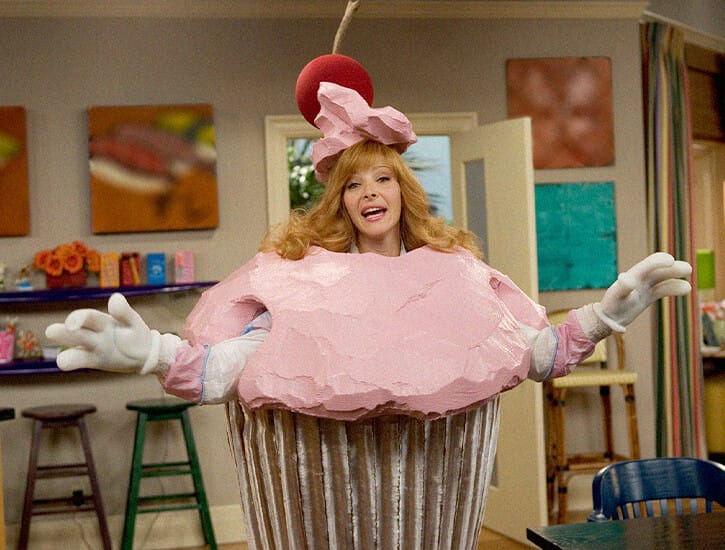
Still from The Comeback. | HBO
“Most English-speaking people,” the fantasist and philologist J. R. R. Tolkien wrote, “will admit that cellar door is ‘beautiful’ . . . More beautiful than, say, sky, and far more beautiful than beautiful.” This comeliness is partially attributable to the psychological phenomenon called semantic satiation, in which the repetition of a word or phrase causes it to lose, or somehow transcend, its meaning. It is experience that defines the most memorable sequence in the HBO comedy The Comeback, which first aired on HBO in 2005 and is returning after a twelve year-absence for a third and final season.
Late in the series’ pilot, washed-up sitcom starlet Valerie Cherish (Lisa Kudrow) is running some lines for her new role on a broad, hacky sitcom called Room and Bored, in which she has been cast as fussy landlady Aunt Sassy. Desperate to revive her flagging career, she spends hours repeating her one, unfunny line, over and over. In her kitchen she performs variations on ostensible laugh-line: “Note to self: after a long day at work, I don’t wanna see that!” In an almost interminable montage, she offers countless variations (“Note to SELF”; “loooong day at work”; “I don’t want to see THAT!”) until the lines become pitchy, strained and semantically satiated, unmoored from meaning as it screeches across the sensitive viewer like fork tines scraped between clenched teeth. The actual punchline, which typifies much of The Comeback’s punishing humor, is that after countless riffs and revisions, Valerie totally flubs the line. Still, her would-be catchphrase works as its own kind of “cellar door” in reverse: dissonant, grating, anti-musical, far less beautiful than beautiful.
It also works as a kind of passe-partout for the series itself. The Comeback (and I mean this as a high compliment) works as an unpleasant, bracing behind-the-scenes document of the TV biz. It confronts us with backstage vanity, cruelty, arrogance, and narcissism that are better left unseen. It is the rare Hollywood insider entertainment that is not merely satirical but unrepentantly disdainful. It hates Hollywood. It has contempt for its stars. Its glowering execs. Its enthusiastic comedians hyping up studio audiences by throwing bags of candy at them. And, yes, for those audiences themselves. It is precisely for this disgust and derision that The Comeback is one of the vanishingly few sitcom revivals that is not only welcome but vital. Call it Must-Don’t-Wanna-See-TV.
The Comeback was born of professional burnout. Lisa Kudrow had spent a decade playing the air-headed, New Age eccentric Phoebe Buffay on NBC’s behemoth Friends. Co-creator Michael Patrick King had, likewise, completed an extended stint as show runner on HBO’s Sex and the City. Over lunch in LA, Kudrow pitched King on a character she’d been nurturing for a while: a vain, egotistical actress, both cripplingly self-conscious and blissfully unaware, who Kudrow had been tweaking since her days as an improviser.
Back in 2004, the conventional sitcom had—especially for two old pros—exhausted its possibilities. It was the era of Curb Your Enthusiasm and, most auspiciously, reality television. Popular “documentary-style” and “docu-soap” programs like Project Runway, The Ashlee Simpson Show, Growing Up Gotti, and The Apprentice (talk about auspicious) dominated programming. Less popular programs like Date My Mom, Dr. 90210, Amish in the City, and The Littlest Groom also scrambled for eyeballs. Flip across the TV dial, and a lurid, brain-dead voyeurism prevailed.
The Comeback’s first season entered into the landscape by committing fully to the bit. The show is presented as raw footage from a namesake reality show-within-the-show, filmed by a hard-pressed documentary filmmaker (Laura Silverman’s Jane). Where other shows mounted in this style work diligently to hide their central conceit—i.e. that there is a film crew following the main characters around at all times—The Comeback embraces it. Valerie is constantly looking to the camera and calling “time out.” She explains self-explanatory insider comedy jargon, like what a “callback” is. The crew themselves edge into the frame as they crowd into offices and luxury cars, diligently trailing Valerie like a bad odor.
The Comeback (and I mean this as a high compliment) works as an unpleasant, bracing behind-the-scenes document of the TV biz.
Initially, it is difficult to even imagine what the fictional Comeback would look like. Valerie is so painstakingly aware of the camera, and her place within the frame, that she forecloses any possibility of naturalism. Her eyes anxiously dart to the camera line. She waves her hands in defeat, begging for interactions to be cut. She addresses the crew by name. The reality it captures is not so much that of an actress engineering her triumphant return but desperately flailing inside her own reality show. The program’s mise en scène is practically Kiarostami-ish: making extensive use of mirrors, windows, lenses, and frames-within-frames to give visual expression to the various mediations of performance and identity, fiction and reality, on display.
It is the very presence of the documentary crew, and the existence of the fictional Comeback itself, that drives much of the show’s tension. Formerly the star of a semipopular sitcom called I’m It—which ran for ninety-six episodes, just four shy of the one hundred episode threshold required for a show to enter into lucrative syndication deals—Valerie struggles to distinguish herself on Room and Bored. Her reality project grinds the gears of that show’s showrunner, a portly, morose cynic named Paulie G (Lance Barber). A once-promising TV writer who won an Emmy for writing on The Simpsons, Paulie’s contempt for his new gig—and for Valerie in particular—is palpable. To him, Valerie and her crew are an in-his-face memento mori, pointing to the debasement of his own creativity. He responds by treating her with a mix of chilly ambivalence and monstrous cruelty.
Like the original UK Office, to which Kudrow has acknowledged a considerable debt, The Comeback is often catalogued as a “cringe comedy.” It’s a catchall term applied to sitcoms that function by placing characters in socially compromising situations to elicit pained embarrassment from the viewer. The Office’s David Brent (as realized by Ricky Gervais) is the godhead of the genre: a mean-spirited, thin-skinned, wannabe crack-up, whose completely unearned self-confidence is the font of his employees’ anguish and the show’s comedy. It is an acquired taste. At the risk of revealing myself as some sort of ashen-hearted sociopath, I’ve never really found The Office, Curb Your Enthusiasm, Party Down, Peep Show, etc. especially tough to stomach. The Comeback, meanwhile, is blood-curdling. It’s a comedy best glimpsed through a lattice of webbed fingers drawn across the eyes, like the gory bits in a horror movie.
The wellspring of this terror is Kudrow. It can be difficult for a famous TV actor to escape the shadow of a career-defining role. Ted Danson will always be Sam Malone. Michael Richards will always be Kramer (or, perhaps, the guy from the 2006 racist Laugh Factory tirade). Kudrow doesn’t only offer another memorable character. She is Valerie Cherish. Unlike a David Brent, Mark Corrigan, Larry David, or other stalwarts of the cringe canon, Valerie is a basically good person. She buys chintzy “first show” gifts for the Room and Bored cast and crew. She is kind to her husband Mark (Damian Young, also excellent), despite his being perpetually hard-pressed by the TV crews in their house. She keeps her aging, flamboyant hair stylist Mickey (Robert Michael Morris; co-creator King’s own college acting teacher) on retainer, ostensibly to fuss with her signature ginger ringlets, but also because it’s a nice thing to do. She works late into the night, rehearsing crappy lines for a crappy sitcom, because she is hell-bent on doing a good job. She is also sincere in her belief that laughter is its own reward.
At the same time, she is doomed by her worst instincts. She is desperate for acceptance and validation. She’ll roll with any punch, no matter how mortifying, if she thinks it might advance her career (including, in the season one finale, pratfalling again and again while costumed as an enormous cupcake). Rooting for her is extremely challenging. But we root nonetheless. It must feel like what it’s like to be a Jets fan. Valerie is so insufferable and annoying precisely because she feels victimized by pridefulness that seems to operate outside of her. She is a good person, trapped inside of a bad one. Or rather, trapped inside of a bad system.
The Comeback is, at least notionally, part of a longer tradition of Hollywood self-satire. It’s a sometimes proud, sometimes obsequious lineage that includes movies from Billy Wilder’s Sunset Boulevard (1950) to Robert Townsend’s Hollywood Shuffle (1987) to HBO’s seminal The Larry Sanders Show (1992–98). It is a genre that has gotten a little too cozy of late.
Last year’s Emmys saw Seth Rogen and Evan Goldberg clean up for their Apple TV series The Studio, which follows Rogen’s character as he attempts to wield control as the newly installed chief of the fictional Continental Studios. It is a grating, self-aggrandizing series that is less in the vein of Shandling than of a kid waiting outside of a studio door for autographs. The Studio sees celebrities playing (typically overweening) versions of themselves, always with a wink and a nudge—acknowledging that, hey, they can take a joke. The show does not ridicule Hollywood so much as flatter it. In one episode, Rogen’s character drives himself into a tizzy because he has a meeting with Ron Howard—or, in Rogenese, “RON FUCKING HOWARD MAN!” The director of the J. D. Vance-washing obscenity Hillbilly Elegy (2020) is treated, without irony, as some rarefied artiste, and not as, you know, the guy who adapted a series of Dan Brown airport novels. Its fatuous, “just happy to be here” quality is insufferable. No wonder it did so well at award shows.
Though it is structured as a backstage Hollywood satire, The Comeback is by no means happy to be here. If the inaugural season leveraged Valerie’s vainglory to mock reality-television desperation, the second, which premiered in 2014, did something different. Doubling down on the premise’s self-reflexivity, it had Kudrow playing a version of herself in an HBO dramedy called Seeing Red, based on the events of the first season—particularly the on-set confabs between Valerie and Paulie G (whose own fictionalized avatar is played by a pre-Studio Seth Rogen). Like the previous show-within-the-show, this new project is not very good. The Comeback evolved, in essence, into an HBO prestige comedy burlesque of HBO prestige dramas, airing alongside The Newsroom (2012–14), True Detective (2014) and Game of Thrones (2011–19). Like Paul Almond and Michael Apted’s Up! films (1964–2019), which caught up with a cast of Brits once every seven years, The Comeback offers a long-view, longitudinal study of both a character and an industry.
In its third (and purportedly final) season, Valerie Cherish returns to a TV landscape that is once again revolutionizing, and not for the better. The show more-or-less drops the “fake reality TV show” conceit. It’s shot like an actual dramedy, with framing, lighting, editing, and the whole ball of wax. This stylistic shift was announced in the show’s second season finale, when a heart-wrenched Valerie ditches the Golden Globes. She steps out of the theater, leaving her crew behind, and walks into the “reality” of a television show. It is only here, away from the prying eyes of the cameras, that the viewer sees Valerie’s true character: kind, sacrificing, and ultimately unselfish.
Technological progress forges ahead, dragging the canned-laughter three-camera sitcom with it on its death march.
In the new season, Valerie’s low-self (as my old therapist would say) returns with a vengeance. When we get reacquainted, she’s not tailed by a reality crew but by a new social media manager, Patience (Ella Stiller). Her career (further) stalled by the Covid-19 pandemic and the mutating landscape of television, Valerie’s prospects have narrowed. She hosts a dull video podcast (called Cherish The Time) and has starred in a cozy-core direct-to-streaming detective show called Mrs. Hat, in which her character wears a big, floppy hat, and which nobody seems to have seen. Eager to once again reassert herself, she reluctantly takes a role as star and executive producer of a sitcom called How’s That?! airing on an upstart network called NewNet that is secretly scripted by AI. By the network’s own admission, it’s the sort program that just has to be “good enough”—inoffensively watchable so that viewers will leave it on the background “while they do . . . whatever.”
Because her name, image, and celebrity have tested positively across various audience quadrants, Valerie is tapped as the face of this new experiment. When a punchline flops in front of the live studio audience, the AI writer (dubbed “Al”) offers up dozens of potential “joke alts.” Two “real” writers (played by John Early and Abbi Jacobson) are hired to keep up appearances. Valerie struggles to suppress her nagging moral conscience (in the first episode, she rolls out to the 2023 Writers Guild of America/SAG-AFTRA picket lines to pose for a photo with union rabble-rouser Fran Drescher) while navigating the ethics of her new show. Say what you will about I’m It, Room & Bored, or even Mrs. Hat, but at least they were written by human beings. It envisions a greige, bureaucratized purgatory, where the human element is being mercilessly downsized. “I didn’t invent technology! I didn’t invent AI!” NewNet’s creatively bankrupt exec (Andrew Scott) protests limply. Technological progress forges ahead, dragging the canned-laughter three-camera sitcom with it on its death march.
Longtime devotees of the Valerie Cherish’s saga may naturally expect her to take the path of least resistance. Over the course of The Comeback’s three seasons, the character is subjected to all manner of professional indignity and personal humiliation. She tolerates it because she believes it will be good for her career. Subjecting herself to a completely depersonalized, computerized entertainment environment would seem another ignominy; little more than the latest frontier of cringe. But in managing the warring factions of writers and technologists, The Comeback’s new season offers Valerie something that has typically eluded her desperate, lifelong struggle for Hollywood relevance and which no computer, LLM, or AI chatbot will ever achieve: agency. It’s also really funny.