, December 19, 2025
Brodifacoum and the Divine Child
Birds come in the morning, in the garden. Catbirds, house finches, chimney swifts, mourning doves—this incredible variety flutters over the wire fence. On this particular morning, a catbird jitters its velvet-gray body around on top of the lead-bearing soil and bobs its perfect dark little head.
“Why should the head bob?” asks the man. It’s pure rhetoric.
“Maybe they think it’s disgusting that ours don’t,” says his lover, a woman with her hands paired on the top window rail and her chin on her hands.
“Maybe it is.”
The new tenants love each other, and they love this garden and the new apartment attached to it. They are people who mean well, surrounded by a violent place, their very special country, and all its people. Both of them are very small. One is very gentle. They’ve done their research and purchased a trove of native seeds: bleed weed, broad- and narrow-leafed bally rum, dallow grass, yellow parenith, and purple lantern flower. The tenants’ desire to improve their garden betrays their belief in the future. So far, none of these intentions have germinated.
“Do you think the birds are eating all our seeds?” says the woman.
“I think we just need to be patient.”
The new tenants have names, but it’s better to call them Rapture and Harmony.
Rapture and Harmony have lived in the apartment for about six weeks. Just long enough for Rapture to menstruate once and emerge one unused ovum closer to the grave. She is filled with gratitude for Harmony, her friend and helpmeet who occupies every space like the shining lamp he is. The front door is a suburban-style storm door covered with a security grate. Next to the door a weed has been growing long enough to become a tree called Ladder of Heaven. Using its sturdy and sticky lowest branch, Rapture has tried and failed numerous pull ups. Harmony sits cross-legged under its giant leaves all day on his laptop. He is finishing a long, painful project, a book about the history of the concept of charity. He is too old anymore to believe in his specialness. Working pleasure is the only thing left, even if he cannot, at this moment, find it.
Domestic satisfaction gone, enchanted up to her eyebrows, Rapture knows that poison cannot be an option.
Harmony watches Rapture go to work; he welcomes her home. The apartment has the spacious quality of a house, doubled because of the garden, which fills every window with green. Books, beautiful knickknacks, and art objects abound in this tiny hermitage that protects their finer feelings. It will be the best place for a nap after grief or to experience the marine quality of garden light after a day in the city sun. Neither of them will ever wear their shoes inside.
That evening Rapture comes home buzzing with the fearsome energy of being streetside, and the retractable metal claw of the garden gate closes behind her. She goes to the fridge and eats her snack, from that snack she goes to the couch to rest her body and look at the evening sparrows. The perennial bushes installed by the landlord have finally unfurled and given color and shape to the garden. Together, Rapture and Harmony make dinner and retire to their room, where they have good sex, fall asleep easily, and experience dreams of unyielding density and magnitude. In the middle of the night, Rapture wakes up to use the bathroom. The sight of Harmony inside his sleepy cocoon fills her with tenderness. She moves through the dark apartment—she thinks of it as their house—to the bathroom and her tenderness is soon augmented by the pleasure of relieving her bladder. Balloon-like with satisfaction, she bobs into the living room to look through the storm door and into the garden. The streetlight shines over the juniper bushes, onto the wide leaves of the Ladder of Heaven, and dissolves in a silver mist atop the oblong bushes. In the southeast corner is the little white table they bought during their first weekend, where Harmony spends all his time when she’s at work and the weather is predictable. Opposite it, a few feet northeast, a blob of darkness signifies the mass of four-point ivy that grows along the fence.
Some small and fast animal moves along the top of the garden fence, and it draws three questions from Rapture’s sleep-clotted mind: Is there such a thing as a night squirrel? Do bats land? What color are possums at night?
In the morning, Harmony sees Rapture to the gate as usual. Beyond it, the country is seething. He feels it as soon as the wire door swings open to let Rapture pass and the twenty-first century blows in against his face, like a wind from hell. He returns to his device. Its screen is muted in the morning glow. Then, about three feet away, there’s movement under the bushes. A huge rat and its slightly less huge companion are grooming each other in the face. Harmony clears his throat, and they pause their toilette to rest with their little pink hands in the air. He’s never seen a rat in a green environment before. The garden is doing its job, providing a beautiful backdrop that ennobles everyone who enters: the birds that fly in from the top down, the humans in the middle with their feet on the dirt and their minds in the air, and the vermin crawling on the ground. The intelligence in their pointed faces is unmistakable.
When Rapture comes home, he meets her at the gate with kisses and, though he can taste the residue of the violating world in her mouth, she is as delicious to him as ever. “I had a visitation this afternoon,” he says. He describes to Rapture the animals’ eyes, the sense of being acknowledged by a very aware awareness, a personality with no person attached.
Rapture relates her own visitation and comes to a decision. “We have to kill them.”
“Yes, I know,” Harmony means to say. “We can’t poison them” is what comes out instead. A vestigial Catholicism is part of Harmony’s wisdom, reminding him to tread lightly during his time on the blue-marble world.
“I don’t know if I can agree with that,” says Rapture. She thinks of herself as a muscle. Her pride comes from doing what needs doing and feeling sturdy afterwards.
“I think the poisons they use are slow.” Harmony has a notion that an animal’s death should be fast.
“Let’s look it up,” says Rapture.
They learn that city poisoners use either strychnine or brodifacoum, but that brodifacoum is the modern preference. Rapture says the word slowly. It sounds like the Latin name of an English town that was once a Roman garrison. Brodifacoum is an anticoagulant; after consuming it, animals get slow and wobbly, then more dazed as the days go on. Inside them, blood vessels leak and disintegrate. City poisoners like brodifacoum because it only takes one dose, which minimizes the chance for bait shyness.
“Plus, they’re cannibals.”
“I don’t think it’s the right thing to do,” Harmony says.
“I don’t know if I agree.”
That night they do their routine of dinner, sex, and sleep, and one more time Rapture wakes in the night to use the toilet. Her satisfaction balloon has been deflated by the pinprick of anxiety. She goes to the window. In the garden, the rats are awake.
She sees rats of many different sizes cavorting under the streetlight. There are parent rats and midsized adolescent rats and baby rats. Two of them chase each other back and forth from under the hostas to the ivy-corner and back again. They return to a cluster of others and are welcomed with a flurry of excited grooming. The cluster dissolves into a writhing pile of camaraderie. She recalls reading that rats laugh when tickled and that they often have sex more than fifteen times a day and that scientists call them “thigmophilic,” which means they love to touch—walls, garbage, flowers, each other.
Domestic satisfaction gone, enchanted up to her eyebrows, Rapture knows that poison cannot be an option.
The next morning, the tenants take their coffee in the garden, not for pleasure but for reconnaissance. They stand holding hands on the gently curving walk that leads from gate to door that had once felt like their own personal Bifrost and now looks like a cracked walkway to a garden apartment. Smell wafts up from the basement window well. There are rat holes on each side of the fence and an opening about a foot long and seven inches wide right beneath the bedroom window.
“There are holes,” Rapture says. “I thought they were from the garden settling or that maybe we had a mole.”
All around them, the city surges in wild multiple directions. If he were a different kind of person, Harmony would laugh at her mention of a mole in the city.
“It smells like a hamster cage,” says Rapture. They peer in together and see that the well is filled with turds.
In the following days they use the garden, but the enchantment is gone, replaced by darkness and scuttling. They have ample opportunity to observe the rats, clean and healthy. It’s hard not to see a sparkle in their all-black eyes. Birds still come throughout the day, but the tenants can’t see them for the rats. On a rainy weekend morning, Harmony stands at the door with his mug of tea. He watches one rat groom another free of raindrops under the perennials.
“There are two bigger ones under the hostas and one sitting in your geranium pot.” Rapture sits in the green chair with her back to the garden view and refuses to look. “That sounds very cute. How can you watch them being like that?”
“I don’t know.”
He doesn’t tell her it comes naturally. It’s easy for him to admit to their preciousness amid the will to exterminate. His own animal commitment to his well-being dictates that they must go. It doesn’t bother him. The world is the world, and he has died himself many times already.
“Our yard is their living room,” says Rapture. She’s imagining pockets of rats just under their feet. They sleep fifteen or twenty to a burrow, a hundred or more to a colony. The garden is an orgy-room. So’s the nursery and the toilet. She looks at their kitchen with its peg board and its fruit bowl, just feet from the sexual bedroom and the hungry toilet. The tenants smear snap traps with peanut butter, set a bucket trap for drowning as many as possible at a time. They map the layout. Rapture takes the lead. It is a short distance from her brain to her hands. In addition to the traps and the bucket, she has considered a pellet gun, but she has no training and there are neighbors’ legs, children, and dogs to consider.
“Rats can tread water for four days,” Rapture reminds him as they fill the bucket and fit the tilty lid on top. But a snap is a snap, and drowning is nothing compared to the slow leaky death of brodifacoum. So she stomps through the garden, hardening her heart as she goes. They’ll put the traps in the northwest corner by the rake, right on the lip of the basement window, and under the biggest hostas.
Within days, all the traps have been licked clean. The bucket trap catches nothing and becomes a nursery for mosquitoes. The tenants reset the other traps and move them around the garden, only for them to snap without claiming any casualties. At this point, they are just feeding the rats.
After dinner, after sunset, Rapture sits on the stairs to watch the rats as they play, framed in the basement window. She calls it Rat Television. A little finger of feeling reaches out to touch the rats and their pups as they climb up and down the security bars with a familiarity that she envies. Rapture realizes that the parents are probably siblings, or mother and son, father and daughter, grandparent-grandchild—endless permutations of incest mobilized by early sexual maturity and twenty-one-day gestation.
One night, Harmony comes to bed and finds Rapture on her knees with her ear to the air conditioning vent.
“Shh! Shh!” Harmony, too, presses his ear against the metal slats and there it is: the unmistakable rattling of rats in the works. It’s only a matter of time before they make it into the apartment.
The tenants wake up adrift among the sheets.
“I dreamed that we had a visitor to the garden,” Harmony says. He reaches to touch one of Rapture’s breasts and her sternum is clammy. “She was a neighbor. She came to see us with her triplets, Darwin, Lamarck, and Wallace.”
“Who?”
“The children couldn’t walk yet; they all crawled. Lamarck followed me around and kept putting dirt in his mouth. When I tried to stop him, the mother said to me ‘No—it’s fine; he learns that way.’ You had Darwin in your arms, and the mother took out both of her breasts to nurse Wallace and Lamarck. She was already pregnant again, with two additional sets of children. Quadruplets. Quintuplets. Each time she got pregnant, it would be with one extra child, forever, until she died. Then I went down on you.”
As he relates the dream, Harmony and Rapture migrate from the bedroom into the garden to check on their failure. This morning something is different. On top of the dirt, between grass patches, pieces of something glitter in the sunlight. A yellowjacket lands on a gray marbled bulb with a crimson topping. Less than a handspan from the sweetbread, flies hum over a piece of ruffled viscera, color peach, and an iridescent membrane. An eyeless rat-mask lies at Rapture’s feet, whiskers, nose, and front teeth intact. She could put it on her thumb and do a puppet show.
“Someone got cannibalized,” she says.
They stand around in the aftermath. Nobody utters the word but they both know that it’s only a matter of time before brodifacoum slithers into their lives. Soon someone will call the landlord and then they will no longer be people who mean well and tread softly.
Rapture and Harmony begin having their morning beverages inside. The windows are still green. The plants continue to grow, unaware of the failed campaign, and the planet revolves in its space pocket while the tenants eat and have sex and sleep and return their minds to their work. Harmony completes his penultimate chapter, arguing that charity can rhyme with the absence of bad intent. Rapture makes her lunch and receives his kisses goodbye and goes to the office where she’s stopped using her free time to research the terms “KILL YARD RAT NO POISON.” They fasten more art onto the walls and have a housewarming party. Everyone congratulates them on their find: a place with a yard.
And then something turns off Rat TV.
As she’s coming up from the basement with the laundry, Rapture braces herself for the usual broadcast. She wonders which is worse: being outnumbered or the fondness she feels for each tiny face. But tonight there are no rats on Rat TV. No furry acrobatic routine interrupts the blue light of the window well. The stove clock confirms that it should be prime time. Harmony stands at the counter making a dressing for their salad. She asks him if he called the landlord. He did not.
An investigation reveals that Rapture’s geranium has healed from the nibbling and sprouted a tentative, optimistic bud. None of the holes has grown wider.
For a week the tenants use the garden as though it’s a normal place. Harmony finishes his project beneath the Ladder of Heaven. He feels he might soon become susceptible to portents and signs. The timing is strange, and a new vigilance descends over their household. Rapture listens to the air vent three times a day and isn’t satisfied with the silence she finds.
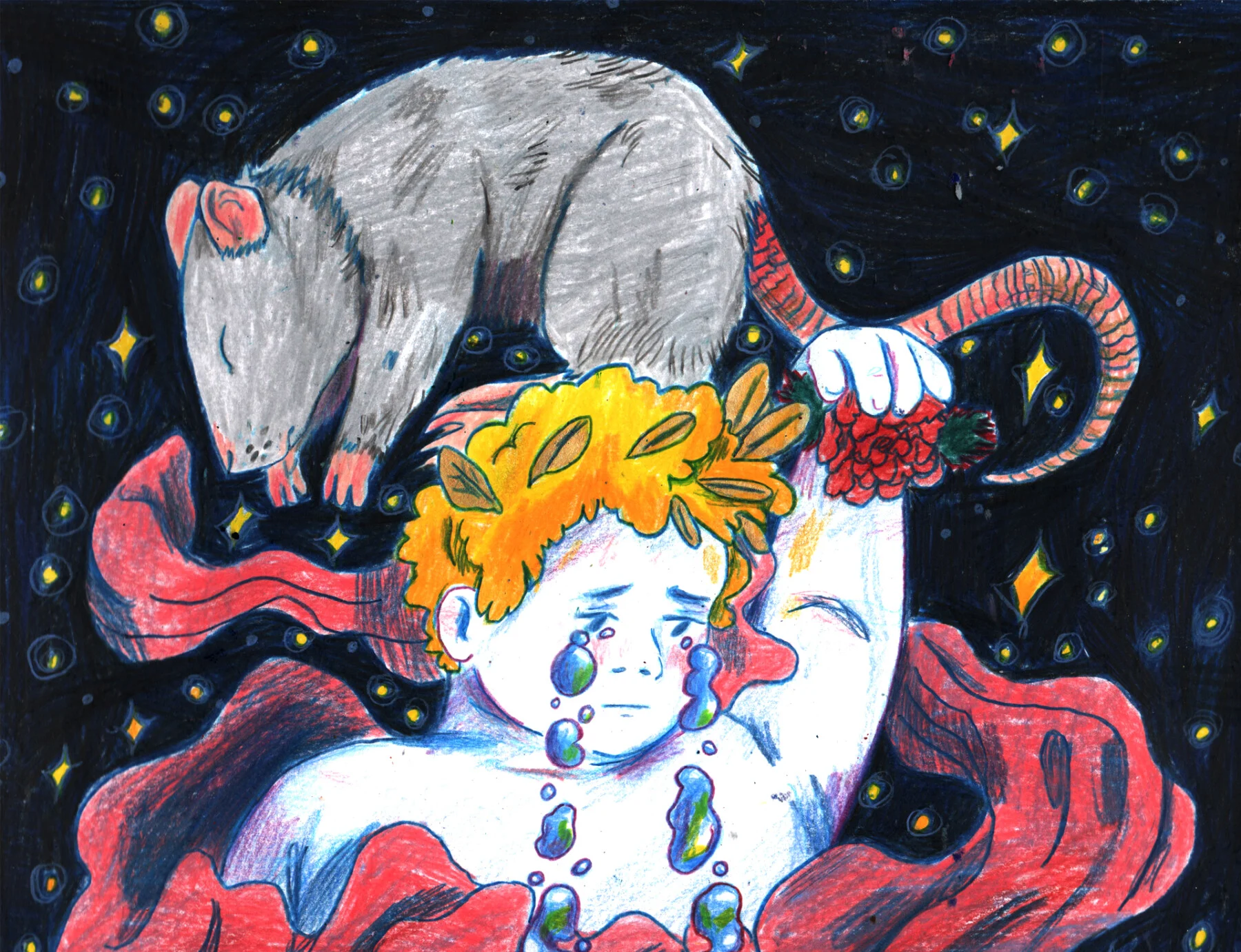
One day, Harmony goes out and returns with a paper bag. He meets Rapture at the gate and shows her his treasure: a statuette of the Divine Child in a pink robe with a blue sash. The androgynous Child is the color of milk and corn and roses. His fat bare feet rest upon a starry cloud. His little hands reach into the air in a gesture that encompasses the universe.
“What is this?”
Harmony describes his trip to a neighborhood botanica. With the project gone and the garden empty, there’s been room for him to consider a spiritual solution. There had been no scented oil for rat problems and no particular candle to burn to keep them from returning.
“But the lady helped me decide to get this. She called it a spiritual focus point. Sometimes it’s hard to do the right thing. But we’re doing it.”
He installs the Divine Child in an attractive tableau on top of the credenza. The Child’s yellow hair and pink robe look good against the sweet cola tone of the wood. Rapture is looking forward to whatever the weekend brings.
When the young rat appears in the garden, it is late in the morning or early in the afternoon. All the curtains have been flung back to let light and the shadows of birds into the apartment. If they were in the bedroom, the tenants would see the rat among the weeds. Nobody says, “Quick, tell the cats” or “Forgive us for everything we do to live this way.”
Harmony lays upon the couch in his underwear, reading with one arm behind his head. Rapture’s trapped pleasurably beneath his legs, occupied by the lines of his thighs and hamstrings. Soon it will be time to go to the grocery store and change the bedsheets. But right now there is no task to think about.
The world is the world, and he has died himself many times already.
In the bedroom window, the rat’s little brown body has just become distinguishable from the mulch. Rapture wants to close the curtain. But the Divine Child frets atop the credenza. His upturned little face looks pained: he’s staring into the midday sky without a parent to shade his eyes. And now he’s bawling.
THERE IS SUFFERING IN THE GARDEN. SOMEONE IS SUFFERING IN THE GARDEN.
To reach the rat, Rapture must walk to the weedy corner where she hardly ever goes. When she bends down to inspect the rat, her shadow covers its body. When she stands backup, her shadow breaks in half on the metal fence. When Rapture nudges the rat with her shoe, it falls onto one side with a tiny sun in its dark eye. The miracle of perspective bursts open her mind.
The outer world has made it through the gate.
The rat is perfectly palm-sized and doesn’t protest when she gathers him into the bag. The garden is his home. He was born here. He has gone and returned countless times, to play and to sleep and to mate and now to die. She can feel his labored breathing through the plastic. The warm nothing of his little body is unbearable. She ties the bag’s handles as fast as she can and lets it dangle from her fingers. Everywhere she looks Rapture can see the brodifacoum. This is the truth of things.
Harmony has emerged from the apartment to radiate goodwill as palpable as the plants crushed by her footsteps. He is watching her, transmitting mercy. She feels totally distilled: the muscle to his imperative. Remorse gushes into her mouth, and Rapture swallows it.
In the living room, the Divine Child reaches into the air. Rapture flexes all her strength into the swing and the hard charity of the ground rises to meet the bag, again and again.