, April 21, 2026
Betting the Farm
Corporate land consolidation in Ukraine
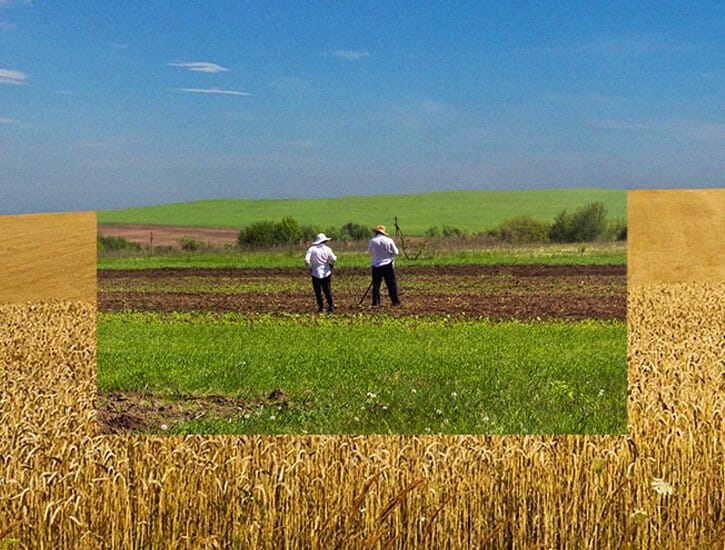
Farmland in Ukraine. | Flickr/Wikimedia Commons/The Baffler

On a bracingly cold morning last October, I drove south from Kyiv and into Ukraine’s agricultural heartland past fields of yellowed corn and green shoots of winter barley just beginning to emerge. With me was Olha Tarasenko, an environmental activist with the NGO Ecoaction, which has spent years investigating complaints about the arrival of massive poultry farms in the region. Dozens have been established in recent years, most of them owned by one company: Myronivsky Hliboproduct, or MHP, which was founded by a Ukrainian billionaire and is Europe’s largest poultry producer.
Outside the village of Olyanytsya, the air grew heavy with the smell of chicken shit. We approached a row of long, white buildings resembling Amazon warehouses, each holding as many as thirty-eight thousand birds, and Tarasenko told me to duck down. MHP had threatened her colleagues and other activists before for bringing journalists here. I snapped a few photos as surreptitiously as I could. On the road back into town, we passed a bus of workers heading the opposite direction, toward the chicken plant. A sign on the side of the vehicle said: “MHP is always close by.”
“It’s supposed to be comforting,” Tarasenko said wryly.
Ukraine is often referred to as Europe’s breadbasket. Before Russian warships blockaded its Black Sea ports in 2022, the country exported 60 million tons of grain per year, a staggering 10 percent of the world’s supply. Corn, barley, seed oils, and—increasingly—poultry were shipped to consumers across Europe, Africa, and Asia, to the point that Russia’s invasion initially raised fears of global famine. But behind Ukraine’s rise as a major agricultural exporter were decades of land consolidation by large and powerful corporations, which took place despite laws that ostensibly sought to protect small farmers.
Now this process stands to accelerate as the government leans into agribusiness as a vehicle for rebuilding the country, arguing that only large companies have the capital needed to repair an agricultural sector devastated by war. In 2021, with the encouragement of lenders like the International Monetary Fund, the country lifted a twenty-year moratorium on the sale of farmland. At first, land sales were restricted to individual Ukrainian citizens who could only transfer small plots; beginning in 2024 corporations were allowed to purchase land too, up to ten thousand hectares. Ukraine’s leadership has said that it plans to hold a referendum to determine whether to expand this opportunity to foreigners, although the timeline has been delayed by the war.
Soil is just one of many natural resources to be sold. Last year, Ukraine signed away 50 percent of its future profits from mineral extraction to the United States in exchange for continued military support. But auctioning off its farmland comes across as particularly egregious for many Ukrainians still deeply scarred by the memory of the Holodomor, the early twentieth century famine spurred by Soviet collectivization policies that killed approximately 3.5 million people and which thirty countries have officially recognized as a genocide. Food sovereignty and self-sufficiency is ingrained in the national culture, and its reverence for small farmers spurred Ukraine’s initial ban on land sales, one of only a few such policies in the world.
But in pursuing an export-oriented growth strategy, the country is putting its agricultural economy at the mercy of global supply chains while subjecting its exceedingly fertile soil to the ravages of industrial monoculture. The small farmers who survived the Soviet Union’s war against the peasant class, it seems, may not be able to withstand the pull of the corporation.
When Ukraine was part of the Soviet Union, private ownership of farmland was banned. Peasants worked on collective farms and earned a small salary, sending most of their products to the state for redistribution. After Ukraine gained independence in 1991, this land was privatized and parceled out, often at a rate of approximately two or three hectares per person. These new landowners had no access to markets or capital to purchase modern equipment or agricultural inputs like fertilizer, and many were senior citizens with no capacity to work the land themselves. The country’s burgeoning oligarch class, sensing an opportunity, pounced and quickly started snapping up thousands of hectares. Fearing a looming speculation crisis, the government banned land sales in 2001.
On the surface, the moratorium was meant to protect small farmers. In reality, it backfired.
On the surface, the moratorium was meant to protect small farmers. In reality, it backfired. Large corporations leased the land instead of buying it, often at low rates, collecting what were previously small family plots into massive “agroholdings.” As agribusiness moved in, Ukrainian villages hollowed out. About 2 million people moved to the cities, with rural areas losing 12 percent of their population between 2001 and 2014. Corporations operating at a large scale might need only one or two workers to manage a thousand-hectare plot that might previously have been farmed by one hundred people.
Today, large agroholdings control around a quarter of Ukraine’s arable land, the largest of which are all registered overseas in tax havens like Cyprus and Luxembourg. Agroprosperis, the fourth-largest landholder in Ukraine at nearly three hundred thousand hectares, is owned outright by American investment firm NCH Capital. Even companies based in Ukraine don’t typically have strong ties to the communities they farm in, with most headquartered in major cities like Kyiv, Mykolaiv, and Vinnytsia. Most receive funding from foreign investors and multinational banks like the European Bank for Reconstruction and Development (EBRD), which since 2014 has financed Ukraine’s agricultural sector with hundreds of millions of euros in loans.
Land, another Ecoaction activist told me, “was highly politicized always.” Ukrainians’ wealth of farmland made them vulnerable to manipulation. That became even more apparent after the Euromaidan demonstrations ousted President Viktor Yanukovych in 2014, and the war in eastern Ukraine’s Donbas region began. That year, the IMF, World Bank, and other multilateral institutions began pushing Ukraine to reform its land policies. When Ukraine’s parliament, the Verkhovna Rada, began debating a law that would lift the moratorium, farmers drove their tractors onto major highways in agrarian regions in protest. Some protesters in Kyiv brought coffins to symbolize what they saw as the death of Ukrainian agriculture, including one containing a dead pig. But by spring of 2020, with Covid-19 restrictions muting protest, the IMF made the lifting of the land sale moratorium a condition of its $8 billion pandemic relief package, and the law passed.
Since then, Ukrainian researchers have been tracking its effects. A typical buyer, according to Viktor Yarovyi, a researcher with the Institute for Economics and Forecasting of the National Academy of Sciences of Ukraine, is an LLC purchasing hundreds of parcels of land. Though officially they’re restricted to ten thousand hectares, “in fact, we don’t know exactly how much land they’re purchasing, because many LLCs could be controlled by one person,” Yarovyi told me. The same goes for purchases by foreigners. According to the law, only Ukrainian citizens or companies can buy land. But opaque ownership structures mean an LLC could be registered in Ukraine but controlled by multiple foreign investors. About two-thirds of the time, companies are registered in major cities, not the rural areas where the farming takes place. One quarter have a main income source outside agriculture, and 10 percent of buyers don’t mention agriculture as part of their business at all.
Rather than an unintended side effect, this appears to be the outcome of a deliberate policy. Ukrainian agribusiness has been devastated by war. The sector faced nearly $80 billion in direct and indirect losses all across Ukraine between 2022 and 2024, most of the damages in areas that were occupied by the Russian army. And policymakers have made the case that only large companies have the necessary capital to help the country’s economic recovery. Fields need to be cleared of land mines; grain silos flattened by shelling need to be rebuilt; and soldiers, once they return from the front lines and reenter civilian life, will need jobs. Ukraine’s First Deputy Minister of Agrarian Policy and Food, Taras Vysotsky, supported the development of the land market in wartime, over objections from farmers’ representatives and academics, according to local media.
I wanted to understand whether these promises of jobs and benefits would actually materialize, and how communities who had experienced the rise of large agribusiness felt about it. Which is how I found myself deep in MHP territory last October, trying to banish the stench of chicken manure from my nostrils.
Around 2011, residents of Olyanytsya and other villages in the Vinnytsia region of south-central Ukraine began reaching out to environmental organizations for support. Throughout the aughts, thanks to financing from lenders like the World Bank and EBRD, MHP, which was founded in 1998, had been expanding. With the land moratorium in place, the company took out forty-nine-year leases on land parcels where it set up vast assemblages of chicken coops known as brigades, each of which could house as many as 1.5 million birds. At the same time, communities started noticing that something seemed off about their water, Anna Danyliak, an Ecoaction activist, told me.
The NGO eventually helped residents test their wells, where they found elevated levels of nitrates. Other complaints soon followed. Massive MHP semitrucks, which roared down residential roads multiple times an hour, were rocking the foundations of houses, leaving huge cracks, villagers alleged. But international support for MHP continued. In 2014, the company secured a $250 million loan from the World Bank’s International Finance Corporation.
Opaque ownership structures mean an LLC could be registered in Ukraine but controlled by multiple foreign investors.
The company began selling organic waste from its chicken plants to nearby farmers to use as fertilizer, which is when Zlata, who has lived in the village of Zaozerne for sixteen years, began to notice a horrendous stench in the air. It was so strong that “all you could do was sit in your house with the windows closed until it disappeared,” Zlata, whose name has been changed because she fears retaliation from MHP, told me on a visit to her home last fall. We sat at a table in her yard despite the freezing weather, sipping hot tea, so that I could look out at the surrounding fields while we talked.
Zlata is forty-six, with blonde hair and black cat-eye glasses. She moved to Zaozerne from Kyiv in 2009, fleeing the financial crisis and lured by promises of jobs; MHP had pledged to build a kindergarten, and Zlata, a teacher, thought she’d find work there. The kindergarten never materialized, but her husband found employment as a repairman for the poultry company. Her children enjoyed the open space and relative freedom of the countryside. The family raised chickens and rabbits on their small plot of land.
One morning about ten years ago, she went outside to find that all of her rabbits, and all but five chickens, had died. The previous day, she later learned, MHP had applied pesticides to corn and soy fields without warning nearby communities. Zlata believed that the wind blew the chemicals toward the village overnight, killing her animals. She began complaining to MHP and to the regional government, and in 2016, when the company proposed building another chicken brigade, she started rallying her neighbors to oppose the construction. After that, she said, her husband was unceremoniously let go from his job, without even being granted two weeks’ notice.
She eventually collected over five hundred signatures against the brigade and says that she faced retaliation from some of her neighbors who worked for the company. Despite her efforts, the company continued expanding, building another brigade in 2018 and opening a bio-gas plant, which turns chicken manure into energy. Zlata says her children have experienced rashes and allergic reactions, which she suspects are due to MHP’s continued application of pesticides.
She and other residents have also demanded that the company provide accountability for their ailments and damaged houses, triggering a legal battle that dragged on through years of mediation talks that eventually failed when the company withdrew. In 2025, the International Finance Corporation’s compliance ombudsman ruled that the case has enough merit to warrant a full investigation, which is ongoing. (MHP has told Ukrainian media that complaints about environmental issues are overblown and insisted that it complies with environmental regulations while denying that it has retaliated against its critics).
In the meantime, the promised economic boom in the area has not materialized. Instead, entering villages like Zaozerne “feels like entering the panopticon,” Danyliak told me. “Everything revolves around this company. They are the main employer in the area, and you can’t be vocal against them. Many people just give up and decide to endure.” That power dynamic has grown more pronounced since the start of Russia’s full-scale invasion in 2022, when wartime patriotism has muted criticism of other issues, she and other activists told me. MHP has contributed to the war effort, donating thousands of tons of chicken to the Ukrainian military, hospitals, and civilians living in areas under siege.
Residents and activists I spoke to haven’t noticed MHP buying more land in the last year since the ban on sales to corporations was lifted. But they’re worried about similarly large and unregulated corporations moving in, fearful of their effects not just on the agricultural economy but on the land’s ability to support agriculture at all.
The soil beneath central Ukraine is known as chernozem, or black earth. The dark, loamy dirt has been called Ukraine’s “black gold,” and it’s some of the most fertile on earth; during the land sale moratorium, the soil itself was sold on the black market, which in 2011 was worth approximately $900 million. But environmental groups and farmers’ advocates have warned that the large-scale industrial monoculture practiced by agribusiness threatens to degrade this prized soil through intensive harvesting and overuse of fertilizers and pesticides. It’s a process that’s already begun in Ukraine, where the Global Environmental Facility has estimated the cost of soil loss from erosion to equal one-third of agricultural GDP each year. Soil degradation in turn makes the country more vulnerable to extreme weather, such as drought, driven by climate change.
Growing massive amounts of wheat, corn, soy, and seed oils for export leaves little room for regenerative practices, like crop rotation or no-till farming.
Before the war, Ukraine’s Strategy for Agrarian Sector Development sought to reduce pressure on its overstressed fields by supporting organic agriculture, implementing a soil quality monitoring system, and funding soil conservation programs. Since 2022, its goals have shifted to instead prioritize reconstruction and recovery through an export-oriented model. Growing massive amounts of wheat, corn, soy, and seed oils for export (or to feed chickens that will be exported) leaves little room for regenerative practices, like crop rotation or no-till farming. Of course, these transformations were underway long before companies were able to purchase land outright, when they were simply leasing it. But what stands to change now is the permanence of these processes. Corporations can afford to pay higher prices for land, Shamil Ibatullin, a researcher at the Land Management Institute, part of Ukraine’s National Academy of Agrarian Sciences, told me when I met him in the institute’s offices in Kyiv. Small farms and individuals, consequently, “will not have access to land,” he said. “They will not be able to compete with big business. And they will continue to be squeezed out of the land market.”
This is particularly true for returning veterans, who, Ibatullin said, will create a “major social problem” without some form of employment. Rather than going back to a ban, he supports a regulated land market, like in other European countries, where parcels can be bought and sold but purchases are limited to a few hundred hectares; often, buyers also have to prove some connection to the communities they’re buying land in. Closer European integration could lead to the breakup of large corporations if such policies are implemented. Local governments could also have a greater say in who operates in their communities and how they do so.
Looking to countries like the United States, where the transition to corporatized agriculture is all but complete, it can be hard to hold on to the idea of the yeoman farmer as a bulwark against neoliberal privatization. But in Ukraine, I learned, the vision is far from dead. Independent producers still control half the land, and they’re not going down without a fight. One of them is Mykola Ivanovych Stryzhak, the former president of the Association of Farmers and Private Landowners of Ukraine, who met with me on one of my last days in Kyiv, before I headed south. He’s confident that the country will find a way to return to its agricultural roots, despite the pressure to sell out.
“When you calculate the economy on a piece of paper, transnational companies are the most successful,” Stryzhak told me. “They’ll squeeze everything they want out of a hectare. But after them, the land becomes an empty desert.”