On the morning of March 25, 2023, an estimated thirty thousand protesters set out across the countryside near the village of Sainte-Soline in western France. They marched for miles in muddy fields and on country roads before coming in sight of the object of the protest: the unfinished 190-million-gallon Sainte-Soline reservoir, a taxpayer-funded boondoggle intended to create a surplus of water for irrigated agriculture. At that time, it was nothing more than a hole in the ground, fifty feet deep and as wide as several football fields. When filled with groundwater via pumps driven below the water table, however, it was to become part of a system of more than two dozen reservoirs in the Vendee, Deux-Sèvres, and Charente-Maritime departments of western France. Proposed in the late 2010s, the reservoirs’ broad purpose was to help large agricultural operators meet their already enormous water needs in the production of corn, a singularly thirsty cash crop, as heat waves and drought worsened across the country.
Put another way, the reservoir complex was a form of climate adaptation, but one that attempted to monopolize a public good—water, that basic necessity of life on Earth—for the benefit of private interests. The protesters considered this both unwise and unjust. At Sainte-Soline, the largest of the planned reservoirs, they wanted construction stopped, the site demolished. By occupying the reservoir for a day, the intention was to make their displeasure known by their numbers, defying local authorities’ ban on such demonstrations.
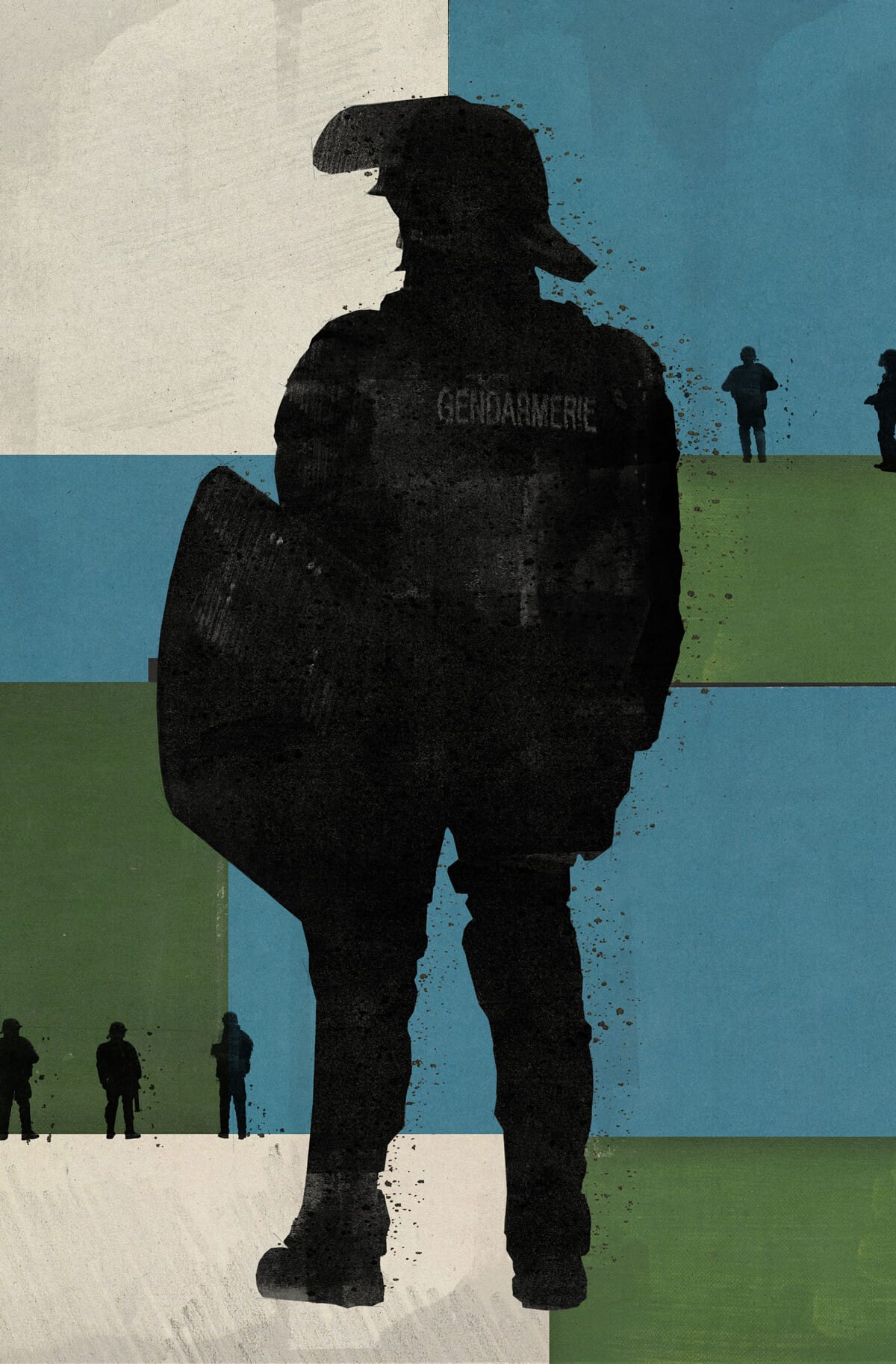
As the first group of marchers crossed the field toward the site, they saw that on the towering berm around the reservoir hundreds of cops had massed, and thousands more were posted in the cover of a forest that edged the field. Then, according to reports, the police attacked without warning. Tear gas sent the crowd running, a toxic haze obscured the landscape, and helicopters whipped overhead while armored vehicles were deployed in the distance. A hail of sting-ball grenades exploded in the air and at people’s feet, sending rubber shrapnel in all directions. A man’s skull was blown open, a woman’s foot shattered, and several people lay blinded by tear gas. As the injured screamed in agony, a few of the marchers fought back. A group of young men, masked and wearing only black and carrying wooden shields, threw Molotov cocktails and rocks dug out of the dirt; others shot fireworks at the forces de l’ordre. Per news accounts, the protesters set at least three police cars on fire and injured sixteen officers.
The battle of Sainte-Soline, as it became known, did not issue out of a political vacuum. It was the culmination of years of conflict over the expanding reservoir system in western France. A coalition of French citizens—antireservoir activists, smallhold farmers, environmentalists, students, eco-saboteurs, and black-clad anarchists—demonstrated against several reservoirs in the Deux-Sèvres and Charente-Maritime departments in 2022, with some of the marchers tearing out pumps and pipes and ripping up and setting aflame the huge plastic tarpaulin linings that kept the water from percolating into the ground. Others had sabotaged reservoirs across the region under cover of night and escaped undetected. The police expected similar property destruction at Sainte-Soline.
After two hours, the battle was over, the protesters forced to flee. The government claimed that nearly fifty police were injured but only seven demonstrators required medical aid. Protest organizers, however, counted two hundred injured in the fighting, including one who fell into a coma from a sting-ball grenade that exploded by his head. The authorities had launched as many as five thousand grenades and tear-gas canisters. Around 3,200 cops had marshalled for the attack, deployed along with nine helicopters, four armored vehicles, and four water cannons, directed from a command center overlooking the field of battle. The attack had been effectively greenlit by Gérald Darmanin, the interior minister in the Macron government, who in the days and weeks following the bloodshed denounced the marchers as “ecoterrorists.” Human rights investigators with the UN had a different view. They called the violence at Sainte-Soline “alarming” and “anti-democratic” and noted that France is the only country in the EU known to deploy tear gas and stun grenades against a peaceful assembly. The repression arose, in part, because the antireservoir movement, radicalized and well organized, had succeeded in monkey-wrenching agribusiness in France—direct action against entrenched interests that could not be tolerated.
Machines in the Garden
I visited western France in 2024 to write about the antireservoir movement, and my first stop was at the home of one of its most outspoken leaders, an elfin environmentalist in his seventies named Jean-Jacques Guillet, in the village of Amuré in the Deux-Sèvres. By trade a carpentry teacher, Guillet had spent decades in some form of elected officialdom, typically as a rabble-rouser. As mayor of Amuré for nineteen years, he clashed with local farmers about their use of GMOs. For six years he was president of the local waste management authority and made a name for himself stopping the construction of a garbage incinerator in the city of Niort and, before that, a nuclear-waste burial site in the town of Neuvy-Bouin.
The reservoir complex was a form of climate adaptation, but one that attempted to monopolize a public good.
What most interested him were the consequences of the transformation of farming in France after World War II. It was to him a history of the destruction of a venerable peasant culture and the erasure of the landscape of his youth. “We say, ‘It is not water that flows through our veins, it is the river of our childhood,’” Guillet told me. “I was a child of agriculture, I grew up on a farm, and if today I am a seventy-three-year-old activist, it’s because, without being really conscious of it, I was traumatized in my childhood after the war,” when these terrible changes took place.
If you were to look at aerial photos of France in 1950, it was a country of millions of small parcels, irregularly shaped, diverse in what they produced, a “nation of three hundred cheeses,” as Charles de Gaulle reportedly once quipped. This patchwork of distinct food cultures had evolved over centuries of experimentation and adaptation based in local knowledge of the interactions of weather and soil, crops and livestock. “We were smart enough,” said Guillet, “to understand that one did not just do anything one wanted anywhere.”
In the wake of the privations of wartime, France turned to the American model of productivist monoculture. Traditional wisdom was jettisoned and local diversity pushed aside for the cultivation of crops best tended by machines for maximum output and efficiency. Large parts of rural France fell to a regimen that required expensive tractors; heady volumes of fossil fuels, fertilizers, herbicides and pesticides; the capture of water for irrigation; and, not least, vast open fields where machines could run unimpeded over miles of uniform terrain. “Nowhere was the transformation of the agricultural sector effected so quickly and so thoroughly as in France,” University of Oxford historian Venus Bivar writes in her account of postwar farming upheaval in the country. “At the close of the Second World War, the agricultural sector was for the most part a backward holdover of the nineteenth century, and yet by the mid-1970s, France had become the world’s second largest exporter of agricultural goods—second only to the United States.”
Taming the land to make way for petroleum-powered tractors would prove devastating for western France’s bocage country, a tangled matrix of woodland, heath, fields, hedgerows, and orchards laced between brooks, rivers, and ancient canals. It was in the bocage country that Guillet romped as a child in the 1950s. Within a decade, large parts of the bocage came under assault. A teenage Guillet watched as bulldozers tore out the hedges and woods and straightened and redirected rivers and streams, transforming waterways into what was effectively “a large collector drain, the goal [being] to move water as quickly as possible for the sowing of cereals.”
By the 1970s, cereals in France had become cash crops for profitable sales to countries overseas. In order to expand into global markets, the areas of domestic cultivation would have to broaden into the most biodiverse and important storage areas for water, les zones humides—marshes, wetlands, river deltas. The new ideal, as Guillet described it, was that “all France would be made into a garden. There must be no uncultivated areas.” It was a move toward total domestication of the countryside, the logical extension of an American model that squeezed every last bit of profit from the land. Between 1960 and 1990, the French agro-industrial complex drained an estimated 50 percent of the country’s “uncultivated” wetlands.
The destruction of the old ways also meant the evisceration of an entire social class: the smallhold farmer or paysan (that is, peasant), an appellation considered a term of endearment by many rural French. Thirty-six percent of the adult population farmed in 1945. Today it’s less than 3 percent—which is to say that modernization eliminated roughly nine out of ten smallholders. (A similar process also unfolded in the United States: less than 2 percent of the U.S. population in 2025 remain in farming, a drop from 17 percent in 1945.) Consolidation and enlargement of French farms followed, with increasing control in the hands of fewer and wealthier players, the monopolies aided by government subsidies and tax breaks. Surviving smallhold farmers sank into the industrial maw: dependent on more machines, more chemical treatments, more fossil fuels, they were driven into increased indebtedness to banks. The types of crops changed with the decline of the smallholder, and one in particular emerged triumphant. With the introduction of hybrid strains from the United States after the war, corn production went from roughly 540,000 metric tons in 1948–50 to nearly 13 million tons in 2024, making corn the country’s second-largest cereal crop. It is now the third-most-exported grain in France.
The dominant voice of French agriculture, and the chief proponent of the corn regime, is the National Federation of Agricultural Workers’ Union (FNSEA), established in 1946. Though its membership includes lots of individuals who own farms, FNSEA defends the interests not of the workers but of the agro-chemical industry, the banks that finance Big Ag, and the largest and most powerful agribusiness companies and allied cooperatives. According to Corporate Europe Observatory, a Belgian watchdog, FNSEA is “France’s agribusiness war machine.” It is “much more than just a farmer’s trade union: it has been the co-manager, together with large sections of the French State, of France’s agricultural system for the past 50 years.” FNSEA promotes the distribution and use of toxic pesticides and herbicides in Europe, and it is also a proponent of pesticide-dependent grain as a cash crop for export. The union has been the loudest booster of reservoir construction in the face of the drought that has afflicted western France. And, unsurprisingly, it has gone to extreme lengths to make sure its interests are protected against dissenters.
In 2019, FNSEA partnered with the National Gendarmerie, the branch of France’s armed forces that focuses on civilian law enforcement, to establish a special intelligence unit, code-named Demeter after the Greek goddess of the harvest, that would single out for surveillance and harassment anyone who engaged in “agribashing.” Agribashing was defined to include criminal activity—trespassing on agricultural facilities, acts of sabotage, and so on—along with “actions of an ideological nature,” including “simple symbolic actions denigrating the agricultural sector.” In cities, towns, prefectures, and rural police stations, and with local members of FNSEA lending a hand, Demeter intel operatives created a network of informants across France.
French courts ruled the program illegal and shut it down in 2022. The Demeter network, however, may still be in place, according to antireservoir activists. When one approaches a reservoir site in the fields of western France today, the response from watchful vigilantes can amount to a menacing display. A few months before I met with him, Jean-Jacques Guillet led a group of fifty students from a Belgian engineering school on a tour of a reservoir not far from his home in Amuré. Angry farmers on tractors—he assumed they were FNSEA—surrounded them at the site, Guillet says; not long after, gendarmes showed up, asking them what they were doing there.
Before the cops arrived, Guillet was able to tell the students about the threat the reservoirs represented:
They were surprised to hear that in France, a democratic country, where we consider water a public good, it can be grabbed by a few, stored in the sun, on black tarps at the mercy of evaporation, at the mercy of cyanobacteria. To be more stupid is impossible. And the cherry on top is that to fill the reservoirs we take water from aquifers. If we were taking the flow from a river or marsh, it wouldn’t be much smarter, but at least it would be less stupid. But to take high-quality water beneath us, protected from light and to place it in the sun? And best of all, to do it using public funds, with the support of elected officials?
Rivers Run Through It
The rivers that flow out of the gentle uplands of western France—the Mignon, the Sèvre Niortaise, the Vendée, and others—come together at roughly a single point west of the city of Niort, by the Atlantic Ocean, in the 386-square-mile coastal wetland-cum-canal system called the Marais Poitevin. No longer a true marsh, the Poitevin is an artifact of human intervention that began in the seventh century, when local monks embarked on construction of a complex of earthen canals and small barrier dams to drain stretches of land in the delta where the many rivers debouched to the sea. The man-made Marais Poitevin acted as a natural reservoir, storing excess water from the uplands. It became a marvel of bocage country—“It is one of the most important wetlands on the European continent,” said one account of the Poitevin, “a favorite stopover for migratory birds” and habitat for European otters—maintained for most of the last 1,400 years first by the monks, then by generations of peasants.
Among those who tended to the wounded at the battle of Sainte-Soline was a hulking, bearded forty-eight-year-old activist named Julien LeGuet, who had spent much of his life as a boat guide and self-taught naturalist in the Marais Poitevin. When the first group of reservoirs was proposed in 2017, LeGuet helped organize the opposition under the banner of a grassroots group called Bassines Non Merci, or Reservoirs No Thank You, which he cofounded that year with a collective of like-minded activists, environmentalists, and smallhold farmers. It was Reservoirs No Thank You that helped spearhead the march at Sainte-Soline.
I spent a day with LeGuet poling on his punt on the Sèvre Niortaise and in the canals that connected to it in the Marais Poitevin. With the spread of industrial-scale farming and the rise of the corn regime, the water had been poisoned with agricultural runoff, so toxified that locals advised not to swim in it. Thirty years ago, when he was a teenager, he and his friends bathed all summer long. Old-timers attested that at one time, as recently as seventy years ago, one could drink the water. Julien’s seventy-year-old father, Christian, a retired schoolteacher who hosted me for a week at his drafty old stone house, told me about the wetland as it once was. “When Julien was a boy, he used to collect frogs, scores of them every day. They’re gone, mostly. And the dragonflies, the variety we once had, the noise they made, the water buzzing with them, the frogs croaking, the number of insects. You don’t see the same plants in the water either.” The water lentils that typically float on the surface of healthy wetlands, richly green, a protein source for waterfowl and cover for the fry and tadpoles of fishes and amphibians, used to be so abundant that the canals of the marsh were dubbed the Green Venice. But the water lentils, according to Christian, were dying out, slowly disappearing.
LeGuet poled our boat in the cold November afternoon under gray skies, wearing a sweatshirt that said eco-terroriste. Not long ago, he had discovered a high-end surveillance camera camouflaged on the ground in front of his father’s neighbor’s house but pointing directly at his father’s home. He assumed it was placed there by the gendarmerie or Demeter agents to keep track of the comings and goings chez la famille LeGuet. He knew he was a target and leaned into it: hence the blaring words on the sweatshirt, which he wore every day I saw him. When I remarked on the sparkling clearness of the water, he insisted that it was full of poisons, that at least two hundred types of chemicals, including a variety of neurotoxins, have been detected there. He related this with a heaving sigh and a shake of his head.
There’s only so much of this type of grief one can bear without descending into rage. In an essay he wrote that was published in 2023, LeGuet addressed the “ecocidal business executives of the sprawling tentacular FNSEA”:
You who idolize to the extreme a capitalistic system and all forms of techno-solutionism, you who are ready to blow up nurturing lands to dig megacraters surrounded with megadams made waterproof by an ocean of black tarps. . . . For 15 years, in the Marais Poitevin, some of you thought well to come here and disturb the water and soil cycles. . . . you thought we’d let this happen? You thought we wouldn’t resist?
What shape, though, should resistance take? In the summer of 2021, LeGuet and other representatives of Reservoirs No Thank You met with members of a grassroots environmental action group called Les Soulèvements de la Terre, or Earth Uprisings, to answer that question. The group was an outgrowth of a successful land-defense movement that had formed in northwestern France, in the rural community of Notre-Dame-des-Landes, where farmers had been fighting for decades to protect four thousand acres of small-hold bocage farmland from destruction for a planned airport. Starting in 2008, activists and anarchists joined the farmers’ movement, and despite attempts by successive administrations to evict the land defenders, who fought repeated battles with police that involved tear gas and beatings and lots of injuries, the airport was never built and the bocage was left intact. The occupation at Notre-Dame-des-Landes—nicknamed zone à défendre (ZAD) as a middle finger at the developer’s common lingo “zone à déveloper”—provided the model for resistance that Earth Uprisings would now uphold. After the founding of Uprisings in January of 2021, chapters sprung up from one side of the country to the other, though the exact numbers of its membership were unknown.
The group’s 2024 manifesto, First Tremors, a three-hundred-page, anonymously authored book published by radical Paris imprint La Fabrique Éditions, made clear their vision of ecological revolt in the context of global capitalism that had become “intoxicated by Herculean power” and left the natural world a shambles. “We are young rebels who have grown up with the ecological disaster in the background and precariousness as our only horizon,” said the manifesto. It inveighed “against the urbanization that tends to cover [the planet] with concrete, to infinitely extend the tentacles of roads, lines, and flows,” the landscape suffocated with infrastructure. It denounced the extractivist economy “that pollutes irremediably in the service of fossil capitalism.”
Earth Uprisings proposed three prongs for land defense: occupation (of places, by people en masse who refuse to budge); blockade (of industrial activities and byways—roads, for example—that threaten those places); and sabotage (of industrial machines and property), which they called “disarmament.” They echoed the long history of working-class machine-breaking in Europe and hailed especially the antecedent of the Luddites of England, artisanal weavers who in the 1810s found themselves out of work with the advent of mechanical looms and took action by donning masks in the night to smash the machines with hammers and clubs. Starting in 2021, cells of direct actionists who issued communiqués via Earth Uprisings sabotaged cement and concrete factories, sand quarries, road construction sites, and road-building equipment across France. Following the meeting that summer with Reservoirs No Thank You, the list of targets expanded to include the reservoirs of the Vendee, Deux-Sèvres, and Charente-Maritime departments.
The movement thereafter grew by leaps and bounds. Autonomous collectives of French anarchists joined and would become instrumental in tactical and defensive strategy to fight back against violent policing and give other protesters, most of them terrified of battle, a better chance to exercise the right of assembly. Anarchists were willing to engage in physical combat with police and use incendiaries such as Molotov cocktails. As a general policy, the representatives from Earth Uprisings neither encouraged nor discouraged these acts of revolt. All rebels were welcome, all methods were in the running, as long as a line was drawn at the taking of life. (“We’re not terrorists!” LeGuet told me.) The movement was hardly fringe. By the end of 2021, FNSEA’s old enemy, the Peasant Confederation, a formidable union of smallhold farmers established in the 1980s to oppose agribusiness, had also joined the rebellion against the reservoirs.
Arrayed against the water defenders, farmers, anarchists, and environmentalists were the FNSEA patrollers—a mix of “virile fraternity, binoculars, beers, sodas, and shotguns in the trunks of utility vehicles,” as described in First Tremors—who took up posts around reservoirs deemed most threatened. The rebels evaded them again and again, raiding the sites under cover of night. Saboteurs posted communiqués using names that evoked satire and enigma: here struck the “Regional Directorate for Water Protection,” there the “Fremens of the Marais Poitevin.” By the time of the Sainte-Soline march, so much damage to reservoirs had accrued across western France that the resources of FNSEA, the Macron government, and local municipalities and police prefectures had been exhausted by a campaign of sabotage that operated across hundreds of miles of rural terrain. The campaign was fluid, organized, anonymous, and relentless. “Considering the multitude of potential targets and the extent of the territory to be protected,” stated a prefectural decree from 2022, “the available law enforcement agencies will not be able to contain these disturbances.”
Dead Reservoirs
Some in the anti-reservoir movement saw the violence of March 25, 2023, as an explosion that issued from this administrative impotence. The odd thing about the Sainte-Soline site is there was nothing for the rebels to sabotage, no pipes or pumps or plastic tarps yet installed. The government defended with ferocity an empty crater because it was symbolic to hold the ground against unruly citizens. The seriousness of the police violence fell into vivid context when a government official noted in a hearing on Sainte-Soline that five thousand tear gas and sting-ball grenades fired in one day in that rural enclave was more than had been fired in 2018 across all of France (and this during the widespread unrest that year from the Gilets Jaunes protests). Interior Minister Gérald Darmanin attempted to legitimize the bloodshed at the battle of Sainte-Soline with a declaration that Earth Uprisings should be banned under French law, its principals and adherents to be charged and imprisoned as terrorists.
What shape should resistance take?
By dissolving Uprisings, rendering it an illegal entity and smearing by association all who worked with the group—including Reservoirs No Thank You, Julien LeGuet, Jean-Jacques Guillet, and so on—one could open the flood gates of mass arrests of ecological rebels. Darmanin issued his order for the dissolution of Earth Uprisings in June 2023, but within months France’s high court shut him down, stating it was Darmanin who was acting outside the law. “Inciting violence against property,” stated the court, “does not justify dissolution.” (In November, journalists with the newspaper Libération and the nonprofit investigative news site Mediapart revealed bodycam footage from gendarmes at the battle of Sainte-Soline that showed officers not only violating laws themselves in their use of weapons against protesters but also rejoicing in the thrill of injuring their targets.)
A few days after my visit with LeGuet in the Marais Poitevin, I went for a drive with Guillet in his little electric car to take a tour of reservoir-construction sites across the Deux-Sèvres. Some of the sites had been sabotaged in the last year, others more recently, others not at all. Piloting dirt roads, we came upon a reservoir in the afternoon light. The barbed-wire fencing of the berm rose from a sea of dead corn stalks, and when we approached the perimeter a surveillance camera flashed from a fence pole. “Uhp,” said Guillet, winking at me. “They’ve got us.”
“No, my friends,” he said, addressing the camera, “we are not here today to smash things or make trouble. That’s for another day.” He speculated on the ease of blowing the camera to bits with a carbine, then we got back in his car to continue the tour. We passed a pump that supplied a reservoir that repeatedly had been put out of commission. Someone, he said, kept hitting that pump again and again, tearing out its guts. It was just terrible, said Guillet, grinning like an imp.
A few days earlier, Guillet and I had attended a march of around a thousand people who gathered in the morning fog in the village of Saint-Sauvant, in the uplands thirty miles east of the Marais Poitevin, not far from the battlefield at Sainte-Soline. The goal was to walk from the village in a procession that would cross the countryside on backroads to the site of the planned Saint-Sauvant reservoir, which had yet to be built. A sizable number of police—scores of officers, allegedly—were said to be hunkered in the forests along the route of the march. No one I talked to knew what to expect. An attack was possible, for whatever reason the state deemed fit. Perhaps the marchers would be allowed to proceed without trouble.
The alliance of peasant farmers with Reservoirs No Thank You and Earth Uprisings’ direct actionists had produced a good run. Reservoirs in Deux-Sèvres were on hold, and in 2025 the authorities in the department of Vienne would announce the cancellation of the planned construction of forty-one other reservoirs, according to LeGuet. Some projects had “died in the cradle,” he told me, “abandoned without anyone knowing because elected officials are terrified of seeing a ‘Sainte-Soline’ in their backyard.” Prompted by lawsuits from nature conservation, fishing, and other environmental groups, French courts had weighed in and killed or delayed projects, finding them in violation of various laws, including those protecting water quality and wildlife. The list of questionable reservoirs included Sainte-Soline; a December 2024 court decision ruled that its construction threatened the habitat of an endangered bird species. At the same time, reservoirs as a publicly funded support for agribusiness have become a growing object of revulsion across France, largely because of the negative publicity the rebellion against them brought. After the violence at Sainte-Soline scared people from fighting in the fields, they opened their pocketbooks; one fundraiser for Reservoirs No Thank You in 2024 netted a sizable sum of donations, according to Jean-Jacques Guillet, though he declined to say how much, and close to two hundred new chapters of Earth Uprisings formed across France, Belgium, and Switzerland.
In some instances, however, the Macron government had defied the court orders and continued building reservoirs. “We are in a kind of Mafia state then. The law has spoken, the government doesn’t listen,” Guillet told me. He had marched at Sainte-Soline and come under attack and now was one of the marchers at Saint-Sauvant. The bitterness and pain of events a year and half earlier had not been forgotten, and many of the people mustered had been in the battle and seen the wounded and heard their cries. Julien LeGuet was also here for the march. That morning, at his father’s house, LeGuet had been chain-smoking and guzzling coffee. He looked weary, like he’d slept in a ditch, and he was worried about how the day would unfold. He expected the worst.
We set out past noon, the procession stretching a mile in length along muddy dirt roads through enormous fields of corn that had been cut for harvest. People sang and shouted slogans, and loudspeakers boomed music, and the marchers wanted to tell their story. I met a woman in her thirties named Laury Gingreau, a co-owner of a cooperative farm, where she and her partners in recent years had planted three thousand trees, including sixty different species, their goal the rewilding of the landscape. She had been tear-gassed at Sainte-Soline. “It was like war,” she told me. Gingreau joined Reservoirs No Thank You at its inception in 2017 and had no intention of backing off. I met a twenty-one-year-old philosophy student named Kate Saoirse, who told me the struggle against reservoirs was about “the nation-state versus the people who live in the land. It’s about ways of life lost to progress—which means colonialism, empire, corporate power.” She said she marched because she was “on the side of people living in the land.”
We reached the site of the future Saint Sauvant reservoir. For miles around, except a few remaining vestigial forests, all one saw was machine-scythed corn that crunched underfoot. Little children carrying buckets of seeds—types of peas and wheat and other grains—sowed the fields with their parents in an act of protest against monoculture. Two peasant farmers spoke about water woes; LeGuet exhorted the crowd with a chant of “No bassaran!” (a joking homage to ¡No pasarán!,” the rallying cry of Republican and anarchist forces in the Spanish Civil War); and a deputé from the National Assembly, adorned with the tricolor sash that elected officials in France often wear at public events, inveighed against agribusiness. A dozen men and women with hammers and nails then proceeded to build a bird-viewing station out of rough-hewn logs. This was in honor of the ground-nesting little bustard, which is headed for extinction in western France because of the overdevelopment of its habitat.
The march unfolded without incident, though at one point a young woman went to urinate in the forest along the route and flushed out a group of armored gendarmes hidden in the brush. The gendarmes ordered her to “piss somewhere else.” A drone followed the crowd, low in the fog. Cops in the distance, armed with long-lens cameras, took photographs. It was reasonable to assume the images would be held in data banks for use under whatever laws the government passes in the future to imprison so-called ecoterrorists—which is to say all those who defend land from the progress of the capitalist machine.
This story was produced in partnership with the Food & Environment Reporting Network, a nonprofit news organization.