, December 9, 2025
A Painter of Landscapes
Nationalism and the sublime in the work of José María Velasco
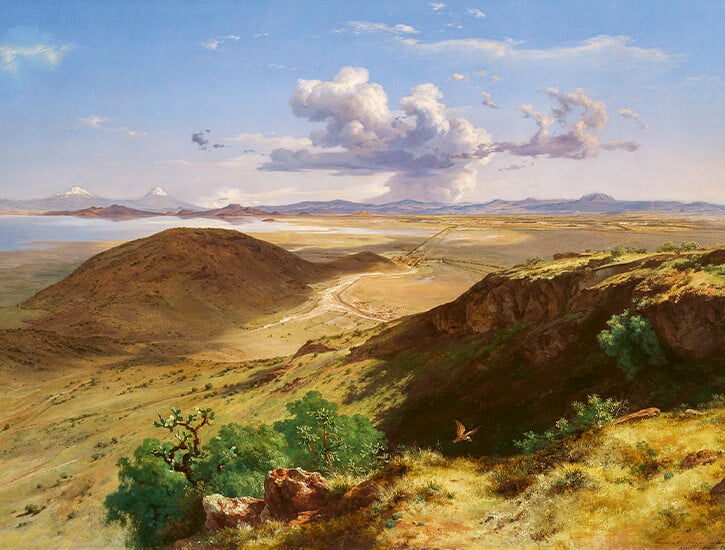
José María Velasco, The Valley of Mexico from the Hill of Santa Isabel, 1877. Oil on
canvas, 161 × 228.5 cm. Museo Nacional de Arte, INBAL, Mexico City. © Reproducción
autorizada por el Instituto Nacional de Bellas Artes y Literatura. Photo: Francisco Kochen.
X12231.
José María Velasco: A View of Mexico. Minneapolis Institute of Art, September 27, 2025–January 4, 2026.
They say he gave one gold imperial coin to each soldier in the firing squad. “Muchachos, aim well, aim right here,” he said, pointing at his chest. He wanted his mother to recognize him. The detail about the coins may be apocryphal, but we know from his funerary photo that the corpse of Maximilian I—Mexico’s short-lived Austrian emperor—went home with his head in one piece that summer of 1867. Well, except for the eyes.
When Mexico’s anti-imperialists defeated the emperor’s occupying army, in a harebrained campaign backed by Napoleon III, they shipped his body back to Mexico City. It was strung up by the legs in a hospital that is now the National Museum of Art and embalmed in preparation for its long journey back to Europe. Looking at the photo of their handiwork, which circulated widely in Europe and may have inspired Édouard Manet to paint his famous depiction of Maximilian’s execution, it seems the morticians didn’t do a very good job: in addition to his stretched and distorted features, his eyeballs were plucked out and replaced with unconvincing implants. They were probably glass or enamel, though some reputable sources say they came from a statue of the Virgin at a nearby cathedral.
This was the culmination of a period of nonstop chaos unleashed in the wake of Mexico’s independence from Spain almost fifty years prior. Geopolitical power was fractured across this vast, newly independent territory. Regional strongmen rebelled constantly against the central government’s attempts to bring them under control. War with the United States ended catastrophically in 1848, with Mexico losing just over half of its territory to the northern victors. It couldn’t pay back its war loans from the French, providing a convenient pretext for Maximilian’s doomed invasion and ever-so-brief imperial foray.
Mexico needed a hero, someone who could bring the country’s conflicting interests together under one banner. And amazingly, that hero turned out to be a painter—a painter of landscapes.
The swell of patriotism that such idealized depictions produce has made them easy fodder for nationalist movements wishing to stake their claims.
José María Velasco rose to prominence in the late nineteenth century for his exquisitely detailed panoramas depicting the Valley of Mexico, the geographic basin that cradles Mexico City amid a halo of volcanic peaks. His success allowed him to tour surrounding states like Oaxaca and Veracruz, producing a body of images that would become canonical to Mexico’s national identity. Through official diplomatic presentations at world-historical fairs and exhibitions abroad, he eventually achieved the status of Mexico’s first international celebrity artist, trumpeted as the supreme maestro of the Mexican school of painting.
But Velasco’s renown crested and then declined, as his work became outmoded by modernism’s fast-changing fashions. He’s no longer a household name in the vein of Diego Rivera (who was his pupil) or Frida Kahlo, especially outside of his home country. That may begin to change, thanks to the long-overdue traveling retrospective José María Velasco: A View of Mexico, which originated at the National Gallery in London and is now on view at the Minneapolis Institute of Art through early January.
Velasco, a polymath trained in botany and geology, reinvigorated landscape painting by pairing the plein air poetics of light, color, and perspective with the empiricism of explorer-scientists like Alexander von Humboldt. His soaring views captured the majesty of Mexican soil without the sentimental embellishment characteristic of Romantic predecessors and counterparts in the United States and Europe. And you can almost always spot the march of industrial progress in the form of mills, factories, and steam trains chugging along shiny iron bridges. This made his paintings more than just exaltations of the untrammeled wild.
Still, his arrival at the status of national hero didn’t just happen. He enjoyed a relationship of convenience with the dictator Porfirio Díaz, who imposed an uneasy stability through a brutal thirty-year regime. While prosperous for the ruling class and foreign capital, this newfound modernity came at the cost of the violent suppression of striking workers and indigenous groups.
Díaz and his men saw in Velasco’s work a picturesque vessel for the delivery of their “developmentalist” agenda, in the words of Velasco expert Fausto Ramírez. Whether a willing participant or a patsy, Velasco’s view of Mexico in transition happened to rhyme with their view of nature as “a ‘profitable’ or ‘saleable’ commodity, available for exploration and exploitation.” They rewarded him with appointments and exhibitions. Furthermore, through his repeated portrayals of key features in the Valley of Mexico, like the snow-capped peaks of the Popocatépetl and Iztaccíhuatl, Velasco helped normalize the consolidation of power and patriotism around the country’s geographic center. These visions signaled a new Mexico proudly on the brink of bourgeois, industrial modernity—“a campaign orchestrated by ‘the wizards of progress’, active in the Development Ministry, who did not hesitate to put art to the service of national interests,” Ramírez writes.
You wouldn’t really get any of this from the exhibition at the Minneapolis Institute of Art. That would be a lot of ground to cover in a small show, the first Velasco exhibition on U.S. soil in nearly fifty years, one meant to introduce the painter to a foreign audience. But even the catalog makes only passing reference to the artist’s role as a booster for the bloody regime known as the Porfiriato, calling him “an essential figure in that generation of nation-builders”—and leaving it at that. We can and should honor the work’s unparalleled beauty and rigor, along with the many lessons it has to teach us. But we’re missing a crucial part of the story without a serious conversation about whose interests it served.
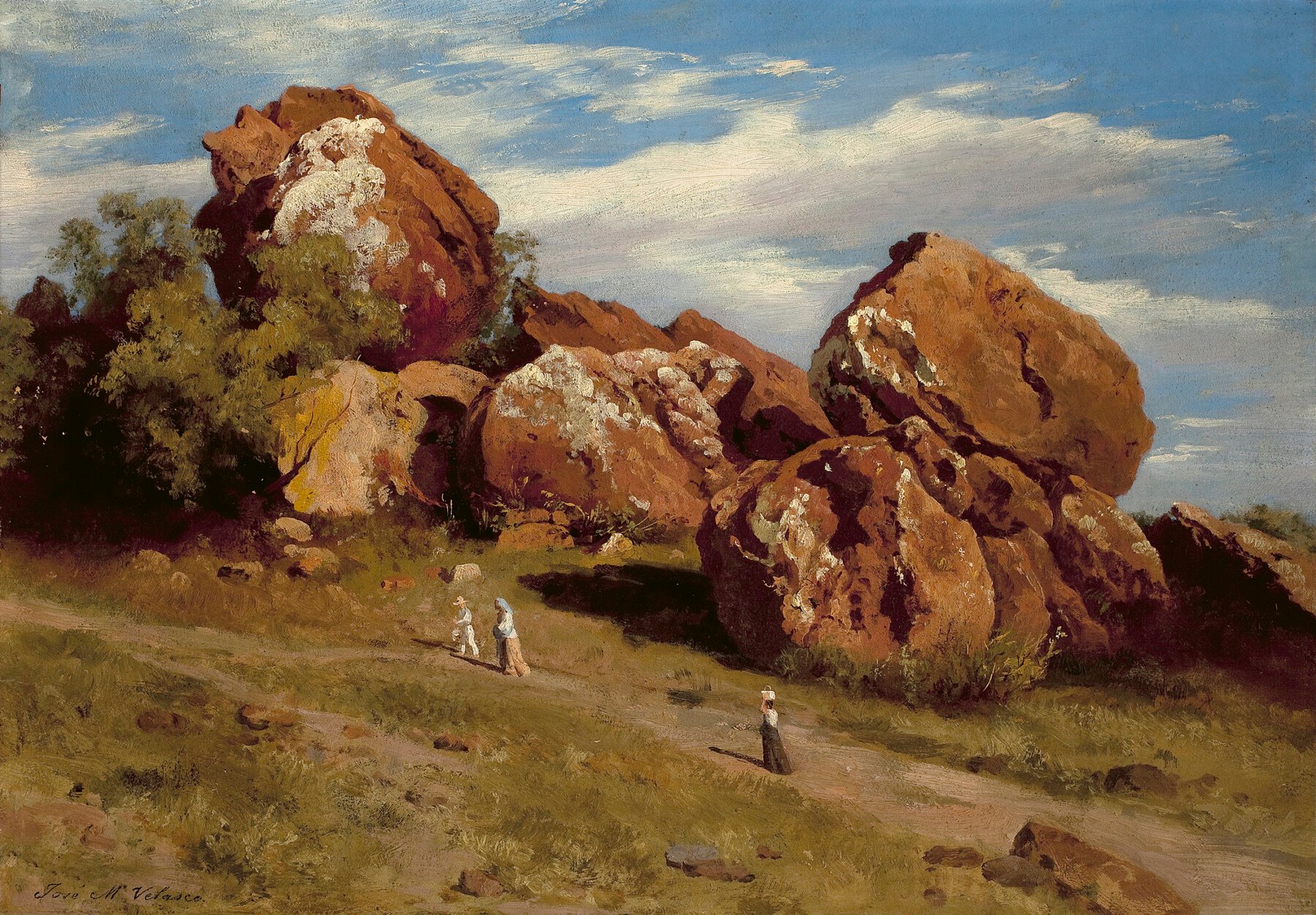
Velasco began his training as a teenager in Mexico City, after moving with his widowed mother and two brothers from their humble village of San Miguel Temascalcingo to the capital. While working in his uncle’s textile shop, he enrolled in night classes at the prestigious Academia de San Carlos, the first art academy in the Americas.
Founded in the previous century, the state-run academy’s curriculum was based on those of the great Old World art schools. It was staffed by European directors and teachers who instilled in their students the aspirational values of European buen gusto, or good taste. Despite his family’s precarity, he was able to continue as a full-time student thanks to a scholarship he’d won for an early oil painting, The Courtyard of the Former Convent of San Agustín (1860). The contemplative scene of a crumbling edifice underscores the developing artist’s exacting yet quietly expressive eye. Under the tutelage of Italian landscapist Eugenio Landesio, who encouraged the schematic study of things both built and natural, Velasco split his classes between the art school and the Escuela Nacional de Medicina. He graduated in 1868 and received his appointment as a lecturer that same year, a vocation he would practice for the next forty-two years.
Before he discovered the Valley of Mexico from on high, Velasco painted from below. He’d spend his days in Mexico City’s Chapultepec Forest—now a 1,700-acre park, where you can wander past swan boats and vendors selling novelty hats shaped like monkeys—gazing up at Chapultepec Castle. Originally built for Spain’s eighteenth-century viceroy, the hillside citadel would captivate Velasco for the better of thirty years. Its stucco-coated walls and parapets—seen from afar or in partial view, flanked by figures toting parasols on their Sunday stroll—provided a vehicle to experiment with shifting atmospheric light, though it invariably appears with its coterie of rustling cypress trees, whose delicate leaves he loved to paint. During Velasco’s student years, it was occupied by the invading Emperor Maximilian I, who one likes to imagine may have glimpsed the still-unknown painter with his portable wooden paintbox.
Velasco and his wife would often visit his mother at her home in Villa de Guadalupe, a village outside the capital that, 150 years later, is now firmly within urban city limits. There, on the hill behind her house, he began the sketches and studies for what would become his first monumental panorama: The Valley of Mexico from the Hill of Atzacoalco (1873). Even in this early work, you can already see his signature: an information density verging on the cartographic. This is especially clear in the painting’s pencil study, which appeared at the National Gallery but was returned to Mexico before the Minneapolis show. It includes assiduous notes on noteworthy mountain peaks and buildings like the Basilica—itself an homage to that most venerated icon, the Virgin of Guadalupe, who embodies the myth of Mexico’s mestizo origins. We see him coming into his own as a colorist here, too, with a tempered palette of reddish rocks and hazy purple mountains that resists the temptation toward bombast. (Hilariously, it is precisely this subtlety—this creativity within a relatively limited spectrum—that a reviewer for the Guardian misread as “boring” and “proudly dull.”)
Then, two years later, he unveiled the first of his two undisputed masterpieces: The Valley of Mexico from the Hill of Santa Isabel (1875), created for the 1876 Centennial Exposition in Philadelphia. This nearly eight-foot-wide knockout is the first thing you’d see walking into the gallery at the Minneapolis Institute of Art. In the foreground is an indigenous campesino family going about their day’s labor, another Velasco motif contrasting life on the margins with the smokestacks and trains in the background. He’d been exploring this uneasy synchrony for nearly fifteen years, going back to early standouts like The Goatherd of San Ángel (1863). Hung directly opposite The Valley of Mexico, this scene of a boy and his goats feels undeniably quaint by comparison. At their left, the figures are seen climbing out of a forested ravine where a river flows through a hydroelectric dam, a rainbow playing in the spray of its cascading stream. On the other bank is a textile mill, where a man, presumably a mill worker, waves from atop the roof—a message of harmonious relations. Far from being drowned out by the gravitas of its neighboring works, The Goatherd stands out for its storybook charm.
The work can be cerebral, serene—and implicated in a publicity campaign to romanticize the dispossession of people from their land.
Velasco’s second monumental masterpiece, completed in 1877, won him a medal from the newly inaugurated President Porfirio Díaz, and was such a hit at the Paris Universal Exhibition that a copy of it was gifted to Pope Leo XIII. Painted from the same hillside vantage as its 1875 predecessor, the work employs a cunning perspectival shift that intensifies the awesome feeling of standing face-to-face with the sublime. A useful concept here might be that of the “imperial sublime,” coined by historian Harsha Ram in reference to the heroic narratives of poets like Pushkin, who portrayed the Caucuses as Edenic wilds awaiting their conqueror. During the early period of Russia’s imperial expansion, Pushkin’s verses forged a link between the sublimity of the natural world and the sublimity of patriotic sentiment. “This new creed . . . taught that a nation’s essence lay in its land, its vernacular language, and its folk culture,” Sophie Pinkham writes in her forthcoming literary history of Russia, The Oak and the Larch. “Rather than seeing identity as conferred by empire or religion, Romantic nationalism held that it grew out of the earth.”
No mental gymnastics are required to see similar forces afoot here. But Velasco’s works didn’t promote empire so much as a kind of “internal colonization,” according to Josué Martínez Rodríguez, the chief curator at the National Museum of Art in Mexico City, which loaned many of the works on display here. The significance of, say, the steam train and its attendant infrastructure, is that it facilitated the penetration of a centralized state into the unincorporated periphery, with all the violence that implied. “In Mexico, in particular, the landscape genre does come from a profoundly colonialist tradition,” Rodríguez told me, “because you had Humboldt, and then Waldeck and then Nebel: the first landscape painters who visited independent Mexico in the nineteenth century came from Germany and France not exclusively to paint and portray the landscape, but in search of territory to exploit.”
This ideological baggage is well documented. As the art historian Jolene Rickard has argued: “From an Indigenous perspective, the genre of landscape painting is one of the conceptual and visceral tools of colonization.” After all, its stars have been co-opted to evil ends: Caspar David Friedrich, the German Romantic enshrined by a recent blockbuster at the Metropolitan Museum in New York, became an official artist of the Nazi party a century after his death. His grand panoramas not only exalt German soil and spirit, they depict humans facing the unknown in a way that makes conquest seem noble.
The Hudson River School painters, including Velasco’s contemporaries like Albert Bierstadt and Frederic Edwin Church, are broadly known for capturing North America’s majesty while providing a visual argument for the project of Manifest Destiny. Bierstadt first traveled West with a government-sponsored survey exhibition to the Nebraska Territory, using this and subsequent trips to produce kitschy epics like The Rocky Mountains, Lander’s Peak (1863). Depicting a Shoshone settlement in a clearing at the foot of the Rockies, it resorts to cheap theatrics you’d never see in a Velasco—over-saturated colors and god light landing on a perfectly reflective lake. The swell of patriotism that such idealized depictions produce has made them easy fodder for nationalist movements wishing to stake their claims.
Velasco was the official artist of his era par excellence. But in the brief instance where the exhibition catalog deigns to consider the implications of that, co-curator Daniel Sobrino Ralston waves any concerns away. “Velasco has occasionally been considered, with some distaste, an adjunct to the Porfirian project,” he writes. “His cerebral, serene art, however, eludes so simplistic an interpretation, even if, as the painter noted in his list, several of his paintings were purchased by Díaz himself.” What’s actually simplistic, however, is not being able to hold two thoughts simultaneously: that the work can be cerebral, serene—and implicated in a publicity campaign to romanticize the dispossession of people from their land.
There is a similarly myopic tendency among Anglo critics to downplay the work’s ideological content. “Velasco is not an overtly nationalistic painter in an iconographic sense,” one Hyperallergic reviewer writes, incorrectly. Maybe that’s because they forget that, despite Mexico’s subaltern status to its northern neighbor, it, too, is a colonial project. Following the recent rise of anti-immigrant fascism in the United States, it’s become fashionable for liberals to declare that places like Texas and California were stolen from Mexico. That’s true. And who do you think Mexico stole them from?