, February 3, 2026
A Human Experience
A conversation with Muntadhar al-Zaidi
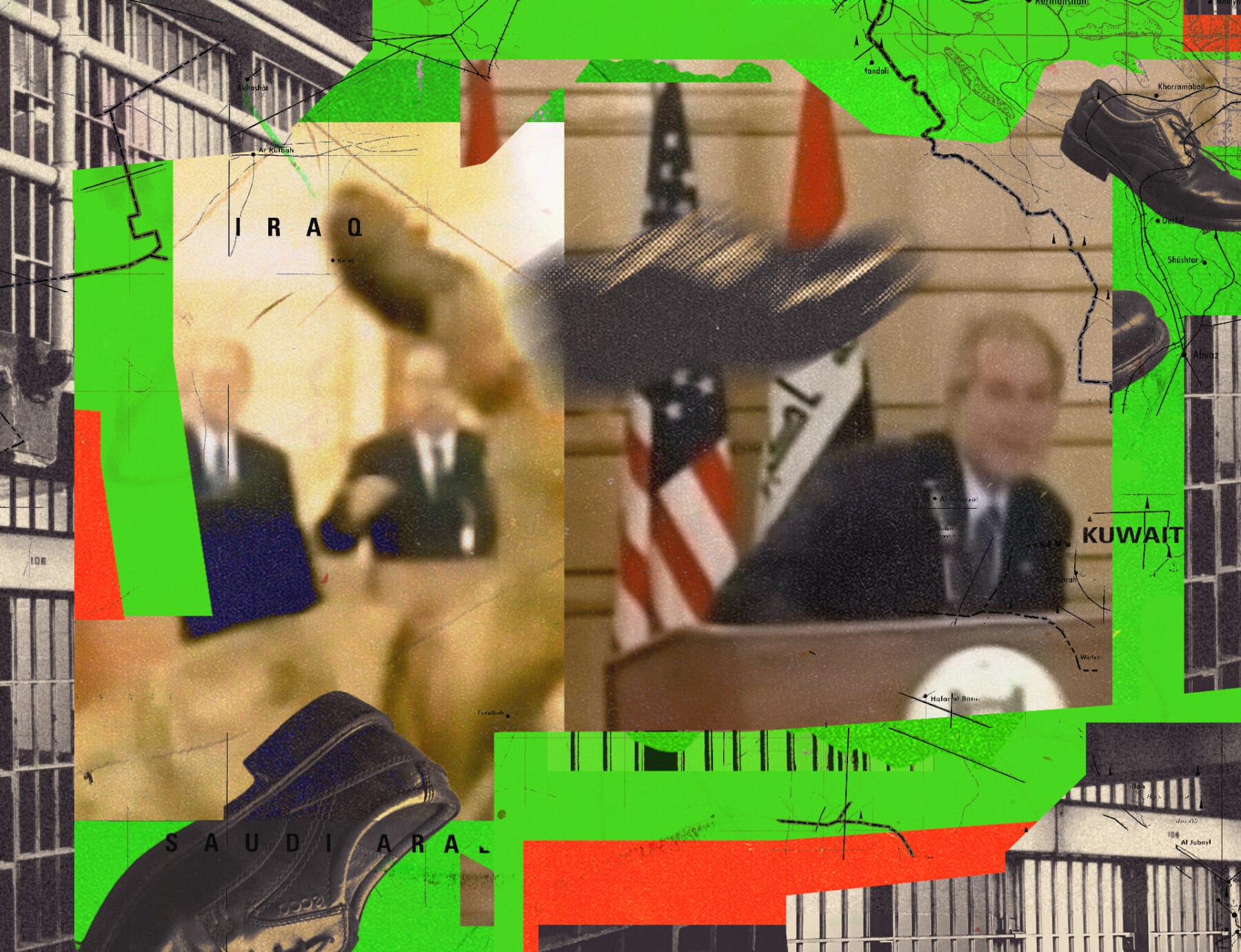
On December 14, 2008, at the tail end of his presidency, George W. Bush made an unscheduled visit to the empire’s newest imperial dominion: Iraq. During his administration, the United States invaded the country (for a second time) and toppled Saddam Hussein, installing the American-dominated Coalition Provisional Authority in his place. After privatizing the country’s economy and appointing the committee that drafted a new constitution, an occupation-approved coalition government was marshaled by former dissident Nouri al-Maliki, with the help of American troops and private military contractors. Those same troops stationed in the remarkably titled Camp Victory would be the first ones to receive Bush after an eleven-hour flight to Baghdad. He noted that he had rechristened Air Force One as Rudolph One in honor of the impending holiday and then commended them for their service.
Bush’s next appointment was a meeting with Iraqi officials to sign the Status of Forces Agreement: a document authorizing the continued presence of American soldiers in the country—otherwise set to expire the day before the new year—and vague allowances for the Iraqi government to prosecute some American contractors for atrocities committed on their soil. Thousands of Iraqis protested these policies as they were being made, with many in disbelief that American troops would ever truly leave their nation.
Young journalist Muntadhar al-Zaidi was covering the event for Al-Baghdadia TV, where he was chief of correspondents. He knew, from the moment he stepped into the room, what he would do, and his resolve hardened as he listened to the president’s empty and callous remarks. As Bush wrapped up his speech, he looked out into the crowd of reporters for a new mark. Al-Zaidi slipped off his footgear and heaved them toward the compassionate conservative, crying, “This is a gift from the Iraqis; this is the farewell kiss, you dog!” Although Bush dodged both, al-Zaidi managed to strike the American flag hanging behind him.
In their report on the shoe-throwing incident, the New York Times quoted Bush’s appreciative description of al-Zaidi’s protest, then described what journalists in the room heard as the president continued his remarks: “[Bush] also called the incident a sign of democracy, saying, ‘That’s what people do in a free society, draw attention to themselves,’ as [al-Zaidi’s] screaming could be heard outside.” Al-Zaidi was sent to jail as soon as the Iraqi prime minister’s guards finished smashing his teeth and breaking his nose.
More than a decade and a half since the shoes left his hand, al-Zaidi has made few media appearances. This he attributes to the wariness of his country’s news organizations in associating with someone who has been so critical of the post-Ba’athist government, which he derides as corrupt and run by wealthy officials. “Every political party has its own armed faction or militia that kills and terrifies people, kills their opposition and assassinates protesters,” he elaborated to CBS News in 2023. On social media, however, there are no gatekeepers, and it’s possible to catch al-Zaidi posting anything from workout pictures to messages of support for those suffering in Palestine.
Although Bush dodged both, al-Zaidi managed to strike the American flag hanging behind him.
We are still living in the world Bush and his cronies designed. Their work caused untold damage, poverty, and death. And yet there was no recourse—the perpetrators, in fact, seemed to have thrived. Members of the Bush administration spread like fungi. Some scored permanent guest spots on cable news shows, while others headed social media companies. A few would continue the work in other Republican administrations, wreaking whatever havoc they wanted and paving the way for today’s even more mendacious, emboldened, and bigoted party. Bush would even find his hand in art, painting portraits of veterans injured in a war he started. Most recently, his support was sought by the opposition party in their failed run for the presidency.
Reading the scoreboard is nauseating, as is even looking out the window. But the courage al-Zaidi showed in that moment years ago revealed a different path. It articulated a frustration with an untouchable class of administrators who used the fears of others for their own gain. Al-Zaidi showed that it is possible to get into a room with the person at the top and break through all the noise. His protest is a model of bold resistance, one that is at least as potent in a world of student activist abductions and deportations and undisguised perfidy from government officials.
I spoke with al-Zaidi by phone about his protest, its consequences, and his life after. Our conversation was conducted with the help of translators Eman Akram Nader and Mina Akram Nader and has been edited for length and clarity.
—Christopher Bell
Christopher Bell: People in America know you as the journalist who threw your shoes at George W. Bush. Can you tell us about who you were before that moment?
Muntadhar al-Zaidi: I was born January 15, 1979. That same year, Ayatollah Khomeini became the ruler of Iran and Saddam took control of Iraq. I grew up during the eight years of the Iran–Iraq War. My first sight since birth was battles and war, and all the death that resulted from them. We were even watching the killing happening on the other side. It was far from a normal childhood.
CB: What, if anything, changed when the United States invaded during the Gulf War?
MZ: After the Iran–Iraq War, the Iraqi invasion of Kuwait in 1990 began. When I was twelve years old, the battle of Desert Storm began: we watched as our homes and cities were destroyed by ghost planes and tornado jets, this being the first we had ever heard of them. We started memorizing what they looked like and what they were called.
We watched as our homes and cities were destroyed by ghost planes and tornado jets.
My teenage years began with an economic blockade on Iraq [imposed by the United States in 1990]. We went from being a country that was rich and comfortable to a country in which the majority of people could not afford more than bread and tea for breakfast. There was death on a daily basis, half a million children among them, and the major reason for this was the involvement of the United States of America. By the United States I mean the White House and not the American people. We wondered, “Why are we hungry? Why are they killing us? Why are they destroying our homes? Why were we experiencing such a tremendous amount of tragedies reoccurring every ten years?”
CB: And this was all before the United States invaded in so-called Operation Iraqi Freedom in 2003.
MZ: In 2003, I was a young man. Thus began the occupation of our whole country. My personal memories or the memories of an Iraqi child or teenager regarding the United States were very negative. You wouldn’t think to consider this a country that is friendly, an ally, or peaceful.
I want to convey to the White House the negative image that this country is arrogant, it kills, it invades—whoever it wants to, however it wants to. It is the one who decides which country is democratic and which country is a dictatorship, and which democratic country must be overthrown— as they did with Chile—and which dictatorship they should support, such as that of Pervez Musharraf, or those in countries in the Middle East or some of the [Gulf] kingdoms.
CB: After the famous shoe throwing incident, you were sent to jail. Are you able to talk about your time in prison and what your experience was like?
MZ: I was in solitary confinement for three months. During this time I was not allowed to read or write or watch TV or listen to the radio. I only had plain walls to look at. [There was] a guard standing outside this room, which was [only] as high as my height. For three months, my body was covered in bruises, contusions, and fractures from the torture that was inflicted on me by soldiers that were affiliated with the prime minister. In the three months, I was not allowed to see the sunlight. I was only allowed to use the bathroom three times a day, and even when I went, it was with my head covered so that the other prisoners and guards would not see the extent of torture that was displayed on my face.
CB: When did you leave prison?
MZ: Then I was transferred to another prison per my request to the judge. This prison was different from the last in that I was no longer in solitude. To me it was like heaven in comparison. Although it was still prison, this prison had a mattress and a toilet, and I was now able to use the bathroom and shower anytime I wanted. Now I was able to finally connect with my family.
Now, I don’t want to say I was a victim: however, this is the system, and I may be the only journalist who went through this experience. [It is for] me to be able to inform others of what happens in Iraqi prisons regarding torture and [violations of] human rights. It was more than being made a victim because I walked into prison on my own two feet, with no one forcing me and no one falsely accusing me. Mine could be a human experience, an ethical experience, a political experience.
CB: Can you tell me about the humanitarian organization you founded after your prison term?
MZ: It was called the al-Zaidi Foundation, to help the victims of the American occupation in Iraq. I organized it with a few Western friends. The goal of this organization was foremost publicity and media exposure of the violations of the American occupation in Iraq in all international social and cultural forums. The second was to file legal cases against the American occupation and anyone else who participated and bring them to international justice, so they receive their punishment for what they did in Iraq. The third goal was to aid and support the victims of the occupation, including orphans and widows. In 2009, [these] reached five million orphans and one million widows because we lost more than one-and-a-half million men in this random war and the civil war that resulted.
However, dreams are one thing and reality is another. I had big hopes for my people, but not only was I not able to achieve my goal [for the foundation], I lost my livelihood as well.
The White House is not God, that can command people’s life or death, who stays and who leaves.
CB: In July 2025, you traveled to Venezuela. Did you feel there was any connection between Venezuela and Iraq?
MZ: I feel the hurt of the Venezuelan people, I feel their hunger, I feel their pain, I feel their need for things that they have been denied because of the White House. I found that the Venezuelan people are no different than us. We may differ in religion, beliefs, politics, and ideology, but they are people just like we are, they have bodies like us, eyes like us, they have legs, desires, needs, and dreams like us. Why are they punishing the people for the government’s crimes?
What resulted in Iraq after the blockade? We starved, we have very bad memories that we might have forgotten, we stopped being victims and we became survivors. I’m worried about [Venezuela] and other countries: that America will control them and the fate of the people who live on that land.
CB: You’ve had a political career of your own. Who do you think has been the best leader for Iraq?
MZ: No one. No one. I think the leader who can lead Iraq has not been born yet. In the past, you have either had someone who is strong but not just, or just but weak, or strong but corrupt. At this stage, our leaders brought by America are weak, corrupt, and cruel.
CB: Speaking of leaders: What would you say to George Bush if you saw him now?
MZ: If we ever meet, God willing, it will be in front of God, where he will not only have to face Muntadhar al-Zaidi but all the millions of people whose lives he took.
CB: What would you say to the people who elected him?
MZ: The White House is not God, that can command people’s life or death, who stays and who leaves. The American people need to know, they have to know and be aware of who they elect: because while I have the ability to differentiate between politics and the people, there are millions on this earth who cannot. They say America is America, the politics are the people who are there. This is my advice to the American people, whoever you are electing to lead you is causing you to be hated. America has people who are persecuted by their own government and its economic policies, and its health care, and its taxes, and its minorities—Latinos, Arabs, Muslims, Hindus. All this is known to the American people, they are all being persecuted because of the policies of the White House.
CB: Any final thoughts, perhaps something you’d like to say to a reader in the West?
MZ: I’d like to say one final word to all the American people, and all the people of Europe, and Australia, and the Asian cities, who went out to protest in support of Gaza and the Palestinian people: we thank you in the name of the millions of sleeping Arabs who have not been able to attend one protest in their own country out of fear of the government. Thank you to all of you, for you have proven that you are more humane than us, you are braver than us, and that you are able to challenge and stand against the Zionist propaganda and your leaders. You left your jobs and put yourselves in danger for your stance. A big thank you for standing on the right side of history.