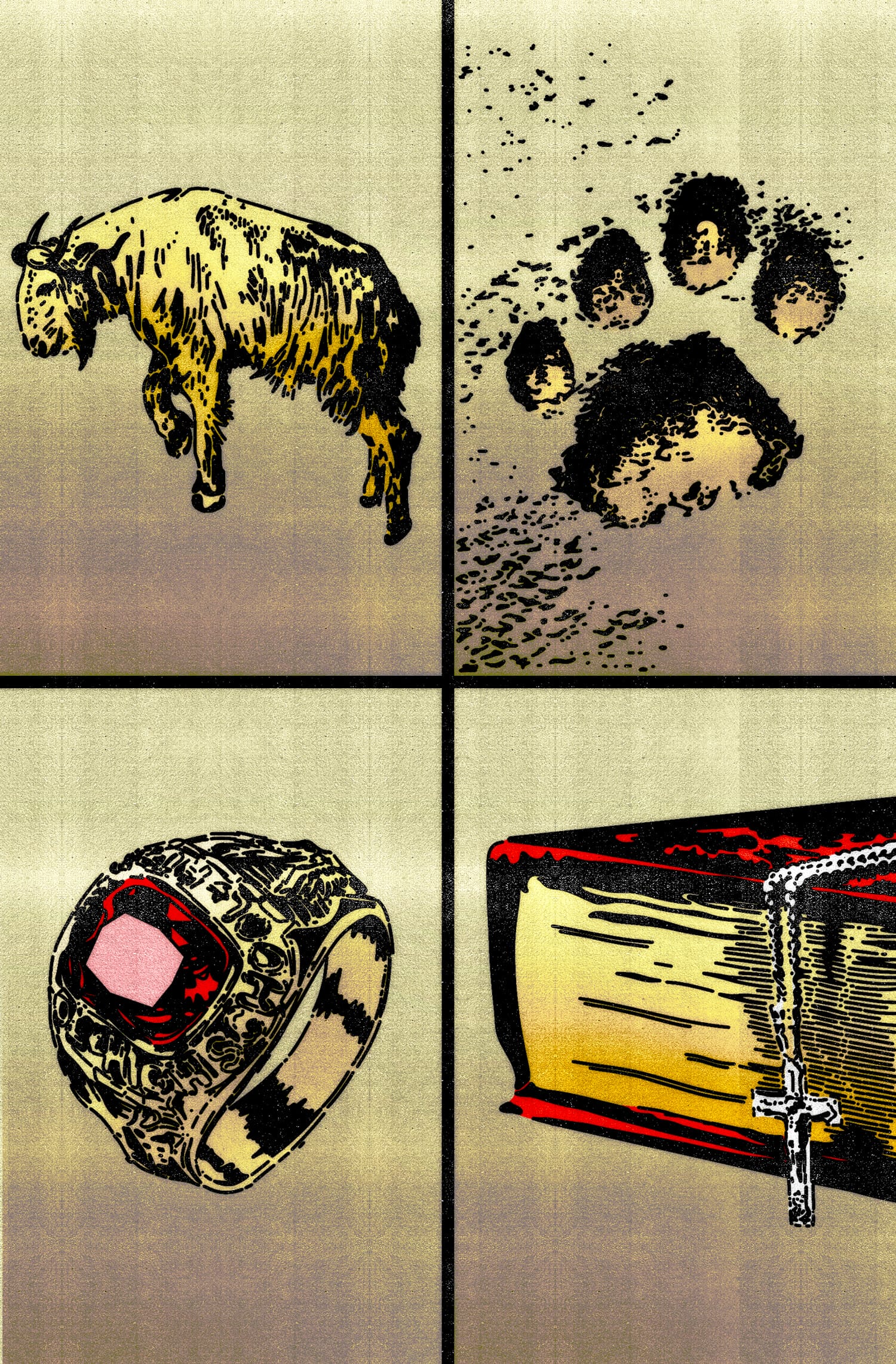
A Portrait of the Sichuan Takin
Susan told me she was marrying the novelist as we stood in front of the Sichuan takin enclosure. That summer we decided we would see the Sichuan takins once a month even though they do not capture anyone’s imagination and not many people like them. There are no great paintings or photographs of a Sichuan takin, not even a regional airport sculpture. The Sichuan takin, an immense mammal like an elk, a cow, a goat, lacks charisma or any photogenic qualities. I was only drawn to their eyes, matte black beads broken off from a cheap goth necklace. In certain kinds of daylight, cloudless, clear, the Sichuan takin’s fur, not snowcap white, not meringue, appears pale yellow, the pale yellow of a clapboard house from childhood, paint peeling, chipped away, the house that always seemed slightly abject as the school bus drove by, the house owned by the single mother who removed her sick daughter from fourth grade in the middle of the year, the Sichuan takin’s fur is that particular shade of pale yellow, I can see it before the bus descends into the ravine. Like me, the sick girl was always sweating and coughing, Erin Mars, her name comes to me now, I remember her because she died at the end of the school year, but I didn’t know her. I wasn’t interested in people, it was too exhausting to look at them for long, even when my own father was dying, I didn’t want to look. All I remember is his fingers were bloated, and my mother couldn’t remove his wedding ring, none of the nurses could, although the smallest one came close to doing it, then she gave up. My mother asked me to try; I wanted nothing more than to pry off that awful ring. After he died, I don’t know what happened to the ring, I forgot to ask.
A few days post-burial, I got a text from my friend Susan. “What are you doing? Do you want to go somewhere?” Thanks to Susan, I was introduced to the Sichuan takins at the free zoo in Chicago, the zoo that people do not go out of their way to go to, but if they’re walking past it, they might stop to look. It is not a destination zoo, it’s a zoo of circumstance where the Sichuan takins, peaceful, content, and slow-moving, never experience boredom or depression; their fur is covered in dust and mats from rolling around in their beloved dirt patches. My life has taken me to many places I wish I could forget, but I will always remember seeing the Sichuan takins. It was the third time we saw them when Susan announced she was going to marry the novelist and they were moving to Berlin. The Sichuan takins looked at us with their taciturn gaze, and we looked at them, and then our encounter ended. According to Wikipedia, the Sichuan takin is not the type of animal that eats pond scum (swans) or shits in a river and then drinks its own shit (cows). It is not the type of animal with a smooth brain (koalas), but there is no doubt it possesses a very small one. The Sichuan takin is never envious; how could it be? It doesn’t know anything.
The Sichuan takin is never envious; how could it be? It doesn’t know anything.
I no longer talk with Susan because she moved to Berlin with her fiancé. At their going-away dinner, her fiancé, the novelist, turned to me and said he would never allow his daughter to transition. What if his beautiful daughter transformed into an ugly man? he mused. I looked down at my napkin. He was speaking hypothetically because he did not have a daughter. And why does he care if his imaginary daughter is beautiful or not? Does he want to have sex with her? I didn’t want to imagine him fucking his daughter, or any woman, but that’s what you do when you read his books, that’s what he writes about, with the insinuation that he’s good at fucking. Why else would he write about it? This is a good enough reason to not write about yourself, or if you must write about yourself, to not write about having sex. I turned thirty-seven years old that night, and I was filling up with ideas. I’ve been a poet since I was six, a boy in a dark bedroom. Instead of writing about a middle-aged woman in an abject way, I remembered thinking, I’ll write about a middle-aged man in an abject way. I’ve been wrong about the future before, even though I am occasionally seen as a god of my childhood town. The last time I saw Susan, I asked her what I should write about. I had run out of ideas. “The Sichuan takin!” she said, as if it were the most natural thing in the world. To this day it pains me how correct she was. Of course the Sichuan takin, but I can’t forgive her for marrying that novelist in Berlin. “Finally,” she had said, “I found it, my life has a great purpose.” When I was growing up, no one told me how important it was to have a purpose, that that’s how you succeed in life. From now on, the purpose of whatever I write will be to announce to the world how great I am at fucking the world.
What I’ve Done and Not Done
For a long time, I did everything I could to keep her alive, until that summer when I gave up and decided I would wait for her to die. For many years I had picked up my cat from the bed or the couch and placed her in the bathtub, where I injected her with a needle underneath her skin to hydrate her with a bag of subcutaneous fluids. I would watch the saline drip down the line slowly. For a long time, the fluids worked; my cat gained weight, slept and ate well, stared out the window at birds, and then that summer the fluids stopped.
The last time I brought my cat to the vet, a man came into the waiting room with a garbage bag slung over his shoulder. His face was very red and he was breathing loudly. He told the woman at the reception desk his dog died at home. He put the dog in the bag because his wife didn’t want to look at the body anymore. Could they do something about it? The man caught himself, stifled a sob as he paid the bill. He left the garbage bag on the reception desk. Turned on its side, the bag looked like a whale washed up one day, shaped and cut down.
When my wife was in her early thirties, she worked at an animal hospital, and she said each day people’s pets were killed with and without intention. Or was it abandon? She told me the veterinarians yelled at her and so did the patrons. It didn’t take her long to get sick of working the phones. Back then, they didn’t use headsets, and she said the phones were greasy and made her break out with cystic acne on her right cheek. Eventually, she turned to private investigation. She gets paid by people to stalk other people. She interrogates men who burn down their own homes and set their cars on fire. She talks to people whose children fall out of windows and die. At least my wife is well equipped to this day to deal with death.
A few weeks after we put our cat to sleep, the animal clinic sent us her ashes in a tied-up plastic bag. There was a second bag with her collar intact, a thin piece of dark blue nylon with a bell the size of a marble. Then, inside the third bag, only a lumpy gray disc. I didn’t know what it was, so I showed it to my wife. A human had smushed their thumb into a piece of clay in a sad imitation of our dead cat’s paw print, she explained. “Oh,” I said. My life is not very exciting. Not much happens, and I do not expect anything to. There was a hole in the gray disc for a ribbon, but we didn’t want to hang it up anywhere. But we didn’t throw it away either. You see, our house is cold and empty now, and each night so willingly we walk into it.
Bad Brother
He took dark blue roads into and out of the country, and one night when he was on his way home from visiting his sister, he hit something, the tires of his Ford Escort bounced up and down, he heard a crunch. He hated that his sister lived out in the country, he hated that he had to drive down these dark blue roads to see her now that she was sick and couldn’t travel.
Growing up, he had been a bad brother to her, he had done bad things to her and hurt her, and he never apologized. It was possible she had forgotten the bad things he had done to her, he reasoned, maybe she had been too young and now she was too old and sick and everything he had done to her was gone, too shaming to name. Of course they had their good days too. They had just had dinner, and after dessert she gave him a check to cover that month’s rent.
He pulled over and took out his phone. He aimed his phone’s flashlight at the middle of the country road. A white cat had rolled on its back, and its legs trembled in the air as if clutching at something. He got out of his car and went up close, so close he could see the tiny pearl spines studding its pink tongue. It was alive but suffering. He thought of hitting the cat with a rock on its head, but he didn’t see any rocks. Only patches of dirt and twigs and weeds. Should he shovel with his hands a mound of dirt onto the cat? Could he kill it with a twig? Could he bash it against a tree? He had no weapons, no tools, no brains. When he got home that night, he noticed his ring was missing, his high school class ring. It must’ve slid off his finger in the dirt. It was white gold with a fuchsia stone that glinted in the sun. When she was alive, his mother never had a kind word for him, but she liked his class ring.
My Father
October 30, the day before my father died, we argued about a piece of paper. Around this time, I made an announcement regarding my identity on social media, and I wrote or called close friends to tell them about it. No one was surprised, which surprised me. I sent a letter to my parents in Wisconsin to let them know about my changes. My letter was clear and decisive; it also expressed a deep desire for understanding and compassion. As an adult, I didn’t need their approval, but I hoped they would be glad. Because of their conservative politics and Catholicism, I did not expect them to be ecstatic.
I knew that a part of him, if it could be said that there are parts of people, could be loving.
On the phone that day in October, the day before he died, my father and I didn’t talk about my decision to change my life. From my parents’ perspective, a part of me, if it could be said there were parts, was dying, the part that once had long black hair past my shoulders, the part that did the dishes without complaint. I grew up in a household with traditional gender roles. I never saw my mother drive the car with my father in the passenger seat, not once. My father didn’t want to talk about what was happening, what I had chosen for myself. He tended to avoid uncomfortable subjects in his quiet, Midwestern Catholic way. He was obsessed with church, charity, airplanes, and forgiveness. A Buddhist therapist wrote: “It doesn’t work that way. You’re not made of parts.” Recently my father had stopped saying “I love you” when we ended our conversations on the phone. He was friendly enough when discussing financial matters, but preoccupied and anxious, almost as if he were calculating how to end the call as quickly as possible. “Is that it?” he would ask.
The day before he died, in our last phone conversation, the subject of my changes, my transformation, did not come up. Instead, we talked about health insurance and medical providers. We talked about the cost of living in Denver, where I would soon move. At the end of the call, we argued about the location of a piece of paper. The fact of its existence established my citizenship. I wasn’t born in this country, and I needed it. I was angry he didn’t know where it was. He was angry I didn’t know where it was. He compared me unfavorably to my middle brother, who kept his important piece of paper locked away in a safe. Why wasn’t I more like my middle brother? Why didn’t I own a safe? How could I have allowed this important piece of paper, this flatness, to disappear into the void? Men always know where their important pieces of paper are. Men keep them in safes. Men memorize their combinations. Men own safes and vaults and crypts. It’s the women who lose everything. I suspected he knew where the paper was all along, he didn’t want me to have it, he didn’t want me to move forward in my life, he didn’t wish me to live as I wanted to live, but I knew that wasn’t right, I knew that a part of him, if it could be said that there are parts of people, could be loving, and even though in less than twenty-four hours he himself would go on to die, I knew he would prefer that I live as I wanted to live as opposed to not living at all.